

Moving to Portugal Checklist: The Comprehensive 2026 Relocation Guide

Most prospective residents believe their relocation begins at the airport, but in 2026, a successful move to Portugal actually starts months earlier at a digital desk. It’s understandable if you feel overwhelmed by the administrative transition from SEF to AIMA or the logistical difficulty of obtaining a NIF and NISS from abroad. This moving to Portugal checklist is designed to eliminate that uncertainty by providing a structured, professional framework for your transition. We recognize that the fear of visa rejection due to minor clerical errors is a significant burden for many families and professionals.
This guide offers a meticulous, expert-led roadmap that covers every legal, fiscal, and logistical requirement for a seamless transition to Portuguese residency. You’ll find a clear, non-overwhelming breakdown of the necessary documentation, from initial visa applications to final residency permit acquisition. We will examine the specific financial thresholds for 2026, the process for securing your fiscal identity remotely, and the precise chronological order of tasks required to maintain legal compliance from day one.
Key Takeaways
- Establishing a fiscal identity through the NIF is the primary requirement for all subsequent administrative steps, including opening bank accounts and signing rental agreements.
- This moving to Portugal checklist provides a chronological roadmap for transitioning through the AIMA system, ensuring all biometric and documentation requirements are met.
- Applicants must select the correct residency pathway, such as the D8 or D7 visa, by verifying specific 2026 income thresholds and professional proof; to strengthen your professional profile for these applications, you can discover Rezumi for AI-powered resume optimization.
- Remote acquisition of the NISS and understanding tax residency rules are essential for maintaining social security compliance and legal status.
- The final stage of relocation involves securing long-term housing documentation and registering with the local Junta de Freguesia to validate your proof of address.
Phase 1: Pre-Departure Essentials and Fiscal Identity
The cornerstone of any effective moving to Portugal checklist is the “Fiscal First” approach. You shouldn’t wait until you land in the country to begin your administrative journey. Securing your Número de Identificação Fiscal (NIF) before your departure is mandatory if you intend to open a bank account or sign a lease. This document serves as your unique tax identification and is required for every legal transaction. While some general guides suggest obtaining this in person at a tax office, doing so after arrival often leads to significant delays in visa processing and housing security.
Securing Your NIF Remotely
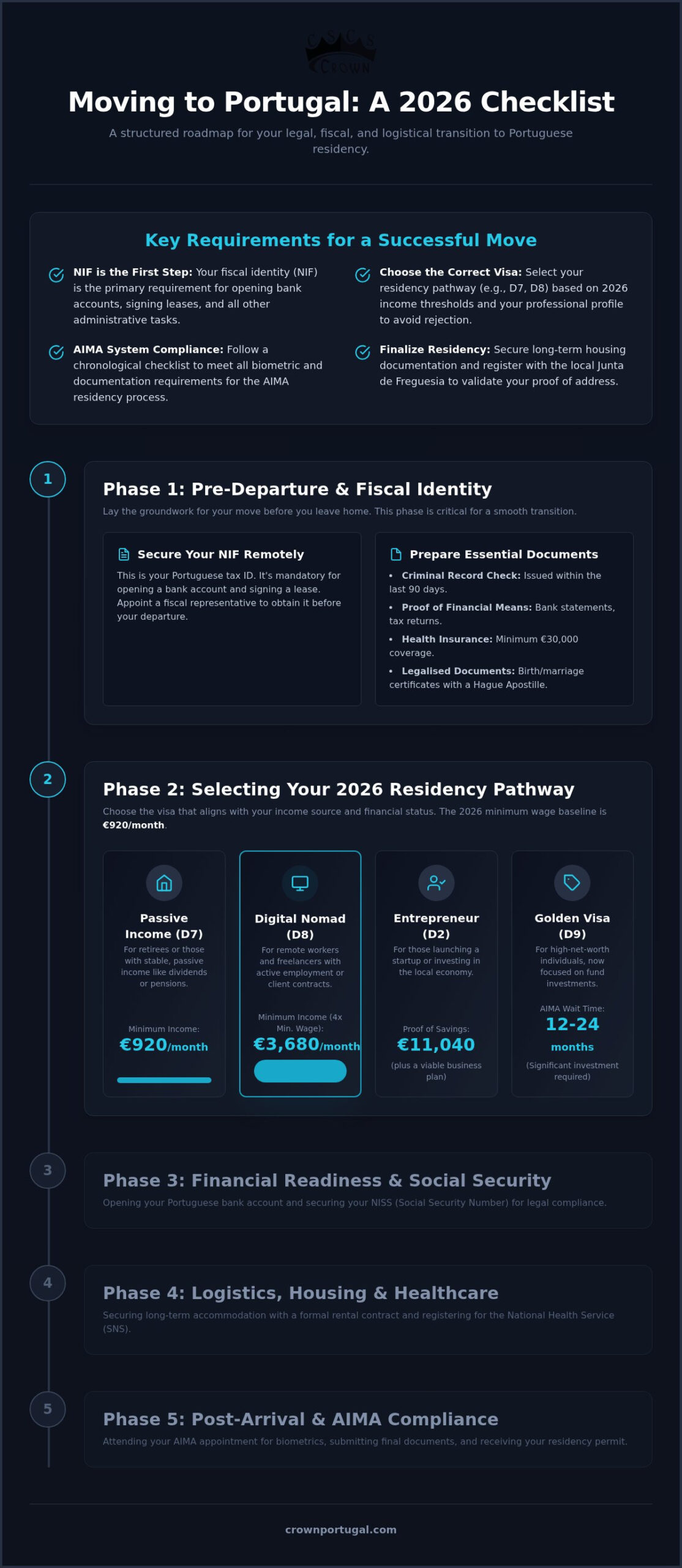
For non-EU or EEA residents, appointing a fiscal representative is a legal requirement. This representative acts as an intermediary between you and the Portuguese tax authorities. Applying for your NIF remotely through a professional service typically involves a €10.20 stamp duty for the government; however, the efficiency gained by having this number ready for your visa application is invaluable. It’s the key that unlocks your ability to satisfy the financial requirements of residency pathways. These often require you to show significant funds in a local bank account. Opening this account remotely is only possible once your NIF is issued. You can find detailed walkthroughs on these administrative steps by visiting Crown Portugal on YouTube.
Understanding the difference between resident and non-resident NIF status is vital. Initially, you’ll be assigned a non-resident status. Once you have secured your residency permit and a permanent address, you must update this status at the tax office to reflect your new position as a tax resident. Failing to update this status can lead to incorrect tax filings and potential fiscal penalties.
Document Preparation and Legalisation
Documentation must be meticulous. The Hague Apostille is a critical requirement for international recognition of your birth and marriage certificates. Without this specific legalisation, Portuguese authorities won’t accept foreign public documents. You’ll also need certified translations performed by recognized professionals to ensure linguistic accuracy and legal compliance. As Immigration to Portugal continues to evolve, maintaining a “Master File” of these apostilled and translated documents will prevent the common errors that lead to visa rejection.
Your preparation should include gathering several key items well in advance:
- Criminal Record Checks: These must be issued by your country of origin and any country where you’ve resided for more than one year. They generally must be issued within the last 90 days.
- Proof of Financial Means: Bank statements and income tax returns from the previous year.
- Health Insurance: Proof of private coverage with a minimum value of €30,000 for the duration of your initial visa.
Phase 2: Selecting Your 2026 Residency Pathway
Selecting the appropriate residency pathway is a foundational element of your moving to Portugal checklist. Each visa category is tailored to specific financial profiles, and the Portuguese government has established clear benchmarks for 2026 to ensure applicants have sufficient means. For instance, the Portuguese minimum wage for 2026 is €920 per month, a figure that serves as the baseline for several financial requirements. Misaligning your professional status with your visa type is a common cause for administrative delays, so you must choose the path that accurately reflects your primary source of income.
The Digital Nomad Visa (D8) is the primary option for remote workers and freelancers. It requires a monthly income of at least €3,680, which is four times the national minimum wage. For retirees or individuals with stable dividends, the Passive Income Visa (D7) is more suitable, requiring proof of €920 per month. If you intend to launch a startup or invest in the local economy, the Entrepreneur Visa (D2) requires a viable business plan and proof of savings of at least €11,040. The Golden Visa (D9) remains a viable route for high-net-worth individuals, though it now focuses on fund investments rather than real estate, with AIMA appointment wait times for this category currently stretching between 12 and 24 months. Before committing to any single pathway, reviewing the full spectrum of Portugal residence permit types for immigrants will ensure you select the category that best aligns with your financial profile and long-term residency goals. Given the complexity of these shifting regulations, engaging Portugal immigration consultancy services can be a strategic necessity to ensure you select the correct pathway and avoid costly administrative errors.
Comparing the D8 and D7 Residency Paths
The distinction between active and passive income is the most significant factor when choosing between these two paths. The D8 path requires proof of remote work, such as employment contracts or invoices, while the D7 is strictly for non-salaried earnings. Both pathways require you to maintain a physical presence in the country, typically 183 days per year, to qualify for tax residency. For a comprehensive analysis of which route aligns with your 2026 goals, you can read our guide on Portugal D8 Visa vs D7: Which Residency Path Is Yours?
The Visa Application Timeline
Your journey begins with an appointment at the Portuguese consulate or VFS Global center in your home country. Processing times for D-series visas in 2026 generally range from two to three months. Once approved, you’ll receive a four-month entry visa that allows you to travel to Portugal and attend your biometrics appointment. This transition from an entry visa to a formal residency permit is a multi-step process that requires careful scheduling. You can find visual guides on managing these appointments by visiting Crown Portugal on YouTube. To ensure your application meets every consular standard, it’s often beneficial to consult with a relocation expert before submitting your final file.
Phase 3: Financial Readiness and Social Security
Financial integration is the next critical stage in your moving to Portugal checklist. Once you have secured your entry visa, you must shift your focus toward establishing a presence within the Portuguese social and fiscal infrastructure. This involves more than just having a bank account; it requires the acquisition of a Social Security Number (NISS) and a clear understanding of your future tax obligations. For 2026, the estimated monthly cost of living for a single person is approximately $1,780, excluding initial setup fees. Budgeting for your first six months should account for rental deposits, which often require two months’ rent plus a security deposit, and the rising costs of utilities and local administrative fees.
The Importance of the NISS Number
While many resources suggest that a NIF is the only document required for professional life, the Número de Identificação de Segurança Social (NISS) is equally mandatory for anyone intending to work or access social benefits. If you’re an employee, your contribution rate is 11% of your gross salary, while your employer contributes 23.75%. Self-employed individuals face a contribution rate of 21.4% on 70% of their income. Beyond employment, the NISS is a prerequisite for registering with the Serviço Nacional de Saúde (SNS). Professional assistance for NISS registration is highly recommended to avoid the lengthy queues often found at local social security offices, ensuring your social rights are protected from the moment you arrive.
Navigating the Portuguese Tax System
Understanding your tax residency status is vital for long-term compliance. Portugal applies the 183-day rule, meaning if you spend more than 183 days in the country during a 12-month period, you’re considered a tax resident and must report your global income. The tax landscape for 2026 has seen a shift in incentives for new residents, making it essential to coordinate your arrival date with your fiscal obligations to avoid double taxation. For a deeper look at the foundational steps of this process, see our guide on How to Get a NIF in Portugal: The Complete 2026 Fiscal Guide.
Healthcare compliance is another non-negotiable financial step. For your initial visa application, you must provide proof of private health insurance (Seguro de Saúde) with a minimum coverage of €30,000. Once you’ve obtained your residency permit, you can register at your local health center (Centro de Saúde) to receive your user number (Número de Utente), which grants access to the public healthcare system. This dual-layered approach ensures you’re covered during the administrative transition period. You can find visual explanations of these registration steps on Crown Portugal’s YouTube channel.
Phase 4: Logistics, Housing, and Healthcare
Transitioning into your physical life in Portugal requires a shift from digital documentation to local registration. A central pillar of your moving to Portugal checklist is securing a residence that meets consular and AIMA standards. While online portals offer a broad overview of the market, many listings don’t provide the legal framework necessary for a residency application. You must prioritize contracts that are registered with the tax authorities to ensure your path to residency remains unobstructed.
Securing Legal Accommodation
AIMA generally requires a minimum of a 12-month lease agreement for residency purposes. This contract must be officially registered with the Portuguese tax authority, Finanças, to be considered valid. Many landlords require a “Fiador,” or a Portuguese guarantor, which can be a significant hurdle for new arrivals. If you don’t have a local guarantor, you may need to negotiate a larger security deposit or seek out vetted landlords who specialize in international tenancies. Once your lease is active, your next task is visiting the local Junta de Freguesia to obtain an “Atestado de Residência.” This document is your official proof of address and is mandatory for your biometrics appointment.
Accessing Healthcare and Insurance
Your healthcare journey involves two distinct stages. Initially, you’re required to maintain private health insurance with a minimum coverage of €30,000 for your visa application. After your residency permit is issued, you can register for the National Health Service (SNS) at your local health center, or Centro de Saúde. This registration provides you with a “Número de Utente,” which is your user number for public medical services. Portugal’s healthcare system is highly regarded, ranking 21st in the 2026 Numbeo Healthcare Index. While the public system is comprehensive, many residents choose to keep private insurance to access a wider network of English-speaking professionals and shorter wait times for elective procedures.
Logistical considerations also extend to the relocation of your personal property. If you intend to ship household goods or import a vehicle, you’ll need to obtain a “Certificado de Bagagem” from your local consulate before moving. This certificate allows you to import used personal items tax-free, provided you’ve owned them for at least six months. Navigating these requirements requires precision and local expertise. To simplify your transition and find compliant housing, you can access our professional accommodation services.
Phase 5: Post-Arrival Formalities and AIMA Compliance
The final phase of your moving to Portugal checklist involves the formal transition from a temporary entry visa to a legal residency permit. This stage is managed by the Agência para a Integração, Migrações e Asilo (AIMA), which has replaced the former immigration service. While the entry visa granted by the consulate allows you to enter the country, it does not confer full residency rights. You must attend a scheduled biometrics appointment to finalise your status. In 2026, AIMA has digitised much of this process to address historical backlogs, though the requirement for a physical interview remains a mandatory step for all D-series visa holders.
The AIMA Residency Appointment
Your biometrics appointment is the most significant administrative event following your arrival. You’re required to present the “Master File” of documents previously prepared, including your passport with the valid entry visa, your NIF, and your NISS. Additionally, you must provide the “Atestado de Residência” obtained from your local Junta de Freguesia to prove your physical address. AIMA charges a reception and analysis fee of €133.00, followed by a fee of €114.30 to grant the temporary residency permit. Many applicants choose to have professional consultants attend these appointments to ensure that any technical queries regarding financial proof or remote work contracts are handled with professional authority. For a detailed breakdown of every step involved in this process, our Portugal residency permit application guide covers the complete 2026 requirements from biometrics to card issuance.
Common pitfalls during this stage include presenting expired criminal record checks or leases that haven’t been properly registered with Finanças. If your documentation is accepted, your Título de Residência (residency card) will be mailed to your Portuguese address within several weeks. Once you receive this card, you must visit a tax office to update your Morada Fiscal. This updates your status from a non-resident to a tax resident, which is essential for accurate fiscal reporting and avoiding penalties.
Long-term Integration and Compliance
Maintaining your residency status requires adherence to the 2+2+1 year renewal cycle. Your initial residency card is typically valid for two years, followed by a two-year renewal, and then a final one-year period before you become eligible for permanent residency. To maintain this status, you must generally spend at least 183 days per year in the country. This physical presence is also a prerequisite for those seeking Portuguese citizenship after five years of legal residency. To stay informed about evolving regulations and procedural changes, you should watch Crown Portugal YouTube for daily immigration news updates and administrative guidance. Following these steps ensures your transition to life in Portugal is both legally secure and professionally managed.
Securing Your Future in Portugal
Establishing residency in 2026 requires more than just a plane ticket. It demands a process-oriented mindset that prioritizes fiscal identity and legal compliance long before your arrival. As this moving to Portugal checklist has detailed, the transition from a non-resident applicant to a legal resident involves complex interactions with AIMA and the Portuguese tax authorities. Securing your NIF and NISS remotely, selecting the appropriate residency pathway, and obtaining registered housing are the three pillars of a stable relocation. Every detail, from apostilled documents to social security registration, contributes to the security of your new life.
Navigating these administrative landscapes doesn’t have to be overwhelming. You can Book a Professional Immigration Consultation with Crown Portugal to access expert guidance on D8, D7, and Golden Visas. Our team provides remote NIF and NISS registration services alongside comprehensive relocation and accommodation support to ensure your transition is seamless. We’re ready to facilitate your journey with local expertise and global professional standards. Portugal is waiting for you, and with the right preparation, your move will be a successful new chapter.
Frequently Asked Questions
How long does the entire process of moving to Portugal take in 2026?
The entire relocation process typically takes between six and twelve months from initial document preparation to the issuance of a residency card. Consular visa processing generally spans two to three months; however, the wait for an AIMA biometrics appointment after arrival can add several months to the timeline. It’s essential to start your moving to Portugal checklist at least half a year before your target departure date to account for document legalisation and apostille requirements.
Can I move to Portugal without a job if I have savings?
Moving to Portugal without active employment is possible through the D7 Passive Income Visa or the D2 Entrepreneur Visa. For the D7, you must demonstrate a stable, recurring passive income of at least €920 per month for the main applicant, rather than relying solely on a lump sum of savings. While having a savings buffer of €11,040 is recommended, authorities prioritize proof of sustainable monthly earnings from pensions, dividends, or rental properties to ensure long-term financial stability.
What is the minimum income required for the D8 Digital Nomad Visa?
The minimum monthly income requirement for the D8 Digital Nomad Visa in 2026 is €3,680. This figure is calculated as four times the current Portuguese minimum wage of €920 per month. Applicants must provide employment contracts or freelance agreements as proof of this active income. For those currently applying for roles to meet these requirements, CVernia provides a centralized system to manage your application journey and track progress. If you’re bringing family members, you must also demonstrate an additional 50% for a spouse and 30% for each dependent child to satisfy the total household financial requirements.
You don’t need to speak Portuguese to obtain an initial temporary residency permit through the D7, D8, or Golden Visa pathways. All administrative interviews with AIMA can be conducted with the assistance of a professional consultant or translator. However, if you intend to apply for permanent residency or Portuguese citizenship after five years of legal residence, you must demonstrate a basic A2 level of proficiency in the language through a certified examination.
What happens if my AIMA appointment is delayed beyond my visa expiry?
If your AIMA appointment is scheduled for a date after your four-month entry visa expires, your presence in Portugal remains legal as long as you have proof of the appointment. The Portuguese government recognizes the current administrative backlogs and considers the appointment confirmation as a valid extension of your stay. You should carry a printed copy of your scheduling confirmation at all times to avoid legal complications while waiting for your biometric data collection and card issuance.
Can I bring my family with me on a D7 or D8 visa?
You can bring your immediate family members to Portugal through the family reunification process associated with the D7 and D8 visas. This typically includes your spouse, dependent children, and in some cases, dependent parents. Each additional family member increases the total minimum income requirement for the primary applicant. It’s advisable to include family members in the initial application process at the consulate to streamline their entry and subsequent residency appointments alongside your own.
It’s entirely possible to obtain a NIF and open a Portuguese bank account remotely?
It’s entirely possible to obtain a NIF and open a Portuguese bank account remotely by appointing a fiscal representative. This is a critical step in any moving to Portugal checklist because a local bank account is mandatory for most visa applications. Professional consultancies can facilitate the entire registration process with the tax authorities while you are still in your home country. This allows you to transfer the required funds and satisfy financial proof requirements before your consular interview.
What are the main reasons for Portugal residency visa rejections?
Residency visa rejections are most commonly caused by insufficient financial proof, missing document apostilles, or inadequate housing contracts. Consulates require meticulous evidence that your income meets the 2026 thresholds and that your rental agreement is registered with the tax authorities for a minimum of 12 months. Minor clerical errors or failing to provide a certified translation for non-English documents can also lead to immediate denial. Ensuring your documentation is professionally reviewed through dedicated Portugal immigration consultancy services can mitigate these risks effectively.
How to Get a NIF in Portugal: The Complete 2026 Fiscal Guide – Crown Portugal at 10:53 am, September 9, 2026 -
[…] Moving to Portugal Checklist: The Comprehensive 2026 Relocation Guide […]
Portugal Immigration Consultancy Services: The 2026 Professional Guide – Crown Portugal at 10:51 am, September 12, 2026 -
[…] Moving to Portugal Checklist: The Comprehensive 2026 Relocation Guide […]
Portuguese Citizenship Application Process: 2024 Reforms and 2026 Guidance – Crown Portugal at 10:01 pm, September 16, 2026 -
[…] official correspondence reaches you without delay. For those just beginning their transition, the Moving to Portugal Checklist: The Comprehensive 2026 Relocation Guide provides a structured framework for these essential tasks. We act as a welcoming expert, […]
Portugal D3 Visa Application Process: The 2026 Step-by-Step Guide – Crown Portugal at 11:46 am, September 18, 2026 -
[…] Moving to Portugal Checklist: The Comprehensive 2026 Relocation Guide – Crown Portugal on Portugal Immigration Consultancy Services: The 2026 Professional Guide […]
Moving to Portugal from the US: The Comprehensive 2026 Expat Guide – Crown Portugal at 8:15 pm, September 18, 2026 -
[…] Portugal D3 Visa Application Process: The 2026 Step-by-Step Guide – Crown Portugal on Moving to Portugal Checklist: The Comprehensive 2026 Relocation Guide […]
Entrepreneur Visa Portugal Process: The 2026 Comprehensive Guide to the D2 Pathway – Crown Portugal at 7:47 pm, September 19, 2026 -
[…] To ensure you have every document and administrative step accounted for before your departure, our moving to Portugal checklist for 2026 provides a structured framework covering all legal, fiscal, and logistical […]
Proud to share that Dharmjit Singh Saini, CEO of Crown Portugal, participated in Startup Summit Lisbon 2026 – Crown Portugal at 2:45 am, September 21, 2026 -
[…] you to focus on your professional transition. To prepare for every facet of your move, refer to our moving to Portugal checklist. This guide provides a definitive roadmap for your […]
Family Reunification Visa Portugal: The Complete 2026 Legal Guide – Crown Portugal at 5:20 am, September 22, 2026 -
[…] Proud to share that Dharmjit Singh Saini, CEO of Crown Portugal, participated in Startup Summit Lisbon 2026 – Crown Portugal on Moving to Portugal Checklist: The Comprehensive 2026 Relocation Guide […]
Portugal Study Visa Document Requirements: The Complete 2026 Checklist – Crown Portugal at 11:45 am, September 23, 2026 -
[…] Family Reunification Visa Portugal: The Complete 2026 Legal Guide – Crown Portugal on Moving to Portugal Checklist: The Comprehensive 2026 Relocation Guide […]