

Portugal Study Visa Document Requirements: The Complete 2026 Checklist

Securing an official university acceptance letter feels like the ultimate milestone, but visa approval depends entirely on structural document compliance rather than academic merit. You’ve worked tirelessly to earn your academic admission, yet confronting divergent consular instructions, strict legalization windows, and opaque financial thresholds often creates profound anxiety. Overlooking the exact Portugal study visa document requirements, whether through an unverified criminal background certificate or an uncertified accommodation declaration, can derail your relocation before your academic semester even begins.
You shouldn’t have to manage these bureaucratic hurdles through guesswork or risk a costly refusal due to minor technicalities. This guide outlines everything you need to compile a fully verified, rejection-proof dossier, giving you clear benchmarks for proving your financial means, securing acceptable housing proofs, and completing certified sworn translations. Ahead, we review the mandatory checklist step by step so you can approach your consular appointment with complete certainty.
Key Takeaways
- Understand how the official Portugal study visa document requirements differentiate between temporary study stays and long-term national residency permits.
- Discover the exact evidentiary thresholds required for unconditional enrollment letters, institutional fee receipts, and accredited academic records.
- Learn how to document financial solvency and secure verified lodging proofs that align directly with consular evaluation standards.
- Master the legalization framework, including Hague Apostille protocols and certified Portuguese sworn translation mandates.
- Streamline your post-arrival transition with verified guidance on administrative registrations, local fiscal setups, and residency scheduling.
Understanding the Portugal Study Visa Framework and Eligibility Categories
Selecting the correct application track is the foundation of a successful consular submission. While general European agreements establish the wider Schengen Area visa policy, Portugal exercises sovereign statutory control over its national study permits. Consular officers enforce rigid standards because a national entry visa serves as the preliminary legal authorization for formal residence status. Understanding the specific Portugal study visa document requirements for your precise academic tier ensures your dossier satisfies administrative scrutiny from the outset.
To visual learners preparing their paperwork, this detailed video walkthrough explains the essential application stages:
Long-Term D4 Residency Visas versus Temporary Stay Visas
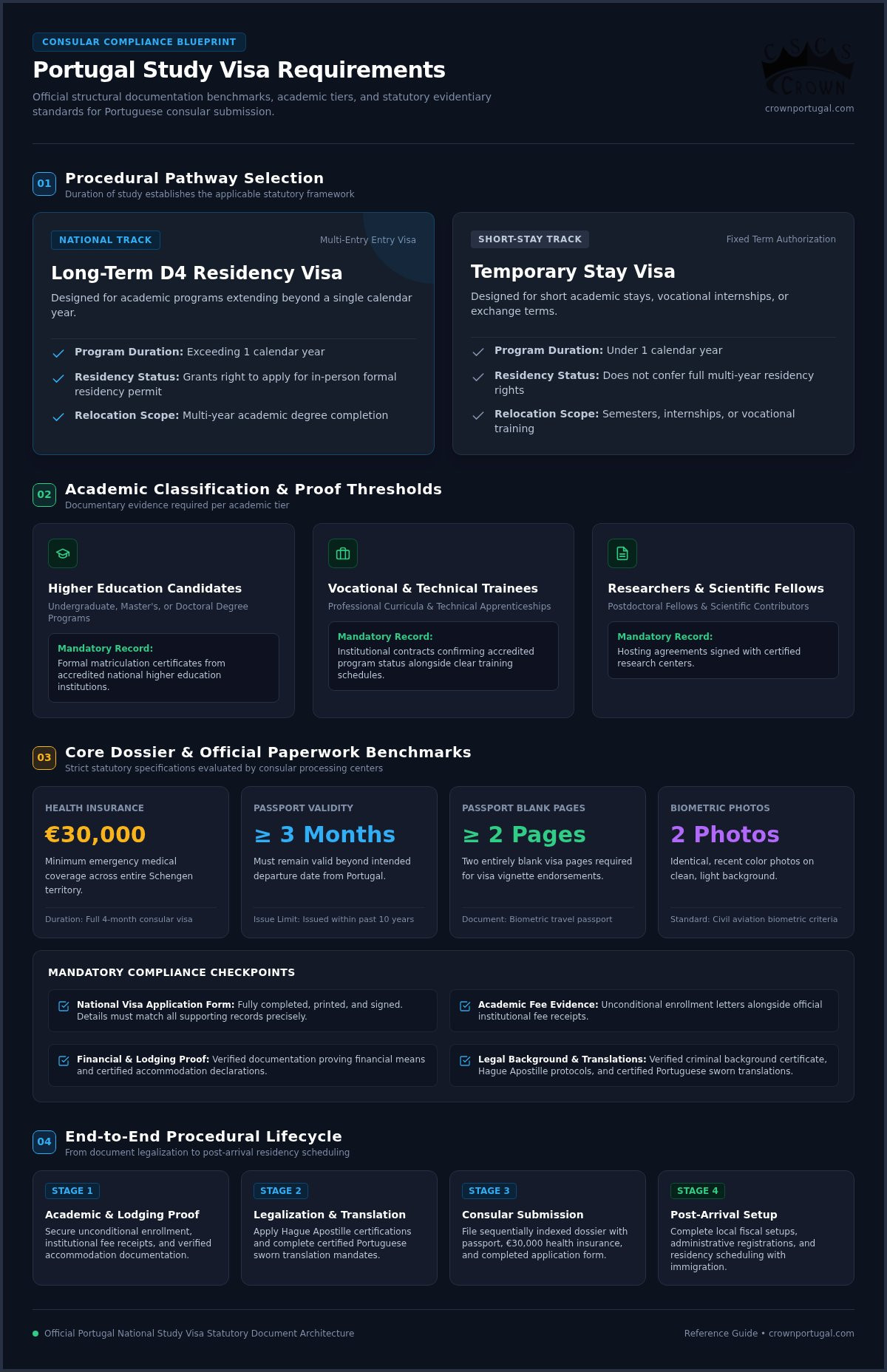
Your intended duration of study dictates your procedural pathway. Programs extending beyond a single calendar year require the national D4 residency visa. This multi-entry authorization allows you to travel to Portugal and attend an in-person appointment with immigration authorities to secure a formal residence permit. Conversely, programs lasting under a year utilize temporary stay visas, which cover short study periods, vocational internships, or exchange terms without conferring full multi-year residency rights.
Academic Categories Covered Under the Study Visa Umbrella
Consular authorities evaluate applications across several distinct academic classifications, each carrying its own evidentiary thresholds:
- Higher Education Candidates: Applicants pursuing undergraduate, master’s, or doctoral degrees must supply formal matriculation certificates from accredited national higher education institutions.
- Vocational and Technical Trainees: Students entering professional curricula or qualifying technical apprenticeships require institutional contracts confirming accredited program status alongside clear training schedules.
- Academic Researchers and Scientific Fellows: Postdoctoral fellows and scientific contributors must demonstrate hosting agreements signed with certified research centers.
Matching your documentary evidence precisely to your academic tier prevents administrative delays. For ongoing video briefings detailing immigration updates and procedural transitions, consult the official Crown Portugal YouTube channel.
The Comprehensive Portugal Study Visa Document Checklist
Filing an administrative filing requires absolute procedural accuracy. While official portals often list statutory provisions without context, consular processing centers evaluate files based on specific presentation benchmarks. Satisfying the formal Portugal study visa document requirements requires an organized, sequentially indexed folder where every record strictly confirms your legal identity, background, and planned travel itinerary.
Core Identity and Official Application Paperwork
Your primary identification papers establish the administrative foundation of your submission. Consulates enforce exacting technical rules on these records:
- National Visa Application Form: Fully completed, printed, and signed. The information must match your supporting records precisely, including spellings, travel dates, and educational details.
- Valid Biometric Passport: Your travel document must remain valid for at least three months beyond the intended departure date from Portugal. It must contain at least two entirely blank visa pages and have been issued within the past ten years.
- Passport-Sized Photographs: Two identical, recent color photographs on a clean, light background conforming strictly to international civil aviation biometric standards.
- Comprehensive Health Insurance: A policy valid for the entire four-month consular visa period, providing minimum emergency medical coverage of €30,000 across the complete Schengen territory, explicitly including medical evacuation and repatriation.
Legal Background and Civil Status Clearances
Background clearance records prove your suitability for national residence. You must submit an official criminal background certificate issued by the competent national authority of your country of origin, as well as from any country where you have resided for more than one year. These certificates carry strict temporal validity windows, generally expiring ninety days after issuance. You must also include the signed statutory declaration authorizing Portuguese immigration authorities to verify your judicial record in Portugal.
Applicants accompanied by immediate family members must supply legalized marriage certificates and birth records to establish dependency. Minor paperwork errors, outdated police checks, or mismatched legal names remain primary drivers of consular processing delays. To eliminate these administrative discrepancies prior to your consular interview, prospective students can engage a professional Crown Portugal consultancy document audit to verify every certificate against active consular instructions.
Academic Proofs: Acceptance Letters, Tuition, and Institutional Records
Academic credentials represent the substantive core of your study application. Consular adjudicators do not simply glance at university stationery; they cross-reference institutional accreditation against official state educational databases. Meeting the Portugal study visa document requirements entails demonstrating unconditional enrollment in a recognized academic track rather than presenting preliminary interest or conditional intent.
Official Acceptance and Matriculation Declarations
Securing an official acceptance document requires strict structural compliance. Consular authorities distinguish between a conditional offer letter and an unconditional declaration of matriculation. To withstand administrative scrutiny, the institutional certificate must state explicit parameters:
- Accreditation Details: Full legal registration of the educational establishment under the competent national ministry of education or regulatory oversight agency.
- Course Specifications: Exact program title, European Credit Transfer and Accumulation System (ECTS) weighting, and expected start and completion dates.
- Instructional Language: Clear confirmation of the language of instruction matching the applicant’s proven linguistic competency.
- Institutional Authentication: Physical signatures of the university dean or registrar, accompanied by the university’s official wet ink seal or a verifiable digital verification hash code.
Conditional offers contingent on future prerequisites are frequently rejected during preliminary consular reviews. Ensure every academic condition has been resolved before requesting your final visa letter.
Tuition Evidence and Scholarship Award Letters
Consulates require conclusive proof that educational expenses will not burden public funds. Applicants entering public universities, where annual non-EU international fees typically span €3,500 to €7,000, or private institutions charging between €5,000 and €12,000, must provide formal financial reconciliation:
- Direct Tuition Receipts: Official institutional bank statements or formal receipts demonstrating payment of full tuition or the mandatory initial deposit.
- Scholarship Declarations: Official award letters from national grant entities, the European Commission, or recognized international foundations stating the award period, total stipend allocation, and tuition coverage.
- Exchange Program Agreements: Bilateral mobility contracts specifying tuition fee exemptions under institutional partnerships or academic protocols.
Adjudicators demand traceable, verifiable monetary records. Every payment receipt must match the exact banking identifiers of the accredited educational facility, leaving zero ambiguity regarding institutional registration.
Financial Solvency, Accommodation Proof, and Healthcare Documentation
Consular officers scrutinize financial solvency and housing security more rigorously than almost any other element of the application file. While an acceptance letter confirms your placement, demonstrating day-to-day sustainability validates your legal presence. Fulfilling the Portugal study visa document requirements requires presenting verifiable, unencumbered resources and residential arrangements that withstand administrative audit.
Proving Financial Subsistence and Sponsorship Compliance
Applicants must prove sufficient subsistence means, calculated against the official national minimum wage benchmarks across the entire academic year. Consular authorities accept three primary mechanisms to establish solvency:
- Personal Bank Statements: Three to six consecutive months of formal bank records showing stable liquid balances. Adjudicators routinely reject files showing sudden, unexplained lump-sum deposits that lack traceable origins.
- Parental Sponsorship Affidavits: A formal, notarized undertaking of financial responsibility executed by a parent or legal guardian. This affidavit must be accompanied by certified employment contracts, recent tax declarations, and corresponding banking statements.
- Institutional Grants: Formal scholarship letters confirming recurring monthly stipends paid directly to the student for living expenses.
Establishing domestic banking access streamlines this verification process. To ensure administrative compliance when preparing your financial portfolio, review our guide on how to get a NIF in Portugal before initiating formal banking protocols.
Securing Consular-Compliant Proof of Accommodation
Lodging documentation must demonstrate confirmed living quarters for your studies. Consulates reject unconfirmed hotel bookings, temporary short-term holiday reservations, or informal private arrangements. Acceptable records must satisfy strict statutory standards:
- University Residence Certificate: An official declaration issued by an accredited academic dormitory confirming a dedicated room allocation for the academic calendar.
- Registered Residential Lease: A formal multi-month rental contract signed by the property owner and tenant, accompanied by the electronic registration receipt issued by the national tax administration.
- Notarized Host Declaration: A legal declaration of responsibility executed by a legal resident or citizen, accompanied by the property’s registered title deed and the host’s identification documents.
Securing fully compliant housing from abroad presents administrative hurdles due to strict registration rules. You can secure verified lodging by booking compliant accommodation in Portugal with Crown Portugal to ensure your residential contract meets every consular filing standard.
Legalization, Consular Submission, and Post-Arrival Steps
Compiling your physical records represents only half of the preparation process. Before any consular officer reviews your application, each foreign-issued record must undergo formal legal authentication. Satisfying every nuance of the Portugal study visa document requirements means ensuring your civil certificates, background checks, and academic papers carry the exact legal attestations required by Portuguese statutory law.
Document Authentication and Certified Translation Protocols
Foreign public records have no legal standing in Portugal without official attestation. The required authentication method depends on your country of issuance:
- Hague Apostille Convention: If your documents originate in a member state of the Apostille Convention, you must obtain an official Apostille directly affixed to original background checks and diplomas.
- Diplomatic Legalization: Documents from non-member nations require a multi-tiered legalization chain, involving certification by your local ministry of foreign affairs followed by legalization at the accredited Portuguese consulate.
- Certified Portuguese Translations: Every document issued in a language other than Portuguese must be accompanied by a sworn, certified translation. Consulates reject uncertified personal translations or unauthorized linguistic agencies.
Timing your document collection is essential. Because police records expire within ninety days and bank statements must reflect recent activity, you should order sworn translations only after obtaining final authentications, leaving adequate validity buffers before your scheduled appointment.
From Consular Visa Lodgment to National Residence Registration
Once your file is verified, you will submit your complete dossier through the designated consular post or authorized external processing partner. Standard processing timelines typically span 60 to 90 days. During your in-person biometric appointment, consular officers confirm the veracity of your physical papers, collect biometric data, and may conduct an eligibility interview regarding your academic path.
Under Portuguese immigration law, entering on an approved national study visa grants a double-entry authorization valid for 120 days. This period allows you to complete initial travel and attend your mandatory post-arrival appointment with the Agency for Integration, Migrations and Asylum (AIMA) to convert your consular entry into a physical student residence permit.
Review the comprehensive steps in our moving to Portugal checklist to prepare for arriving in the country. To see how your academic residency pathway compares with other long-term permissions, consult our Portugal residence permit types guide. You can also watch step-by-step administrative procedures on the Crown Portugal YouTube channel to stay informed throughout your entire relocation journey.
Finalize Your Academic Relocation with Procedural Certainty
Consular success hinges on building an airtight application file where unconditional matriculation letters, verified subsistence records, and properly apostilled clearances align seamlessly. Navigating every stage of the Portugal study visa document requirements demands strict administrative precision, especially when managing ninety-day police certificate validities alongside consular scheduling windows. When your paperwork strictly complies with statutory standards, consular officers can process your application without friction.
Operating continuously since 2018, Crown Portugal delivers full-service nationwide relocation assistance tailored to prospective students. From preliminary pre-submission document audits that eliminate clerical filing discrepancies to remote NIF acquisition and compliant lease sourcing, our team protects your transition against avoidable delays. Don’t leave your educational aspirations to administrative chance. Take the next step toward your future and secure your academic journey with Crown Portugal’s expert document review today.
Frequently Asked Questions
Can I submit bank statements from my home country to prove financial means for a Portugal study visa?
Yes, consulates routinely accept official bank statements from your country of origin provided they demonstrate stable liquid assets. These statements must cover consecutive recent months and be clearly issued in or translated into Portuguese. To satisfy standard Portugal study visa document requirements, avoid submitting accounts with sudden unexplained deposits, as adjudicators expect to see traceable, unencumbered funds capable of supporting your living expenses throughout your academic stay.
Do all educational certificates and background checks require an apostille or consular legalization?
Yes, all foreign-issued public records must undergo formal legal verification before consular submission. Documents issued by nations belonging to the Hague Apostille Convention need an official Apostille affixed directly to the original certificate. If your home country isn’t a signatory, your paperwork requires diplomatic legalization through your foreign affairs ministry and the nearest Portuguese consulate. Sworn Portuguese translations must follow legalization to ensure full procedural validity.
What qualifies as acceptable proof of accommodation for international student visa applications?
Acceptable accommodation proof requires a legally binding lodging confirmation rather than a temporary reservation. Consular authorities approve formal university dormitory certificates, residential lease agreements registered with the national tax authority, or notarized host responsibility terms accompanied by property deeds. Short-term hotel stays or cancellable vacation bookings fail statutory standards because consular officers need evidence of stable, continuous shelter across your initial residence period in Portugal.
Can parents sponsor my Portugal study visa, and what specific documents must they supply?
Yes, parental sponsorship is fully recognized when accompanied by verified legal and financial documentation. Sponsors must provide a notarized declaration of financial responsibility explicitly committing to cover all living and academic costs. This affidavit must be supported by the sponsor’s recent certified bank statements, employment contracts, and tax filings, along with the student’s legalized birth certificate to formally establish the familial relationship for consular review.
How far in advance of my academic term should I initiate the study visa application?
You should initiate your paperwork approximately three to four months prior to your intended academic program start date. Consular review periods typically require several weeks, while securing apostilles, certified translations, and appointment slots can create substantial administrative bottlenecks. Aligning your timeline early ensures your criminal background clearance remains within its validity window while fulfilling all Portugal study visa document requirements well before class registration begins.
What happens if my acceptance letter is delayed past my consular appointment date?
You must reschedule your consular appointment if your formal matriculation letter isn’t ready in time. Consulates do not accept incomplete dossiers, conditional offer slips, or promises of subsequent delivery. Submitting an application without unconditional academic proof results in administrative refusal. Rescheduling protects your record, allowing you sufficient time to obtain an authentic certificate containing all required institutional accreditations, signatures, and curricular parameters.
Is private health insurance mandatory if my home country has reciprocal public healthcare coverage?
Private health insurance remains mandatory for the initial consular application stage unless a recognized bilateral treaty explicitly waives this requirement. Your policy must cover emergency medical expenses, hospitalization, and repatriation across the entire Schengen zone for at least your initial entry period. Once you conclude your post-arrival administrative registration with immigration authorities, you can register for national public healthcare access for ongoing medical services.