

How to Calculate the Portugal D3 Visa Minimum Salary Threshold

The Portugal D3 visa minimum salary threshold isn’t one fixed euro amount: it’s assessed against the applicable salary test. The usual benchmark is at least 1.5 times Portugal’s national average gross annual salary, while certain high-demand professions may qualify under a 1.2-times threshold. An alternative test is based on three times the Social Support Index (IAS).
It’s understandable to look for one clear monthly figure, but the calculation depends on which test applies to the role and application route. In 2026, the IAS is €537.13, making three times the index approximately €1,611 gross per month. This guide explains how the average-remuneration and IAS calculations work, what the figures mean in practice, and why an older online amount may not reflect the applicable threshold when you prepare an application.
Key Takeaways
- Identify which salary test applies to the role before calculating the required amount.
- Compare the offered remuneration using the correct gross and annual basis, rather than relying on an old monthly estimate.
- Keep the D3 qualification threshold separate from Portugal’s general means-of-subsistence requirement.
- Check whether the role falls within a high-demand profession that may use a lower salary multiplier.
- Use the applicable year’s remuneration data when assessing an application, since the benchmark can change.
Alternative salary threshold based on the Portuguese Social Support Index
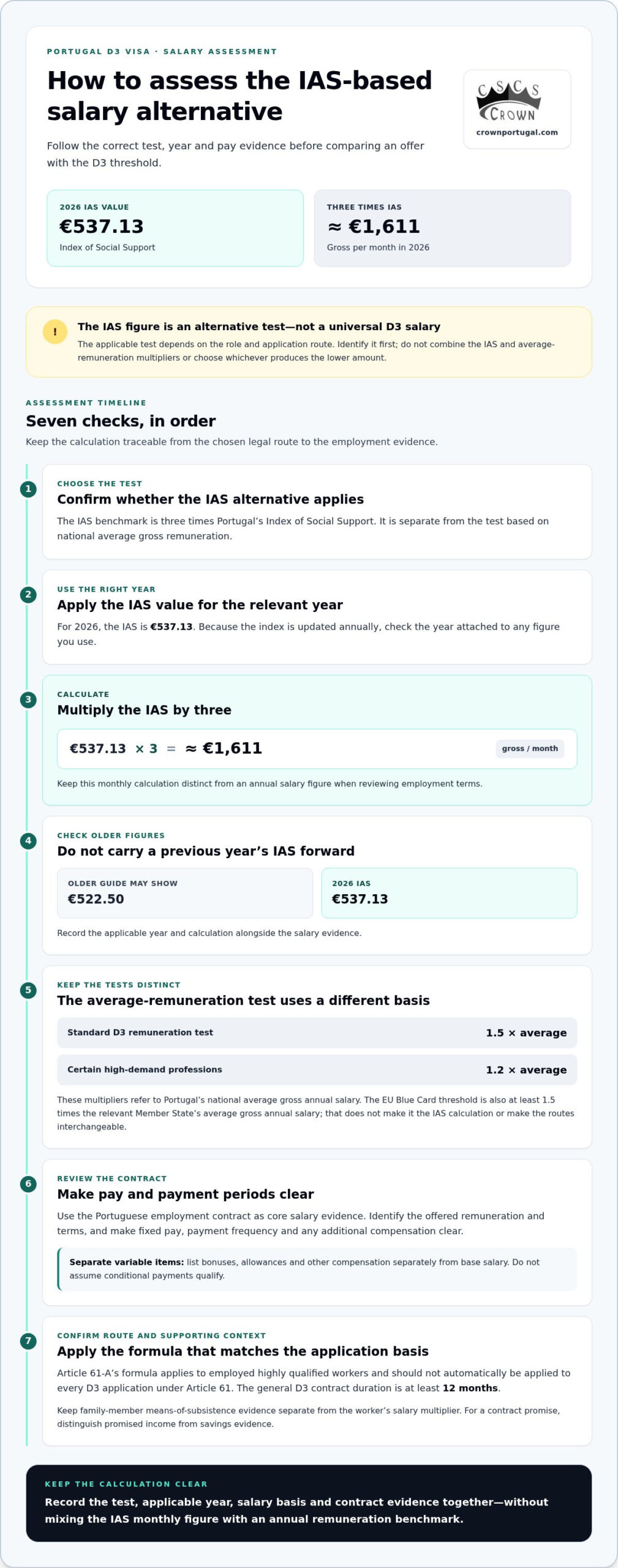
- First, identify whether the IAS-based test applies to your application. The alternative benchmark is three times Portugal’s Index of Social Support (IAS). It is calculated separately from the test based on national average gross remuneration, so do not combine the multipliers or select whichever gives the lower amount.
- Use the IAS value for the relevant year, then multiply it by three. In 2026, the IAS is €537.13, so three times the index is approximately €1,611 gross per month. The calculation uses a monthly amount here; distinguish it from an annual salary figure when reviewing your employment terms.
- Check the year attached to any IAS figure you encounter. An older D3 guide may show €522.50, while the 2026 IAS is €537.13. Because the index is updated annually, using a previous year’s value can produce a different result. Record the applicable year and the calculation alongside the salary evidence in your application.
- Compare the IAS alternative with the EU Blue Card threshold before assessing your employment offer. The D3 remuneration test generally uses 1.5 times Portugal’s average gross annual salary, with a 1.2-times threshold for certain high-demand professions. The EU Blue Card threshold is also at least 1.5 times the relevant Member State’s average gross annual salary, so it is not the same as three times IAS.
- Use the Portuguese employment contract as the core salary evidence. It should state the offered remuneration and employment terms; keep the amounts and payment periods clear so the relevant test can be applied. The general D3 contract duration is at least 12 months. For a contract promise, distinguish promised income from savings evidence rather than treating them as identical.
- List bonuses, allowances and other compensation separately from the stated base salary. The threshold depends on the remuneration measure for your route, so do not assume variable or conditional payments qualify. Make the contract’s fixed pay, payment frequency and any additional compensation clear.
- For highly qualified employment, first identify the applicable legal route, then apply its salary formula. Article 61-A’s formula applies to employed highly qualified workers and shouldn’t automatically be applied to every D3 application under Article 61. The IAS calculation is therefore a distinct alternative, not a substitute for identifying the correct test.
How the threshold relates to national average gross remuneration
- Identify the salary test attached to the proposed activity before comparing figures. For the standard D3 remuneration test, the threshold is at least 1.5 times Portugal’s national average gross annual salary. Certain high-demand professions may use 1.2 times that average. These are statutory multipliers, not permanent euro amounts, so calculate from the applicable benchmark.
- Use the gross annual measure, not a net monthly estimate, for the comparison. If the relevant national average gross annual salary is represented as X, the standard calculation is 1.5 × X. For an eligible high-demand profession, it is 1.2 × X. The example shows the method without substituting an outdated or unrelated salary figure.
- Establish which national average salary data applies to the application period. Portugal’s D3 salary limits reference national average-salary data transmitted to Eurostat. The benchmark can therefore change as the relevant remuneration data changes. Keep the reference period clear when comparing the contract’s gross annual pay.
- Review the employment contract as a complete record of remuneration. Identify the guaranteed gross pay, payment frequency and annual total, then compare that total with the applicable multiplier. Keep conditional payments separate from fixed remuneration unless the relevant calculation counts them as qualifying pay. This makes the comparison easy to trace and prevents a monthly net figure from obscuring the annual test.
- Distinguish the D3 assessment from the EU Blue Card salary test. The Blue Card threshold is also at least 1.5 times the relevant Member State’s average gross annual salary. That shared multiplier doesn’t make the two routes interchangeable: eligibility, employment conditions, and the applicable legal provisions must still match the chosen residence route.
- Check the legal route before applying any formula. Article 61-A’s salary formula applies to employed highly qualified workers and shouldn’t automatically be applied to every D3 application under Article 61. The activity and application basis matter. A residence permit application should therefore present the contract and salary calculation in a way that corresponds to its specific route.
- Keep family-member requirements in a separate calculation. Children and other family members may affect means-of-subsistence evidence, but that assessment is distinct from the worker’s salary multiplier. Don’t add family allowances or household amounts to the national average benchmark. Record the D3 salary test and any family subsistence evidence separately for a clear immigration file.
D3 visa salary threshold
- Calculate the salary test only after confirming the D3 application route. The standard benchmark is 1.5 times Portugal’s national average gross annual salary. Certain high-demand professions may use 1.2 times that average. The Portugal D3 visa minimum salary threshold is therefore a statutory calculation, not one fixed euro amount for every qualified worker.
- Compare the signed employment contract with the applicable test. Record gross remuneration, payment frequency, and annual total separately; a net monthly figure cannot be compared directly with a gross annual benchmark. For employed highly qualified workers, Article 61-A contains a salary formula. It should not automatically be applied to every D3 application under Article 61.
- Distinguish an employment contract from a promise of employment. The general rule is a contract duration of at least 12 months. Applicants using a promise may also need to demonstrate savings of at least €11,040 in a personal account for the main applicant. That savings evidence is separate from the salary assessment, not a replacement for the remuneration test.
- If the offered salary is below the applicable threshold, it does not meet that remuneration test as presented. Ask the employer to revise the guaranteed pay, or assess whether another qualifying route or salary test applies to the activity. Do not rely on variable bonuses to cover a shortfall unless they count under the applicable calculation.
- Verify the current test through the applicable text of Portugal’s Law 23/2007 and its relevant provisions, including Article 61-A where applicable. Article 121.º-Q n.º 6 connects the D3 salary limits to national average-salary data transmitted to Eurostat. Check the relevant year and calculation basis before lodging documents at the consulate.
- Prepare salary evidence that makes the calculation clear to the consulate. Include the signed contract or employment promise, with remuneration and duration stated clearly, alongside supporting records for the stated pay. Keep gross annual figures distinct from net income and savings. A lawyer may review the documents, but you remain responsible for submitting a consistent visa application.
- Focus the assessment on the worker’s qualified activity. The IAS alternative, national-average multiplier and EU Blue Card salary test are not interchangeable. Identify the legal basis first, apply only its relevant formula, and make sure the residence application and employment evidence use matching figures and periods.
Minimum salary threshold
- Separate the D3 salary test from Portugal’s general means-of-subsistence calculation. The 2026 D3 guide gives approximately €2,300 per month for a highly qualified professional. By comparison, the 2026 minimum monthly salary used for long-term visa subsistence is €920, net of Social Security deductions. These figures serve different purposes and shouldn’t be substituted for each other.
- Match the salary figure to the employment route before preparing documents. D3 remuneration benchmarks are linked to national average gross annual salary or, where applicable, the IAS. The relevant calculation depends on the application’s legal basis and the worker’s activity. Record the chosen test, reference year, gross pay, and payment period together for a consistent file.
- Keep qualification evidence alongside salary records. Portuguese D3 applicants are generally expected to hold higher education relevant to the role, such as a Bachelor’s degree, Master’s degree, or PhD. A guide also describes five to six years of field experience as an alternative route. Match the degree or experience evidence to the highly qualified position in the contract.
- Calculate household subsistence separately if family members accompany the applicant. For Portugal’s 2026 means-of-subsistence calculation, the first adult is assessed at 100% of the minimum monthly salary. The second adult and each additional adult count at 50%. Each child under 18 and each non-minor dependent child counts at 30%.
- For example, an applicant should not treat the 2026 D3 salary guide figure of approximately €2,300 per month as the family reunification calculation. The household test uses the stated adult and child percentages against the minimum monthly salary. Keep that assessment distinct from the worker’s D3 remuneration evidence, and identify each family member in the supporting record.
- Before lodging the visa application, arrange documents by purpose: employment contract and salary evidence for the D3 remuneration test; qualification evidence for the role; and separate subsistence evidence where relevant. A clear record helps distinguish the worker’s eligibility from household resources. It also prevents a general long-term visa benchmark from being mistaken for the D3 salary test.
What is the minimum salary threshold for Portugal’s D3 visa in 2026?
- Begin with the route-specific answer: a 2026 D3 guide gives approximately €2,300 per month for a highly qualified professional. This is a useful headline estimate, not a universal fixed amount. The Portugal D3 visa minimum salary threshold depends on which legal salary test applies to the applicant’s employment and role.
- Compare that guide figure with the IAS-based alternative. Portugal’s IAS is €537.13 in 2026, and three times IAS is approximately €1,611 gross per month. This calculation produces a lower reference amount, but it applies only where the IAS-based remuneration test governs. Don’t treat the IAS calculation and average-salary test as interchangeable.
- For the national-average test, calculate the applicable multiplier against Portugal’s national average gross annual salary. The standard multiplier is 1.5 times, while certain high-demand professions may use 1.2 times. Since these are statutory multipliers rather than fixed euro values, the resulting threshold depends on the relevant salary data and application period.
- Check the employment category before relying on either amount. Article 61-A’s salary formula applies to employed highly qualified workers and should not automatically be applied to every application under Article 61. Identify the route first, then use its corresponding test. This explains why different D3 summaries may show €2,300 or approximately €1,611.
- Keep the salary test separate from Portugal’s general means-of-subsistence figure. For long-term visa applications, the 2026 minimum monthly salary used for subsistence is €920, net of Social Security deductions. That figure serves a different purpose. It is not a substitute for the D3 remuneration test or proof that an employment offer meets its threshold.
- Prepare a calculation record with the application. State the legal route, the benchmark year, the multiplier or IAS value, and the contract’s gross pay and payment period. For example, an IAS-based calculation should show €537.13 multiplied by three, producing approximately €1,611 gross per month in 2026. Keep any annual gross figure clearly labelled.
- Use the figures as decision points, not as unrelated amounts to select between. If the offer appears below the relevant threshold, assess whether another test genuinely applies to the role. A high-demand profession may use the 1.2-times multiplier when eligible; a lower IAS result alone does not establish eligibility for that alternative.
Crown Portugal: Portugal Digital Nomad D-8 Visa
Crown Portugal can help you assess whether the Portugal Digital Nomad D-8 Visa better fits your circumstances than a D3 application. The D3 route is designed around highly qualified employment and its applicable salary test; a different residence purpose may call for a different visa category.
If your plans point toward the D-8 route, Crown Portugal can guide you through that visa process. It also assists with Portugal Golden Visa D-9, Portugal Passive Income D-7 visa, and NIF Registration (Personal Tax Number). The appropriate next step depends on your intended activity and residence plans, not on treating visa categories as interchangeable.
Contact Crown Portugal to discuss which Portuguese immigration route fits your plans.
Turn the salary calculation into a clear application plan
Your next step is to align the remuneration calculation with the role, contract, and supporting documents you intend to submit. A concise record of the chosen test and its basis can help keep the application consistent from preparation through review. The Portugal D3 visa minimum salary threshold is only one part of selecting a route that matches your work and residence plans.
If your circumstances point toward a different immigration pathway, Crown Portugal also assists with the Portugal Digital Nomad D-8 Visa, Portugal Golden Visa D-9, and NIF Registration (Personal Tax Number). These options serve different purposes, so consider the route that reflects your actual plans rather than treating them as substitutes for a D3 application.
Contact Crown Portugal for guidance on the next step for your Portuguese immigration plans. A well-organized application starts with a route that fits your circumstances.
Frequently Asked Questions
What Is the Portugal D3 Visa?
The Portugal D3 visa is a residence visa for research, higher-education professorial activity, or highly qualified activity. Its legal framework includes Articles 61 and 61-A, while Article 90 governs the subsequent residence permit. For a professional applicant, the role and supporting qualifications must fit the highly qualified activity route. The D3 is therefore an employment-related immigration pathway, not a general visa for any job in Portugal.
Are there exceptions to the minimum salary requirement?
There are alternative salary tests, but they depend on the applicable route and profession. Certain high-demand professions may use a threshold of 1.2 times the national average salary instead of the standard 1.5-times test. An IAS-based test may also apply in relevant cases. Treat these as defined calculation methods, not automatic waivers: the applicant’s role and legal basis determine which test is relevant.
Can I calculate the D3 salary using an old online figure?
No. IAS and national remuneration benchmarks can change, so an older figure may no longer match the application year. For example, an online page showing IAS at €522.50 differs from Portugal’s 2026 IAS of €537.13. Check the date and basis of any figure, then recalculate using the applicable test. Also distinguish monthly amounts from annual gross remuneration before comparing them.
How much salary do I need for the D3 Visa?
For 2026, a D3 guide gives approximately €2,300 per month for a highly qualified professional, but the applicable test matters. The Portugal D3 visa minimum salary threshold may be calculated using national average gross annual remuneration or an IAS-based alternative. Compare the employment offer on the same gross basis and period as the relevant test. A net monthly payslip alone may not show whether the threshold is met.
Is there a lower salary threshold for some D3 applicants?
Yes. Certain high-demand professions may qualify for a 1.2-times national-average salary threshold rather than the standard 1.5-times multiplier. An IAS-based calculation is another alternative where that test applies. Neither lower figure is a general discount for applicants who earn less. The profession, application route, and applicable remuneration test must align before using a reduced calculation.
Is the D3 visa salary threshold based on the national minimum wage or average gross salary?
The principal D3 salary test uses a multiple of Portugal’s national average gross annual salary, not simply the national minimum wage. A separate IAS-based test may apply in relevant cases. Portugal’s 2026 long-term visa means-of-subsistence benchmark is €920 monthly, net of Social Security deductions, but that serves a different purpose and shouldn’t be mistaken for the D3 employment salary test.
Does the Portugal D3 visa require a salary of at least 1.5 times the national average gross annual salary?
That is the standard national-average test: the salary must reach at least 1.5 times Portugal’s average gross annual salary. It isn’t the only possible calculation. Certain high-demand professions may use 1.2 times the average, and an IAS-based test may apply under a different route. Article 61-A’s formula concerns employed highly qualified workers and shouldn’t automatically be applied to every Article 61 application.
Does the D3 visa minimum salary change for shortage occupations or certain regions?
Certain high-demand professions may use the lower 1.2-times national-average multiplier. The stated adjustment relates to the profession, so don’t assume that working in a particular region alone lowers the salary test. The national-average calculation relies on Portuguese remuneration data transmitted to Eurostat. Identify whether the role qualifies for the occupational adjustment before comparing the contract’s gross annual salary.