

Portugal Company Formation: 2026 Step-by-Step Guide

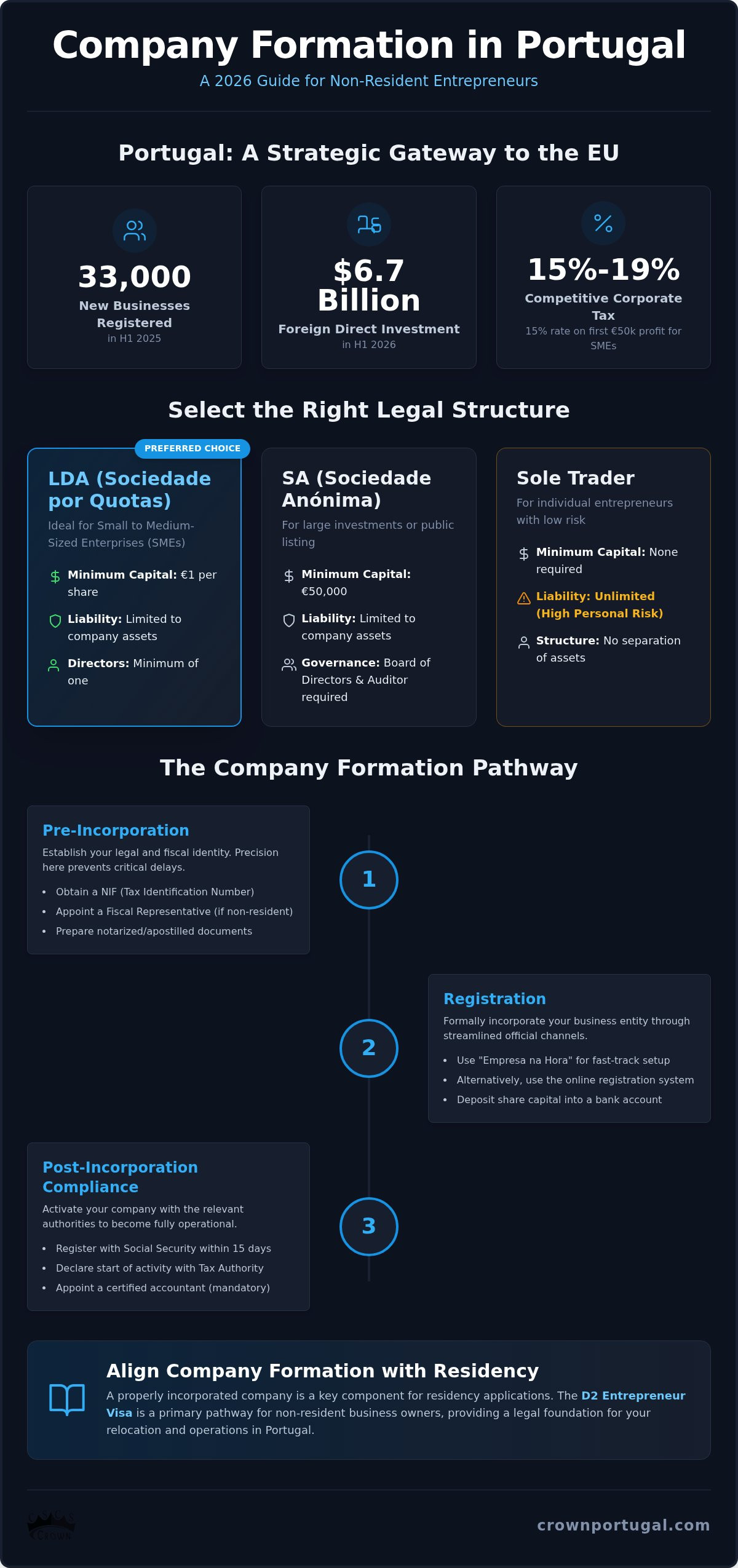
With nearly 33,000 new businesses registered in Portugal during the first half of 2025, the country has solidified its position as a primary destination for international investment. However, establishing a presence here requires more than just capital; it demands a precise understanding of local administrative protocols. If you find yourself overwhelmed by the prospect of opening a bank account as a non-resident or differentiating between various legal structures, you aren’t alone. Successful company formation in Portugal for foreigners depends on navigating these bureaucratic layers with technical accuracy.
This 2026 guide is designed to help you master the complete process of incorporating a Portuguese business as a non-resident, from selecting the correct legal structure to ensuring full residency alignment. We’ll provide a methodical breakdown of the registration systems alongside a clear path toward securing an Entrepreneur or Startup visa. By following this structured approach, you’ll gain a legally compliant entity and seamless access to the EU single market. We will examine the specific requirements for fiscal representation, share capital deposits, and the mandatory appointment of certified accountants to ensure your venture stands on a firm legal foundation.
Key Takeaways
- Identify the most suitable legal structure, such as an Lda, to ensure your business is optimized for both the Portuguese market and the broader European Union.
- Understand the critical pre-incorporation steps, specifically the acquisition of a NIF and the appointment of a fiscal representative, which are essential for company formation in Portugal for foreigners.
- Evaluate the efficiencies of different registration methods, including the “Empresa na Hora” and online systems, to streamline your administrative timeline.
- Maintain regulatory compliance by mastering the mandatory requirements for Social Security registration and the formal declaration of activity with the Tax Authority.
- Align your corporate entity with residency pathways, such as the D2 Entrepreneur Visa, to secure a stable and legal foundation for your relocation to Portugal.
Navigating the Strategic Landscape of Portuguese Business Structures
Portugal serves as a strategic entry point into the European Union single market. For international entrepreneurs, the decision to incorporate here is often driven by competitive corporate tax rates; currently, the standard mainland rate is 19%, with a reduced rate of 15% for the first €50,000 of taxable profit for SMEs. Foreign direct investment in Portugal totaled $6.7 billion in the first half of 2026, reflecting the high level of confidence in the national economy. Navigating these options requires a disciplined approach to ensure the chosen legal framework aligns with your long-term operational goals.
Successful company formation in Portugal for foreigners relies on selecting a structure that balances administrative simplicity with robust liability protection. As your guide, we prioritize a “welcoming expert” approach that maps out every possible pathway for your business. This professional consultancy is necessary to avoid document rejection and navigate the exhaustive rules and regulations governing cross-border operations. Selecting the wrong entity type can lead to unnecessary fiscal burdens or complex governance requirements that hinder your ability to scale within the EU. For more visual insights into these procedures, you can explore the Crown Portugal YouTube channel.
To better understand this concept, watch this helpful video:
The LDA (Sociedade por Quotas): The Preferred Choice for SMEs
The Sociedade por Quotas, or LDA, remains the most frequent choice for foreign investors due to its inherent flexibility. One of its primary advantages is the minimal capital requirement; shareholders can establish an LDA with as little as €1 per share. This structure provides limited liability, which ensures that your personal assets remain protected from corporate obligations. An LDA requires at least one director, and while residency is not a prerequisite for ownership, at least one representative must maintain legal and fiscal residency in Portugal to satisfy local administrative rules. This structure is particularly effective for small to medium-sized enterprises seeking a stable foothold in the Portuguese market.
Joint Stock Companies (SA) and Sole Proprietorships
For larger investment projects or those planning to go public, the Sociedade Anónima (SA) is the appropriate vehicle. It requires a minimum share capital of €50,000 and involves more rigorous governance, including a board of directors and a statutory auditor. Conversely, some individuals consider operating as a Sole Trader (Empresário em Nome Individual). While this involves lower administrative costs, it carries significant risk because there is no separation between personal and business assets. Comparing these structures is vital; while an SA offers prestige and easier share transfers, the LDA typically provides the most efficient balance of compliance and control for most international ventures. Each choice impacts your future reporting requirements and tax liabilities, making precision in the initial setup mandatory. If you are also exploring options in other major global trade hubs, you may want to check out Expert Plus Businessmen Services for expert guidance on company formation in the UAE.
Before the formal registration process begins, entrepreneurs must establish a legal and fiscal identity within the Portuguese administrative system. This preparation is the most critical phase of company formation in Portugal for foreigners. Documentation standards for foreign stakeholders are rigorous; you’ll typically need notarized and apostilled copies of passports, proof of address, and, for corporate shareholders, updated certificates of incorporation. Precision at this stage prevents the bureaucratic delays often highlighted in the World Bank Doing Business report for Portugal, which emphasizes the importance of following standardized regulatory procedures to ensure commercial viability.
Securing Your NIF and Fiscal Representation
The NIF (Número de Identificação Fiscal) is your primary tax identification number. It’s the prerequisite for every legal action, from signing a lease to hiring staff. For non-EU or non-EEA residents, appointing a fiscal representative is a mandatory legal obligation. This representative serves as your official point of contact with the Portuguese Tax Authority, ensuring that all fiscal notifications are received and addressed promptly. If you’re starting this process, our How to Get a NIF in Portugal guide provides a detailed walkthrough. Selecting a reliable partner for NIF registration and fiscal representation ensures your initial filings are compliant with 2026 standards.
Opening a Portuguese Corporate Bank Account
In 2026, the Portuguese banking sector maintains strict Know Your Customer (KYC) protocols. Foreign directors should prepare for an exhaustive review of their professional background and the source of funds. While traditional Portuguese banks offer stability and local presence, many entrepreneurs now opt for digital business platforms that provide faster onboarding for non-residents. The choice between these options should depend on your specific transaction volume and the need for physical branches.
Once the account is active, you must deposit the initial share capital. For an LDA, while the minimum is €1 per shareholder, the law requires these funds to be deposited within five business days of incorporation. This step is vital because the bank’s confirmation of the deposit is often required to finalize the company’s activation with the Tax Authority. Handling this sequence correctly avoids the risk of registration suspension or fiscal penalties. Our team provides the necessary guidance to streamline these interactions with financial institutions, ensuring your capital is correctly registered from day one.
The Step-by-Step Process of Company Registration in Portugal
The actual registration phase represents the culmination of the fiscal preparation discussed in earlier chapters. For international investors, company formation in Portugal for foreigners typically follows one of two paths: the Empresa na Hora (On the Spot Firm) or the Empresa Online (Online Company) systems. The in-person service is a same-day procedure costing €360, while the digital process usually takes one to two days. The online route is priced at €220 for pre-approved articles or €360 for custom ones. While these systems are designed for efficiency, they require all shareholders to have their fiscal documentation in perfect order before the first submission.
Name Reservation and Business Activity Codes (CAE)
Selecting a corporate name is the first formal step in the registration sequence. You must obtain a Name Reservation Certificate (Certificado de Admissibilidade) from the Institute of Registries and Notaries (IRN). This document ensures your chosen name doesn’t conflict with existing entities and remains valid for a specific period. A standard application costs €75, while urgent requests are €150. Simultaneously, you must select the correct Business Activity Codes (CAE). These codes define your company’s commercial scope and directly influence your VAT obligations and corporate tax eligibility. A common pitfall for foreigners is defining the corporate object too narrowly, which can restrict future expansion or necessitate expensive legal amendments later.
Drafting and Executing the Articles of Association
The Articles of Association (Estatutos) serve as the company’s constitution. They must include mandatory clauses regarding share capital distribution, governance rules, and the specific powers of directors. For foreign-owned companies, these documents often require specialized wording to account for cross-border management and potential remote operations. If you’re managing the company formation in Portugal for foreigners from abroad, you’ll likely need to execute a Power of Attorney (PoA) to allow a local expert to sign on your behalf. This professional oversight is vital; any error in the drafting phase can lead to the rejection of the entire registration by the Conservatória.
Once the articles are signed and the share capital deposit is confirmed, the final act of registration is completed at the Commercial Registry (Conservatória do Registo Comercial). This provides the company with its permanent legal identity and its own NIPC (Corporate Tax Number). This corporate number is distinct from the individual NIFs of the shareholders and serves as the foundation for all future commercial contracts and tax filings. Following this, the company is legally birthed, but several immediate compliance deadlines follow to ensure it can actually begin operations.
Post-Incorporation Compliance: Tax, Social Security, and Reporting
Once the Commercial Registry provides the NIPC, the administrative focus shifts to the Autoridade Tributária. You must submit the Declaration of Commencement of Activity (Declaração de Início de Atividade) within 15 days of incorporation. A vital requirement at this stage is the mandatory appointment of a Certified Accountant (TOC). In Portugal, every corporate entity must have a TOC from the start of its operations to manage tax filings and ensure compliance with the 2026 reporting calendar. This professional oversight is a non-negotiable aspect of company formation in Portugal for foreigners to avoid immediate administrative penalties.
Registering for Social Security (NISS) and VAT
While your local accountant ensures regulatory compliance, it is also beneficial to explore specialized financial strategies that can enhance your company’s growth. For businesses focused on innovation and looking to optimize their capital through R&D tax credits and corporate finance, you can find out more to leverage these opportunities effectively.
The company must establish its presence within the social security system to process payroll and legal benefits. The NISS is the mandatory social security link for all Portuguese employees. Obtaining a NISS for the company and its directors is a prerequisite for any hiring activity. For 2026, employer contributions are set at 23.75% of the gross salary, while employee contributions are 11%. Additionally, the company must register for VAT (IVA) if the projected annual turnover exceeds €15,000. For those engaged in cross-border commerce, registration with the VAT Information Exchange System (VIES) is required to facilitate intra-EU trade without immediate tax friction.
The Declaration of the Ultimate Beneficial Owner (RCBE)
Transparency protocols have become more stringent to prevent financial irregularities. The Central Register of Beneficial Owners (RCBE) is a critical compliance step that identifies the natural persons who ultimately own or control the legal entity. This declaration must be submitted within 30 days of incorporation. Failure to comply with RCBE rules can lead to the suspension of the company’s Permanent Certificate (Certidão Permanente). This certificate is needed for most commercial activities, including bank interactions and contract renewals. To ensure your business remains fully compliant with these complex reporting requirements, you can access our professional support for Social Security Number (NISS) and fiscal registration.
In 2026, corporate entities must adhere to a strict reporting rhythm. This includes monthly or quarterly VAT declarations and the annual Model 22 for corporate income tax. Your TOC will play an ongoing role in mapping these deadlines, which vary based on your company’s fiscal year and turnover volume. A disciplined approach to these deadlines is the only way to protect your investment and maintain your status as a legally compliant entity within the Portuguese market. Precision in these post-incorporation duties is just as important as the initial registration of company formation in Portugal for foreigners.
Aligning Company Formation with Residency and Visa Pathways
For many international investors, company formation in Portugal for foreigners serves as the primary legal anchor for securing long-term residency. The act of incorporation is rarely a standalone administrative event; instead, it’s a strategic foundation for the D2 Entrepreneur Visa or the Startup Visa. By establishing a Portuguese entity, you demonstrate a concrete economic commitment to the national market, which is a core requirement for residency approval. This alignment ensures that your corporate structure satisfies both the Commercial Registry and the immigration authorities, creating a unified path for your professional and personal relocation.
The D2 Entrepreneur and Startup Visa Integration
The D2 visa is specifically designed for entrepreneurs who have either started a business in Portugal or have a solid business plan for a new venture. Successfully navigating the Entrepreneur Visa Portugal Process requires your company setup to reflect the economic viability of your project. Alternatively, some founders may find the Portugal Startup Visa Requirements more suitable if their business is innovation-led and eligible for incubator support. While the D2 path focuses on traditional business metrics and local impact, the Startup Visa prioritizes scalability and technological potential. Crown Portugal facilitates this bridge by ensuring your company’s CAE codes and Articles of Association are perfectly aligned with your chosen visa category.
Corporate investment also remains a viable route for the Portugal Golden Visa. Under current 2026 regulations, a €500,000 investment in a new or existing business that creates at least five permanent jobs offers a pathway to residency without the requirement for daily management. This roadmap is particularly attractive for those seeking to balance EU market access with flexibility in their global operations. Each of these pathways demands meticulous documentation, where every corporate filing serves as evidence for your immigration application. Precision in these early stages prevents the need for corrective filings during the residency renewal process.
Professional Advisory and Relocation Support
Transitioning your professional life to a new country involves significant logistical complexity beyond the initial registration. Accessing end-to-end support, from NIF acquisition to Portugal Business Visa assistance, minimizes the risk of administrative rejection. Our role as a disciplined professional partner is to map out every requirement, ensuring your family reunification and relocation processes are as steady and predictable as your business setup. We invite you to view detailed process breakdowns and expert consultations on the Crown Portugal YouTube channel. By combining local expertise with global standards, we facilitate a smooth transition into the Portuguese business environment, allowing you to focus on your company’s growth while we manage the administrative burden.
Securing Your Commercial Future in Portugal
Establishing a business in the European Union requires a methodical approach to both corporate registration and fiscal compliance. Successful company formation in Portugal for foreigners depends on securing a solid fiscal foundation with a NIF and choosing a legal structure that supports your specific operational goals. Beyond the initial registration, maintaining your entity’s standing through RCBE declarations and mandatory social security filings ensures long-term stability and protects your investment in the national market.
Since 2018, Crown Portugal has specialized in providing end-to-end relocation and administrative support for international investors. Whether you’re navigating the complexities of D2 and Tech Visas or require expert guidance on fiscal representation, our team is ready to facilitate your transition. We encourage you to Contact Crown Portugal for Expert Company Formation Support and begin the process of aligning your business ambitions with a secure residency pathway. With the right professional partner, your entry into the Portuguese market can be a seamless and successful endeavor.
Frequently Asked Questions
Can a foreigner open a company in Portugal remotely?
Foreigners can complete the entire process of company formation in Portugal for foreigners remotely by granting a Power of Attorney (PoA) to a local representative. This legal instrument allows a consultant to sign the Articles of Association and handle the Commercial Registry filings on your behalf. While the digital Empresa Online portal is available, it requires a Portuguese digital signature or a legal proxy. You’ll still need to secure your NIF and appoint a fiscal representative before the remote registration can proceed.
What is the minimum share capital required to start an LDA in Portugal?
The minimum share capital for a Sociedade por Quotas (Lda) is just €1 per shareholder, meaning a company can technically be incorporated with very low initial funds. For a Sociedade Anónima (SA), the requirement is significantly higher at €50,000. While the €1 rule for LDAs offers high flexibility, you must deposit these funds into a corporate bank account within five business days of incorporation to remain compliant with Portuguese commercial law and finalize your tax activation.
Do I need a Portuguese residence permit to own a company in Portugal?
You don’t need a Portuguese residence permit to own or incorporate a company in Portugal. Foreigners can be 100% shareholders and even directors while residing abroad. However, if you intend to live in the country to manage your business, you’ll need to apply for a suitable residency pathway, such as the D2 Entrepreneur Visa or the Startup Visa. Ownership is a commercial right, whereas residency is a separate administrative process governed by immigration authorities.
How long does the company formation process take for a non-resident?
The duration of the company formation in Portugal for foreigners varies depending on the chosen registration method. The Empresa na Hora service allows for same-day incorporation at a physical registry office. In contrast, the Empresa Online process typically takes between one and two business days. It’s important to account for pre-incorporation steps, such as obtaining a NIF and drafting a Power of Attorney, which can add several days or weeks to the total preparation timeline.
Is a local bank account mandatory for a Portuguese company?
A Portuguese corporate bank account is mandatory for several critical business functions. You’ll need it to deposit the initial share capital and to facilitate the payment of corporate taxes and social security contributions. While digital business platforms are increasingly popular in 2026, the account must be capable of interacting with the Portuguese Tax Authority’s systems. Most entrepreneurs find that a local account is essential for establishing commercial credibility and managing daily operational expenses within the EU.
What are the main corporate taxes for a new business in Portugal in 2026?
For 2026, the primary corporate tax is the Corporate Income Tax (IRC), which carries a standard mainland rate of 19%. Small and medium-sized enterprises benefit from a reduced rate of 15% on their first €50,000 of taxable profit. Other significant obligations include the standard Value Added Tax (VAT) at 23% and employer social security contributions at 23.75%. It’s mandatory to work with a certified accountant to ensure these filings are submitted accurately and within the legal deadlines.
What is the role of a fiscal representative during company formation?
A fiscal representative acts as the mandatory legal intermediary between a non-EU/EEA resident and the Portuguese Tax Authority. Their primary role is to receive official tax notifications and ensure the taxpayer is aware of their fiscal obligations in Portugal. Without a representative, non-resident shareholders cannot obtain a NIF, which is the foundational requirement for any corporate registration. This role provides a necessary layer of administrative security, ensuring that your company remains in good standing with the tax office.
Portugal Business Visa: 2026 Guide for Entrepreneurs – Crown Portugal at 1:11 am, September 19, 2026 -
[…] Portugal Company Formation: 2026 Step-by-Step Guide – Crown Portugal on Portugal Business Visa: 2026 Guide for Entrepreneurs […]
Tech Visa Portugal: 2026 Guide for Qualified Workers – Crown Portugal at 2:04 pm, September 19, 2026 -
[…] Portugal Business Visa: 2026 Guide for Entrepreneurs – Crown Portugal on Portugal Company Formation: 2026 Step-by-Step Guide […]