

Portugal D3 Visa Application Process: The 2026 Step-by-Step Guide

The Portugal D3 visa isn’t just another residency option; it’s a strategic fast-track designed for the world’s most capable professionals who seek a stable future in Europe. You likely understand that the Highly Qualified Activity designation offers significant benefits, yet the administrative path often feels daunting. Many applicants face intense anxiety over meeting specific 2026 salary thresholds or navigating the complex document legalization required for a successful submission. We recognize that the Portugal D3 visa application process demands a high level of professional organization and meticulous attention to detail to ensure every fiscal requirement is met.
This article provides the professional roadmap you need to master these complexities with absolute confidence. You’ll gain a clear, chronological timeline of actions that prioritizes security and stability for your entire family. We’ll guide you through the essential preliminary steps, including NIF and Social Security Number (NISS) registration, and explain the transition from your initial visa to a long-term residence permit. By following this expert-led framework, you can replace bureaucratic confusion with a disciplined, step-by-step strategy for your relocation.
Key Takeaways
- Differentiate between the specialized D3 pathway and standard work visas to capitalize on administrative fast-tracking for highly qualified professionals.
- Evaluate your 2026 eligibility based on academic qualifications or the specific five-year professional experience threshold recognized by Portuguese authorities.
- Navigate the Portugal D3 visa application process with a clear, two-phase timeline that covers everything from document legalization to your consulate interview.
- Ensure full compliance with fiscal and social security requirements by prioritizing the remote acquisition of your NIF and NISS.
- Minimize the risk of administrative rejection through a methodical review of all professional evidence and certified documentation.
Understanding the Portugal D3 Visa for Highly Qualified Activity
The Portugal D3 visa represents a specialized residency pathway specifically designed for professionals engaged in “Highly Qualified Activities” (HQA). Unlike the standard D1 work visa, which applies to general employment contracts across all sectors, the D3 track is reserved for individuals whose roles demand a high level of academic or professional expertise. Highly Qualified Activity (HQA) refers to activities requiring specialized technical skills or senior management expertise. This distinction is critical because it places the applicant in a priority administrative category within the Portuguese immigration framework, ensuring that the labor market’s most essential contributors receive expedited attention.
Standard work visas are often subject to labor market quotas and broader scrutiny. In contrast, the D3 pathway bypasses these common hurdles. It targets a specific tier of the workforce. The Portugal D3 visa application process is designed to be a fast-track system, offering priority processing that isn’t available to general workers. This efficiency is paired with robust provisions for family reunification, ensuring that your spouse and dependents can join you shortly after your arrival. For those seeking a long-term future, this visa provides a secure foundation for obtaining a permanent residence permit after five years of legal residency.
To better understand the foundational requirements of this program, watch this helpful video:
D3 Visa vs. EU Blue Card: Clarifying the Connection
The D3 visa often serves as the initial entry mechanism for those seeking the EU Blue Card in Portugal. This alignment with the EU Blue Card framework for highly skilled professionals ensures that successful applicants benefit from standardized rights across the European Union. Eligibility typically requires a high-level qualification, such as a university degree, or significant professional experience in a specialized field. Specifically, five years of relevant professional experience can often substitute for formal academic degrees in certain technical sectors. For those navigating the Portugal D3 visa application process, securing this status provides enhanced mobility and professional recognition throughout the Schengen Area, facilitating a smoother transition for career growth in Europe.
Why the D3 Pathway is the Priority Choice in 2026
By 2026, Portuguese immigration policy has shifted to prioritize the acquisition of global talent to drive the national economy forward. The D3 pathway remains the priority choice because it offers significantly faster processing times than other D-series visas, reflecting the strategic value of HQA. Professionals who utilize this track find that their contributions are treated as essential economic drivers, resulting in a more predictable and stable relocation experience. The government’s commitment to tech and senior management sectors means that these applications are handled with a higher degree of administrative efficiency. For ongoing updates on policy changes, you can find detailed Portugal Data on Crown Portugal YouTube, where we track the latest administrative shifts and regulatory updates.
2026 Eligibility: Are You a Highly Skilled Professional?
Securing residency through the D3 track requires strict alignment with national academic and professional standards. The primary requirement is a Bachelor’s degree or an equivalent high-level qualification that matches your intended role. However, Portuguese regulations acknowledge that professional mastery isn’t always academic. For individuals in specific technical sectors, five years of documented professional experience can substitute for a formal degree. It’s vital to consult the official Ministry of Foreign Affairs residency visa checklist to ensure your professional credentials meet the statutory requirements under Article 61.
Defining Highly Qualified Activity (HQA) Sectors
Not every skilled position is eligible for this specialized pathway. Common roles that qualify include IT specialists, scientific researchers, senior executives, and medical professionals. If your prospective employer is a “Tech Visa” certified company, the Portugal D3 visa application process is often more efficient. This certification confirms the business operates in a high-value sector, reducing the administrative burden on the applicant. You must verify that your job offer is for a duration of at least 12 months and includes mandatory clauses regarding social security and fiscal compliance. Without these specific legal protections, the application may face immediate scrutiny.
Financial and Social Security Thresholds
The 2026 salary threshold is tied to the Indexante de Apoios Sociais (IAS) multiplier. Typically, a D3 applicant’s gross annual salary must be at least 1.5 times the national average. This economic benchmark distinguishes highly qualified professionals from the general labor force. Beyond the salary itself, you’re required to provide proof of subsistence. This involves demonstrating a bank balance that meets the 12-month reserve requirement based on the current minimum wage. Your Portuguese employer must also guarantee your social security registration (NISS) and ensure that all contributions are managed according to national law. This fiscal alignment is a non-negotiable component of the Portugal D3 visa application process.
Administrative precision is the most effective way to prevent application delays. You can find real-time updates and detailed breakdowns of these requirements by visiting the Portugal Data on Crown Portugal YouTube channel. Our team provides the security and stability you need by performing meticulous document reviews before you submit your file. If you aren’t certain that your contract meets these 2026 standards, you can request a professional eligibility assessment to safeguard your relocation plans.
Essential Document Checklist for a Successful D3 Application
A successful Portugal D3 visa application process depends entirely on the integrity and organization of your supporting documents. Portuguese authorities maintain a rigorous standard for administrative compliance. Every document must serve as verifiable evidence of your professional status and fiscal stability. This methodical arrangement of your dossier doesn’t just fulfill a requirement; it provides the security and stability needed to lower the risk of administrative rejection during the final review.
The Critical Role of the NIF and NISS
You cannot finalize a Portuguese employment contract or register for social security without a NIF (Número de Identificação Fiscal). This tax identification number is the primary requirement for all administrative actions in the country. It’s often necessary to obtain a NIF remotely through a fiscal representative before you begin your official application. For a detailed breakdown of this procedure, consult our How to Get a NIF in Portugal: The Complete 2026 Fiscal Guide. Following the NIF, your employer will facilitate the acquisition of your NISS (Número de Identificação de Segurança Social), which is essential for accessing health and social benefits once you arrive.
Legalization and Translation Standards
Documents issued outside the European Union must undergo a formal legalization process to be recognized by Portuguese consulates. Most applicants will require an Apostille under the Hague Convention. If your country is not a signatory, you’ll need legalization through the local Portuguese consulate. Additionally, all non-Portuguese documents must be accompanied by certified translations. A common pitfall that leads to application delays is the use of standard, non-certified translations. Ensuring your degree certificates and criminal record checks are properly legalized and translated is a non-negotiable step in the Portugal D3 visa application process.
Your professional evidence should include certified copies of your highest academic degrees and detailed transcripts. If you’re substituting experience for education, you’ll need formal work references that specify your roles and responsibilities over at least five years. Legal requirements include:
- A passport valid for at least two years beyond your application date.
- Criminal record certificates from your country of origin and any country where you’ve resided for more than one year.
- Comprehensive health insurance covering your initial 120-day entry period.
- Proof of accommodation, which in 2026 requires a registered rental contract with a minimum duration of 12 months or a property deed.
Meticulous document review is the most effective way to ensure a smooth transition. Our role as an expert intermediary is to ensure that your dossier meets every global professional standard before it reaches the authorities, leaving nothing to chance.
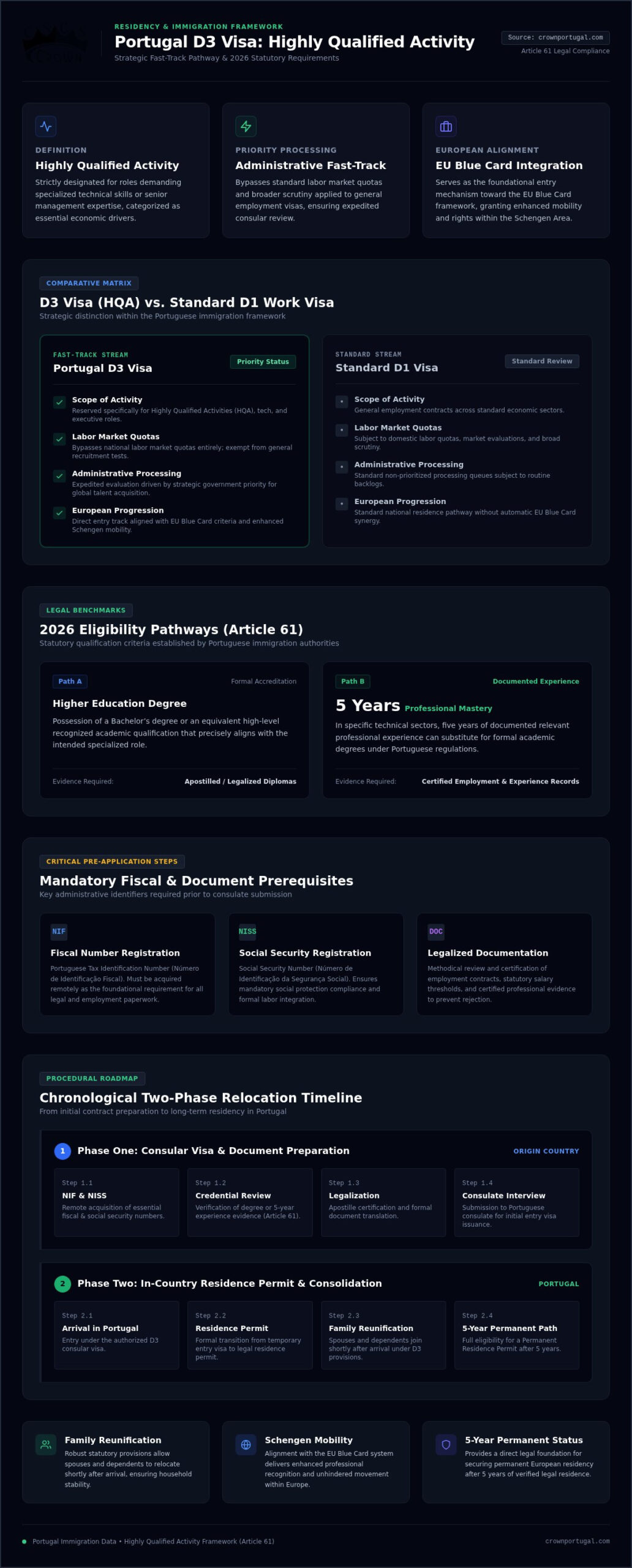
The Step-by-Step D3 Visa Timeline: From Contract to Residency
The Portugal D3 visa application process follows a disciplined, chronological sequence that transforms a professional job offer into legal residency. This timeline is divided into distinct phases, each requiring specific administrative actions to maintain the priority status of your application. Rushing through these stages without proper organization often leads to delays; therefore, a methodical approach is essential for a successful relocation.
Phase 1 begins with pre-application preparation. This includes acquiring your NIF, signing your employment contract, and legalizing your professional credentials as discussed in previous sections. Once your dossier is complete, Phase 2 involves the consulate submission. You’ll schedule an appointment at the Portuguese consulate in your country of residence to present your physical documents and undergo a brief interview. This stage is where the meticulous document review performed earlier proves its value, as it ensures your file meets every consular standard without exception.
Navigating the Consulate Interview
During the D3 visa interview, the consular officer will verify the authenticity of your qualifications and the specific terms of your Portuguese employment. You should arrive with a structured “Process Folder” that organizes every document according to the official checklist. This demonstrates professional competence and facilitates a faster review. Typical processing times for the initial 120-day entry visa in 2026 range from 60 to 90 days. This initial visa serves as your legal entry permit, allowing you to travel to Portugal to finalize the residency transition.
Post-Arrival: Registration with AIMA
Phase 3 initiates upon your arrival in Portugal. Your entry visa usually includes a pre-scheduled appointment with AIMA (Agency for Integration, Migration and Asylum). During this appointment, you’ll provide biometrics and submit any updated documents, such as your local rental agreement. It’s also the time to update your fiscal address from your previous residence to your new Portuguese home. For a full list of post-arrival tasks, see our Moving to Portugal Checklist: The Comprehensive 2026 Relocation Guide. Finally, Phase 4 concludes with the issuance of your residency card and the finalization of your Social Security (NISS) registration.
Managing this multi-stage timeline requires constant vigilance and an exhaustive understanding of Portuguese regulations. If you’re ready to begin your journey with the security of an expert partner, you can book a comprehensive D3 application consultation to ensure every milestone is met with precision.
Overcoming Common Obstacles with Crown Portugal’s Professional Consultancy
The Portugal D3 visa application process requires a level of administrative precision that many independent applicants find difficult to maintain. Minor clerical errors, such as incorrect document apostilles or missing clauses in an employment contract, frequently lead to avoidable rejections. We operate as a steady, knowledgeable partner, providing a comprehensive document review service that ensures 100% compliance before your file ever reaches the consulate. By managing the administrative “heavy lifting,” our team provides the security and stability necessary for a successful transition to Portuguese residency.
Attempting a DIY application often results in bureaucratic confusion, especially regarding 2026 salary thresholds and document legalization. Our role is to act as an active intermediary, mapping out every possible pathway to ensure no detail is left to chance. We combine local expertise with a global professional standard to facilitate a smooth transition for those entering a new environment. This disciplined approach minimizes the anxiety associated with complex procedural requirements.
Specialized Fiscal and Administrative Support
We specialize in the remote acquisition of your NIF and NISS, which are the non-negotiable first steps for any international professional. These fiscal registrations must be handled with care to ensure your tax status is correctly categorized from the outset. Our consultants also provide guidance on Portuguese taxation for highly qualified workers, helping you understand your obligations within the national framework. For those who may be considering other professional pathways, our Portugal D1 Visa Step-by-Step Guide offers a comparison of the requirements for standard work visas versus the specialized HQA route.
Relocation Logistics and Resettlement
Relocation success extends beyond the visa approval. We assist with finding accommodation that satisfies the 2026 requirement for a 12-month registered contract, ensuring your housing documentation is beyond reproach. Our team provides professional airport pick-up and local logistical support to facilitate a smooth arrival. This exhaustive approach ensures that every facet of your move is accounted for, from the initial contract signing to your final resettlement. We don’t just guide you through the paperwork; we ensure your entire family is successfully integrated into your new environment.
Don’t leave your European career to chance. You can Book a consultation with Crown Portugal for your D3 Visa application and secure your future with an authoritative expert guide.
Secure Your Professional Future in Portugal
The D3 pathway remains the most efficient route for highly skilled professionals to establish a long-term presence in Europe. By aligning your qualifications with the 2026 salary and fiscal requirements, you secure a priority status that standard work permits don’t provide. Success in the Portugal D3 visa application process requires more than just a job offer; it demands a disciplined approach to document legalization and remote fiscal registration. Since 2018, our team has provided the comprehensive support necessary to navigate these administrative complexities with absolute confidence.
We invite you to secure your Portugal D3 Visa with expert guidance from Crown Portugal. Our services include meticulous document review to prevent rejections, remote NIF and Social Security (NISS) acquisition, and end-to-end relocation support. We’ve mapped every step of the journey to ensure your transition is both stable and secure. Portugal’s thriving professional landscape is ready for your expertise.
Frequently Asked Questions
What is the minimum salary for the Portugal D3 visa in 2026?
In 2026, the minimum salary threshold for D3 applicants is tied to the Indexante de Apoios Sociais (IAS) multiplier. Typically, your gross annual income must equal at least 1.5 times the national average salary. This specific financial benchmark ensures that the role qualifies as a Highly Qualified Activity. You should verify the exact updated IAS figures for 2026 through official government portals to ensure your employment contract meets these statutory requirements before submission.
Can I apply for the D3 visa without a university degree?
You can apply for the D3 visa without a university degree if you possess at least five years of documented professional experience in a relevant field. This experience must be equivalent to high-level qualifications and is usually reserved for technical sectors or senior management roles. You’ll need to provide formal work references and detailed job descriptions. These documents must prove your expertise and its alignment with the Highly Qualified Activity legal definition.
How long does the D3 visa application process take from start to finish?
The Portugal D3 visa application process generally takes between four and six months from the initial preparation to the issuance of a residence permit. The consular stage typically requires 60 to 90 days for processing the entry visa. After arriving in Portugal, you’ll attend an appointment with AIMA to finalize your residency. This timeline depends on the accuracy of your document folder and the current administrative volume at the local consulate.
Is the D3 visa the same as the EU Blue Card?
The D3 visa is the national entry mechanism that allows you to apply for the EU Blue Card once you’re in Portugal. While they’re closely linked, the D3 is technically the residency visa issued by a consulate, whereas the Blue Card is the specific residence permit granted for highly skilled work. Both pathways share similar eligibility criteria, such as salary thresholds and professional qualifications, and offer enhanced mobility within the European Union.
Can my family join me on a Portugal D3 visa?
Your family members are entitled to join you through the family reunification process. This applies to your spouse, dependent children, and in some cases, dependent parents. You can often submit their applications simultaneously with your own or shortly after your residency is established. You must demonstrate sufficient financial means and suitable accommodation to support all dependents according to the 2026 national standards for subsistence and housing.
Do I need a NIF number before applying for the D3 visa?
You must obtain a NIF (Número de Identificação Fiscal) before signing your employment contract or starting the Portugal D3 visa application process. This tax identification number is a fundamental requirement for all legal and fiscal actions in the country. Most international professionals acquire their NIF remotely through a fiscal representative. This ensures that your contract and social security registrations are legally valid and ready for inspection by consular officers.
What happens if my D3 visa application is rejected?
If your application is rejected, you’ll receive a formal notification outlining the specific grounds for refusal. You have the legal right to appeal the decision or submit a new application after addressing the identified deficiencies. Most rejections result from minor administrative errors or insufficient professional evidence. Utilizing a professional document review service before submission is the most effective way to identify potential pitfalls and ensure full compliance with current regulations.
How long is the D3 residence permit valid for?
The initial residence permit issued under the D3 pathway is typically valid for two years. After this period, you can renew it for successive periods of three years, provided you still meet the employment and salary requirements. Once you complete five years of legal residency, you become eligible to apply for a permanent residence permit or Portuguese nationality, assuming you meet the language and integration criteria set by the government.