

Law No. 62/2026: Guide to Portugal’s New Nationality Rules

Does Law No. 62/2026 change who can apply for Portuguese nationality? The number alone can be misleading. Search results may point to an Italian labour measure, while Portugal’s Law No. 62/2026 concerns immigration and asylum. It took effect on September 11, 2026, but it doesn’t directly amend the Portuguese Nationality Law.
It’s understandable that applicants are unsure which rules apply. Similar law numbers, references to decree-laws, and immigration headlines can make it difficult to identify the relevant instrument and effective date. The direct nationality changes in 2026 were made by Organic Law No. 1/2026, in force from May 19, 2026.
This guide explains how to distinguish the jurisdiction and subject of Law No. 62/2026, verify an instrument against its official Portuguese publication, and assess whether a confirmed change affects a nationality application. It also explains why the relevant law and application date matter, without assuming that any individual qualifies or will receive a particular outcome. Crown Portugal provides immigration consultancy and practical guidance on understanding nationality-rule changes in light of individual circumstances and administrative requirements.
Key Takeaways
- Don’t rely on a matching law number alone. Identify the issuing country and the legislation’s subject before applying it to your case.
- Use the Diário da República to locate Portuguese legislation, then check the exact text and its commencement provisions.
- Law No. 62/2026 concerns immigration and asylum. Assess any nationality impact only against the verified wording and related nationality legislation.
- Before relying on a summary, identify your nationality route and application stage, and keep official notices and application records together.
- Structured guidance can help you understand how a confirmed rule relates to your circumstances and navigate Portuguese nationality-related administrative requirements.
What Is Law No. 62/2026, and Which Country Does It Apply To?
Italian Decree-Law No. 62/2026 is a labour measure, not a Portuguese nationality amendment. The number alone doesn’t identify one unique instrument: Portugal also has a separate Law No. 62/2026, concerning immigration and asylum. These are distinct acts from different jurisdictions. Neither the shared number nor an online headline establishes a change to Portuguese nationality rules.
Why the jurisdiction matters when searching Law No. 62/2026
Countries number their own laws and decrees, so the same or a similar number can appear in unrelated legal systems. To identify an instrument, check its full title and issuing authority, then confirm its publication date and subject. A search result about employment incentives or platform work points to the Italian labour measure. It isn’t guidance on Portuguese nationality. Portugal’s Law No. 62/2026 is a separate immigration and asylum law, in force from September 11, 2026, and does not directly amend the Nationality Law.
The type of instrument matters as well as its number. For example, “Decree-Law” in a result identifies a different type of instrument from a Portuguese law bearing a matching number. Before drawing a conclusion, make sure the country, title, and text all match the issue you’re researching. General background on Portuguese nationality law can help explain the subject, but an overview isn’t a substitute for the enacted legal text.
What the supplied results say about Italy’s Decree-Law 62/2026
Italian summaries describe a package focused on employment policy. Reported themes include fair pay, employment incentives, and platform work. Those subjects may matter to employers or workers dealing with Italian law, but they don’t establish a requirement, benefit, or deadline for a Portuguese nationality applicant.
References to conversion can add to the confusion. DLA Piper reports that Italy’s Decree-Law No. 62/2026 was converted into Law No. 112 of 2026. That reference concerns the Italian measure’s legislative history. It isn’t evidence that Portugal’s Law No. 62/2026 was converted into the same act, or that either Italian instrument changed Portugal’s nationality rules.
For an applicant, the practical distinction is straightforward: don’t transfer provisions from an Italian employment-law summary into a Portuguese nationality assessment. Portugal’s Law No. 62/2026 concerns immigration and asylum. Any claimed nationality change must be supported by the relevant Portuguese legal text. Verify the official publication and read the provisions that actually apply to nationality, rather than inferring an effect from a number or search snippet.
How to Verify Whether Law No. 62/2026 Changed Portuguese Nationality Rules
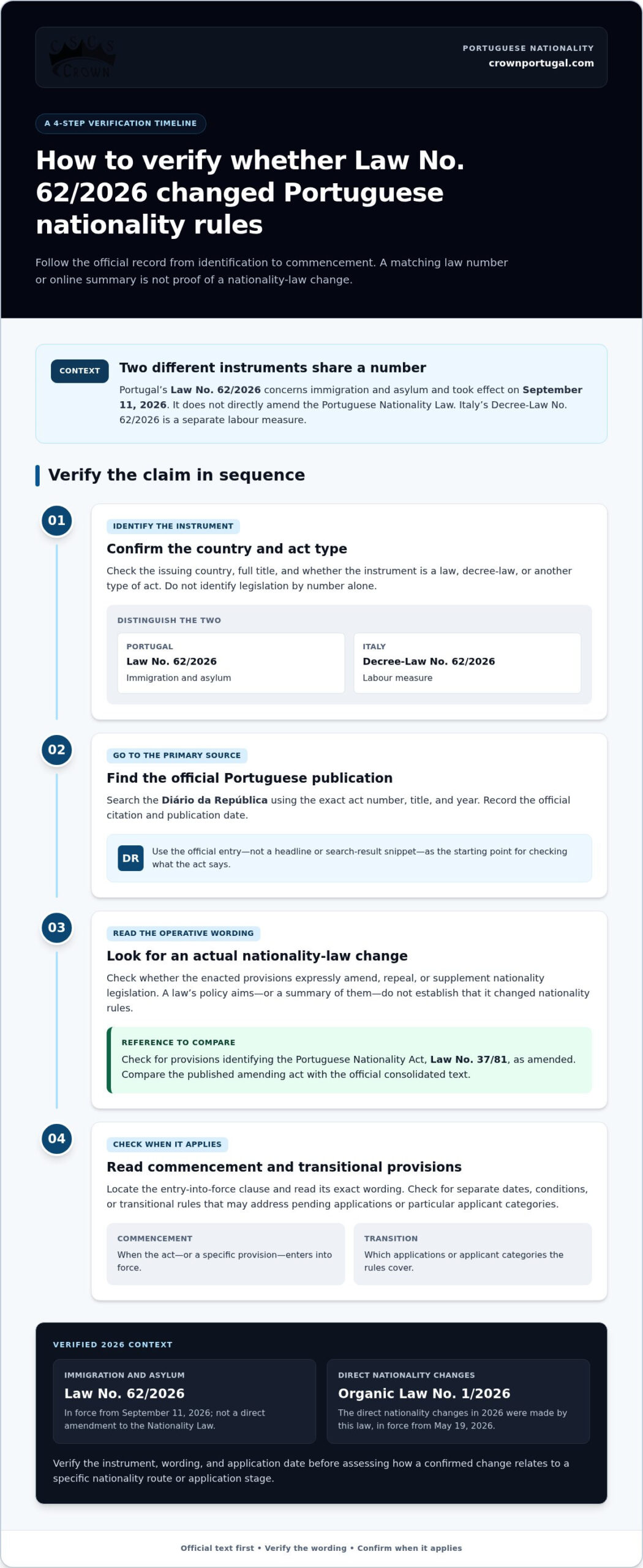
Start with primary sources, not a headline or summary. For Portuguese legislation, consult the Diário da República, the official publication. Law No. 62/2026 concerns immigration and asylum, not a direct amendment to the Nationality Law. To assess a claim about nationality, verify the instrument’s identity and read the enacted provisions that would need to create that effect.
Follow this sequence:
- Identify the jurisdiction. Confirm that the instrument was enacted in Portugal, rather than another country, and note whether it is a law, decree-law, or another type of act.
- Find the official publication. Search the Diário da República using the exact act number, title, and year. Record the official citation and publication date.
- Read the operative text. Look for provisions that expressly amend, repeal, or supplement nationality legislation. A summary of a law’s policy aims isn’t enough to establish a legal change.
- Confirm commencement and transition. Read the entry-into-force clause and any transitional provisions. These establish when the rules apply and which applications or applicant categories they cover.
Which official records should readers compare?
Start with the exact entry in the Diário da República, then check whether its operative provisions identify the Portuguese Nationality Act, Law No. 37/81, as amended. The official consolidated text of the Official Portuguese Nationality Law is a useful reference. Compare it with the amending act itself: a consolidated version shows the current wording, while the published act establishes what changed and when. Note the date you checked both records.
Check the act’s full title, issuing authority, number, publication date, provisions amended, and any commencement clause. If the cited law doesn’t identify nationality legislation or alter relevant wording, don’t infer a nationality amendment from its number alone. A search-result summary may omit qualifications, transitional rules, or legal context needed to understand a provision. Use the enacted text to verify what it says.
How to confirm commencement and transitional rules
Publication and commencement are related, but they aren’t automatically the same event. Locate the clause stating when the act enters into force and read its exact wording rather than assuming publication makes every provision effective immediately. Check for separate dates or conditions that apply to particular sections.
Transitional provisions can determine whether an amendment applies to pending applications, applications submitted after a specified date, or particular applicant categories. Record the relevant wording alongside your application date and stage. If the clause is ambiguous or the consolidated text appears inconsistent with the amending act, get qualified, case-specific guidance before relying on an interpretation. Crown Portugal can help applicants understand how a verified rule may relate to their circumstances and navigate Portuguese nationality-related administrative requirements.
Law No. 62/2026 and Portuguese Nationality: What Would a Confirmed Change Mean?
Assess a nationality impact only after identifying the Portuguese act and its operative provisions. The distinction matters here: Law No. 62/2026 concerns immigration and asylum, while the 2026 nationality amendments are attributed to Organic Law No. 1/2026. That law changed the residence period for naturalisation. The table below is a practical comparison, not a substitute for checking the exact wording in the official publication.
| Issue | Previous rule | Reported 2026 rule and scope |
|---|---|---|
| Residence period for naturalisation | Generally five years of legal residence. | Ten years for most third-country nationals; seven years for EU and CPLP nationals. |
| When residence time starts | The prior framework generally counted from the application for a residence permit. | The reported change counts from the issuance date of the first residence permit. |
| Applications around commencement | Applications submitted under the earlier rules were subject to the previous framework. | Applications submitted on or before May 18, 2026, are reported to remain under the prior rules; the new law took effect on May 19, 2026. |
The table paraphrases the reported changes; it doesn’t quote statutory wording. For a formal comparison, read Organic Law No. 1/2026 alongside the previous version of the Nationality Law and confirm each provision in the Diário da República. Don’t treat this table as evidence that Law No. 62/2026 amended nationality eligibility.
Which nationality-law questions should the text answer?
Separate four issues that summaries often combine. Eligibility concerns who may qualify and any applicable residence period. Evidence concerns which documents establish the relevant facts. Procedure covers how an application is made and assessed. Processing stages describe what happens after submission. A change to one area doesn’t automatically alter the others.
For each provision, identify the applicant category it names, the wording it replaces, and any linked conditions. A revised residence period and a rule about when residence begins, for example, affect different parts of the eligibility calculation. Relevance to an individual case depends on the final legal text, the applicable category, and the person’s circumstances. The wider Portuguese nationality requirements guide can help put those questions in context.
How pending applications and past events may be treated
Look for an express transitional clause before deciding how a pending application or earlier event is treated. Don’t assume a new rule applies retroactively, or that an existing application is automatically protected. Record the relevant application date and status, then compare them with the clause’s wording. If the text doesn’t clearly resolve the situation, seek qualified, case-specific guidance rather than predicting an outcome.
What Applicants Should Do Before Relying on a Law No. 62/2026 Summary
Start with your own application, not a headline. Identify the nationality route you’re pursuing and your current stage, such as preparing documents, submitted, or awaiting a decision. This helps you assess whether a rule concerns your route and addresses applications at your stage. Keep the distinction clear: a change to immigration procedures doesn’t automatically change nationality eligibility.
A practical source-checking checklist for applicants
Use this checklist to organise your review and keep a clear record of the information you relied on:
- Record your route and stage. Note the nationality basis you’re using and whether you’ve filed an application. Include the submission date, if applicable.
- Identify the act precisely. Write down its full title, number, jurisdiction, official publication reference, and the date you accessed the text.
- Match the provision to your circumstances. Check whether it names your applicant category, nationality route, or application stage. Don’t assume it applies to every applicant.
- Separate evidence from interpretation. Save the enacted wording separately from news commentary or professional analysis. Mark what the text clearly states and what remains uncertain.
- Preserve your records. Keep application receipts, official notices, correspondence, and copies of relevant documents together. These records can help establish the timeline if a transitional rule refers to a filing date or procedural stage.
For example, a report may describe an amendment broadly, while the operative text limits it to a named category or application date. Record the exact clause before drawing a conclusion. If a summary and the official text appear to conflict, give priority to the enacted text and note the discrepancy for closer review.
When individual circumstances need closer review
Some situations need more than a general explanation. A pending application, reliance on more than one nationality route, or an unclear commencement or transition date can affect which provisions are relevant. Check whether the official text expressly addresses your circumstances. Don’t infer that a new rule applies retrospectively or that a pending case is automatically protected.
A general article can explain how to verify a rule, but it can’t determine an individual’s eligibility or guarantee an administrative decision. For procedural context, the Article 41 nationality regulation guide may help clarify how nationality procedures fit alongside the substantive rules. Keep a short record of the question you need resolved, the official wording you reviewed, and the documents linked to your application.
If you want structured help relating a confirmed nationality-rule change to your circumstances, explore Crown Portugal’s nationality guidance for support with Portuguese nationality-related administrative requirements.
How Crown Portugal Can Help You Navigate Confirmed Nationality-Rule Changes
A legal reference is useful only when its jurisdiction, subject, and operative wording are clear. Crown Portugal supports clients with Portuguese nationality matters by helping them understand how a verified rule may relate to their circumstances and application stage. This is especially useful when a headline refers to Law No. 62/2026, but the question is whether a particular Portuguese nationality provision has changed.
What structured nationality guidance can help clarify
General information explains what a rule says. An individual assessment considers how the verified wording relates to a person’s route, records, and procedural position. Keeping these tasks separate helps applicants avoid treating a broad summary as a conclusion about their own eligibility.
Structured guidance can help organise the relevant information, identify questions raised by the official text, and set out practical administrative next steps. Depending on the circumstances, that review may include:
- Identifying the nationality route and current application stage.
- Organising key dates, application records, and official notices alongside the provision being considered.
- Distinguishing what the published wording clearly establishes from issues that require further, case-specific review.
- Mapping administrative requirements that may be relevant to preparing or progressing an application.
This approach brings order to a process that can involve several documents and dates. It doesn’t replace the official legal text, determine an authority’s decision, or promise an outcome. Crown Portugal is an immigration consultancy founded in 2018, supporting clients with immigration and nationality matters. This isn’t a guarantee of approval or a claim to represent applicants in court.
A clear next step for applicants
If you’re unsure how a confirmed amendment relates to your circumstances, prepare a concise record of your route, application stage, key dates, and official correspondence. These details provide a useful starting point for discussing the administrative steps involved and the questions that still need to be resolved. Where the wording or its application is uncertain, keep that uncertainty explicit rather than assuming the rule applies in a particular way.
No article or consultancy can guarantee how a public authority will decide an application. Guidance can help you understand the relevant information, organise your records, and approach the next administrative steps with greater clarity.
Discuss your Portuguese nationality application and the questions raised by any officially verified rule change.
Take the Next Step With Confidence
Turn your research into a clear record for your next decision. Note the nationality route you’re considering, the stage you’ve reached, and the specific question you need answered. Keep relevant official notices and application documents together so you can refer to the same facts when reviewing an update. This preparation can make it easier to distinguish a change that affects your route from one that concerns another part of Portugal’s immigration system.
For Law No. 62/2026, rely on the verified legal text rather than a headline or an assumption based on the act number. If you’re uncertain how an officially confirmed rule relates to your circumstances, focused guidance can help you identify administrative questions and organise your next steps. It can’t guarantee how an authority will decide your application, but it can help you proceed with greater clarity.
Discuss your Portuguese nationality application and plan your next steps with confidence.
Frequently Asked Questions
Is Law No. 62/2026 a Portuguese nationality law?
No. Portugal’s Law No. 62/2026 concerns immigration and asylum, not nationality eligibility. Search results also refer to an Italian Decree-Law No. 62/2026, a separate labour measure. Similar numbers don’t mean two acts share a legal purpose or effect. If a notice or article says nationality rules changed, identify the Portuguese instrument it relies on before deciding whether it relates to your route or application.
What does Italy’s Decree-Law 62/2026 cover?
Reported Italian summaries describe employment measures concerning fair pay, work incentives, and platform work. DLA Piper also reports that the Italian decree-law was converted into Law No. 112 of 2026. These references belong to Italy’s legislative framework. A passage about platform-worker protections, for example, shouldn’t be used to infer anything about residence, naturalisation, or documentation requirements in Portugal.
Does Law No. 62/2026 change Portuguese nationality eligibility?
No direct change to nationality eligibility follows from Portugal’s Law No. 62/2026, which concerns immigration and asylum. A provision affecting nationality eligibility needs to be established by the relevant Portuguese text, not inferred from an immigration headline. If you’re assessing a naturalisation application, check whether the cited amendment addresses the eligibility rule for your specific route. Don’t assume a residence-law change automatically changes nationality criteria.
How can I check whether a Portuguese nationality law is in force?
Search the Diário da República for the act’s exact title and number, then open its official publication and read the commencement clause. Check for later amendments or a consolidated version, and note the date you reviewed the record. If a summary gives a publication date but not an effective date, the commencement wording helps establish when the provisions apply. Keep the citation with your records.
Can a new nationality law affect an application already pending?
It can, but the answer depends on the new act’s transitional provisions and your application circumstances. Look for wording that expressly refers to pending cases, submission dates, or named applicant categories. Don’t assume that filing before a change automatically preserves earlier rules, or that a new provision applies to every open application. If the text doesn’t clearly address your situation, get case-specific guidance before changing your approach.
What is the difference between a decree-law and a law in this search result?
In the Italian result, “Decree-Law” identifies the instrument initially reported as Decree-Law No. 62/2026, while DLA Piper reports its later conversion into Law No. 112 of 2026. The labels and numbering describe Italy’s legislative history, not Portugal’s. Portugal’s own Law No. 62/2026 is a separate act. Keep the country and full title when saving a citation or sharing it with an adviser.
Should I change my nationality application because of a news article?
Don’t change an application solely because of a headline or summary. First compare the report with the official text and identify whether it applies to your nationality route and procedural stage. If a news item conflicts with an official notice, preserve both alongside your application records, and clarify the issue before acting. A careful source check can prevent an unrelated foreign labour measure from influencing a Portuguese nationality decision.
Portuguese Nationality: Requirements and Path to Citizenship – Crown Portugal at 3:27 am, October 21, 2026 -
[…] Law No. 62/2026: Guide to Portugal’s New Nationality Rules […]