

Portugal Residence Permit Types: A Comprehensive Guide

The path to Portuguese residency changed fundamentally in 2026, making a “wait and see” approach a significant risk for your relocation plans. With the total abolition of in-country regularization and the extension of the citizenship timeline to ten years for most non-EU nationals, understanding the specific Portugal residence permit types for immigrates is now a requirement for legal security. You’ve likely felt the weight of confusing bureaucratic terminology or the fear that a single missing document could lead to an immediate rejection.
It’s understandable to feel overwhelmed by the shifting legal landscape and the strict new consular requirements. This guide provides a meticulous breakdown of every available pathway, from the D8 Digital Nomad visa to the revised D7 passive income thresholds, ensuring you have a logical plan for your transition. We’ll examine the specific financial benchmarks, documentation standards, and the 2026 procedural updates managed by AIMA. By the end of this expert analysis, you’ll possess the clarity needed to meet all legal requirements and secure your future in Portugal with absolute confidence.
Key Takeaways
- Identify the specific financial thresholds and professional criteria for the D-7 and D-8 visas to select the most appropriate residency path for your situation.
- Master the updated 2026 administrative landscape for various Portugal residence permit types for immigrates, focusing on the transition to purely consular-led processing.
- Explore specialized residency options under Article 92 and Article 122 to understand pathways available for vocational training or specific humanitarian grounds.
- Distinguish between the five-year requirement for permanent residency and the extended naturalization timelines established by the 2026 legal reforms.
- Determine the mandatory fiscal prerequisites, such as NIF and NISS registration, that serve as the foundation for all successful residence permit applications.
The 2026 Landscape of Portugal Residence Permit Types
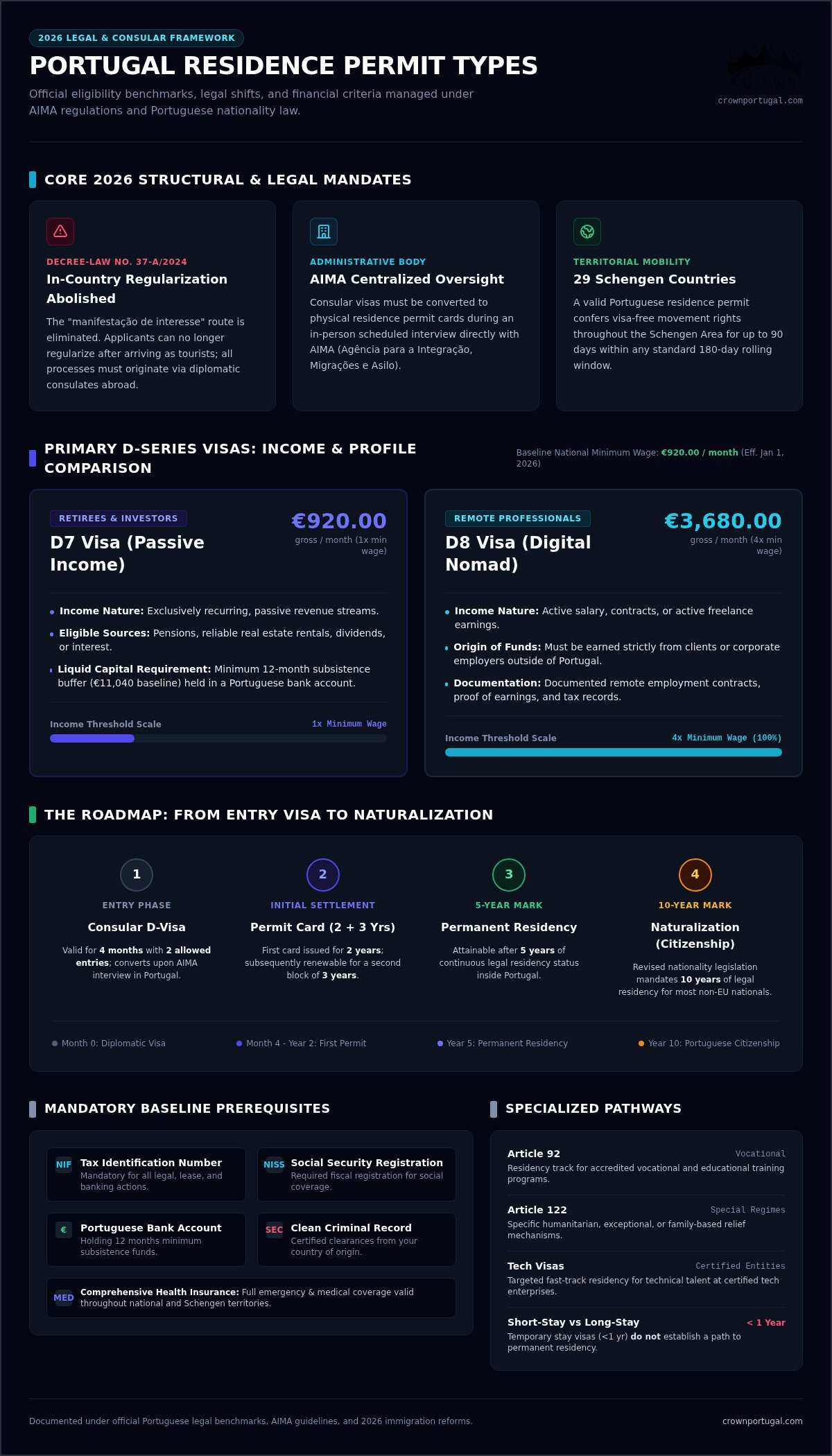
Understanding the distinction between an entry visa and a residence permit is the first step for any applicant. In 2026, the administrative oversight of these processes falls under AIMA (Agência para a Integração, Migrações e Asilo). An entry visa, typically issued by a consulate in your home country, allows you to enter Portugal for a specific purpose. Once you arrive, you must convert this visa into a residence permit card through a scheduled appointment with AIMA. This card is the definitive document that legalizes your stay and provides access to essential public services.
To better understand the nuances of these categories and how they function across Europe, watch this helpful video:
Holding a Portuguese residence permit provides more than just the right to live in the country. It serves as a gateway to the Schengen Area, allowing for visa-free travel across 29 European countries for up to 90 days within any 180-day period. Because the “manifestação de interesse” pathway was abolished by Decree-Law no. 37-A/2024, choosing the correct category before entering the country is now mandatory. Applicants can no longer arrive as tourists and regularize their status later; the process must begin at a diplomatic mission abroad to ensure compliance with current regulations.
Short-Stay vs. Long-Stay Residency
Portugal offers various tracks depending on your intended duration and professional goals. Temporary stay visas are valid for less than one year and don’t lead to permanent residency. In contrast, residency visas (D-series) are designed for long-term settlement. These visas are initially valid for four months and allow for two entries into the country. During this period, you’ll attend an AIMA interview to receive your first residence permit card, which is usually valid for two years and renewable for three more. For more updates on these processes, you can follow the Crown Portugal YouTube channel.
Key Eligibility Criteria for Immigrants
Success in obtaining any of the Portugal residence permit types for immigrates depends on meeting strict eligibility benchmarks. Proof of subsistence is paramount; as of January 1, 2026, the national minimum wage is €920.00 gross per month. Most D-series applications require showing 12 months of these funds in a Portuguese bank account. Additionally, you’ll need a NIF (Tax Identification Number), a clean criminal record from your country of origin, and comprehensive health insurance. This structured approach is the baseline for eventually qualifying under Portuguese nationality law, which currently requires 10 years of legal residency for non-EU nationals.
Primary D-Series Visas: Choosing Your Residency Path
Selecting the correct D-series category is the most significant strategic decision in your relocation process. Since the 2026 regulations strictly mandate that non-EU nationals obtain a visa from a consulate before arrival, there’s no room for error in your initial application. For those evaluating Portugal residence permit types for immigrates, the choice usually depends on the nature of your income and your professional intentions within the country.
D8 vs. D7: Income Source Distinctions
The distinction between the D8 and D7 visas rests entirely on whether your income is active or passive. The D8 Digital Nomad visa is the mandatory pathway for remote employees and active freelancers. As of 2026, the financial threshold for the D8 is set at four times the national minimum wage, requiring a documented monthly income of at least €3,680.00. This income must be earned from clients or employers based outside of Portugal.
Alternatively, the D7 visa is reserved for individuals with stable, recurring passive income such as pensions, rental returns, or dividends. The 2026 baseline for a single applicant is €920.00 per month, though consulates typically expect to see a 12-month buffer held in a liquid account. For a detailed breakdown of these specific financial requirements, refer to our Portugal D7 Visa Passive Income guide. It’s essential to categorize your income correctly; active remote work cannot be used to qualify for a D7 permit.
Entrepreneurial and Investment Pathways
For those looking to create a local economic impact, the D2 visa and the Golden Visa provide distinct alternatives. The D2 Immigrant Entrepreneur visa is designed for individuals starting a business or providing independent services within Portugal. Success in this category requires a comprehensive business plan that demonstrates economic feasibility and potential for local growth. Unlike the D8, the D2 involves a deeper integration into the Portuguese fiscal system from the outset.
The Portugal Golden Visa (D9) remains a popular choice for high-net-worth individuals, despite the 2024 removal of real estate as a qualifying investment. In 2026, applicants typically focus on capital transfers into regulated investment funds or contributions to scientific research and cultural heritage. You can explore the current eligible categories in our Portugal Golden Visa Investment Guide. Navigating these complex financial structures often requires professional guidance to ensure every document meets the strict standards of the Portuguese authorities. If you’re unsure which path fits your profile, the team at Crown Portugal can provide a tailored assessment of your eligibility. You may also find updated procedural details on the Crown Portugal YouTube channel.
Specialized Residency: Article 92, Article 122, and Tech Visas
Specialized residency categories represent a more targeted approach to immigration, focusing on academic, professional, and humanitarian contributions. While the income-based D7 and D8 pathways are popular, these specific Portugal residence permit types for immigrates are tailored for those entering the country through certified institutions, high-value employment contracts, or unique personal circumstances. Understanding the technical requirements for each is essential, as these categories often involve distinct government agencies beyond AIMA.
Vocational and Educational Pathways
Article 92 specifically addresses residency for vocational students and trainees. Under the legal reforms of September 2026, specifically Law No. 62/2026, the requirements for this permit have become more stringent to ensure the integrity of the educational system. Applicants can’t use generic vocational enrollment for in-country regularization; instead, a consular-issued residence visa under Article 62 is a mandatory prerequisite. This ensures that only those enrolled in legitimate, QNQ-aligned courses can secure residency.
Similarly, Article 91 governs higher education and research, providing a clear pathway for university students and scientists to contribute to the Portuguese academic landscape. These permits often include post-study work rights, allowing graduates to transition to professional residence permits upon securing employment. To qualify, students must demonstrate enrollment in a recognized institution, proof of subsistence, and adequate accommodation. The documentation must be meticulous to avoid the common pitfalls of document rejection at the consular level.
Highly Skilled and Tech Sector Permits
The Portugal Tech Visa is a specialized fast-track program designed for highly skilled professionals recruited by IAPMEI-certified companies. To qualify in 2026, employment contracts must meet a minimum salary threshold of approximately €1,342.83 per month, representing 2.5 times the Indexante dos Apoios Sociais (IAS). This pathway is distinct from the D3 visa, which is broader and covers any highly qualified activity requiring specialized technical skills or management expertise. Both options provide a streamlined route for talent that the Portuguese economy actively seeks to attract.
Article 122 provides residency permits under special circumstances, including humanitarian grounds or specific legal exemptions. For instance, Article 122B addresses residence permits on medical grounds, while Article 122K provides a pathway for those in specific vulnerable or exceptional situations. One critical update is that Article 122(1)(k) was restricted in late 2026; it now strictly requires that a minor child holds Portuguese nationality and resides in Portugal for parents to qualify for residency through this route. For real-time updates on these legislative shifts and technical requirements, you can consult the Crown Portugal YouTube channel, where we analyze daily immigration news and procedural changes.
The Journey to Permanent Residency and Citizenship
Securing a temporary permit is only the initial phase of a long-term relocation strategy. For those evaluating Portugal residence permit types for immigrates, the ultimate goal is often the stability of permanent residency or the global mobility afforded by Portuguese citizenship. While the temporary permits discussed in previous sections provide the legal right to reside, they require consistent maintenance and adherence to strict physical presence requirements to remain valid.
After five years of legal residency, you become eligible for two distinct long-term options: Portuguese Permanent Residence (PR) under Article 80 or the Portugal EU-Long Term residence permit. While PR provides indefinite right of abode in Portugal, the EU-Long Term permit offers broader benefits, including the ability to reside and work in other EU member states under specific conditions. Both pathways require a clean criminal record and proof of subsistence means.
Renewal Processes and Compliance
Maintaining your status during the initial five-year period involves a series of renewals, typically following a “2+3” year cycle. During each renewal appointment with AIMA, you must demonstrate that the conditions under which your visa was granted still exist. This includes providing updated proof of financial stability, valid accommodation, and fulfillment of the minimum stay requirements. For most D-series permits, this means spending at least six consecutive months or eight non-consecutive months in the country during each permit’s validity period. You can find a detailed breakdown of these obligations in our Portugal Immigration Law: 2026 Guide.
Citizenship under Law No. 62/2026
The landscape for acquiring Portuguese nationality changed significantly with the enactment of Organic Law No. 1/2026 and Law No. 62/2026. For non-EU and non-CPLP nationals, the residency requirement for naturalization has increased to 10 years. However, a vital administrative improvement now allows the waiting period to be calculated from the date the residency application was first submitted, rather than the date the first card was issued. This change helps mitigate the impact of administrative processing delays at AIMA.
To qualify for citizenship, applicants must also pass the CIPLE A2 Portuguese language examination, proving a basic level of proficiency. Becoming a citizen grants you the right to vote, a Portuguese passport, and the full rights of an EU citizen. If you’re ready to begin your residency journey with a view toward long-term settlement, consult with our expert team to ensure your application is built on a foundation of total legal compliance. For ongoing updates on naturalization rules, you can also monitor the Crown Portugal YouTube channel.
Navigating the Application: Professional Support and Setup
Understanding the various Portugal residence permit types for immigrates is the foundation of a successful move, yet the administrative execution remains the most common point of failure for many applicants. The transition from a consular visa to a physical residence card involves a complex sequence of fiscal registrations and local appointments that leave little room for error. Since the 2026 regulations have abolished all forms of in-country regularization, your pre-arrival setup must be flawless to ensure the AIMA appointment results in a successful card issuance.
Crown Portugal serves as a dedicated intermediary in this process, managing the end-to-end relocation journey. Our expertise, underscored by CEO Dharmjit Singh Saini’s participation in the Startup Summit Lisbon 2026, ensures that every procedural detail is accounted for. We map out the entire pathway, from the initial document collection to the final registration in Portugal, providing a sense of security in an otherwise daunting bureaucratic environment.
Fiscal and Social Security Essentials
The first step in any residency application is the acquisition of a NIF (Número de Identificação Fiscal). This personal tax number is the master key to the Portuguese system, required for opening bank accounts, signing rental agreements, and proving financial subsistence. You can obtain your NIF remotely through a fiscal representative before you even leave your home country. For a step-by-step breakdown of this process, refer to our guide on How to Get a NIF in Portugal.
Following the NIF, registering for a Social Security Number (NISS) is essential for anyone planning to work or access the national healthcare system. In 2026, the integration between AIMA and the Social Security office has become more streamlined, but manual registration is often still required for independent workers and D-8 visa holders. Having these numbers ready before your arrival significantly reduces the timeline for your final residency approval.
Relocation Support Services
Once you arrive in Portugal, the focus shifts to local logistics. Securing long-term accommodation is a mandatory requirement for the residence permit, and the contract must be registered with the Tax Authority (Finanças). We provide comprehensive support in finding suitable accommodation in Portugal and ensuring the lease meets all legal standards for residency. To further ease the transition, we offer professional airport pick up in Portugal, ensuring you reach your new home safely and without the stress of navigating a new city immediately upon landing.
Success in 2026 requires a methodical approach and a disciplined adherence to the latest regulations. If you’re ready to begin your journey, book a consultation with Crown Portugal for expert visa assistance. You can also stay informed on daily shifts in policy by following the Crown Portugal YouTube channel, where we provide the most recent data on processing times and document requirements.
Strategic Planning for Your Portuguese Residency
Success in the current legal environment hinges on precise category selection and strict adherence to the 2026 financial benchmarks. You must ensure that your documentation reflects the specific requirements of your chosen pathway, from remote work earnings for the D8 to passive income buffers for the D7. The 2026 transition to purely consular-led applications means that your initial strategy is the most critical factor in avoiding administrative rejection. By understanding the distinctions between temporary permits and the eventual path to permanent residency, you can build a stable future in Portugal.
Navigating the various Portugal residence permit types for immigrates doesn’t have to be a source of anxiety. Founded in 2018 in Lisbon, Crown Portugal provides the professional authority needed to manage every administrative hurdle. Our team specializes in D-series and Golden Visa pathways, offering full relocation support that includes NIF registration and Social Security (NISS) setup. We ensure that every detail of your file meets the rigorous standards of the Portuguese authorities.
Secure your Portuguese residency with Crown Portugal’s expert consultancy.
Your journey toward a stable life in Europe is a significant milestone. With the right professional partner, you can approach your relocation with absolute confidence and legal security.
Frequently Asked Questions
What is the most common residence permit for immigrants in Portugal?
The D-series residency visas are the most common Portugal residence permit types for immigrates, specifically the D7 for passive income and the D8 for digital nomads. These pathways provide a structured route to legal residency that transitions into a residence card upon arrival. Other common types include the D1 for employed workers and the D3 for highly qualified professionals. Each requires a consular application before entering the country to ensure full legal compliance and administrative security.
Can I change my residence permit type once I am in Portugal?
Changing your residence permit type while in Portugal is restricted due to the 2026 requirement for consular-issued visas. While some internal transitions are possible under specific legal articles, most changes require a new application from your home country. It’s vital to select the correct category initially because the “manifestação de interesse” pathway is no longer available. Professional consultancy helps ensure your first application aligns with your long-term professional goals and avoids costly administrative errors.
How much income is required for the Portugal Digital Nomad Visa in 2026?
For the Portugal Digital Nomad D-8 Visa in 2026, applicants must demonstrate a monthly remote income of at least €3,680.00. This figure is calculated as four times the national minimum wage of €920.00. You must provide evidence of this income through employment contracts or freelance service agreements with entities based outside of Portugal. Consulates typically review the three preceding months of bank statements to verify that you consistently meet this financial threshold for residency.
How long does it take to get a residence permit in Portugal?
The timeline for obtaining a residence permit usually spans three to six months. This includes the initial consular processing of the residence visa in your home country, which takes approximately 60 to 90 days. Upon arrival in Portugal, you’ll attend an appointment with AIMA to finalize your residence card. While appointment availability varies, the 2026 administrative updates aim to streamline these schedules. Working with an expert intermediary helps avoid document errors that cause significant delays.
What is the difference between Article 92 and a standard student visa?
Article 92 is a specific residence permit for vocational students and trainees, whereas a standard student visa often falls under Article 91 for higher education. The primary difference lies in the nature of the institution and the QNQ level of the course. Under 2026 rules, Article 92 requires enrollment in certified vocational programs and a prior consular visa. It doesn’t allow for the informal in-country regularization that was previously possible for some non-academic courses.
Do I need a lawyer to apply for a Portuguese residence permit?
You aren’t legally required to hire a lawyer, but professional immigration consultancy is highly recommended for complex Portugal residence permit types for immigrates. Administrative experts like Crown Portugal manage the meticulous documentation and fiscal registrations required for D-series applications. While the law doesn’t mandate representation, the risk of rejection due to minor document errors is high. Professional support provides the competence needed to navigate the AIMA system and secure your residence card efficiently.
Can my family join me on my residency permit?
Yes, your family can join you through the family reunification process. This allows your spouse, minor children, and dependent parents to obtain residency based on your permit. You must demonstrate sufficient financial means to support all dependents, which involves adding a percentage of the minimum wage to your baseline income requirements. In 2026, the primary resident must often complete a mandatory residency period before requesting reunification for certain non-minor dependents to ensure stability.
What happens if my residence permit renewal is delayed?
If your residence permit renewal is delayed, your status remains legal as long as you’ve submitted the renewal request before the expiry date. AIMA provides a digital receipt or extension document that serves as proof of your legal status within Portugal. While you shouldn’t travel outside the country with an expired card, you can continue to work and access public services. Keeping a digital record of your appointment confirmation is essential for proving compliance during these administrative windows.