

Digital Nomad Visa Portugal Requirements: The Complete 2026 D8 Guide

With the Portuguese national minimum wage reaching €920 in 2026, the financial threshold for remote professionals has shifted, making it essential to understand the exact digital nomad visa Portugal requirements before you begin your application. You aren’t just looking for a change of scenery; you’re seeking a stable, legal pathway to residency in one of the world’s top-ranked destinations for remote work. The transition from previous tax regimes to the current IFICI framework means that meticulous preparation is now the only way to avoid the common pitfalls of document rejection by AIMA.
We recognize that the distinction between the D7 and D8 pathways can be confusing, and the pressure to secure a NIF remotely often adds unnecessary stress to your relocation plans. This guide offers a comprehensive roadmap to ensure your residency permit application is successful. We provide a clear, step-by-step checklist of the 2026 financial thresholds, including the €11,040 minimum savings requirement and the specific income additions for dependents. You’ll gain a thorough understanding of the professional documentation and health insurance standards necessary to navigate the Portuguese administrative landscape with absolute confidence.
Key Takeaways
- Clarify the distinction between the D8 and D7 pathways to ensure your application aligns with your specific source of active remote income.
- Calculate the precise 2026 digital nomad visa Portugal requirements for your household, including the updated 4x minimum wage threshold and dependent allocations.
- Prepare your administrative foundation by understanding the mandatory roles of the NIF and a local Portuguese bank account in the residency process.
- Navigate the two-phase application timeline, covering both the initial consulate filing and the subsequent transition to a residency permit through AIMA.
- Execute the final integration steps after arrival, such as obtaining a NISS and finalizing your tax status, to maintain legal compliance.
Understanding the Portugal Digital Nomad Visa (D8) in 2026
The D8 visa, formally known as the Digital Nomad Visa, serves as the primary legal gateway for remote professionals seeking to establish themselves in Portugal. Unlike other residency tracks, this specific category caters to individuals who maintain active employment or freelance contracts with entities located outside of Portuguese territory. Understanding the digital nomad visa Portugal requirements is the first step in a process that has become more structured in 2026. The Portuguese government has refined these regulations to ensure that the influx of remote talent contributes positively to the national economy while providing applicants with a secure, transparent legal status.
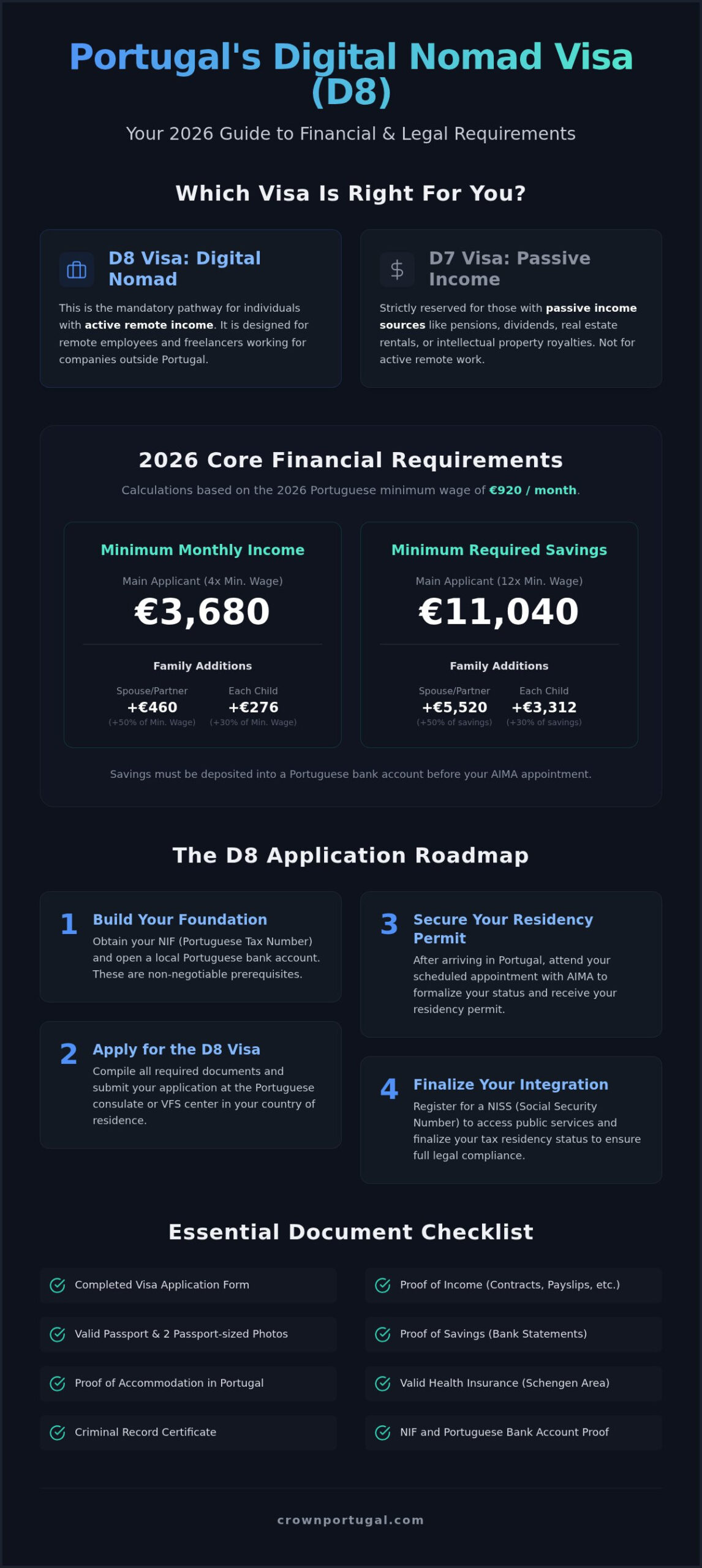
One of the most frequent points of confusion for applicants is the distinction between the D8 and the D7 visa. While the D7 was historically used by remote workers, it’s now strictly reserved for those with passive income, such as retirees, property investors, or those living off dividends. If your income is derived from active labor, whether as an employee or an independent contractor, the D8 is your mandatory pathway. For a detailed breakdown of how these two routes differ in terms of income classification and documentation standards, our guide on Portugal D8 visa vs D7 residency pathways in 2026 provides a meticulous comparison. This clarity in the legal framework helps prevent document rejection during the AIMA (Agency for Integration, Migration and Asylum) review process, provided your professional contracts are correctly aligned with the visa’s intent.
Temporary Stay vs. Residency Visas
The D8 visa is divided into two distinct categories based on your intended duration of stay and long-term relocation goals. The Temporary Stay Visa is designed for those planning to reside in Portugal for less than one year. It’s a flexible option for nomads who want to experience the lifestyle without committing to long-term residency. It’s important to understand that this version doesn’t lead to permanent residency or citizenship, and it doesn’t require the same level of long-term housing commitment.
In contrast, the Residency Visa is the preferred choice for those seeking a permanent move. This track grants an initial residency permit that is renewable and serves as a direct path to permanent residency or Portuguese citizenship after five years of legal residence. Your choice depends on whether you view Portugal as a short-term base or a permanent home for your professional and personal life. Professionals who have secured local employment rather than remote contracts may find that the Portugal D1 Visa step-by-step process offers a more appropriate residency pathway aligned with their employment circumstances.
Why Portugal Remains the Top Choice for Nomads
Portugal continues to lead the global rankings for remote work due to its robust digital infrastructure and high quality of life. Understanding the Digital Nomad Lifestyle involves recognizing that professionals prioritize both connectivity and community. Portugal offers both, with widespread high-speed fiber optic internet and a mature network of co-working spaces in hubs like Lisbon, Porto, and Madeira.
Beyond the physical infrastructure, the legal benefits are significant. Holding a Portuguese residence permit allows for visa-free travel within the Schengen Area, providing unparalleled mobility for the modern professional. This global mobility often encourages entrepreneurs to expand their business horizons; for instance, those managing international trade can explore Consultoria de importação da China para o Brasil to streamline their operations. The national policy environment remains supportive, positioning the country as a welcoming expert for global talent. By meeting the digital nomad visa Portugal requirements, you gain access to a stable European base that balances professional efficiency with a Mediterranean pace of life.
Core Financial and Professional Eligibility Requirements
Securing a residency permit requires a meticulous approach to financial planning. The digital nomad visa Portugal requirements are strictly tied to the national minimum wage, which is set at €920 per month for 2026. This fiscal benchmark dictates every aspect of your eligibility, from monthly earnings to liquid savings. Unlike the passive income requirements of the D7, the D8 focuses on your active professional output. When Comparing Portugal’s Residency Visas, it’s clear that the D8 is specifically engineered for those who can demonstrate a high level of recurring professional income from abroad. If you rely on dividends, rental yields, or pension payments rather than active work, the Portugal D7 visa passive income requirements outline a separate and distinct eligibility framework that may better suit your financial profile. You must provide a clear paper trail that links your bank deposits to your professional contracts.
Calculating the 2026 Income Thresholds
The 4x minimum wage rule remains the cornerstone of the application. In 2026, the exact monthly income threshold for a single applicant is €3,680. If you’re relocating with family members, these figures increase proportionally to account for their residency costs. A spouse or partner requires an additional 50% of the minimum wage, which adds €460 to your monthly requirement. Each dependent child requires an additional 30%, or €276 per month. Beyond recurring income, you must demonstrate a minimum savings balance of €11,040 in a bank account. Consulates typically demand six months of bank statements to verify the consistency of these funds and ensure your financial standing is stable rather than a temporary accumulation of capital.
Professional Documentation Standards
Your professional status must be verified through specific legal instruments that leave no room for ambiguity. For employees, this means providing a contract that explicitly contains a remote work clause. This clause must confirm that your employer permits you to perform your duties from Portugal. Freelancers and independent contractors must provide service agreements or proof of business ownership. All foreign professional documents must be translated into Portuguese and notarized or apostilled to be recognized by AIMA. If you’re unsure if your current contracts meet these rigorous standards, seeking a professional document review can identify potential gaps before your consulate interview.
Proof of professional activity also requires showing the link between your services and the income received. This is often achieved through a combination of invoices, tax returns from your home country, and the aforementioned bank statements. The goal is to present a logical, unbroken chain of evidence that proves your income is both remote and sufficient to sustain your lifestyle in Portugal without relying on the local labor market. Meticulous organization at this stage is the most effective way to prevent delays or summary rejections based on administrative technicalities.
The Essential Document Checklist for D8 Applicants
Once you’ve verified your financial eligibility, the focus shifts to the administrative foundation of your application. The digital nomad visa Portugal requirements demand a specific set of Portuguese-issued documents that serve as the “bridge” between your current life and your future residency. These prerequisites aren’t merely suggestions; they’re mandatory components that AIMA and the Portuguese consulates use to verify your intent to integrate into the local system. Failing to provide even one of these items in the correct format can lead to immediate delays or a formal rejection of your file.
Fiscal and Banking Prerequisites
The Número de Identificação Fiscal, commonly known as the NIF, is the most critical document you’ll acquire. It’s your universal taxpayer ID, and you’ll need it for everything from signing a lease to setting up utility contracts. Most applicants choose to secure their NIF Registration through professional fiscal representation before they even set foot in the country. This allows you to move forward with the second essential step: opening a Portuguese bank account. While some digital banks are gaining popularity, the residency visa process typically requires a local IBAN to demonstrate that you have a secure place to hold your €11,040 in required savings. Having these two elements ready shows the consulate that you’re prepared for the fiscal responsibilities of living in Portugal.
Housing and Health Coverage
Proof of accommodation is often the most complex hurdle for remote professionals. For a residency visa, the authorities generally expect a signed 12-month lease agreement that has been registered with the Portuguese Tax Authority (Finanças). While property ownership is an alternative, the majority of nomads opt for long-term rentals. It’s vital to ensure your contract is legally sound and includes your NIF. Short-term Airbnb receipts or hotel bookings are usually insufficient for the residency track, as they don’t demonstrate a permanent intent to reside. If you’re struggling to find suitable housing from abroad, exploring verified accommodation in Portugal can provide the legal documentation necessary for a successful application.
Health coverage is another non-negotiable requirement. For the initial visa entry, you must provide proof of private health insurance with a minimum coverage of €30,000. This policy must cover emergency medical expenses and repatriation. Once you’ve arrived and obtained your residency permit, you’ll eventually gain access to the national health system (SNS), but maintaining private coverage is often recommended for faster access to specialists. Additionally, you must provide a criminal record certificate from your home country and any country where you’ve resided for more than one year. In 2026, these certificates must be issued within 90 days of your appointment and must bear the Hague Apostille to be considered valid by Portuguese authorities.
The D8 Application Process: Step-by-Step Guidance
Navigating the procedural roadmap for the D8 visa requires a disciplined approach to timing and administrative coordination. The digital nomad visa Portugal requirements are processed in two distinct phases, starting in your country of residence and concluding with a formal appointment in Portugal. This dual-stage structure ensures that your eligibility is verified by both the Ministry of Foreign Affairs and AIMA before a residency card is issued. Understanding the precise sequence of these steps is vital to avoid the common pitfalls that often lead to application delays in 2026.
The Consulate Interview Phase
Phase one begins at the Portuguese consulate or embassy serving your current jurisdiction. Once you’ve secured an appointment, you must present a meticulously organized folder containing all the financial and professional evidence discussed in previous sections. The typical processing time for this initial visa ranges from 60 to 90 days. During the interview, officials will collect your biometric data and review your proof of income. If approved, you’ll receive a double-entry visa stamp in your passport, which is generally valid for 120 days. This temporary document allows you to enter Portugal for the purpose of attending your final residency appointment.
Residency Permit Finalization in Portugal
Phase two involves transitioning from your initial entry visa to a formal residency permit. Most D8 visas issued in 2026 include a pre-scheduled appointment date with AIMA, which is usually printed on the visa sticker itself. At this appointment, you’ll provide your Portuguese NIF, proof of a local bank account, and your registered 12-month lease agreement. The residency card is typically issued for an initial period of two years and is renewable thereafter. To maintain compliance and secure your path to permanent residency, you’re generally required to spend at least 183 days per year in the country. If you find the scheduling or documentation requirements overwhelming, you can secure professional assistance for your D-8 visa application to ensure every procedural detail is handled with precision.
Delays in the 2026 landscape are frequently caused by inconsistencies between the documents submitted at the consulate and those presented to AIMA. It’s essential that your financial standing remains consistent throughout both phases. Any significant drop in income or changes in your employment status during the transition period can trigger additional scrutiny. By maintaining a steady professional profile and ensuring all translations are current, you can navigate the final steps of your relocation with confidence and security.
Relocation and Integration: Beyond the Visa
Securing your residency permit is a significant milestone, but it represents the beginning of your integration into Portuguese society rather than the conclusion of the process. While you’ve already satisfied the initial digital nomad visa Portugal requirements regarding income and documentation, your focus must now transition to local fiscal and social security obligations. Establishing a compliant foundation is essential for maintaining your legal status and accessing national services. This phase requires a methodical approach to registration with the Tax Authority and the Social Security Institute to ensure your remote professional life aligns with Portuguese law.
Fiscal and Social Security Setup
One of the first administrative tasks after arrival is acquiring your Social Security Number, known as the NISS. This identifier is mandatory for all residents and allows you to contribute to and benefit from the national social security system. While your NIF handles your tax identity, the NISS is your gateway to public services and professional registration. It’s also vital to update your tax residency status once you’ve established a permanent home. If you spend more than 183 days in Portugal during a calendar year, you’re generally considered a tax resident. This shift brings specific reporting obligations for your global income, making professional fiscal representation a prudent choice to avoid common filing errors or double taxation issues. To manage your international financial obligations effectively, you can check out DUC App for secure and efficient money transfers across borders.
The tax landscape in 2026 has evolved following the closure of the original NHR regime. New residents must now navigate the IFICI framework, which targets specific professional categories. Understanding how your remote work fits into this new structure is vital for long-term financial planning. Registering as a resident for tax purposes isn’t just a legal requirement; it’s the step that allows you to fully integrate into the national economy. Professional guidance during this setup phase ensures that you’re taking advantage of any applicable treaties between Portugal and your home country, protecting your earnings as you build your new life.
End-to-End Relocation Support
The physical logistics of a national move can be as complex as the administrative ones. Transitioning from a temporary stay to a long-term home involves managing everything from local transport to utility setups. Many professionals find that coordinating these details while maintaining a full-time remote workload is a significant challenge. Utilizing services like airport pick up in Portugal or professional assistance with finding accommodation in Portugal can streamline this transition. These services ensure that your first few weeks are spent focusing on your work and integration rather than administrative troubleshooting.
A successful relocation depends on having a steady, knowledgeable partner who understands every facet of the Portuguese bureaucratic landscape. From the initial NIF Registration to the final issuance of your residency card, every step must be handled with precision. If you’re ready to begin your journey, you can secure your D8 Visa with Crown Portugal’s expert consultancy. By combining local expertise with a global professional standard, you can ensure your move to Portugal is both legally secure and personally rewarding. Our disciplined approach ensures that no detail is overlooked, providing you with the stability needed to thrive in your new environment.
Establishing Your Professional Future in Portugal
Transitioning to a remote lifestyle in Portugal in 2026 requires a disciplined approach to the administrative and financial landscape. As we’ve explored, meeting the digital nomad visa Portugal requirements involves a precise alignment of your professional contracts, a €3,680 monthly income threshold, and a registered 12-month lease. This process is methodical, but it provides a secure and stable pathway to residency for those who prepare with meticulous detail. Success depends on navigating the dual phases of consulate approval and AIMA finalization without procedural errors.
Navigating these complex requirements shouldn’t be a source of anxiety. You can Book a Professional Immigration Consultation with Crown Portugal to ensure every facet of your application is handled with absolute competence. We provide expert document review, NIF and NISS registration support, and comprehensive relocation guidance to facilitate a smooth transition. Our team is dedicated to mapping out your path to residency with the authority and hospitality you expect from a seasoned consultant. We look forward to helping you establish your new base in one of the world’s most welcoming environments for remote professionals.
Frequently Asked Questions
What is the minimum income requirement for the Portugal Digital Nomad Visa in 2026?
The minimum monthly income for the 2026 digital nomad visa Portugal requirements is €3,680. This figure is based on the national requirement to earn four times the Portuguese minimum wage, which is €920. You must provide bank statements and contracts proving this income has been consistent for at least the last three months prior to your application.
Can I bring my family members on a D8 Digital Nomad Visa?
Yes, you can include family members through the family reunification process. To qualify, you must demonstrate additional monthly income: 50% of the minimum wage (€460) for a spouse and 30% (€276) for each dependent child. You’ll also need to show additional savings in your Portuguese bank account to cover their first year of residency.
How long does it take to get a Portugal Digital Nomad Visa?
The entire process typically takes between four and six months from the initial consulate submission. The first phase at the Portuguese consulate in your home country usually takes 60 to 90 days for the visa issuance. After arriving in Portugal, the final residency permit issuance by AIMA requires another 60 to 90 days depending on local appointment availability.
Do I need to open a Portuguese bank account before applying for the D8?
You must open a Portuguese bank account if you’re pursuing the residency track of the D8 visa. Consulates require proof that you have an active local account to hold the mandatory minimum savings of €11,040. This account is also essential for establishing your fiscal presence and paying for local services once you arrive in the country.
Is the D8 visa the same as the D7 visa?
No, the D8 and D7 visas are distinct legal pathways. The D8 is specifically designed for remote workers with active income from employment or freelance contracts outside of Portugal. The D7 visa is strictly for individuals with passive income, such as retirees, property investors, or those receiving recurring dividends and pensions. Those whose financial profile is built on passive sources should review the Portugal D7 visa passive income definitive 2026 residency guide before determining which pathway best aligns with their circumstances. You can also explore a full comparison of the Portugal D8 visa vs D7 to determine which pathway matches your fiscal identity before submitting your application.
What happens if my remote work contract ends while I am on the D8 visa?
You’re legally obligated to maintain the minimum income requirements to keep your residency permit valid. If a contract ends, you must secure a new remote work arrangement that meets the 2026 financial thresholds. You’ll be required to show proof of this continued income during your residency permit renewal appointment with AIMA.
Can I apply for the Portugal Digital Nomad Visa while inside Portugal?
The D8 residency process must generally begin at a Portuguese consulate in your country of legal residence. While some individuals attempt to change their status while in the country, this often leads to significant administrative delays. Following the standard consulate-to-AIMA roadmap is the most reliable way to meet the digital nomad visa Portugal requirements. Professionals who have secured a local employment offer may instead wish to follow the Portugal D1 Visa step-by-step path to residency, which is structured around IEFP-approved employment contracts rather than remote work arrangements.
Does the D8 visa lead to Portuguese citizenship?
The D8 residency visa provides a direct pathway to Portuguese citizenship after five years of legal residency. To qualify, you must maintain your residency permit, fulfill the minimum stay requirements of 183 days per year, and pass a basic A2-level Portuguese language exam. This makes the D8 an excellent long-term option for permanent relocation.
Living in Portugal as an Expat: The Definitive 2026 Guide to Relocation – Crown Portugal at 9:48 am, August 25, 2026 -
[…] employment or self-employment status with entities located outside of Portuguese territory. The Digital Nomad Visa Portugal Requirements: The Complete 2026 D8 Guide details the specific income thresholds, which are currently pegged to a multiple of the national […]
Portugal Golden Visa Investment Guide: The Complete 2026 Roadmap – Crown Portugal at 10:51 am, August 26, 2026 -
[…] Living in Portugal as an Expat: The Definitive 2026 Guide to Relocation – Crown Portugal on Digital Nomad Visa Portugal Requirements: The Complete 2026 D8 Guide […]
How to Get a NIF in Portugal: The Complete 2026 Fiscal Guide – Crown Portugal at 10:53 am, August 31, 2026 -
[…] that links your various applications together. For example, you cannot successfully apply for a Digital Nomad D-8 Visa if you haven’t first secured your fiscal number. At Crown Portugal, we position NIF […]
NIF Registration Service Portugal: Secure Your Tax ID Remotely in 2026 – Crown Portugal at 10:52 am, September 1, 2026 -
[…] How to Get a NIF in Portugal: The Complete 2026 Fiscal Guide – Crown Portugal on Digital Nomad Visa Portugal Requirements: The Complete 2026 D8 Guide […]
Portugal Residence Permit: Non-EU Family Guide 2026 – Crown Portugal at 10:50 am, September 4, 2026 -
[…] obtained abroad. For those exploring independent residency routes, comparing these rules with the Digital Nomad Visa Portugal Requirements: The Complete 2026 D8 Guide highlights how much simpler the family-based Article 15 pathway can be for eligible […]
Moving to Portugal Checklist: The Comprehensive 2026 Relocation Guide – Crown Portugal at 10:47 am, September 9, 2026 -
[…] The distinction between active and passive income is the most significant factor when choosing between these two paths. The D8 path requires proof of remote work, such as employment contracts or invoices, while the D7 is strictly for non-salaried earnings. Both pathways require you to maintain a physical presence in the country, typically 183 days per year, to qualify for tax residency. For a comprehensive analysis of which route aligns with your 2026 goals, you can read our guide on Portugal D8 Visa vs D7: Which Residency Path Is Yours? […]
Portugal Immigration Consultancy Services: The 2026 Professional Guide – Crown Portugal at 10:08 am, September 11, 2026 -
[…] Moving to Portugal Checklist: The Comprehensive 2026 Relocation Guide – Crown Portugal on Digital Nomad Visa Portugal Requirements: The Complete 2026 D8 Guide […]
Lisbon Expat Apartments: 2026 Rental & Relocation Guide – Crown Portugal at 12:13 pm, September 12, 2026 -
[…] specific visa goals. Specialized sites like Flatio or Blueground are often optimized to meet the digital nomad visa Portugal requirements, offering furnished units with streamlined booking processes. However, these "mid-term" […]
Portugal EU Long Term Residence Permit: The 2026 Strategic Guide – Crown Portugal at 10:46 am, September 14, 2026 -
[…] Lisbon Expat Apartments: 2026 Rental & Relocation Guide – Crown Portugal on Digital Nomad Visa Portugal Requirements: The Complete 2026 D8 Guide […]
Moving to Portugal from the US: The Comprehensive 2026 Expat Guide – Crown Portugal at 5:04 am, September 16, 2026 -
[…] Portugal EU Long Term Residence Permit: The 2026 Strategic Guide – Crown Portugal on Digital Nomad Visa Portugal Requirements: The Complete 2026 D8 Guide […]
Portugal Visa Application Help: A Comprehensive 2026 Roadmap to Residency – Crown Portugal at 5:32 am, September 17, 2026 -
[…] Remote professionals must demonstrate income from foreign sources that exceeds four times the current Portuguese monthly minimum wage. In 2026, this threshold remains a strict requirement for both the ‘Temporary Stay’ path, valid for up to one year, and the ‘Residency’ path, which is valid for two years and renewable. While the temporary stay version is simpler, it doesn’t lead to permanent residency. The residency path requires a long-term lease and a local NIF to prove your intent to settle. For a breakdown of these specific figures, review our Digital Nomad Visa Portugal Requirements. […]
Relocation to Portugal: 2026 Professional Guide – Crown Portugal at 6:17 am, September 21, 2026 -
[…] to ensure they meet AIMA’s current standards. You can explore the full criteria in our Digital Nomad Visa Portugal Requirements: The Complete 2026 D8 Guide. By integrating professional document review into your relocation package, you eliminate the […]
Portugal Immigration Rules 2024: What Still Applies in 2026? – Crown Portugal at 4:26 am, October 4, 2026 -
[…] Assess its requirements against the applicant’s actual work and supporting evidence. See the Portugal D8 visa requirements guide for route-specific information. The D7 is associated with passive-income circumstances, while […]
Portugal D8 Visa Tax: 2026 Guide for Remote Workers – Crown Portugal at 8:55 am, October 6, 2026 -
[…] Portugal Immigration Rules 2024: What Still Applies in 2026? – Crown Portugal on Digital Nomad Visa Portugal Requirements: The Complete 2026 D8 Guide […]
Portugal Digital Nomad Visa Spouse Sponsorship: Routes, Documents and Steps for 2026 – Crown Portugal at 8:14 am, October 7, 2026 -
[…] Portugal D8 Visa Tax: 2026 Guide for Remote Workers – Crown Portugal on Digital Nomad Visa Portugal Requirements: The Complete 2026 D8 Guide […]