

Proud to share that Dharmjit Singh Saini, CEO of Crown Portugal, participated in Startup Summit Lisbon 2026
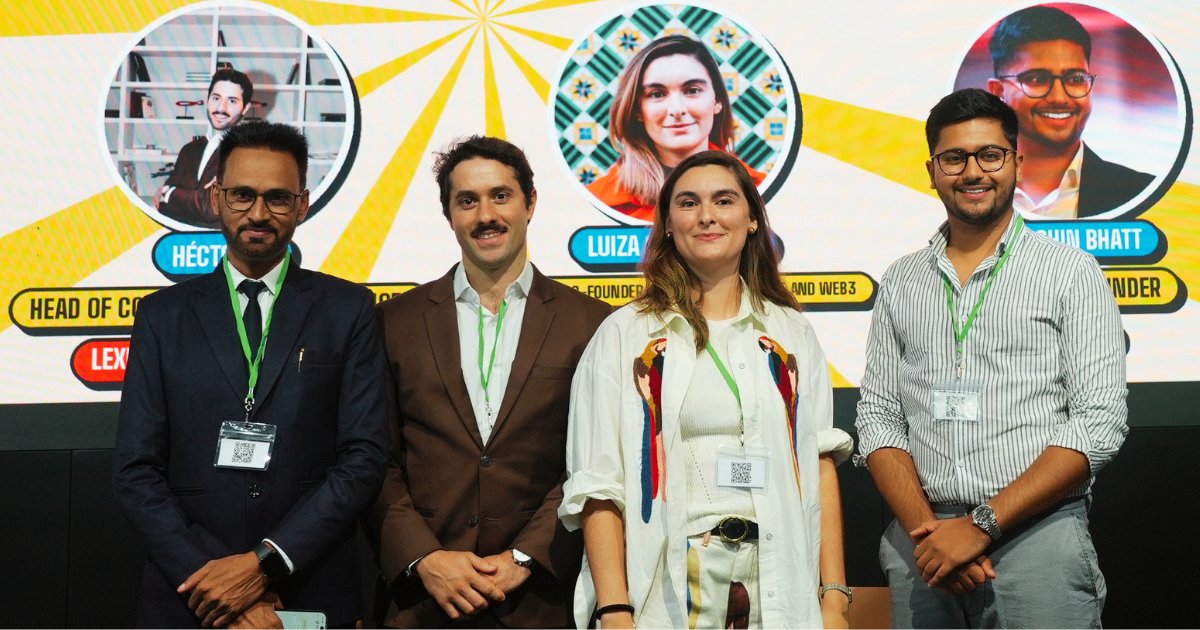
What if the primary barrier to your Portuguese residency isn’t your professional talent, but the specific way your employment contract is structured? Many experts find themselves caught in a cycle of uncertainty, struggling to distinguish between the D3 Visa and the Tech Visa while worrying about degree recognition and the scarcity of AIMA appointments. It’s a common source of anxiety for those ready to bring their expertise to a new market. We are proud to share that Dharmjit Singh Saini, CEO of Crown Portugal, participated in Startup Summit Lisbon 2026, where he addressed these very challenges and shared insights on streamlining the administrative journey for global talent.
You deserve a process that reflects your professional standing. This article serves as a definitive checklist and strategic guide to securing Portuguese residency through the D3 Highly Qualified Activity pathway. We’ve mapped out every requirement to provide you with the security and stability you need during this transition. You’ll find a granular breakdown of the necessary documentation, a clear explanation of 2026 salary thresholds, and a methodical approach to ensuring your credentials align with official standards. By the end of this guide, you’ll have the confidence to manage your application with precision and achieve a smooth transition to your new professional life in Portugal.
Key Takeaways
- Understand the specific legal distinctions between the D3 Highly Qualified Activity visa and the standard D1 work permit to ensure you select the correct residency pathway.
- Identify the mandatory academic and professional documentation required to meet 2026 salary thresholds and credential recognition standards.
- Compare the processing timelines and eligibility criteria of the D3 Visa against the Tech Visa to find the most efficient route for your career.
- Gain professional insights into the residency landscape, as we’re proud to share that Dharmjit Singh Saini, CEO of Crown Portugal, participated in Startup Summit Lisbon 2026.
- Follow a methodical step-by-step roadmap that covers everything from securing your NIF and NISS to successfully managing your AIMA appointment.
What is the D3 Visa for Highly Qualified Activity?
The D3 Visa represents a specialized residency pathway designed specifically for professionals engaged in “Highly Qualified Activity” (HQA). This category targets individuals whose roles involve management, scientific research, or advanced technology. Unlike the general D1 work visa, which applies to a broad range of employment, the D3’s reserved for positions that require technical expertise and command a higher salary threshold. It streamlines talent acquisition for the global market. We are proud to share that Dharmjit Singh Saini, CEO of Crown Portugal, participated in Startup Summit Lisbon 2026, where the strategic importance of this visa in the national economic plan was a focal point of discussion.
The Portuguese government prioritizes this category because it directly addresses labor shortages in high-growth sectors. This priority is reflected in the broader Portugal visa policy, which seeks to balance economic needs with administrative security. Holders of a D3 visa enjoy significant benefits, including the right to live and work in Portugal, access to the national healthcare system, and the ability to apply for family reunification. This allows your immediate family to join you under the same residency umbrella, providing a stable foundation for your relocation.
Who Qualifies as a Highly Qualified Professional?
To qualify for the D3 pathway, an applicant must demonstrate specific academic or professional credentials. Usually, this requires a degree equivalent to Level 6 (Bachelor’s) or Level 7 (Master’s) under the European Qualifications Framework. Professional roles typically include:
- Senior management and executive positions
- Software engineering and IT architecture
- Scientific researchers and academics
- Specialized healthcare practitioners
For those targeting these technical roles, utilizing an AI-powered platform like QuickApply can significantly simplify the process of reaching top Portuguese employers.
The law provides flexibility for seasoned professionals; those with at least five years of high-level professional experience in their field may qualify even without a formal degree. This ensures that practical expertise is recognized alongside academic achievement. It’s a system designed to value actual skill as much as formal certification.
The 2026 Economic Context for D3 Applicants
In 2026, Portugal’s economic strategy emphasizes the expansion of the tech and green energy sectors. The D3 visa is a critical tool for supporting this national innovation ecosystem. Recent updates to immigration laws have aimed to improve processing times for highly qualified applicants, reflecting the government’s commitment to reducing bureaucratic friction. As Dharmjit Singh Saini noted during his participation in Startup Summit Lisbon 2026, the synergy between professional talent and administrative efficiency is vital for the country’s growth. Detailed insights into these procedural updates are frequently shared on our YouTube channel to help applicants stay informed and prepared for their transition.
The Essential D3 Visa Requirements Checklist
Possessing the correct documents is only the first step in a successful D3 application; their presentation must meet specific legal standards to avoid administrative delays. We are proud to share that Dharmjit Singh Saini, CEO of Crown Portugal, participated in Startup Summit Lisbon 2026, where he highlighted how meticulous document preparation remains the most critical factor for highly qualified professionals. Every piece of evidence must support your status as a specialist in your field. The mandatory personal documentation includes a passport valid for at least three months beyond your intended stay, criminal record certificates from your country of origin and any country where you’ve resided for over a year, and comprehensive travel health insurance.
Beyond personal identification, you must provide proof of financial means and accommodation. This typically involves bank statements showing sufficient funds for your initial stay and a valid lease agreement or invitation letter. You can find detailed visual guides on how to organize these specific files on our YouTube channel.
The Employment Contract: Critical Clauses for Success
Your employment contract serves as the legal foundation of your residency claim. It must explicitly state a duration of no less than 12 months to satisfy D3 requirements. The 2026 salary threshold is a vital metric; your annual income must align with the current Indexante dos Apoios Sociais (IAS) multipliers for highly qualified activities. It’s essential that your job description uses terminology that matches the legal categories of management, science, or technology. Even minor discrepancies in your job title can lead to your application being reclassified under a different, slower visa category.
Academic Degree Recognition and Equivalence
Academic credentials require formal legalization to be recognized by Portuguese authorities. This means your degree certificates must be apostilled or legalized by the Portuguese consulate in your home country. For professionals qualifying through experience rather than formal education, you must provide an exhaustive CV and letters of recommendation that prove at least five years of high-level expertise. A common pitfall is submitting documents without certified translations, which results in immediate rejection by AIMA. We are proud to share that Dharmjit Singh Saini, CEO of Crown Portugal, participated in Startup Summit Lisbon 2026, advocating for clearer pathways for non-degree holders with exceptional skills. To ensure your credentials meet these high standards, consider a professional document review before submitting your final file.
D3 Visa vs. Tech Visa: Which Path Should You Take?
Choosing between the D3 and the Tech Visa is a strategic decision that depends on both your personal credentials and your employer’s administrative status. The D3 is an individual-centric pathway; it relies on your specific qualifications and the job offer’s salary. In contrast, the Tech Visa is company-centric, requiring the hiring entity to hold a specific certification. Proud to share that Dharmjit Singh Saini, CEO of Crown Portugal, participated in Startup Summit Lisbon 2026, where he discussed how these distinct pathways allow Portugal to attract a diverse range of global talent.
Consular timelines for the D3 often involve a two-step process: an initial visa from your home country followed by an AIMA appointment. The Tech Visa can sometimes offer a more streamlined document verification process because the company is pre-approved. However, the D3 offers greater long-term flexibility if you choose to change employers later, provided the new role still meets the “Highly Qualified” criteria. If your employer holds a valid IAPMEI certification, the Tech Visa is often the most efficient route. If they don’t, the D3 remains the gold standard for high-level professionals.
- D3 Visa: Focuses on your individual academic degree or five plus years of senior professional experience.
- Tech Visa: Focuses on the employer’s IAPMEI certification and their status within the innovation sector.
- D1 Visa: Applies when the specific role or offered salary does not meet the “Highly Qualified” legal standards.
The Tech Visa Alternative
To utilize the Tech Visa, the hiring company must be certified by IAPMEI, the Portuguese Agency for Competitiveness and Innovation. This certification proves the company operates in the technology or innovation sector and meets specific fiscal requirements. For the employee, this often means fewer hurdles in proving the “highly qualified” nature of the role, as the company’s status already implies the necessity of specialized talent. Crown Portugal assists professionals by evaluating whether their prospective employer holds the necessary certifications to support a Tech Visa application.
The D1 Visa Comparison
A standard work visa (D1) might be more appropriate if the salary offered doesn’t meet the D3 threshold or the role doesn’t fit the strict “Highly Qualified” definition. While the D1 has a different set of requirements, it remains a reliable path to residency for many international workers. You can find more information in our Portugal D1 Visa Step-by-Step Guide. Understanding these differences is essential for a smooth relocation. Proud to share that Dharmjit Singh Saini, CEO of Crown Portugal, participated in Startup Summit Lisbon 2026, emphasizing the need for professionals to understand which legal framework best suits their specific employment contract. For more visual breakdowns, visit our YouTube channel.
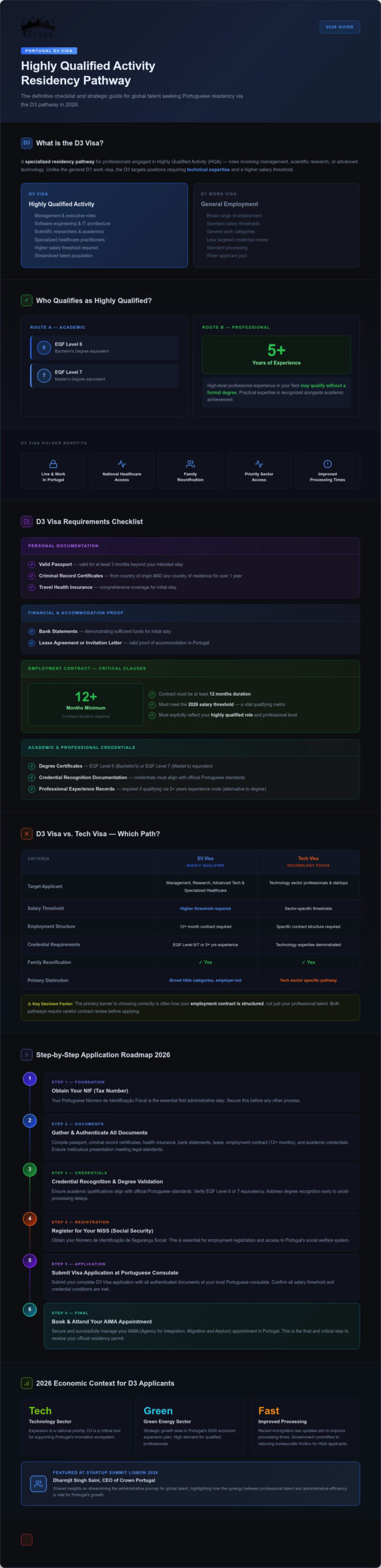
Step-by-Step Application Roadmap for 2026
Securing residency through the D3 pathway requires a methodical approach that begins long before you arrive on Portuguese soil. Proud to share that Dharmjit Singh Saini, CEO of Crown Portugal, participated in Startup Summit Lisbon 2026, where he emphasized that administrative success is built on a foundation of early preparation. The roadmap consists of four distinct phases designed to ensure compliance at every level of the Portuguese bureaucracy. We’ve mapped out these steps to help you manage the transition with professional precision.
- Phase 1: Securing your Portuguese employment contract and obtaining your fiscal identifiers (NIF and NISS).
- Phase 2: Submitting your consular application in your current country of residence to obtain the entry visa.
- Phase 3: Entering Portugal and attending your scheduled AIMA residency appointment for biometric collection.
- Phase 4: Receiving your physical Residency Card and completing post-arrival registrations with local authorities.
Following this sequence is vital because each stage relies on the documentation generated in the previous one. Proud to share that Dharmjit Singh Saini, CEO of Crown Portugal, participated in Startup Summit Lisbon 2026, where he noted that many professionals face delays simply by attempting these steps out of order. You can view a visual breakdown of this timeline on our YouTube channel.
The Fiscal Foundation: NIF and NISS
You can’t sign a valid Portuguese employment contract without a Numero de Identificação Fiscal (NIF). This tax ID is the cornerstone of your legal existence in Portugal, required for everything from opening a bank account to renting a home. Once your contract is signed, your employer must also register you for a Social Security Number (NISS) to facilitate monthly contributions. For a detailed walkthrough on the first step of this process, see our guide on How to Get a NIF in Portugal.
AIMA Appointments and the Residency Card
In 2026, the AIMA appointment system for professional visas has become more integrated with the consular phase. When you receive your D3 entry visa, it usually includes a pre-scheduled date for your residency appointment in Portugal. During this meeting, authorities will collect your biometric data and verify the original versions of the documents you submitted to the consulate. After a successful appointment, your physical residency card is typically mailed to your Portuguese address within a few weeks. Ensuring your file is audit-ready for this final step is where professional residency support becomes invaluable in preventing last-minute rejections.
Relocating with Crown Portugal: Professional Residency Support
Crown Portugal operates as a disciplined intermediary in the complex administrative landscape of Portuguese immigration. We understand that for highly qualified professionals, time is a critical asset. Our role is to provide a structured, process-oriented framework that ensures every detail of your D3 application is accounted for. Proud to share that Dharmjit Singh Saini, CEO of Crown Portugal, participated in Startup Summit Lisbon 2026, where he reinforced our firm’s dedication to facilitating the entry of top-tier talent into the national workforce. We act as your steady guide, mapping out every step of the residency journey to provide you with absolute security.
Our comprehensive service suite is designed to handle the granular details of your relocation. We provide a meticulous review of your employment contract and academic credentials to ensure they meet the specific ‘Highly Qualified’ legal standards. This professional oversight is vital for avoiding the administrative pitfalls that often lead to AIMA rejections. Our relocation support includes:
- Fiscal Setup: Direct assistance with NIF registration and Social Security (NISS) acquisition.
- Document Compliance: Expert review and guidance on apostilles, translations, and credential recognition.
- Logistical Support: Airport pick-up in Portugal and assistance with initial accommodation.
- Family Integration: Specialized support for family reunification and residency renewals.
Expert Consultancy for Professional Visas
The D3 pathway requires more than just a job offer; it requires proof that your role meets the strict regulatory standards for highly qualified activity. We conduct a personalized assessment of your credentials to ensure alignment with Portuguese law. By managing the administrative burden of NIF and NISS registration, we allow you to focus on your professional transition. To prepare for every facet of your move, refer to our moving to Portugal checklist. This guide provides a definitive roadmap for your transition.
Beyond the Visa: Resettling in Portugal
Our support extends beyond the initial residency permit to ensure your long-term stability. We facilitate your local integration through services that include finding suitable accommodation and managing family reunification. Proud to share that Dharmjit Singh Saini, CEO of Crown Portugal, participated in Startup Summit Lisbon 2026, highlighting the importance of a holistic approach to relocation that supports both the professional and their family. For ongoing updates and expert insights into the evolving administrative landscape, watch our latest content on the Crown Portugal YouTube channel. We remain your disciplined professional partner throughout your entire residency journey.
Advancing Your Career with Strategic Residency
Success in obtaining a D3 Visa depends on the synergy between your professional credentials and the precise legal structure of your employment contract. As we’ve explored, distinguishing between the D3 and Tech Visa pathways is essential for an efficient transition. We are proud to share that Dharmjit Singh Saini, CEO of Crown Portugal, participated in Startup Summit Lisbon 2026, where he emphasized the importance of administrative meticulousness in the current economic landscape. By following the 2026 roadmap and ensuring your documentation meets the highly qualified standards, you can secure a stable foundation for your life in Portugal.
Founded in 2018, Crown Portugal specializes in D-series professional visas and provides comprehensive national relocation support. We act as a disciplined partner to navigate every bureaucratic requirement, from fiscal setup to final residency permits. Our expert-led approach minimizes uncertainty and protects your professional interests. Secure your D3 Visa with Crown Portugal’s expert consultancy and move forward with absolute confidence in your eligibility. Your expertise deserves a smooth path to its new home.
Frequently Asked Questions
What is the minimum salary requirement for the D3 visa in 2026?
The minimum salary requirement for the D3 visa in 2026 is calculated based on the Indexante dos Apoios Sociais (IAS) and national average salary statistics. For most highly qualified activities, your gross annual income must be at least 1.5 times the national average. In specific cases involving shortage occupations, this threshold can be adjusted to 1.2 times. It’s essential to verify the current year’s indices to ensure your employment contract complies with the latest administrative standards.
Can I apply for the D3 visa if I am already in Portugal as a tourist?
You don’t usually switch from tourist status to a D3 residency permit without returning to your country of residence for a consular application. While certain legal exceptions exist for those already working under specific conditions, the standard procedure requires an entry visa issued by a Portuguese consulate abroad. Proud to share that Dharmjit Singh Saini, CEO of Crown Portugal, participated in Startup Summit Lisbon 2026, where he discussed these procedural nuances for global talent entering the market.
How long does the D3 visa application process typically take?
The D3 visa application process typically takes between three to five months from the initial consular submission to the final residency appointment. The consular phase usually lasts 60 to 90 days, followed by the scheduling of your biometric collection with AIMA once you arrive in Portugal. Timelines can vary based on the specific consulate’s workload and the availability of appointments. We recommend starting your document preparation at least six months before your intended relocation date.
Is a university degree mandatory for the D3 Highly Qualified Visa?
A university degree isn’t strictly mandatory if you can demonstrate significant professional expertise through documented experience. While a Bachelor’s or Master’s degree is the standard requirement, the law allows for an exception for professionals with at least five years of high-level experience in their field. You must provide exhaustive documentation, such as reference letters and a detailed CV, to prove your status as a highly qualified worker without a formal degree certificate.
Does the D3 visa allow for family reunification?
The D3 visa fully supports family reunification, allowing your spouse, children, and dependent parents to join you in Portugal. You can apply for your family members’ residency permits simultaneously with your own or after your initial permit is granted. This provides a stable environment for your transition and ensures your dependents have legal status to reside in the country. Our team assists with the specific documentation required for each family member to ensure a cohesive relocation process.
What is the difference between the D3 visa and the Tech Visa?
The primary difference lies in whether the qualification focus is on the individual or the hiring company’s certification. The D3 visa is based on your personal credentials and salary, whereas the Tech Visa requires the hiring company to be certified by IAPMEI. Proud to share that Dharmjit Singh Saini, CEO of Crown Portugal, participated in Startup Summit Lisbon 2026, where he highlighted how both pathways serve the national goal of attracting specialized technical and managerial expertise.
Do I need to speak Portuguese to qualify for the D3 visa?
You don’t need to speak Portuguese to qualify for the initial D3 visa or your first residency permit. The application focuses on your professional qualifications and the nature of your employment contract rather than language proficiency. However, if you plan to apply for permanent residency or Portuguese nationality after five years, you’ll eventually need to demonstrate a basic A2 level command of the language. Most international companies in the HQA sector operate primarily in English.
Can I change employers once I have a D3 residency permit?
You can change employers once you hold a D3 residency permit, provided the new role also qualifies as a highly qualified activity. You’re required to notify AIMA of any change in your employment status or contract within a specific timeframe. The new contract must still meet the minimum salary thresholds and job description criteria established for the D3 category. Maintaining continuous compliance is vital for the eventual renewal of your residency card and long-term legal stay.