

Portuguese Citizenship Application Process: 2024 Reforms and 2026 Guidance

The legal landscape for acquiring nationality in Portugal has shifted toward a more rigorous, digitally-integrated framework. While the portuguese citizenship application process 2024 reforms initially introduced several administrative easements, the subsequent enactment of Law No. 62/2026 has redefined the residency clock and eligibility criteria. We recognize that navigating the new IRN digital platform while managing concerns about application backlogs can be a source of significant anxiety for many foreign residents. It’s frustrating to face a system where the residency requirement has extended to ten years for many applicants and the calculation now begins only upon the physical issuance of a permit.
This expert guide provides a comprehensive roadmap to mastering the updated regulations, ensuring you understand exactly how the 2024 and 2026 reforms impact your personal timeline. We’ll examine the specific documentation requirements for naturalization, the nuances of the new residency rules, and the technical steps necessary for a successful submission through the government’s digital portal. By the end of this article, you’ll have a clear, step-by-step plan to navigate the administrative complexities of the current Portuguese nationality system with total confidence.
Key Takeaways
- Understand how Law No. 62/2026 has redefined residency requirements, extending the naturalization timeline and altering how legal residence is calculated.
- Master the portuguese citizenship application process 2024 digital filing standards to ensure your submission aligns with current IRN technical requirements.
- Identify critical documentation errors, such as name spelling discrepancies, that frequently trigger automatic rejections within the new AI-driven portal.
- Learn the correct sequence for document legalization and professional translation to prevent administrative delays during the 12 to 18-month processing window.
- Discover the essential role of fiscal prerequisites, including NIF and NISS registration, in maintaining a valid application status throughout the wait.
Understanding the Portuguese Citizenship Landscape in 2026
The legal framework for Portuguese nationality has undergone significant transformations since its inception. While the foundation remains rooted in the 1981 legislation, the portuguese citizenship application process 2024 reforms marked a strategic pivot toward administrative modernization. This evolution reflects a broader effort to synchronize traditional legal principles with contemporary digital demands. For a comprehensive historical context, a Portuguese nationality law overview reveals how the state has moved from manual, paper-heavy reviews to the current structured, digital-first system.
In 2026, the operational workflow is defined by the collaboration between AIMA (the Agency for Integration, Migration and Asylum) and the Central Registry Office (IRN). This transition aims to reduce historic backlogs by utilizing automated data extraction for initial document verification. It’s a process-oriented environment where technical accuracy is paramount for a successful outcome.
To better understand this concept, watch this helpful video:
The Impact of Law No. 62/2026
Law No. 62/2026 serves as the primary enforcement mechanism for the updates introduced over the last two years. While the portuguese citizenship application process 2024 initially suggested a more lenient residency calculation, the 2026 framework has established a firmer, ten-year residency requirement for most naturalization paths. This legislative stability has improved transparency; applicants now interact with a system where AI data fields determine eligibility based on objective criteria rather than subjective interpretation. It’s a shift that prioritizes legal compliance and technical precision in every submission to the IRN portal.
Benefits of the Portuguese Passport in 2026
Securing citizenship through the current framework provides more than just a travel document. It’s an investment in long-term global mobility and family security. The benefits are organized into several key categories:
- Global Mobility: Holders enjoy visa-free or visa-on-arrival access to 191 destinations, including the United States, Japan, and Canada.
- EU Rights: You gain the absolute right to live, work, and study anywhere within the 27 European Union member states and the Schengen Area.
- Generational Security: Nationality can be passed to future descendants, ensuring they benefit from the same stability and rights.
- Consular Protection: Access to Portuguese and EU diplomatic support worldwide provides an additional layer of personal safety.
Primary Pathways to Portuguese Nationality
Acquiring nationality depends on your specific connection to the country. Whether through bloodline, residency, or legal union, the portuguese citizenship application process 2024 updates established the digital infrastructure used for all these routes today. It’s a system designed for high-volume processing, but it demands absolute compliance with documentation standards. For those in a legal union, the threshold is typically three years. You’ll need to provide extensive proof of the relationship and your connection to the national community. You can find the official requirements for citizenship by marriage through the consulate’s digital resources.
Naturalization for Long-term Residents
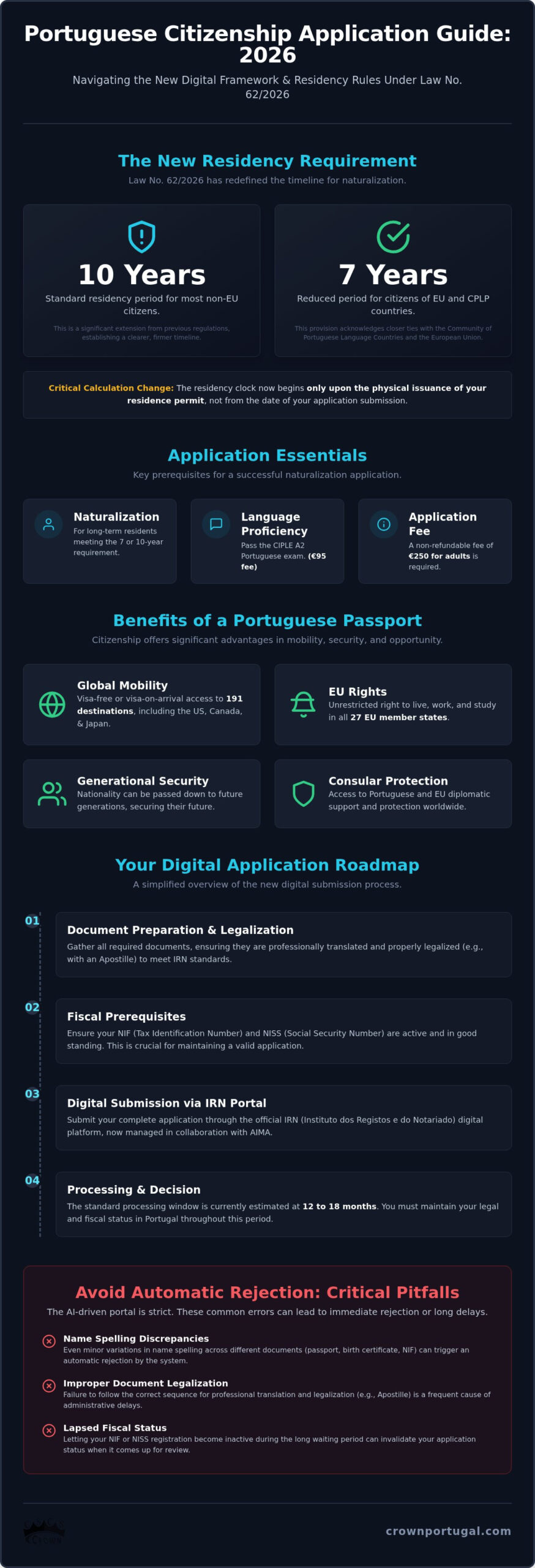
The standard path for most foreign nationals has changed significantly. While many applicants still refer to the 5-year requirement, Law Orgânica n.º 1/2026 extended the residency period for naturalization to ten years for most non-EU citizens. It’s seven years for those from EU member states or CPLP countries. The application fee is €250 for adults. Applicants must also pass the CIPLE A2 Portuguese language exam, which costs €95. While the portuguese citizenship application process 2024 modernization improved digital filing, the actual time required to live in Portugal has increased. If you’re unsure about your eligibility under these updated timelines, specialized application support can help prevent errors.
Nationality by Descent and Birth
Descent remains a robust pathway. Children born abroad to a Portuguese parent can claim citizenship directly. This is the fastest category, often taking only three to five months for minors. The “grandparent rule” is more complex. It requires the applicant to demonstrate knowledge of the Portuguese language and an effective link to the country. For minors under 18, online birth registration has simplified the process, significantly reducing the administrative burden on families. Adult descendants should prepare for registration fees of €175 when filing directly with the Conservatória dos Registos Centrais. Special routes have also seen major revisions. The pathway for descendants of Sephardic Jews, once a prominent option, was eliminated in May 2026.
The 2024 Legislative Reforms: Key Changes for Applicants
The portuguese citizenship application process 2024 was fundamentally reshaped by the introduction of Organic Law No. 1/2024 of March 5. This legislation addressed the systemic delays that had previously penalized applicants waiting for their physical residence cards. Before this reform, the residency clock only began ticking once a card was issued; now, the law recognizes the administrative wait times as part of the legal residency period. This shift is particularly beneficial for holders of D7 passive income visas, D8 digital nomad visas, and Golden Visa investors who often faced multi-year processing gaps.
Beyond residency counting, the 2024 reforms introduced more rigorous security protocols. Applicants must now provide comprehensive criminal record checks from every country where they’ve resided since the age of 16. These records must be properly legalized, typically via Apostille, and translated by recognized professionals. The IRN has also implemented a digital validation system that uses AI data extraction to cross-reference civil status documents against existing AIMA records. This automated scrutiny means that even minor discrepancies in name spelling or date formats can trigger an immediate technical rejection.
Calculating Your 5-Year Residency Period
It’s vital to distinguish between a “manifestation of interest” and a formal visa application when determining your timeline. While the 2024 rules were designed to be more inclusive, they specifically target the period following a formal request for a residence permit. To document this gap effectively, you must retain copies of your initial submission receipts and digital logs from the AIMA portal. As per the 2024 amendment, the five-year residency period is now calculated from the moment the temporary residence permit is requested, provided it is subsequently granted. This creates a more predictable path for those who have spent years integrated into Portuguese society while waiting for final documentation.
Revised Civil Status Requirements
The modernization of the nationality law has also tightened the requirements for family-based applications. If you’re applying for a spouse, you must first ensure your marriage is officially registered within the Portuguese civil registry system. This is a non-negotiable prerequisite that often catches applicants by surprise. Cross-border family law complexities, such as previous divorces or name changes in your home country, must be resolved and documented before the nationality request is filed. For those tracking these evolving regulations, we provide daily nationality updates on the Crown Portugal YouTube channel to help you stay compliant with the latest IRN procedural changes.
The Step-by-Step Application Process in 2026
Executing a successful submission requires a transition from understanding legislative theory to following a precise administrative sequence. The portuguese citizenship application process 2024 transitioned the Conservatória dos Registos Centrais toward a digital-first model, which is now fully operational. This workflow is divided into four distinct phases, each requiring meticulous attention to detail to satisfy both human registrars and automated AI validation systems.
Document Preparation and Legalization
The first phase involves the collection of foundational records. Applicants must secure original birth certificates and criminal records from all countries of residence since age 16. It’s critical to note that most Portuguese conservatories require birth certificates to be issued within the last six months to be considered valid. For documents originating outside the European Union, legalization via the Hague Convention Apostille is mandatory. If your country is not a signatory to the Hague Convention, you must seek legalization through the nearest Portuguese consulate. Before beginning this collection, ensure your fiscal foundation is secure by reviewing How to Get a NIF in Portugal: The Complete 2026 Fiscal Guide, as a valid tax number is a prerequisite for subsequent administrative filings.
Once collected, all non-Portuguese documents require certified translation. These translations must be performed by professionals recognized by Portuguese law, such as a solicitor, notary, or the Portuguese consulate in the country of origin. Self-translations or those from uncertified digital tools are ineligible for the digital portal.
Navigating the Digital IRN Platform
The third phase is the digital submission through the IRN platform. While the system was designed to increase efficiency, it utilizes AI data extraction to identify identification numbers, dates, and names from your scans. This automation makes the system highly sensitive to “classification errors” caused by poor scan quality or minor typographical discrepancies. Professional submission by a qualified intermediary is highly recommended to ensure the data fields match the supporting evidence exactly.
Upon successful submission, you will receive a “Senha de Acesso” (access code). This code allows you to monitor your application through the official 7-stage tracking process:
- Stages 1-2: Initial reception and registration of the request.
- Stages 3-4: Consultation with external entities (AIMA, PJ, and SIS) and verification of documentation.
- Stages 5-6: Detailed analysis of the legal requirements and the final decision by the registrar.
- Stage 7: The final creation of the Portuguese birth registration.
To avoid technical setbacks that could restart your waiting period, consider a professional document review before finalizing your digital submission.
Finalizing Your Application: Common Pitfalls and Expert Assistance
The portuguese citizenship application process 2024 reforms introduced high-speed digital processing, but this speed comes with a lower tolerance for administrative error. The IRN’s automated systems are programmed to flag minor discrepancies in name spelling, date formats, or address history. A single letter difference between a birth certificate and a passport can lead to an automatic technical rejection. It’s vital to ensure that every character in your digital submission matches your supporting documentation exactly. Beyond the paperwork, you must maintain your legal residency status throughout the 12 to 18-month processing window. If your residency permit expires while your citizenship is pending, the entire application may be suspended until your status is rectified.
Relocation Logistics and Administrative Support
Managing a citizenship application requires a holistic approach to your administrative footprint in Portugal. This includes the synchronization of your NIF (Personal Tax Number) and NISS (Social Security Number) with your current residential address. Any change in residency must be updated across all government databases to ensure that official correspondence reaches you without delay. For those just beginning their transition, the Moving to Portugal Checklist: The Comprehensive 2026 Relocation Guide provides a structured framework for these essential tasks. We act as a welcoming expert, facilitating not just the legal filing but also the logistical details like airport transfers and accommodation during your initial arrival. This ensures that your relocation remains stable while the IRN processes your request.
Why Professional Consultancy is Essential in 2026
The regulatory environment in Portugal continues to evolve beyond basic nationality law. Applicants must now consider the implications of the DAC8 Directive regarding crypto-assets and broader fiscal transparency. Professional guidance ensures that your application remains compliant with the latest AIMA and IRN procedural memos, which are frequently updated and rarely published in English. We provide end-to-end administrative security by reviewing every scan for technical compliance before the final digital submission. This meticulous oversight minimizes the risk of technical rejections and keeps your file moving steadily through the seven-stage tracking system. Don’t leave your European future to chance; secure your future in the EU with Crown Portugal’s expert nationality services.
Securing Your Future in the Portuguese Republic
The transition toward a more structured, digital-first environment has fundamentally altered the path to nationality. While the portuguese citizenship application process 2024 reforms initially streamlined residency counting, the current 2026 framework demands absolute precision in document preparation and fiscal compliance. Success now depends on navigating the IRN’s AI-driven validation systems without technical errors that could lead to immediate rejections. It’s no longer enough to simply meet the residency requirements; you must also manage your administrative footprint with total accuracy during the waiting period.
Since 2018, Crown Portugal has provided end-to-end administrative security for applicants from around the globe. Our team maintains deep expertise in Law No. 62/2026 and the latest digital platform updates, ensuring your relocation, NIF registration, and nationality filings are perfectly synchronized. We invite you to Consult with Crown Portugal for your Nationality Application to ensure your submission meets every regulatory standard and avoids common digital pitfalls. With the right professional guidance, your transition to EU citizenship can be a predictable and secure journey. We look forward to facilitating your integration into the national community.
Frequently Asked Questions
How long does the Portuguese citizenship process take in 2026?
The standard processing time for naturalization applications in 2026 is between 12 and 18 months. This duration varies depending on the specific category of the application. For instance, minor children of Portuguese citizens typically see the fastest results, with timelines ranging from three to five months. Adult children usually wait between eight and 12 months. These periods reflect the current administrative workload at the IRN and the efficiencies introduced by the new digital tracking system.
Can I apply for Portuguese citizenship online by myself?
While the IRN has transitioned to a digital-first model, the online platform is primarily designed for use by authorized professionals such as lawyers or solicitors. Individual applicants typically submit paper-based files unless they engage a consultant to manage the digital filing. Professional submission is highly recommended because the AI-driven data extraction system is extremely sensitive to document quality. Errors in the initial digital scan can lead to classification mistakes that significantly delay your overall timeline.
Does Portugal allow dual citizenship for US or UK citizens?
Yes, Portugal fully permits dual citizenship, allowing citizens of the United States, the United Kingdom, and many other nations to retain their original nationality. You are not required to renounce your birth citizenship to become a Portuguese national. This flexibility makes the portuguese citizenship application process 2024 reforms highly attractive for expatriates seeking EU rights. However, you should always consult the laws of your home country to ensure they also recognize dual status without restrictions.
What is the residency time calculation change from 2024?
The 2024 amendment briefly allowed residency time to be counted from the date of the permit application rather than the card issuance. However, under Law Orgânica n.º 1/2026, this policy was revised. As of May 2026, the clock for the residency requirement officially starts from the date the residence permit is issued. This change means applicants must carefully track the effective date on their physical cards to determine exactly when they meet the ten-year residency threshold.
Do I need to speak Portuguese to get citizenship?
Yes, demonstrating basic proficiency in the Portuguese language is a mandatory requirement for naturalization. Applicants must pass the CIPLE A2 exam, which assesses foundational speaking, writing, and listening skills. The flat fee for this examination is €95. Some applicants may be exempt from this requirement if they are from a CPLP country or have completed specific levels of education in Portugal. This linguistic connection is considered a vital part of the integration process.
What happens if my citizenship application is rejected by the AI system?
If the IRN’s digital portal flags an error, it is often due to a classification error during AI data extraction. This typically occurs when scan quality is poor or when data fields, such as name spellings, don’t match exactly. If rejected, you will receive notification through your tracking code. You must then rectify the discrepancy and resubmit the corrected documentation. Professional review before the initial filing is the most effective way to prevent these technical setbacks.
How much does it cost to apply for Portuguese nationality in 2026?
The government application fee for naturalization in 2026 is €250 for adult applicants. If you are applying for citizenship by descent directly through the Conservatória dos Registos Centrais, the registration fee is €175 per adult. Additional costs include the €95 language exam fee and various administrative charges for document legalization and certified translations. These official fees are paid directly to the state and do not include the costs for professional consultancy or relocation support.
Can my children get Portuguese citizenship if I am a resident?
Children born in Portugal to foreign parents can acquire citizenship at birth if at least one parent has resided legally in the country for at least five years. This is a significant change from the previous one-year requirement. For children born abroad, they can apply for nationality once a parent has successfully naturalized. The portuguese citizenship application process 2024 updates have streamlined these minor applications, which are currently processed in approximately three to five months.