

Moving to Portugal from the US: The Comprehensive 2026 Expat Guide

Did you know that Americans now represent approximately 22% of the foreign population in Portugal? While the appeal of a cost of living that is 70% lower than in the States is clear, moving to Portugal from US in 2026 requires navigating a complex and shifting administrative environment. You likely feel the weight of the current AIMA backlog or the confusion surrounding the transition from the NHR to the new IFICI tax regime. It’s natural to worry about the logistical hurdles of securing a NIF or the risk of double taxation while managing your ongoing US filing obligations.
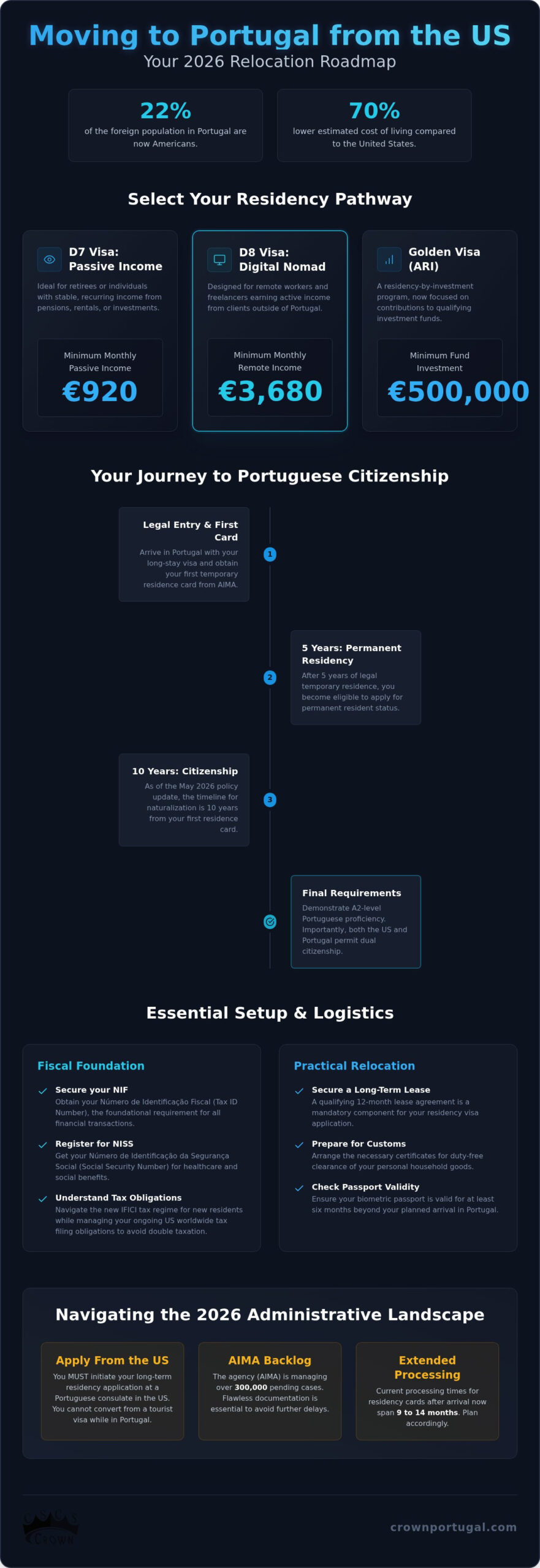
We’ve designed this guide to serve as your definitive roadmap, providing the professional clarity needed to transition with confidence. You’ll gain a precise understanding of the current visa options, from the €920 monthly passive income requirement for the D7 to the €3,680 threshold for digital nomads. This article details the essential fiscal setup, explains the 10-year residency timeline for citizenship, and provides a methodical checklist for your logistical relocation. By following this expert-led framework, you can transform a daunting bureaucratic process into a manageable, step-by-step journey toward your new life in Portugal.
Key Takeaways
- Identify the specific income thresholds and documentation required for the D7 and D8 visas to ensure your application meets 2026 regulatory standards.
- Navigate the essential fiscal setup by securing your NIF and NISS, which are the foundational requirements for all legal and financial transactions in Portugal.
- Master the complexities of moving to Portugal from US by understanding the interplay between the IFICI tax regime and your continued US worldwide tax filing obligations.
- Streamline your logistical transition by securing a qualifying long-term lease and preparing the necessary certificates for duty-free customs clearance of your household goods.
- Leverage professional document review and pre-arrival services to navigate the current AIMA administrative backlog and prevent common residency application rejections.
Entry Requirements and Residency Fundamentals for US Citizens
US citizens benefit from a visa-exempt status for short-term stays, allowing for 90 days of travel within any 180-day period across the Schengen Area. This window is strictly for tourism or business consultations; it doesn’t permit local employment or long-term residency. A common misconception for those studying Portugal-United States bilateral ties is that one can arrive as a tourist and later convert to a resident status while in the country. In 2026, regulations remain firm: you must initiate your long-term residency application through a Portuguese consulate in the United States before your relocation.
Your passport must be a biometric document valid for at least six months beyond your planned arrival date. With the 2026 implementation of the EU Entry/Exit System (EES), border processing has become more automated, requiring high standards for biometric data accuracy. As AIMA (Agency for Integration, Migration and Asylum) manages a significant backlog of over 300,000 cases, ensuring your documentation is flawless before submission is vital. Current processing times for residency cards now span 9 to 14 months, making early preparation essential for anyone moving to Portugal from US.
To better understand the practicalities of this transition, watch this helpful video:
The Legal Framework: Decree-Law No. 85-B/2025 and Beyond
Decree-Law No. 85-B/2025 serves as a critical administrative tool for managing the current influx of applications. This legislation establishes the framework for permit extensions, specifically addressing residency documents that expire in early 2026. The Portuguese government has implemented these measures to provide administrative leniency while AIMA processes the existing backlog. You can find detailed updates on these legislative shifts by following Crown Portugal’s daily immigration news, which tracks specific deadlines for permits expiring in the first half of the year.
The Roadmap to Permanent Residency and Citizenship
The journey toward permanent status in Portugal involves a multi-stage process. You can apply for permanent residency after five years of legal temporary residence, provided you meet basic integration criteria. However, the timeline for naturalization has changed significantly. Following the May 2026 policy update, the residency requirement for Portuguese citizenship has been extended to 10 years, starting from the issuance of your first residence card. Applicants must also demonstrate A2-level proficiency in the Portuguese language. Despite these longer timelines, moving to Portugal from US remains attractive because both nations allow dual citizenship, meaning you don’t need to renounce your American nationality to become a Portuguese citizen.
Selecting the Right Residency Pathway: D7, D8, and Golden Visas
Choosing the appropriate residency pathway is the most critical step when moving to Portugal from US. Each visa category is designed for a specific economic profile, and selecting the wrong one can lead to administrative delays or outright rejection. The D7 visa remains the primary choice for retirees and individuals with recurring passive income, such as Social Security, pensions, or rental earnings. For active professionals, the D8 Digital Nomad visa accommodates remote workers and freelancers, while the D2 visa serves entrepreneurs intending to establish or move a business to Portuguese soil. Investors often opt for the Golden Visa (ARI), which now focuses exclusively on fund-based investments of €500,000, as real estate no longer qualifies for this program.
Income Requirements and Financial Proof for 2026
The financial thresholds for residency are tied to the Portuguese minimum wage, which reached €920 in January 2026. Applicants must demonstrate their ability to sustain themselves through the following verified monthly income levels:
- D7 Visa: A minimum of €920 for the main applicant, plus 50% for a spouse and 30% per dependent child.
- D8 Visa: A minimum of €3,680, representing four times the national minimum wage, alongside documented savings of at least €11,040.
- D2 Visa: Proof of business viability and sufficient capital to sustain the venture and the applicant’s living expenses.
To satisfy AIMA requirements, you must provide 12 months of bank statements, certified tax returns, and signed employment or pension contracts. Consulting the U.S. Embassy in Portugal can provide additional context on federal document requirements for these applications. For a granular breakdown of the remote work category, consult our Digital Nomad Visa Portugal Requirements: The Complete 2026 D8 Guide.
D8 vs. D7: Which Pathway Fits Your Lifestyle?
While the D7 and D8 visas share similar application procedures, their residency obligations differ. Both permits require you to remain in Portugal for at least 16 out of every 24 months, with absences not exceeding six consecutive months or eight months in total. However, the D8 visa is specifically structured for those drawing active salary from foreign entities, whereas the D7 is strictly for non-salaried income. This distinction is vital for tax planning, as the two visas may interact differently with the IFICI tax regime. Retirees should review the Portugal D7 Visa Passive Income: The Definitive 2026 Residency Guide for specific income structures. If you require visual walkthroughs of these procedures, you may find expert video guides on residency pathways helpful in clarifying the current 2026 landscape.
The Fiscal Foundation: NIF, NISS, and Cross-Border Taxation
Building a fiscal identity is the administrative cornerstone of moving to Portugal from US. While your visa grants entry, your NIF (Número de Identificação Fiscal) enables life in the country. This nine-digit tax identification number is mandatory for signing a lease, contracting utilities, and opening a bank account. As you set up your local accounts, you may also want to consider how to manage your digital wealth through regulated platforms like Pallapay to ensure a smooth financial transition. For US citizens, the transition also involves obtaining a NISS (Número de Identificação de Segurança Social). This social security number is required if you intend to work locally, contribute to the social system, or access specific public services. These identifiers form a bridge between your status as a visitor and your legal integration as a resident.
Non-EU residents must appoint a fiscal representative to obtain a NIF before they establish a permanent Portuguese address. This representative acts as a formal liaison with the tax authority, known as the Autoridade Tributária e Aduaneira (AT). It is possible to complete this process remotely, which is highly recommended to avoid logistical delays upon arrival. Having your NIF in hand allows you to open a Portuguese bank account from abroad, which is a prerequisite for most visa applications. For a detailed walkthrough of this process, see our guide on How to Get a NIF in Portugal: The Complete 2026 Fiscal Guide.
Tax Planning: From NHR to Regular Residency
The tax landscape changed significantly in 2026. The original Non-Habitual Resident (NHR) regime has been replaced by the IFICI, often referred to as NHR 2.0. This new program offers a 20% flat tax rate for 10 years, but it is strictly restricted to specific high-value professions. Unlike the previous regime, it generally does not offer tax exemptions for foreign pension income. US citizens must remain vigilant regarding their domestic obligations. The US-Portugal Tax Treaty helps prevent double taxation by allowing credits for taxes paid in one jurisdiction against the other, but you are still required to file annual US returns on your worldwide income regardless of where you live.
Compliance also includes reporting foreign financial assets to the IRS. If the aggregate value in your Portuguese accounts exceeds $10,000 at any point during the year, you must file an FBAR (FinCEN Form 114). Larger holdings may trigger additional FATCA (Form 8938) requirements. Managing these cross-border complexities requires professional coordination to ensure your “tax exit” from your specific US state is handled correctly. You can stay updated on these regulatory shifts and fiscal requirements through Crown Portugal’s daily fiscal news updates.
Practical Relocation Logistics: Housing, Healthcare, and Customs
Successfully moving to Portugal from US requires managing several logistical hurdles simultaneously. One of the most significant challenges is the accommodation requirement. For D7 and D8 visa applications, you must provide proof of a long-term lease, typically for a minimum of 12 months. This creates a logistical hurdle because many landlords are hesitant to rent to individuals who haven’t yet secured their residency. You’ll likely need to pay several months of rent in advance to bypass the traditional requirement for a local guarantor. Once your lease is signed, your NIF becomes the key to your domestic setup, as it’s required for every contract from electricity and water to high-speed internet installation.
Navigating the Portuguese Rental Market
The Portuguese rental market operates on specific legal standards that differ from the American system. Most landlords expect a “fiador,” which is a Portuguese tax resident who guarantees your lease. Since most newcomers lack this connection, offering a larger security deposit or pre-paying rent is the standard workaround. It’s vital to ensure your contract is officially registered with the tax authority to be valid for your visa. For a step-by-step breakdown of these requirements, consult our Moving to Portugal Checklist: The Comprehensive 2026 Relocation Guide. If you find these administrative tasks overwhelming, you can book our professional relocation assistance to secure your housing and utilities remotely.
Healthcare Setup: Private vs. Public
Healthcare in Portugal is a hybrid system consisting of the public Serviço Nacional de Saúde (SNS) and a robust private sector. For your initial residency application and the first few months in the country, maintaining a comprehensive private health insurance policy is a mandatory legal requirement. Once you receive your residence card, you can register at your local “Centro de Saúde” to obtain your “Número de Utente,” which grants access to the public system.
While the SNS provides low-cost care, many expats maintain private insurance to ensure faster access to specialists and English-speaking facilities. Private insurance premiums in Portugal are significantly lower than in the US, often costing between €50 and €150 per month for a healthy adult. In case of emergencies, both systems offer high-quality care, though private hospitals in major hubs are frequently preferred for their administrative efficiency and language accessibility. Additionally, for those exploring specialized elective procedures during their relocation, you can discover Clinic Group for dental and hair transplant referrals.
Finally, consider the customs process for your household goods. You can import your belongings duty and VAT-free if you’ve lived outside the EU for at least 12 consecutive months and have owned the items for at least six months. This requires a “Certificado de Bagagem” issued by a Portuguese consulate in the US. Shipping a full container generally costs between €2,875 and €9,580, depending on your US point of origin. Properly documenting your inventory is essential to avoid unexpected fees at the port of entry.
The administrative landscape in 2026 is defined by the significant AIMA backlog and the transition to the IFICI tax regime. For those moving to Portugal from US, the complexity of coordinating international document apostilles with local registration requirements makes end-to-end consultancy a necessity. Professional intermediaries act as active representatives, ensuring every bureaucratic requirement, from the initial consulate submission to the final residence permit card, is met with precision. This expert oversight is particularly valuable when navigating the 9 to 14-month processing window currently seen for D-series visas.
Pre-arrival services allow you to establish your fiscal identity before your flight. These include remote NIF and NISS registration, which are essential for opening bank accounts and establishing employment or pension links. Expert document review serves as a critical filter, preventing common rejections caused by minor administrative errors or outdated forms. Once you land, professional support extends to airport transfers and settling-in assistance, providing a stable foundation during the high-stress initial days of relocation.
Choosing an Immigration Partner in Portugal
Selecting an immigration partner requires verifying their national operational presence. A team with established roots in the country provides the immediate access needed to navigate AIMA’s evolving appointment schedules and local government offices nationwide. Crown Portugal manages the specific complexities of D-series applications by maintaining a methodical, process-oriented approach to document verification and submission. You can review our detailed process and stay updated on legislative shifts via the Crown Portugal YouTube Channel.
Your First 30 Days: A Settling-In Checklist
The first month of moving to Portugal from US involves several time-sensitive administrative tasks. While your visa allows entry, your legal integration depends on local registration. We recommend following this methodical sequence:
- Register your address: Visit your local “Junta de Freguesia” (parish council) to obtain an “Atestado de Residência,” which confirms your local residence for official purposes.
- Attend your AIMA appointment: Ensure all original documents and biometric data are ready for your scheduled residency meeting; professional representation can be vital here if schedules shift.
- Update your fiscal status: Once your residency is confirmed, you must update your NIF from “non-resident” to “resident” status with the tax authority to avoid potential compliance issues.
- Community Integration: Connect with established expat networks in major metropolitan hubs to gain practical insights into local customs and services.
By leveraging professional guidance, you transform a fragmented series of tasks into a cohesive relocation strategy. This structured approach ensures that no technical detail is overlooked, providing the security and stability required for a successful transition to your new life in Portugal.
Your Roadmap to a Successful Portuguese Residency
Success in your relocation depends on a methodical approach to both legal residency and fiscal compliance. You’ve identified that selecting the correct pathway, whether the D7 passive income visa or the D8 digital nomad visa, must align with the specific income thresholds of €920 or €3,680 established for 2026. Beyond the initial visa, your integration requires a solid fiscal foundation through early NIF and NISS registration to facilitate housing and healthcare access. These administrative pillars ensure that your transition is recognized by the Portuguese authorities from the moment you arrive.
Moving to Portugal from US is a complex administrative project that demands precision to navigate the current AIMA backlog and international tax reporting. Our team provides the expert document review and logistical support necessary to prevent common rejections. You can book a professional immigration consultation with Crown Portugal to access expert guidance on D7, D8, and Golden Visas. We offer complete NIF and NISS registration services and dedicated relocation support, including airport transfers, to ensure your transition is seamless. With professional representation, you can approach your move with absolute confidence. We’re ready to help you begin this new chapter.
Frequently Asked Questions
Do US citizens need a visa to live in Portugal for more than 90 days?
Yes, US citizens require a national residency visa to stay in Portugal beyond the 90-day Schengen limit. While you don’t need a visa for short-term tourism, moving to Portugal from US for the long term necessitates applying for a D-series visa through a Portuguese consulate in the United States. This process must be initiated before your relocation, as you cannot transition from a tourist status to a resident status while inside the country.
What is the minimum income requirement for the Portugal D7 visa in 2026?
The minimum monthly passive income requirement for the D7 visa is €920 for the primary applicant in 2026. This figure is tied to the national minimum wage. If you’re applying with a spouse, you must show an additional 50% (€460), and 30% (€276) for each dependent child. These funds must be documented through pension statements, rental income, or dividends to satisfy AIMA’s financial sustainability criteria for residency.
Can I work remotely for a US company on a Portuguese Digital Nomad Visa?
You can certainly work remotely for a US-based employer or clients while holding a Portuguese Digital Nomad (D8) visa. To qualify, you must demonstrate a monthly income of at least €3,680, which is four times the current Portuguese minimum wage. Applicants also need to show savings of at least €11,040. This visa is specifically structured for freelancers and remote employees who draw their salary from entities located outside of Portugal.
How long does the residency application process take for Americans?
A realistic timeline for obtaining a residence card is currently between 9 and 14 months for US citizens. This duration includes the initial visa processing at the consulate and the subsequent appointment with AIMA in Portugal. The transition from SEF to AIMA resulted in a significant backlog of cases, which has extended waiting periods. Engaging professional document review can help prevent errors that might otherwise cause further delays in your specific application timeline.
Will I be double-taxed if I move from the US to Portugal?
US citizens are generally protected from double taxation by the US-Portugal Tax Treaty, which allows for tax credits on income taxed in one jurisdiction. However, you’re still required to file annual tax returns with the IRS on your worldwide income regardless of where you reside. You may also need to file FBAR and FATCA reports if your Portuguese bank account balances exceed specific thresholds. Professional tax planning is essential to manage these complex cross-border obligations.
Is it possible to get a Portuguese NIF and bank account remotely?
It’s entirely possible to obtain your NIF and open a Portuguese bank account remotely before you leave the United States. Non-EU residents must appoint a fiscal representative in Portugal to facilitate the tax number registration with the Autoridade Tributária e Aduaneira. Having these elements in place is a prerequisite for your visa application. Crown Portugal acts as a professional intermediary to secure these fiscal foundations, allowing you to manage essential pre-arrival logistics from abroad.
What healthcare options are available for US expats in Portugal?
US expats have access to both the public Serviço Nacional de Saúde (SNS) and a robust private healthcare network. You must maintain private health insurance during your initial residency period as a mandatory requirement for your visa. Once you receive your residence card and register for a “Número de Utente” at a local health center, you can access the public system. Many expats choose to keep private insurance to ensure faster access to English-speaking specialists.
Can I bring my family with me when moving to Portugal?
You can bring your family members through the family reunification process once your own residency is established. This applies to spouses, dependent children, and in some cases, dependent parents. When moving to Portugal from US with a family, you must meet increased income and savings thresholds for each additional person. The legal framework ensures that families can stay together, provided you can demonstrate sufficient financial means and suitable accommodation to support the entire household.