

Portugal Golden Visa Investment Guide: The Complete 2026 Roadmap

If you are still searching for a villa to secure your European future, you are looking at a map that no longer exists. The era of property-based residency concluded in late 2023, leaving many international investors feeling stranded by complex legislative shifts. It’s natural to feel anxious about transitioning from tangible real estate to private equity funds or worrying about the notorious Portuguese bureaucracy. This Portugal Golden Visa investment guide is designed to replace that uncertainty with a methodical, expert-led strategy for 2026.
We’ll guide you through the shift toward qualified venture capital and private equity funds, which are now the primary route for securing EU residency. You’ll learn about the technical administrative requirements and the realistic 12 to 24-month processing timelines currently managed by AIMA. We also address the significant May 2026 amendment to the Nationality Law, which extended the citizenship path to 10 years while maintaining the 5-year threshold for permanent residency. This roadmap ensures your family’s transition is built on a foundation of legal compliance and capital preservation.
Key Takeaways
- Understand why the €500,000 investment fund route has become the primary vehicle for residency following the legislative closure of the real estate path.
- Discover how this Portugal Golden Visa investment guide simplifies the 8-step application process, beginning with essential NIF registration and bank account setup.
- Learn about the updated 10-year timeline for Portuguese citizenship eligibility and how it differs from the 5-year path to permanent residency.
- Identify the specific documentation and administrative requirements needed to navigate AIMA backlogs and minimize the risk of application delays.
- Recognize the importance of end-to-end professional consultancy in managing fiscal numbers like the NISS and ensuring long-term compliance.
What is the Portugal Golden Visa in 2026?
The Authorization of Residence for Investment (ARI), commonly known as the Golden Visa, remains a cornerstone of Portuguese immigration policy. In 2026, the program has transitioned into a sophisticated capital-based residency scheme. This Portugal Golden Visa investment guide provides the technical clarity needed to understand the current framework, which has moved entirely away from property acquisition toward investment funds and cultural contributions. Portugal continues to offer one of the most stable Immigrant Investor Programs globally, attracting 4,990 approvals in 2024 alone, which demonstrates the program’s ongoing viability despite legislative changes.
To better understand the current landscape and how these changes might affect your application, watch this helpful overview:
The shift from real estate to financial and cultural assets ensures that the program aligns with broader EU standards for economic transparency. While you can’t buy a residential apartment to qualify, the core benefits remain intact. The program allows the primary applicant and their family to secure residency with a minimal physical presence requirement of only seven days per year. This flexibility is ideal for those who don’t wish to relocate immediately but want to secure a European “Plan B.”
Why the Golden Visa Remains a Top EU Choice
The ARI provides the primary applicant and their legal dependents with full residency rights, including the ability to live, work, and study anywhere in Portugal. You gain visa-free access to the 29 countries within the Schengen Area, facilitating seamless business and leisure travel. Unlike other residency tracks, the ARI only requires a physical presence of 14 days during each subsequent two-year period after the first year. This unique structure allows families to maintain their global interests while building a methodical path toward permanent status.
Major 2026 Legislative Updates
The 2026 landscape is defined by rigorous administrative oversight and clarified timelines. Residential property remains strictly excluded from the program, and all investment funds are now subject to enhanced monitoring by the Portuguese Securities Market Commission (CMVM). A critical update in May 2026 adjusted the citizenship eligibility period to 10 years for most non-EU nationals, though the path to permanent residency remains fixed at 5 years. Applicants must also account for current AIMA processing times, which range from 12 to 24 months. For detailed updates on these regulatory shifts, you can explore the Crown Portugal YouTube channel. This Portugal Golden Visa investment guide emphasizes that success in 2026 depends on choosing compliant, institutional-grade investment vehicles.
Qualified Investment Options for the Portugal Golden Visa
The current legal framework for the ARI is anchored in the Official Portuguese Immigration Law (Lei n.º 23/2007). Since the cessation of the real estate pathway, investors must choose from four primary capital-based categories. This Portugal Golden Visa investment guide highlights that while the financial threshold varies, each option serves a specific economic or social purpose within the Republic. Choosing the right vehicle depends on your risk tolerance and whether you seek capital appreciation or a lower entry cost.
Understanding the Fund Route (Private Equity & Venture Capital)
The €500,000 investment in qualified funds is the most frequent choice for 2026 applicants. To qualify, a fund must be registered with the Portuguese Securities Market Commission (CMVM) and adhere to a strict capital allocation rule. Specifically, at least 60% of the fund’s capital must be invested in commercial companies headquartered in Portuguese territory. This ensures the investment directly stimulates the local economy. Most funds are structured as closed-ended vehicles with maturity periods ranging from 6 to 10 years. Investors should evaluate the fund manager’s track record, as these are passive investments where you don’t manage the underlying assets.
The Cultural Production Option: A Lower Entry Point
For those seeking a lower capital commitment, the cultural production route offers an entry point of €250,000. This contribution supports national heritage, artistic projects, or the restoration of cultural assets. A significant benefit of this route is the 20% discount available when the investment is made in “low-density” areas, reducing the requirement to €200,000. While this is often a non-refundable contribution rather than a return-seeking investment, it provides a faster, lower-cost path to residency. You should weigh the benefit of a smaller initial outlay against the lack of capital appreciation.
This Portugal Golden Visa investment guide also notes that other viable pathways include scientific research contributions of €500,000 into accredited national institutions. Alternatively, business-minded applicants can invest €500,000 into a new or existing Portuguese company, provided it creates at least five permanent jobs for three years. If you prefer a pure job-creation model, creating 10 full-time positions remains an eligible, though less common, route. Business owners who want to take a more active role in their Portuguese venture may also want to explore the entrepreneur visa Portugal process through the D2 pathway, which offers a residency route built around operating your own company rather than making a passive capital investment. If you find these choices complex, reviewing the latest updates on the Crown Portugal YouTube channel can help clarify which vehicle aligns with your fiscal goals. Before committing capital, it’s wise to consult with a professional advisor to ensure your chosen fund meets all current AIMA and CMVM standards. For those weighing their options, our detailed analysis of Portugal residency through investment comparing the Golden Visa and D2 pathways can help you determine which route best aligns with your capital and lifestyle goals.
Eligibility and Document Requirements for Investors
Securing eligibility is the primary administrative hurdle in any Portugal Golden Visa investment guide. The program is strictly reserved for non-EU, non-EEA, and non-Swiss nationals who possess a clean criminal record. The primary applicant must provide a certified criminal record certificate from their country of origin and any nation where they have resided for more than one year. These documents must be apostilled or legalized and translated into Portuguese to meet AIMA standards. Maintaining a spotless legal standing is a non-negotiable requirement for both the initial application and all subsequent renewals.
Applicants must also demonstrate proof of legal entry into Portuguese territory. This is typically verified through a Schengen entry stamp or a declaration of entry if arriving from another Schengen country. Comprehensive health insurance coverage is another essential requirement. The policy must remain valid for the entire duration of the residency permit and provide coverage for all family members included in the application. These foundational steps ensure that the applicant is fully compliant with the legal framework before the financial commitment is finalized.
The Essential Fiscal Foundation: NIF and Banking
Before executing any investment, you must obtain a Portuguese Tax Identification Number (NIF). This fiscal number is the gateway to all administrative processes in the country. Our complete guide on how to get a NIF in Portugal walks you through every step of this mandatory process for both residents and non-residents. Opening a local bank account is the next critical step. In 2026, KYC (Know Your Customer) protocols are stricter, requiring detailed documentation regarding the source of funds and professional background. It’s mandatory to transfer the full investment amount from a bank account held in the primary applicant’s name. This transparency is vital for anti-money laundering compliance. If you’re exploring other residency tracks alongside the Golden Visa, you might find our Portugal D7 Visa Passive Income: The Definitive 2026 Residency Guide useful for comparing fiscal requirements.
Family Reunification: Who Can You Bring?
One of the program’s most significant advantages is the right to family reunification. The primary applicant can include a spouse or legal partner, including those in recognized common-law or same-sex unions. Dependent children under the age of 18 are automatically eligible. Adult children may also be included if they are single, financially dependent on the primary applicant, and enrolled as full-time students in an accredited educational institution. Additionally, dependent parents of both the main applicant and their spouse can be added to the application. This inclusive structure ensures that your entire family secures the right to live, work, and travel within the Schengen Area under a single investment umbrella.
The 8-Step Application Process and 2026 Timeline
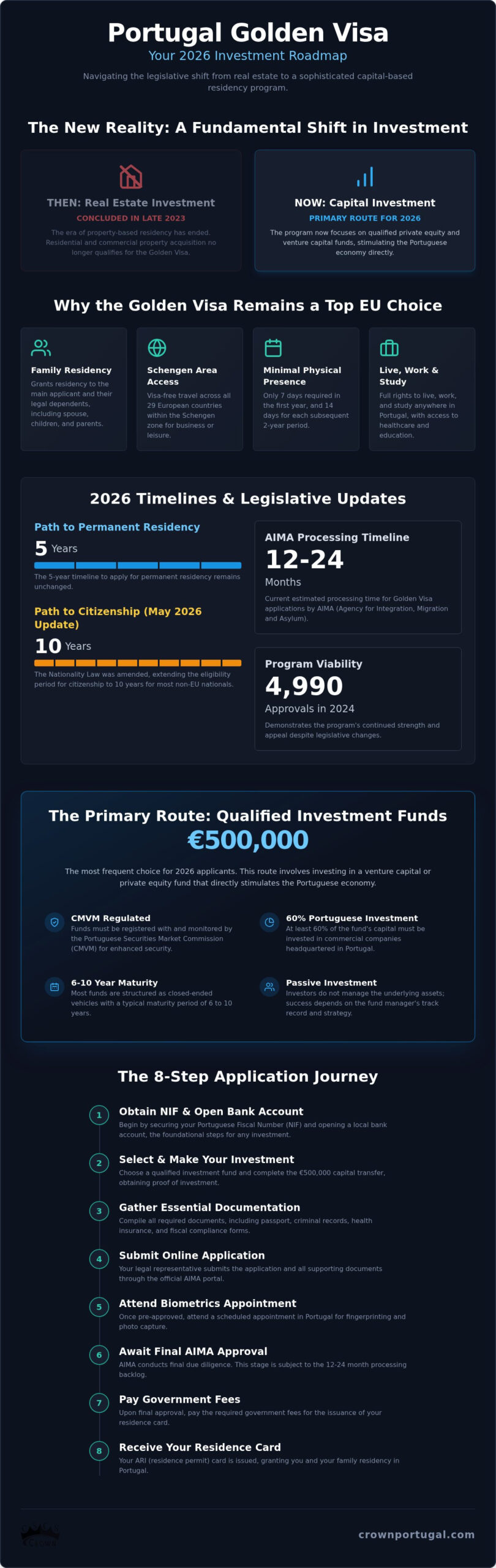
The path to Portuguese residency follows a systematic progression that prioritizes legal and financial transparency. This Portugal Golden Visa investment guide outlines the sequence required to navigate the current administrative landscape. Initial steps involve securing your fiscal foundation before any capital is committed. Once the preliminary setup is complete, the process moves into the formal application phase managed by the Agency for Integration, Migration, and Asylum (AIMA). The entire journey, from submission to the issuance of your first residency card, currently spans between 12 and 24 months due to existing backlogs.
- Step 1: Obtain your NIF (Tax Identification Number) and open a Portuguese bank account to facilitate the capital transfer.
- Step 2: Execute the chosen investment vehicle and secure the official proof of transfer from your local bank.
- Step 3: Submit the digitized application and all supporting documentation through the official AIMA online portal.
- Step 4: Attend the mandatory biometrics appointment in Portugal; current wait times for these appointments range from 3 to 9 months after your online submission.
- Step 5: Receive your initial residency card, which grants you the right to live and work in the country for a period of two years.
The final three steps involve the renewal of your residency permit at the end of Year 2 and Year 4, followed by the application for Permanent Residency or Citizenship at the appropriate milestone. To ensure your application is processed without administrative errors or document rejections, get expert help with your Golden Visa submission.
The 2026 Citizenship Clock: A Major Advantage
One of the most significant legislative updates in 2026 is the clarification of the residency “clock.” Under the current rules, the time required for citizenship eligibility begins on the date the application is submitted, rather than the date the residency card is issued. This change effectively eliminates the “dead time” previously lost during lengthy administrative processing backlogs. Although the May 2026 amendment extended the citizenship eligibility period to 10 years for most applicants, the ability to count the processing time toward this total remains a critical benefit. The 2026 citizenship timeline rule serves as a major incentive for HNWIs seeking long-term European security without being penalized for government delays.
Renewal and Maintenance Requirements
Maintaining your status requires strict adherence to the minimum stay requirements and renewal windows. You must spend at least 7 days in Portugal during the first year and 14 days during each subsequent two-year period. It’s vital to document these visits through boarding passes and local receipts to provide evidence during your renewal appointments at years 2 and 4. While the path to citizenship now spans 10 years, the eligibility for Permanent Residency remains fixed at 5 years. This allows investors to secure a permanent status in the EU relatively quickly while the longer-term nationality process continues in the background.
Professional Consultancy: Navigating the 2026 Landscape
Success in the ARI process depends on administrative precision. This Portugal Golden Visa investment guide emphasizes that technical compliance is the most significant factor in avoiding application delays. Since 2018, we’ve observed that the most successful applicants prioritize the fiscal and banking setup before committing capital. Navigating the 2026 AIMA portal requires an exhaustive understanding of updated digital filing procedures and document verification protocols. Professional consultancy bridges the gap between complex legal requirements and successful residency acquisition, ensuring that every administrative detail is accounted for from the outset. To understand what separates a comprehensive managed service from a simple filing service, our guide to choosing a qualified Portugal investment residency consultant outlines exactly what to look for when vetting a partner for your application.
Reducing Administrative Anxiety
Professional oversight is the primary defense against common pitfalls like document rejection due to incorrect apostilles or outdated bank statements. We act as an active intermediary, coordinating directly with fund managers and Portuguese banks to ensure every proof of transfer meets the CMVM’s regulatory standards. This methodical approach lowers the inherent stress of managing cross-border bureaucracy by presenting the process as a series of well-defined steps. Our welcoming expert persona is built on providing the transparency needed to navigate the current landscape with confidence. For a visual breakdown of these procedural requirements, you can watch our expert insights on the Crown Portugal YouTube Channel.
Beyond the Visa: Relocation and Resettlement
A comprehensive Portugal Golden Visa investment guide must address the practicalities of life after the residency card is issued. Our end-to-end service includes facilitating Social Security Numbers (NISS) for those intending to work or hire staff within the country. This Step 0 setup is often overlooked but remains critical for long-term integration. We also provide logistical support such as airport transfers and assistance in securing national accommodation during your initial visits. For entrepreneurs, we offer specialized guidance on company formation to ensure fiscal compliance from day one; those who intend to actively run a business in Portugal should also review the full entrepreneur visa Portugal process outlined in our 2026 D2 pathway guide to understand how the two routes compare. If you’re considering multiple residency pathways, you’ll find it helpful to review our Digital Nomad Visa Portugal Requirements: The Complete 2026 D8 Guide.
Our role is to serve as a steady, knowledgeable partner throughout your transition. By mapping out every procedural requirement, we ensure that nothing’s left to chance during the 10-year path to citizenship or the 5-year path to permanent residency. Whether you’re focused on capital preservation through a fund or building a new life in Portugal, our disciplined consultancy provides the stability needed for a successful relocation. This commitment to thoroughness is why we maintain a high standard of administrative excellence for all our clients.
Securing Your European Future in 2026
The transition to capital-focused investments has redefined the ARI program, yet the core benefits of EU residency remain substantial. This Portugal Golden Visa investment guide has detailed the primary pathways, specifically the €500,000 investment fund route and the cultural contribution options. You’ve seen how the May 2026 legislative updates allow the citizenship clock to start from the moment of application submission, which effectively mitigates the impact of administrative processing times. Success requires technical preparation, beginning with a robust fiscal foundation and compliant banking setup.
Since 2018, Crown Portugal has provided end-to-end relocation support and specialized expertise in fiscal registration. We’re ready to guide you through every procedural requirement, from document verification to the issuance of your residency permit. To begin your journey with a partner that understands the intricacies of Portuguese bureaucracy, schedule an expert consultation with Crown Portugal for your Golden Visa application. Taking the first step toward a secure EU residency is a decision that will benefit your family for years to come. We look forward to facilitating your smooth transition into the Portuguese environment.
Frequently Asked Questions
Can I still invest in real estate for the Portugal Golden Visa in 2026?
No, you cannot invest in real estate to qualify for the program in 2026. The property investment pathway was officially closed in October 2023. This Portugal Golden Visa investment guide focuses on the active routes, such as qualified investment funds and cultural donations. All current applicants must select from capital-based categories that support the national economy without impacting the residential housing market.
What is the minimum investment for the Portugal Golden Visa fund route?
The minimum investment for the fund route is €500,000. This capital must be committed to a qualified Portuguese venture capital or private equity fund registered with the CMVM. At least 60% of the fund’s capital must be invested in companies headquartered in Portugal. This remains the most popular option for investors seeking a passive route that doesn’t require direct management of a business or property.
How many days do I need to spend in Portugal to maintain my Golden Visa?
You’re required to spend 7 days in Portugal during your first year of residency. For each subsequent two-year period, the requirement increases to 14 days. These minimal stay requirements are a primary reason the program remains attractive for global professionals. It’s essential to keep records of your travel, such as boarding passes, to prove compliance during your residency card renewal appointments at years 2 and 4.
How long does it take to get Portuguese citizenship through the Golden Visa?
Portuguese citizenship currently requires a 10-year period of legal residency following the May 2026 legislative changes. While this is an increase from previous years, the path to permanent residency remains fixed at 5 years. A significant procedural benefit in 2026 is that the clock for these milestones begins on the day you submit your application, meaning the 12 to 24-month processing period counts toward your total time.
Is the capital invested in a Golden Visa fund guaranteed?
Capital invested in a Golden Visa fund is not guaranteed and carries the same risks as any private equity investment. These funds are regulated by the CMVM, but their performance depends on the underlying assets and the fund manager’s expertise. Most funds target capital preservation and modest growth over a 6 to 10-year term. It’s vital to review the fund’s prospectus and management history before transferring your €500,000 investment.
Can I include my adult children in my Golden Visa application?
Yes, adult children can be included if they’re single, financially dependent, and enrolled in full-time education. They don’t need to live in Portugal, but they must maintain their student status to remain eligible during renewal periods. This provision ensures that the whole family can benefit from EU residency rights, including the ability to live and work in Portugal, provided the primary applicant maintains the qualifying investment for the duration.
What are the tax implications of being a Golden Visa holder in Portugal?
Tax residency in Portugal is generally triggered if you spend more than 183 days in the country during a calendar year. If you don’t meet this threshold, you’re typically only taxed on income earned within Portugal. Golden Visa holders should seek professional advice to understand their specific fiscal obligations, especially regarding international income and potential tax treaties between Portugal and their home country to avoid double taxation.
Do I need to speak Portuguese to get the Golden Visa or citizenship?
You don’t need to speak Portuguese to obtain your initial residency cards under the ARI program. However, this Portugal Golden Visa investment guide reminds applicants that a basic A2 level of Portuguese is mandatory for the final citizenship or permanent residency application. You’ll need to pass the CIPLE exam to demonstrate this proficiency, so it’s wise to begin basic language training during your initial residency period.
Portugal Residency Through Investment: A 2026 Comparison of Golden Visa vs. D2 Options – Crown Portugal at 10:45 am, August 27, 2026 -
[…] Portugal Golden Visa Investment Guide: The Complete 2026 Roadmap […]
Choosing a Portugal Investment Residency Consultant: The 2026 Buyer’s Guide – Crown Portugal at 10:48 am, August 28, 2026 -
[…] Portugal Golden Visa Investment Guide: The Complete 2026 Roadmap […]
Portugal Golden Visa Investment Funds: The Complete 2026 Investor Guide – Crown Portugal at 10:59 am, August 29, 2026 -
[…] Portugal Golden Visa Investment Guide: The Complete 2026 Roadmap […]
Portugal Permanent Residence: The Complete 2026 Guide to Long-Term Stability – Crown Portugal at 10:55 am, August 30, 2026 -
[…] Portugal Golden Visa Investment Guide: The Complete 2026 Roadmap […]
Portugal Immigration Consultancy Services: The 2026 Professional Guide – Crown Portugal at 7:51 am, September 18, 2026 -
[…] specialize in managing high-stakes pathways, including the Portugal Golden Visa and various D-series visas. Unlike agencies that focus solely on the legal filing, we integrate […]
Portugal Business Visa: 2026 Guide for Entrepreneurs – Crown Portugal at 4:59 am, September 19, 2026 -
[…] their presence in the country, we offer advisory on long-term investment paths, such as the Portugal Golden Visa. This pathway remains a viable route for those investing in scientific research or cultural […]
Portugal Residence Permit Types: A Comprehensive Guide – Crown Portugal at 10:51 am, September 20, 2026 -
[…] scientific research and cultural heritage. You can explore the current eligible categories in our Portugal Golden Visa Investment Guide. Navigating these complex financial structures often requires professional guidance to ensure every […]
Relocation to Portugal: 2026 Professional Guide – Crown Portugal at 6:38 am, September 21, 2026 -
[…] from this route. Managing these complexities requires high-level advisory, as detailed in our Portugal Golden Visa Investment Guide. A structured relocation package to Portugal manages these dual compliance requirements, ensuring […]
Portugal Golden Visa Qualifying Funds: 2026 Investment Guide – Crown Portugal at 6:18 am, September 24, 2026 -
[…] The transition toward collective investment funds stems from sweeping legislative changes enacted in October 2023 under the Mais Habitação bill. This statute eliminated both direct property purchases and conventional capital transfers as qualifying routes for residency. The Portuguese government recalibrated the regime to alleviate residential housing market pressures and direct foreign direct investment into innovative domestic companies. For broader perspective on this strategic transition, review our detailed Portugal Golden Visa investment guide. […]
Portugal Golden Visa Maintenance Requirements in 2026: Stay, Investment and Renewal – Crown Portugal at 1:51 am, October 5, 2026 -
[…] additional context on qualifying routes, see Portugal Golden Visa investment guidance. Transitional arrangements and individual authorization dates can affect the analysis, so verify […]