

Portugal EU Long Term Residence Permit: The 2026 Strategic Guide

Did you know that holding a standard Portuguese Permanent Residence permit might actually limit your future mobility within the European Union? While many residents aim for permanent status as their final milestone, the Portugal EU long term residence permit offers a strategic advantage that standard residency cannot match. It serves as a “European Passport Lite,” granting you rights that extend far beyond the Portuguese borders.
After five years of building a life in Portugal, it’s natural to feel overwhelmed by the shifting administrative landscape of AIMA and the concern that absence limits might jeopardize your status. You’ve worked hard to integrate, and you deserve a permit that reflects your commitment while providing the freedom to live across the Schengen Area. We understand that the transition from a temporary visa to long-term status requires absolute precision to avoid the significant 2026 application backlogs.
This strategic guide provides a meticulous breakdown of the 2026 requirements, ensuring you understand exactly how to secure this status without falling victim to bureaucratic delays. We’ll examine the specific A2 language thresholds, the €920 monthly income requirement for 2026, and the precise steps to transition to a stable, long-term future in Europe.
Key Takeaways
- Analyze the strategic advantages of the Portugal EU long term residence permit over standard permanent residency, specifically regarding mobility rights across the Schengen Area.
- Evaluate the specific absence thresholds for both residence types to maintain your status while traveling or spending time abroad.
- Review the updated 2026 protocols for securing AIMA appointments and the necessary verification steps for your financial and personal documentation.
- Learn how professional immigration consultancy facilitates a seamless transition from temporary residency to long-term stability by managing complex procedural requirements.
The 5-Year Milestone: Transitioning to Long-Term Residency in Portugal
Reaching the five-year mark in Portugal represents a fundamental shift in your immigration journey. It’s the transition from holding a temporary title, such as the Digital Nomad D8 Visa or the Passive Income D7 Visa, to securing a stable, long-term foothold in the country. This milestone isn’t merely a renewal; it’s a strategic decision that determines your future mobility and rights within the European Union.
To better understand the specific advantages of this status and how it compares to other options, watch this detailed overview:
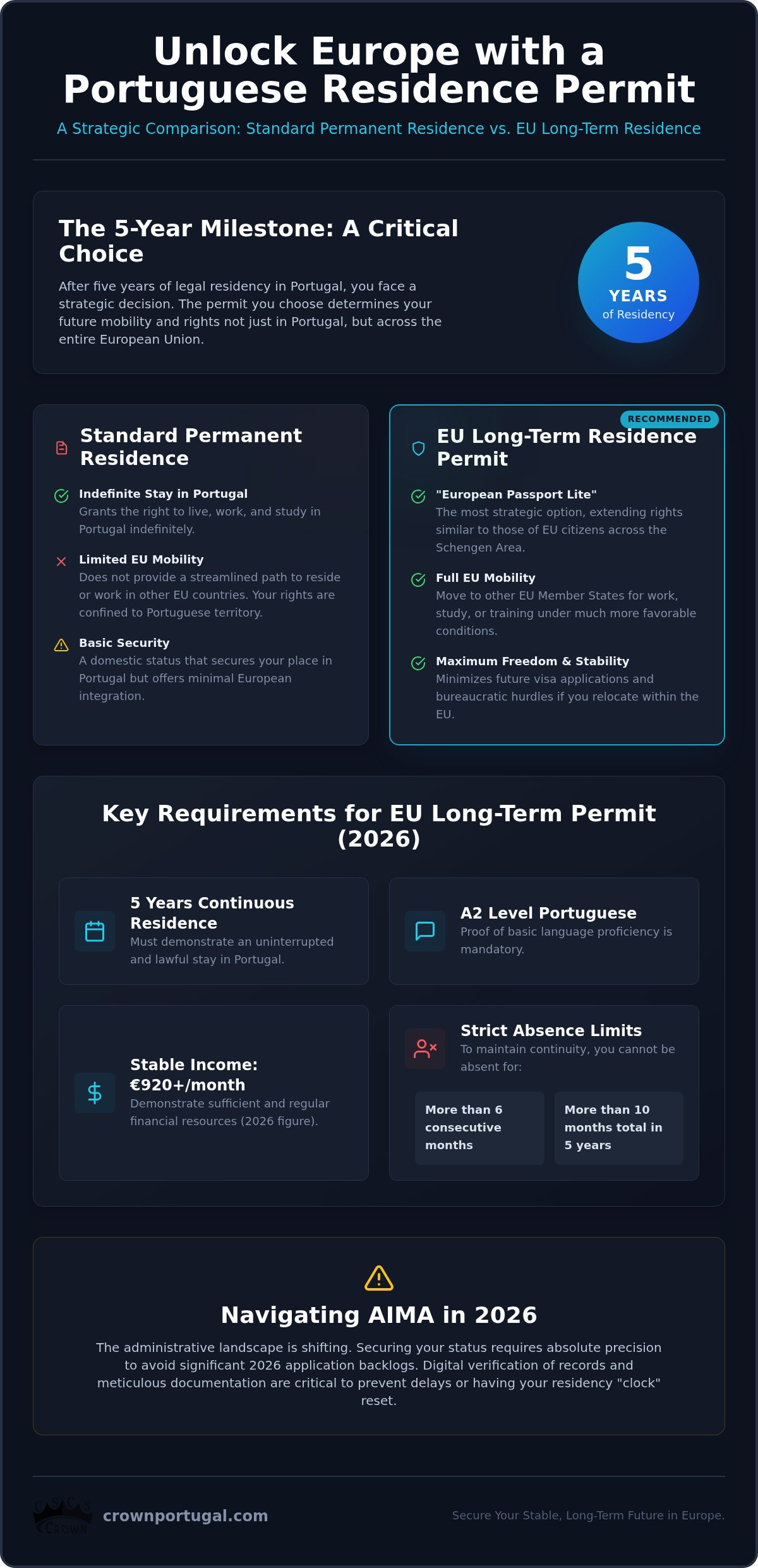
The choice between a standard National Permanent Residence permit and a Portugal EU long term residence permit depends on your long-term objectives. While both provide the security of indefinite stay, the EU status is governed by a specific directive that facilitates movement across the continent. Understanding the status of a Long-term resident (European Union) is essential for those who envision a life that isn’t confined to a single member state.
Defining ‘Legal Residence’ for Long-Term Status
Legal residence is defined by the continuous and lawful stay in Portuguese territory. Under the 2026 AIMA administrative framework, the calculation of this five-year period is scrutinized with high precision. You must demonstrate that your presence has been consistent, with specific attention paid to any absences that might disrupt the “uninterrupted” requirement. The 2026 rules emphasize a digital-first verification of your entry and exit records.
- Continuity: You shouldn’t be absent from Portugal for more than six consecutive months or ten months in total over the five-year period.
- Documentation: Every day counted must be backed by a valid residence title; expired permits that weren’t renewed within legal grace periods can cause complications.
- Administrative Rules: Gaps caused by late renewals or changes in visa categories can occasionally reset the clock if not managed with professional oversight.
Permanent Residency vs. EU Long-Term Resident Status
The primary distinction lies in the geographical scope of your rights. National Permanent Residence grants you the right to live and work indefinitely in Portugal, but it doesn’t provide a streamlined path to residency in other EU countries. Conversely, the Portugal EU long term residence permit allows you to move to another Member State for work, study, or training under more favorable conditions than a first-time applicant. For many professionals, the EU permit is the preferred choice because it minimizes the need for complex visa applications if their career takes them to France, Germany, or Spain. While applying for Portuguese Nationality remains a third option, the long-term permit serves as an immediate solution for those who require enhanced mobility without the longer processing times often associated with citizenship applications.
EU Long-Term Residence Permit vs. Permanent Residence: Key Differences
Deciding between these two permits isn’t just about administrative convenience; it’s a choice that defines your future freedom within the continent. While both documents grant the right to live in Portugal indefinitely, the Portugal EU long term residence permit operates under a broader legal framework. As detailed by the European Commission on Long-Term Residents, this status aims to bring non-EU nationals closer to the rights enjoyed by EU citizens. National Permanent Residence (PR) is a domestic status that secures your place in Portugal, but it doesn’t offer the same portability if you decide to relocate to another Member State.
Absence Flexibility: A Deep Dive
The EU Long-Term permit offers superior protection for those who travel frequently or maintain global business interests. Under this status, you generally only lose your residency if you’re absent from the entire EU territory for 12 consecutive months. This is a significant advantage over many national permanent residency rules, which often have stricter requirements regarding physical presence within Portugal’s borders to maintain the permit’s validity. If your lifestyle involves spending months at a time in North America or Asia, the EU permit provides a more robust safety net against accidental residency loss. It’s a strategic shield for your immigration status during extended periods abroad.
The Mobility Advantage in the Schengen Area
Accessing the “Mobility” factor is where the EU permit truly outshines national PR. With this status, you’re entitled to move to a second EU Member State for periods exceeding 90 days for purposes such as work, study, or vocational training. While you’ll still need to notify the authorities in the new country, the process is streamlined. You don’t have to start a visa application from scratch as a “third-country national.”
- Work Exemptions: Some countries offer simplified work permit procedures for those holding EU long-term status from another Member State.
- Social Integration: You benefit from equal treatment regarding social security, tax benefits, and access to public goods in your new host country.
- Renewability: In 2026, both permits typically require renewal every five years, but the EU permit’s underlying status is permanent unless revoked for specific legal breaches.
You’ll find that the administrative requirements for both paths are similar, involving proof of income and language proficiency. However, the long-term utility of the EU permit often justifies the specialized application process. If you’re navigating the choice between these two pathways, securing expert guidance can help ensure you select the permit that best supports your European career and family goals.
Eligibility and Requirements for the EU Long-Term Permit in 2026
The legal foundation for the Portugal EU long term residence permit is rooted in Council Directive 2003/109/EC. This directive establishes the harmonized criteria that all applicants must meet after completing five years of legal residency. Beyond the time requirement, AIMA mandates clear evidence of social and financial stability. This includes maintaining active Social Security (NISS) contributions and ensuring your health coverage is current, whether through the National Health Service (SNS) or private insurance. The 2026 administrative landscape requires a meticulous approach to document preparation, as any inconsistency in your five-year record can lead to immediate delays.
Financial Solvency: Proving Your Income
For 2026, the financial threshold for long-term residency is tied to the national minimum wage, which has been set at €920 per month. Applicants must demonstrate that they possess stable and regular resources to support themselves and their dependents without relying on the Portuguese social assistance system. The calculation follows a specific hierarchy based on family composition.
- Main Applicant: 100% of the national minimum wage (€920 per month).
- Additional Adults: 50% of the minimum wage for each additional adult in the household.
- Children: 30% of the minimum wage for each child under the age of 18.
Your Portuguese NIF is the primary tool for this verification. AIMA will review your personal income tax returns (IRS) from previous years to verify the stability of your earnings. Acceptable proof of funds includes remote work contracts, pension statements, or documented investment income. It’s essential that these funds are regular and predictable; one-off savings balances are generally insufficient without a recurring income stream.
Language and Integration Requirements
The CIPLE (A2 Level) Portuguese language exam is a mandatory requirement for most non-EU nationals seeking long-term status. This exam evaluates your ability to handle basic tasks, such as shopping, navigating public transport, or interacting with local services. The test includes reading comprehension, written expression, and an oral component. You should schedule your exam well in advance of your five-year anniversary, as testing centers often have limited capacity.
Exemptions for the language requirement are strictly defined. Individuals who have lived in a Portuguese-speaking country for ten years, or those who hold a certificate of proficiency from a recognized institution, may be exempt. Furthermore, integration is assessed through your criminal record. You must provide a clean criminal record certificate from Portugal and any country where you resided for more than one year during the last five years. AIMA uses these documents to ensure that your presence does not pose a threat to public order or security.
The Application Process: Navigating AIMA in 2026
Applying for the Portugal EU long term residence permit requires a methodical approach to administrative deadlines and document legalization. The first step involves gathering your global documentation, specifically criminal record certificates from every country where you’ve resided for more than one year. These documents must be apostilled and translated by a certified professional to be accepted by the Agency for Integration, Migration and Asylum (AIMA). Second, you must secure an appointment through the AIMA digital portal or their dedicated telephone lines. While the transition to a digital-first system has improved accessibility, high demand means that strategic timing is essential for booking. Third, you’ll attend an in-person appointment for biometric data collection and a verification interview. Finally, once approved, you can track the production of your physical residence card through the online portal until it is delivered to your registered address. As of mid-2026, the average processing time for long-term status applications typically ranges from nine to fifteen months as AIMA continues to clear the substantial backlog of over 300,000 cases.
Document Checklist for Long-Term Status
Precision in your document portfolio is the most effective way to prevent application rejections. You must provide an updated NISS registration and proof of social security contributions to demonstrate your integration into the national fiscal system. Additionally, you’ll need a valid certificate of accommodation, such as a rental contract or a deed of property ownership. Professional document review is highly recommended at this stage; even a minor discrepancy in your address history or a missing translation can result in your file being returned, forcing you to restart the appointment process. Ensuring your file is “decision-ready” before you arrive at the AIMA office is a critical safeguard for your residency timeline.
How to Exercise Your EU Mobility Rights
The true power of this permit lies in the “EU Long-Term Resident – PT” notation printed on your card. This status allows you to relocate to a second EU country for periods longer than 90 days without the standard hurdles faced by first-time visa applicants. When moving, you generally follow a notification process rather than a full application from scratch, though you must still prove you have sufficient financial resources and health insurance in the new host country. Your Portuguese permit remains valid and serves as the legal basis for your status until you have successfully established residency in the second Member State. This mobility framework is designed to support professionals and families who require the flexibility to follow career opportunities across the Schengen Area without losing their long-term security.
The complexity of the AIMA transition makes it more important than ever to have a clear administrative roadmap. If you’re approaching your five-year milestone and want to ensure your application is handled with professional precision, contact Crown Portugal for expert residency assistance.
Securing Your Future with Crown Portugal
Reaching the five-year threshold marks a significant achievement in your immigration journey. It’s the point where temporary residency matures into a more permanent European status, offering the stability you’ve worked to build. Professional immigration consultancy services provide the necessary oversight to ensure this transition is handled with precision, protecting the years of residency you’ve already accumulated. We act as your authoritative guide through the final administrative hurdles of the 2026 landscape.
Our role as an intermediary involves the meticulous organization of your fiscal and administrative identity. We manage the hierarchy of NIF, NISS, and residency renewals, ensuring that your five-year history is documented without gaps. This attention to detail is particularly important for the Portugal EU long term residence permit, where AIMA examiners look for total compliance in social security contributions and tax filings. Beyond the permit itself, we provide strategic advisory for those considering the next step: Portuguese nationality. This includes managing the transition under the 2026 nationality law reforms and providing investment advisory for those looking to diversify their portfolio within the country.
End-to-End Relocation Support
A lifelong partnership with a consultant ensures that your immigration strategy remains consistent over several years. Our relocation checklist serves as a living document, adjusting to reflect your changing status and family needs. For long-term permit holders, family reunification becomes a simplified process when the primary applicant’s status is already secured. We provide the expertise needed to navigate the specific documentation required for dependents, ensuring the entire household benefits from European mobility rights. This comprehensive approach minimizes the risk of administrative errors that could stall your family’s progress.
Contact Crown Portugal for Expert Guidance
The administrative environment in 2026 is complex, but it doesn’t have to be overwhelming. You can access our latest updates and data through our Portugal immigration news channel, which provides real-time insights into AIMA processing times and regulatory shifts. Over 1,000 clients have trusted Crown Portugal to guide them through the intricacies of the Portuguese bureaucracy. We invite you to schedule a professional consultation to develop a personalized residency roadmap. Our team is ready to facilitate a smooth, secure transition to your long-term future in Europe, providing the stability and professional standard you expect.
Achieving Stability and Mobility in the European Union
Securing the Portugal EU long term residence permit is more than an administrative renewal; it’s the final step in transforming your temporary stay into a permanent European future. By meeting the 2026 financial thresholds and demonstrating A2 language proficiency, you unlock the right to live and work across the Schengen Area. This status provides a level of security and flexibility that standard residency cannot match.
Since 2018, Crown Portugal has specialized in guiding residents through these critical D-series visa transitions. We manage the entire administrative burden, from initial NIF and NISS acquisition to the final AIMA appointment scheduling. Our methodical approach ensures your documentation meets every regulatory standard, protecting the years of residency you’ve already established. Professional precision is the key to navigating the current bureaucratic landscape without unnecessary delays.
Secure your long-term future in Europe with Crown Portugal’s expert consultancy. Your path to a stable life in Portugal is well within reach, and we’re here to ensure every step is handled with absolute competence.
Frequently Asked Questions
What is the main difference between Portuguese Permanent Residence and EU Long-Term Resident status?
The primary distinction lies in your geographical rights. While Portuguese Permanent Residence secures your right to live and work indefinitely within Portugal, the Portugal EU long term residence permit grants you enhanced mobility across the European Union. This status allows you to move to other Member States for work or study under more favorable conditions, effectively treating you more like an EU citizen regarding cross-border residency rights.
Can I work in Germany or France with a Portugal EU Long-Term residence permit?
You can relocate to other EU countries for employment, but you must still comply with the host country’s specific notification procedures. Holding this permit means you don’t have to apply for a fresh visa as a first-time applicant from outside the EU. Instead, you’ll generally apply for a residence permit in the new country while proving you have sufficient financial resources and health insurance to support yourself without state assistance.
How long can I be absent from Portugal without losing my EU Long-Term status?
You may remain outside of the European Union territory for up to 12 consecutive months without losing your long-term status. This provides significantly more flexibility than many national permits, which often require more frequent physical presence. If you’re traveling within the EU, your status is even more protected, though you should always maintain a registered address in Portugal to ensure your fiscal and administrative compliance remains intact.
Is the A2 Portuguese language exam mandatory for the EU Long-Term permit?
Successful completion of the CIPLE (A2 Level) exam is a mandatory requirement for most non-EU applicants. This test ensures you have the basic linguistic skills necessary for daily integration, such as understanding common expressions and participating in simple conversations. Certain exemptions apply for those who have completed higher education in Portuguese or those who originate from Portuguese-speaking nations, provided they can produce official supporting documentation of their proficiency.
Does the time spent on a student visa count toward the 5-year requirement?
Under current regulations, the five-year residency period must consist of legal and continuous residence. While time spent on certain temporary visas counts toward the Portugal EU long term residence permit, time spent on a student visa is typically calculated at a 50% rate toward the total five-year requirement. You must hold a valid residence title at the time of your application to transition into the long-term status successfully.
What are the financial requirements for EU Long-Term residency in 2026?
Applicants must demonstrate a stable and regular income that meets the 2026 national minimum wage of €920 per month. If you’re applying with family members, you’ll need an additional 50% of this amount for each adult and 30% for each child. These funds must be verifiable through bank statements, tax returns, or employment contracts, proving you can support your household without relying on the national social assistance system.
How long does it take for AIMA to process the EU Long-Term permit application?
The processing time currently ranges from nine to fifteen months, depending on the complexity of your file and the current volume of applications. AIMA is actively working to clear a significant backlog inherited from the former SEF, which was reported to be over 300,000 applications in early 2026. Submitting a “decision-ready” file with all documents correctly translated and legalized is the most effective way to avoid additional administrative delays.
Can my family members also get EU Long-Term status if I am the primary applicant?
Family members are eligible for the EU Long-Term status, but they must individually meet the five-year residency requirement and demonstrate their own integration and language proficiency. While you can apply for family reunification to bring them to Portugal initially, their transition to long-term residency depends on their own continuous legal stay. We provide comprehensive support to ensure every family member’s documentation is aligned with AIMA’s specific 2026 requirements for milestone permits.
Portugal Immigration Consultancy Services: The 2026 Professional Guide – Crown Portugal at 6:22 pm, September 19, 2026 -
[…] residents planning their long-term future in Europe, understanding the strategic advantages of the Portugal EU long term residence permit is an essential step beyond standard permanent residency. Secure your Portuguese residency with the […]
Lisbon Expat Apartments: 2026 Rental & Relocation Guide – Crown Portugal at 11:08 am, September 20, 2026 -
[…] Portugal Immigration Consultancy Services: The 2026 Professional Guide – Crown Portugal on Portugal EU Long Term Residence Permit: The 2026 Strategic Guide […]