

Portugal Visa Application Help: A Comprehensive 2026 Roadmap to Residency

What if the success of your relocation was decided months before you set foot in a Portuguese consulate? Many applicants focus solely on the visa form, yet the real challenge lies in the administrative groundwork required for a residency permit. It’s common to feel apprehensive about the transition to AIMA or the strict documentation standards for financial proof. You likely fear that a minor clerical error or a misunderstanding of fiscal requirements could lead to a rejection and disrupt your relocation plans. We provide the specialized Portugal visa application help needed to navigate these bureaucratic layers with absolute precision.
This 2026 roadmap introduces a fiscal-first strategy, ensuring your tax and social security registrations are secured before submission. You’ll learn the technical requirements for D-series visas, including the D8 Digital Nomad and D7 Passive Income paths, while identifying how to avoid common rejection pitfalls. By following this methodical guide, you can transition to your new life with the security of a well-executed administrative plan. We break down the complexities of the immigration process into manageable steps to ensure your move is both compliant and stable.
Key Takeaways
- Understand the 2026 administrative transition to AIMA and the technical distinctions between short-stay Schengen visas and long-stay National residency permits.
- Identify the specific income thresholds and contract requirements for the D8 Digital Nomad and D7 Passive Income visas to ensure your financial eligibility.
- Obtain professional Portugal visa application help to navigate common rejection pitfalls, including strict formatting for financial proof and 12-month lease standards.
- Follow a methodical roadmap that prioritizes remote NIF registration and the opening of a Portuguese bank account as essential prerequisites for residency.
- Discover how end-to-end relocation services coordinate fiscal registration, social security setup, and housing to facilitate a seamless transition to Portugal.
Navigating the Portugal Visa Landscape in 2026
The transition from SEF to AIMA (Agência para a Integração, Migrações e Asilo) has redefined the administrative experience for non-EU nationals. In 2026, the immigration climate is characterized by a push for digital efficiency, yet applicants must still manage complex procedural requirements that vary significantly by consulate. Distinguishing between a Schengen visa, which allows for short-term stays up to 90 days, and a National visa, which serves as the entry point for residency, is the first conceptual hurdle. Successful relocation depends on understanding current immigration trends and legal frameworks in Portugal to avoid common bureaucratic delays.
To better understand the practical steps of this transition, watch this helpful video:
A “fiscal-first” strategy is no longer optional for those seeking residency. Before a visa application is even submitted, the applicant must possess a NIF (Número de Identificação Fiscal). This tax number is the foundational key to the Portuguese economy, allowing for the opening of bank accounts and the securing of long-term accommodation. Without this registration, the residency process cannot legally commence, making it the true first step in any relocation roadmap.
The Role of Professional Visa Application Help
Securing professional Portugal visa application help involves more than just administrative assistance. It’s about building a comprehensive residency strategy that accounts for local regulations and consulate-specific preferences. Expert consultants act as an essential bridge, translating technical Portuguese legal requirements into manageable steps for the applicant. This methodical approach significantly reduces the risk of document rejection by ensuring every file meets the high standards of AIMA’s current review process. Meticulous organization at this stage often dictates the speed of the final residency permit issuance.
Core Residency Pathways: An Overview
The D8 Digital Nomad Visa remains the primary choice for remote professionals, requiring proof of stable foreign income that meets the 2026 thresholds. The D7 Passive Income Visa serves retirees and those with recurring dividends or rental returns. For those seeking investment or business opportunities, the Golden Visa and D2 Entrepreneur Visa provide structured routes to residency. Each pathway requires specific documentation, such as the NISS (Social Security Number), which is essential for those planning to work or access public services. For visual walkthroughs of these processes, you can find updated data on the Crown Portugal YouTube channel.
Understanding the Primary Visa Categories for Residency
Selecting the correct pathway is a strategic decision that influences your tax obligations and long-term residency rights. The Portuguese Ministry of Foreign Affairs visa portal categorizes these options into distinct national visas, each with specific financial and administrative benchmarks. For many applicants, the sheer volume of choices makes professional Portugal visa application help indispensable to ensure the chosen category aligns with their actual financial profile and long-term goals.
The D8 Digital Nomad Visa for Remote Workers
Remote professionals must demonstrate income from foreign sources that exceeds four times the current Portuguese monthly minimum wage. In 2026, this threshold remains a strict requirement for both the ‘Temporary Stay’ path, valid for up to one year, and the ‘Residency’ path, which is valid for two years and renewable. While the temporary stay version is simpler, it doesn’t lead to permanent residency. The residency path requires a long-term lease and a local NIF to prove your intent to settle. For a breakdown of these specific figures, review our Digital Nomad Visa Portugal Requirements.
The D7 Visa for Passive Income Earners
The D7 visa is tailored for individuals with stable, recurring income from pensions, dividends, or rental properties. Portuguese authorities require evidence that these funds are ‘stable and regular’ and can be accessed within the country. Consequently, opening a Portuguese bank account and transferring the required minimum balance is a non-negotiable step before your consulate interview. Detailed documentation of your global assets is essential to prevent delays. Our Portugal D7 Visa Passive Income Guide provides the necessary checklists for this category.
The D2 and Startup Visa for Entrepreneurs
The D2 visa focuses on the viability of a new or existing Portuguese business entity. Applicants must present a robust business plan that highlights the local economic impact and potential for job creation. Specialized professionals may also utilize the Tech Visa, which facilitates the recruitment of highly qualified talent for certified startups. Navigating these entrepreneurial paths requires a deep understanding of local corporate regulations and fiscal duties. You can explore the Entrepreneur Visa Portugal Process to learn how to structure your business entity correctly.
In 2026, the Golden Visa (D9) continues to evolve, with the primary focus shifting toward investment funds and cultural heritage projects rather than residential real estate. This path remains attractive for those seeking residency through capital transfer without the requirement of full-time physical presence. Regardless of your chosen route, coordinating your fiscal registration and bank setup early is the most effective way to ensure success. If you need assistance with these initial steps, you can consult our relocation specialists to begin your journey with a clear, error-free strategy.
Why Applications Fail: Common Rejection Pitfalls
The primary reason for visa denial is often found in the fine details of financial documentation. While the Portuguese Ministry of Foreign Affairs national visa portal outlines the broad requirements, it doesn’t emphasize the strict formatting required for bank statements and proof of remote income. Applicants frequently submit documents that lack the necessary bank stamps or fail to show a clear source of funds for the required three-month period. Without professional Portugal visa application help, these technical omissions can lead to an immediate rejection during the initial review phase.
The ‘Proof of Accommodation’ requirement presents another significant hurdle for 2026 applicants. Consulates generally demand a registered 12-month lease agreement. Short-term rentals or platform bookings are typically insufficient for residency visas. This creates a logistical challenge for those who haven’t yet arrived in the country. Also, the ‘NIF Paradox’ remains a point of confusion; you need a tax number to sign a lease, yet the NIF registration usually requires a residential address. We solve this by facilitating NIF acquisition through a fiscal representative before you secure a local property.
Criminal record background checks must be recent, typically issued within the last 90 days, and perfectly authenticated. Every foreign document requires an Apostille, which is a critical authentication step that verifies the legitimacy of the document for use within Portugal. Errors in the timing of these checks or the lack of proper apostilles are frequent causes for administrative delays that can derail an entire relocation timeline.
The Complexity of Portuguese Bureaucracy
Administrative nuances vary significantly between different Portuguese consulates globally. Some locations may require a direct consulate application, while others utilize a ‘manifestation of interest’ model for those already within the territory. Understanding these local variations is essential for a successful outcome. An Apostille serves as a critical authentication step for all foreign documents to ensure they are legally recognized by AIMA and the Ministry of Foreign Affairs.
Strategic Document Preparation
Document sets must be meticulously prepared, including certified translations into Portuguese for all non-Portuguese records. It’s often better to over-prepare your file by including supplementary evidence of financial stability. Crown Portugal reviews every document set to ensure 100% compliance with current regulations before submission. This level of scrutiny ensures that your file is ready for the high standards of AIMA. For more technical insights, you can review our educational content on the Crown Portugal YouTube channel.
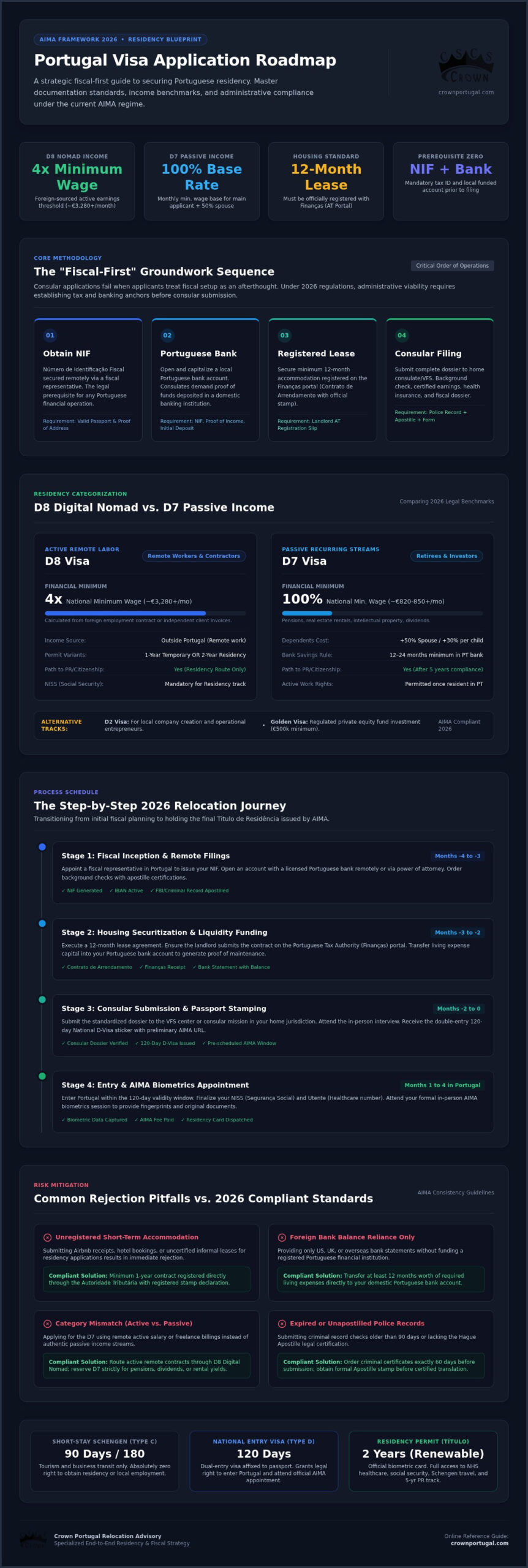
Step-by-Step Roadmap to Your Portuguese Visa
Transitioning from administrative theory to practical execution requires a clear, chronological checklist. While specific requirements vary by visa type, the core sequence remains consistent for all residency applicants. Following this structured roadmap ensures you don’t waste resources on steps that depend on prior registrations. Many applicants find that professional Portugal visa application help is most valuable during these early stages to prevent sequential delays.
- Step 1: Obtain your NIF (Número de Identificação Fiscal) remotely through a fiscal representative to avoid traveling before your visa is ready.
- Step 2: Open a Portuguese bank account and deposit the minimum required funds. For most D-series visas, you’ll need to show at least 12 months of the Portuguese minimum wage in savings.
- Step 3: Gather home-country documents, including criminal record certificates and birth certificates. Ensure each carries an Apostille from your national authority and is less than 90 days old.
- Step 4: Secure a registered 12-month lease agreement. This document must be registered with the Portuguese Tax Authority (Finanças) to be considered valid proof of accommodation.
- Step 5: Attend your VFS appointment. This is the final step for biometric data collection and file submission.
Phase 1: The Fiscal Foundation
The NIF acts as the central administrative key that facilitates every other transaction in Portugal. You’ll need this number to sign a lease, set up local utilities, and open your bank account. For a comprehensive walkthrough on this essential prerequisite, see our guide on How to Get a NIF in Portugal. Additionally, if you’re applying for work-related visas like the D8 or D2, obtaining a Social Security Number (NISS) is equally critical. This number allows you to contribute to the social security system and access public healthcare services once you’ve successfully relocated.
Phase 2: The Application and Interview
Consulate appointment availability is often limited, so it’s vital to monitor the online booking portals frequently. During the interview, stay consistent with the financial data provided in your documentation. Consular officers typically focus on your financial self-sufficiency and your genuine intent to reside in the country. For visual data on current application trends and AIMA processing times, refer to the Crown Portugal YouTube channel. If you’re ready to secure your future in Portugal, you can book a comprehensive relocation consultation to ensure your roadmap is error-free.
How Crown Portugal Simplifies Your Relocation
Managing the administrative lifecycle of a move to a new country requires a partner who understands the granular details of the local bureaucracy. We provide expert Portugal visa application help that extends far beyond the initial form submission. Our consultancy begins with a thorough eligibility assessment and continues until you hold your final residency card in hand. By coordinating essential fiscal registrations like the NIF and NISS remotely, we ensure your administrative foundation is complete before you ever visit a consulate. This includes facilitating the opening of a Portuguese bank account, which is a non-negotiable requirement for D7 and D8 residency applicants.
Relocation is as much about logistics as it is about administrative law. We assist entrepreneurs with company formation and Tech Visa advisory, ensuring your business entity is compliant with current Portuguese economic standards. For those arriving with families, our team arranges airport pick up in Portugal and provides dedicated support in finding suitable accommodation. Securing professional Portugal visa application help allows you to delegate these complex tasks to a partner with local expertise. These services are designed to eliminate the common stressors of moving, allowing you to focus on your transition while we manage the procedural intricacies.
End-to-End Residency Support
Working with a local consultant provides a distinct ‘boots on the ground’ advantage that international agencies often lack. We understand the specific preferences of various consulates and AIMA offices, allowing us to tailor your file to meet their exact standards. Our document review services mirror the intense scrutiny of government officers, identifying potential errors before they lead to an administrative rejection. For a detailed breakdown of the steps involved in your move, you can consult our Moving to Portugal Checklist. This resource ensures every milestone, from document authentication to the final biometric appointment, is accounted for in your timeline.
Beyond the Visa: Resettling in Portugal
Your journey doesn’t end when the visa is stamped in your passport. We provide ongoing support for local administrative tasks, such as home address registration and securing a Social Security Number for your family members. If you’re bringing loved ones, our expertise in family reunification, including Article 98-A procedures, ensures a unified and legal relocation experience. We also offer advisory services on maintaining your residency status and the eventual path toward Portuguese nationality under the new 2026 rules. For more technical insights into these processes, you can view our latest educational content on the Crown Portugal YouTube channel. Every step is handled with the meticulous organization expected of a professional residency partner.
Securing Your Future in Portugal
Successful residency in 2026 depends on a proactive, fiscal-first strategy that addresses administrative requirements long before you arrive. The transition to AIMA has created a landscape where meticulous document preparation and early NIF registration are the primary factors in approval. By understanding the specific nuances of your chosen visa category and ensuring all home-country records are correctly apostilled, you eliminate the common pitfalls that lead to rejection. Professional Portugal visa application help transforms this complex bureaucratic journey into a structured and predictable roadmap.
Crown Portugal has provided expert guidance since 2018, offering comprehensive support for NIF and NISS registration alongside end-to-end relocation and accommodation assistance. We act as your steady partner, managing every technical detail from initial assessment to the issuance of your residency permit. Book a Professional Immigration Consultation with Crown Portugal today to ensure your transition is handled with the highest global professional standards. Your new life in Portugal is within reach when you have a knowledgeable expert mapping the way forward.
Frequently Asked Questions
Do I really need a Portuguese bank account for my visa application?
Yes, a Portuguese bank account is a mandatory requirement for most residency applications, particularly the D7 Passive Income and D8 Digital Nomad visas. Consular officers require evidence that you have immediate access to your funds within the Portuguese financial system. This involves opening an account using your NIF and transferring a balance that meets the minimum annual requirement for your specific visa category to demonstrate financial self-sufficiency.
How long does the Portugal visa application process take in 2026?
Processing timelines for 2026 vary depending on the specific consulate and the current administrative load of AIMA. Typically, the initial visa processing at a consulate takes between 60 and 90 days. Once you arrive in Portugal, securing your final residency permit can take several additional months. Obtaining professional Portugal visa application help ensures your file is complete, which prevents unnecessary delays caused by administrative requests for additional information.
Can I apply for a Portugal visa while I am already in the country as a tourist?
Most National residency visas require you to submit your application at a Portuguese consulate in your country of legal residence before traveling. While some administrative paths like a manifestation of interest existed for those already in the country, these procedures are increasingly restricted under 2026 regulations. It’s generally more stable to secure your entry visa abroad to ensure you have the legal right to transition to a residency permit upon arrival.
What is the minimum income requirement for the Digital Nomad Visa in 2026?
Remote professionals applying for the D8 Digital Nomad Visa must demonstrate a monthly income that is at least four times the current Portuguese monthly minimum wage. This figure is calculated based on gross salary and must be proven through employment contracts or service agreements. You’ll need to provide bank statements from the last three months to verify that these funds are consistently deposited into your account from foreign sources.
Is it possible to get a NIF (Tax Number) remotely?
You can absolutely obtain a NIF remotely through the use of a fiscal representative. This is a standard procedure we facilitate for our clients, allowing you to secure your tax number without physical presence in Portugal. Having a NIF is the essential first step for opening a bank account and signing a lease, making remote acquisition a vital part of an efficient and organized relocation timeline.
What happens if my Portugal visa application is rejected?
If your application is rejected, you typically have the right to appeal the decision within a specified timeframe or submit a new application. Rejections often stem from technical errors in financial proof or outdated criminal record checks. We review your previous submission to identify the exact cause of failure and help you restructure a compliant file for a successful second attempt by addressing every administrative discrepancy identified by the consulate.
Do I need to speak Portuguese to apply for residency?
You don’t need to speak Portuguese to qualify for an initial residency permit. Most administrative interactions can be handled with the assistance of a consultant or through translated documents. However, if you plan to apply for permanent residency or Portuguese nationality after five years, you’ll eventually need to demonstrate a basic A2 level of language proficiency through a certified exam to meet the legal requirements for long-term integration.
Can my family join me on the same visa application?
Family members can join you through the family reunification process, often referred to under Article 98-A. While they don’t always submit the exact same visa as the primary applicant, their applications are linked to your residency status. You must demonstrate that you have sufficient financial resources and adequate housing to support all dependents included in your relocation plan to ensure a successful outcome for the entire household.