

Portugal D9 Golden Visa investment routes and minimum amounts

The Portugal D9 Golden Visa process offers non-EU nationals a residence-by-investment route through qualifying options such as investment funds, cultural support, research or business investment, and job creation. The minimum depends on the route: qualifying cultural-support investment starts at €250,000, with a €200,000 threshold in qualifying low-density areas, while several other routes require €500,000 or meeting specific employment criteria. Real estate purchases no longer qualify.
Choosing a route involves more than comparing minimum amounts: the investment must meet the programme’s rules, and residence requirements and future eligibility for permanent residence or citizenship also matter. This guide explains how the Golden Residence Permit Program works, which investments may qualify, what the main application stages involve, and how residence may lead to longer-term status in Portugal. It also clarifies the differences between investment routes so you can see which requirements shape your decision.
Key Takeaways
- Understand how Portugal’s Golden Residence Permit Program links qualifying investment with a residence permit for non-EU nationals.
- Compare the main qualifying investment routes, their minimum amounts, and the employment criteria that may apply.
- Learn which application documents are central to the process, including identity, police, and tax or Social Security records.
- See how residence requirements and investment maintenance relate to eligibility for permanent residence or citizenship.
- Find out why the date your application fees are paid may affect when the citizenship residence clock begins.
What is the Portugal Golden Residence Permit Program?
Portugal’s Golden Residence Permit Program is a five-year residence-by-investment route for non-EU nationals. The Portugal D9 Golden Visa process links a qualifying investment with residence, document review, and an appointment for biometrics before a residence card is issued.
Required Application Documents
Application documents establish your identity, good standing, healthcare coverage, and qualifying investment. A complete, consistent record helps the authorities assess eligibility and compliance, with services such as dokumen24.com offering support for applicants who need assistance managing official civil registration and immigration documents.
The main applicant’s file includes a valid passport, two passport-size photographs, a criminal record certificate no older than three months at submission, and healthcare coverage issued within three months of the application date. It also includes documents showing good standing with Portugal’s Tax and Customs Authority and Social Security, issued within 45 days of form submission. Evidence of the chosen qualifying investment supports the residence application.
Application Stages and Timelines
The process typically moves from checking eligibility and preparing documents to submitting the application, attending biometrics, and receiving a residence card. Understanding this sequence helps you plan investment evidence and family applications around the required appointment.
After the investment route and supporting record are assembled, the application is submitted for review. The applicant then attends a biometric appointment before the residence card can be issued. The indicative processing timeline is 12-18 months, although the full period from initial preparation to the first card may be 12-24 months. AIMA has 90 days by law to decide a residence permit application and may extend that period by 30 days in complex cases.
Applicant and Family Eligibility
The main applicant must be at least 18 and meet the requirements of a qualifying investment route. Family eligibility matters because each relative’s relationship and dependency must be documented.
Eligible family members can include a spouse or eligible de facto partner, dependent children, and parents over 65 of the applicant or spouse. An unmarried partnership requires proof of at least two years of cohabitation. Dependent children aged 18 to 26 may qualify if unmarried and in full-time education or living with the investor. Children under 18 can join through family reunification.
D9, D7, and Golden Visa Comparison
The D9 Golden Visa is investment-based, while Portugal’s D7 visa is intended for applicants relying on passive income. The routes therefore differ in the basis for eligibility, not simply in their names.
For the Golden Visa, financial means are demonstrated through a qualifying investment, rather than a single income threshold. By contrast, the D7 assessment centres on passive income and the applicant’s ability to support residence. The route that fits depends on whether the applicant qualifies through investment or recurring income.
Government charges are separate from the investment amount. The listed initial digital application analysis fee is €632.10, and the first residence-card issuance fee is €6,314.20 per person. Other costs depend on the application stage and family members included.
Incomplete records, failure to meet the selected investment route’s criteria, or inconsistencies in the evidence can undermine an application. If your application is refused, read the decision carefully: its stated grounds determine the available appeal or challenge route and what evidence may address them.
Qualifying investment routes and minimum amounts
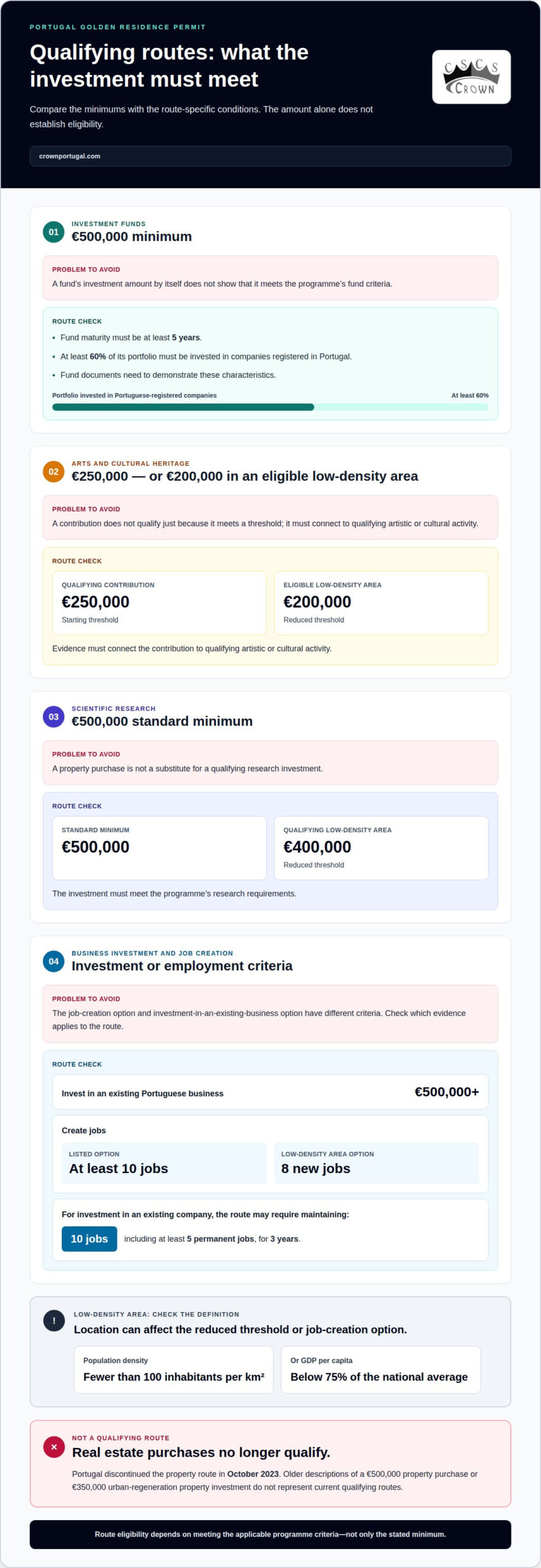
Portugal’s qualifying routes involve different forms of capital, cultural support, research funding, or job creation. The minimum amount alone does not establish eligibility. The investment structure, location, fund criteria, and employment evidence can all matter.
- Investment funds: The minimum is €500,000. A qualifying fund must have a maturity of at least five years, and at least 60% of its portfolio must be invested in companies registered in Portugal. Fund documents need to demonstrate these characteristics.
- Arts and cultural heritage: A qualifying contribution starts at €250,000. The threshold falls to €200,000 for an eligible project in a low-population-density area. The evidence must connect the contribution to qualifying artistic or cultural activity.
- Scientific research: The standard minimum is €500,000. In a qualifying low-density area, the threshold is €400,000. The route depends on research investment meeting the programme’s requirements, rather than a property purchase.
- Business investment and job creation: Investing at least €500,000 in an existing Portuguese business may qualify. A business route can also qualify through creating at least 10 jobs. In a low-density area, creating eight new jobs is listed as an option. For investment in an existing company, the route may require maintaining 10 jobs, including at least five permanent jobs, for three years.
Low population density is relevant to the reduced cultural and research thresholds, and to the business job-creation option. A qualifying area has fewer than 100 inhabitants per square kilometre or GDP per capita below 75% of the national average. Location therefore affects whether a reduced threshold applies, not merely where an investment is made.
Property purchases no longer qualify for the Golden Visa; Portugal discontinued that route in October 2023. Older descriptions of a €500,000 property purchase or €350,000 urban-regeneration property investment don’t represent current qualifying routes. Likewise, a capital transfer by itself isn’t among the current options described here.
Applicants must maintain the qualifying investment for at least five years. This holding period is separate from the minimum travel requirement, which applicants should check when planning their time in Portugal. These residence obligations matter when planning travel alongside investment management.
Before choosing a route, compare its minimum amount with the evidence it requires. A fund applicant needs documents establishing the fund’s maturity and Portuguese portfolio allocation; a business applicant needs capital and employment records. Eligible dependent family members can be included, but each person’s residence documents remain part of the application.
Citizenship residence-clock start date and expected requirements
For Golden Visa holders, citizenship eligibility depends on the applicable residence period and the date from which it is counted. Permanent residence is a separate route, with its own residence and investment conditions.
Residence-Clock Start Date
The citizenship residence clock is the date from which qualifying legal residence is counted. For Golden Visa applicants, the applicable start date depends on whether submission fees were paid before or after the revised Nationality Law was gazetted.
If you paid before gazetting, the clock is counted from the fee-payment date. If you paid after gazetting, it starts when your first residence card is physically issued. This distinction may affect the earliest date you reach the residence period for Portuguese citizenship. Keep both your payment record and card-issuance date.
Portugal’s revised Nationality Law was approved by Parliament on 1 April 2026 and promulgated by President António José Seguro on 3 May 2026. It enters into force the day after publication in Portugal’s official gazette. Citizenship applications already filed with the IRN when it enters into force are decided under the previous five-year regime.
Citizenship Eligibility and Language Requirements
Citizenship eligibility combines the required period of legal residence with other applicable conditions. Under the rules effective from 19 May 2026, nationals of Portuguese-speaking countries generally need seven years of legal residence; nationals of other countries generally need 10 years.
Meeting the residence period is not the only eligibility consideration. Portuguese-language ability must be considered separately alongside residence and your supporting documents. The rules summarized here do not specify a language level, so one should not be inferred from the residence period alone. Also distinguish citizenship eligibility from permanent residence, which has its own five-year threshold.
The five-year period previously applied to naturalisation is relevant to applications already filed with the IRN when the revised law enters into force. Those applications follow the previous regime. Other applicants should use the residence period applicable to their nationality and circumstances, rather than assume every Golden Visa holder has the same timetable.
Annual Physical Presence
Golden Visa residence has a limited physical-presence requirement, separate from the longer residence period used for citizenship. Holders must spend at least 14 days in Portugal during the first two years, followed by 21 days during the subsequent three years.
Across the five-year period, that schedule works out to an average of seven days per year. Organize travel records by permit period to help demonstrate whether presence requirements were met, particularly when travel spans several years. The residence schedule alone does not establish citizenship eligibility: the applicable legal residence period and other conditions still apply.
Permanent residence may be available after at least five years of temporary residence, subject to applicable conditions, and the required investment period must also be completed. Citizenship follows a distinct residence-clock calculation. Track these milestones separately when planning travel, maintaining the investment, and deciding when to apply. Holding a residence card does not automatically establish eligibility for either status.
Permanent residence and citizenship
Permanent residence and citizenship are separate legal outcomes, each with its own qualifying conditions. A residence permit, its renewal schedule, and the timeline for an application decision are also distinct stages.
Permanent Residence and Citizenship Timelines
Permanent residence may be available after at least five years of temporary residence, subject to applicable conditions. You must also complete the required five-year investment period. Distinguish time holding a permit from meeting every condition for permanent status.
Citizenship follows a separate residence-clock calculation. Under the rules described for Portugal, the applicable period is generally seven years for nationals of Portuguese-speaking countries and 10 years for nationals of other countries. The clock’s start date can depend on when submission fees were paid and when the first residence card was issued.
AIMA has 90 days by law to decide a residence permit application and may extend the period by 30 days in complex cases. This statutory decision period is not the same as the overall time from preparation to card issuance. A decision deadline, appointment scheduling, and permit issuance are separate points in the process.
Residence, Work, and Schengen Travel Rights
A Portuguese residence permit allows you to reside in Portugal; it is not a Portuguese passport or proof of citizenship. Keep these statuses distinct when planning work or travel beyond Portugal: neither a citizenship timeline nor a Portuguese residence card amounts to citizenship.
For Golden Visa holders, the first residence card is valid for two years, and permits must be renewed every two years. Renewals should be made 30-90 days before expiry. The investment must remain in place for the required period, while the holder also meets the applicable physical-presence conditions.
Presence requirements are measured across permit periods: holders must spend at least 14 days in Portugal during the first two years and 21 days during the subsequent three years. Keeping travel records organized by period helps distinguish time spent in Portugal from travel elsewhere. Those records can support a clear account of whether the residence obligations were met.
Children and other eligible family members may have their own residence documents linked to the application. Track each person’s permit dates and renewal periods separately rather than assuming they match the principal applicant’s card. A household calendar can help you keep expiry dates and renewal windows organized.
Planning these milestones together helps prevent treating one status as a substitute for another. Permanent residence has its own application conditions, while Portuguese citizenship depends on the applicable legal residence period and other eligibility criteria. A residence card remains a time-limited permit until the relevant next status is granted.
Portugal Golden Visa eligibility and program overview
Portugal’s Golden Residence Permit Program is a five-year residence-by-investment programme for non-EU nationals. Its legal basis is Article 90-A of Law No. 23/2007, and it has operated since 8 October 2012. The central eligibility question is whether an applicant meets a qualifying investment route and the related residence requirements.
The programme grants residence status, not automatic Portuguese citizenship. Applicants must be at least 18 years old and meet the conditions for their chosen investment category. The investment routes include regulated fund investment, qualifying support for arts or cultural heritage, scientific research, and business activity linked to employment. Each route has its own evidence requirements, so selecting a category determines what the application must demonstrate.
Eligibility is assessed through several connected parts of the application, not the investment amount alone:
- Applicant identity and status: The main applicant must be an adult non-EU national. Identity and criminal-record documents support assessment of the applicant’s personal eligibility.
- Qualifying investment: The evidence must match the route claimed. For example, a fund application relies on documentation about the fund, while a business application may require evidence of investment and qualifying jobs.
- Residence conditions: Golden Visa holders must meet the programme’s physical-presence requirements and maintain the qualifying investment for the required period.
- Family applications: Eligible family members may be included, subject to the relationship and dependency conditions relevant to each person.
This matters because immigration planning often involves more than one applicant. A spouse, dependent child, or eligible parent may need separate supporting documents, even when applying in connection with the same principal investment. Plan for each family member’s documents and permit timelines, not just the main applicant’s investment evidence.
Programme eligibility has also changed over time. Portugal discontinued the real-estate investment route in October 2023, so purchasing property does not qualify under the current route. This is a key distinction for applicants comparing older descriptions with current investment categories: an asset’s value alone does not make it an eligible investment.
Start with the legal route, then assess whether the applicant, investment evidence, and planned residence meet its conditions. A qualifying investment must satisfy the category’s criteria, and a complete application also needs consistent personal and supporting records. This route-based approach helps clarify what you are applying for before committing capital or preparing family applications.
Crown Portugal: Portugal Golden Visa D-9
Crown Portugal supports applicants pursuing the Portugal Golden Visa D-9, including guidance on the application and its supporting documentation. It can help you understand how your selected investment route relates to the residence application and what records are needed for your case.
If your circumstances are based on remote work or passive income rather than a qualifying investment, the Portugal Digital Nomad D-8 Visa or Portugal Passive Income D-7 visa may be more relevant. NIF Registration (Personal Tax Number) is also available as a related service. Contact Crown Portugal to discuss your Portugal Golden Visa D-9 application and the next steps for your situation.
Make your next decision with a clear plan
The next step is to turn general programme rules into a decision framework for your circumstances. Consider how long you intend to remain in Portugal, whether you can maintain a qualifying investment, and how your family’s plans fit the same residence pathway. These priorities can help you assess whether the Portugal D9 Golden Visa process aligns with your broader relocation objectives; for applicants who are also considering international routes into the United States, visahumancapital.com provides dedicated U.S. immigration legal services.
Before committing capital, organize your decision around three questions: Which qualifying route fits your circumstances? What evidence will demonstrate compliance? How will you manage residence obligations over time? Considering these together helps you weigh the investment against your plans for permanent residence or citizenship, without treating either outcome as automatic.
Crown Portugal can help you assess the application pathway and prepare for the next stage. Request an eligibility discussion to consider how the requirements apply to your plans. A well-structured decision now can give your Portugal plans a practical, confident starting point.
Frequently Asked Questions
Who is eligible for the Golden visa in Portugal?
Non-EU nationals aged at least 18 may qualify if they meet a current investment route and the related residence conditions. Eligibility depends on the evidence for that route, not simply on having funds available. For example, an investment-fund application must meet the fund criteria, while business routes may involve qualifying employment. Property purchases no longer qualify as an investment route.
Can your family join you on a Golden Visa?
Yes, eligible family members can be included, subject to their relationship and dependency conditions. This can include a spouse or eligible de facto partner, dependent children, and parents over 65 of the main applicant or spouse. For an unmarried partnership, the application needs evidence of at least two years of cohabitation. Each family member’s supporting documents should correspond to their relationship category.
Do I need to pass a language test for the Golden Visa?
A language test is not part of the Golden Visa investment criteria described here. Portuguese citizenship is a separate application with its own eligibility requirements, so residence under the investment programme is not citizenship or proof that citizenship conditions have been met. If you plan to apply for citizenship, consider its requirements separately from the initial residence application.
Does Waiting Time Count Toward Citizenship?
Yes. The qualifying residence-clock start date depends on when you paid your submission fees. If you paid before the revised Nationality Law was gazetted, the clock is counted from the fee-payment date. If you paid after gazetting, it starts when your first residence card is physically issued. Keep the payment record and card-issuance date to establish which start rule applies.
Does a Complete File Really Speed Things Up?
A complete file can reduce avoidable gaps in the review, but it does not determine appointment availability or guarantee a faster decision. Include evidence that matches your selected investment route, alongside personal records and required certificates. Missing or inconsistent evidence may require further handling. Treat document preparation and the authorities’ processing schedule as separate parts of the overall timeline.
How Long After Biometrics Until I Receive My Residence Card?
The overall processing estimate does not give a separate countdown from biometrics to card delivery. Biometrics are one stage before the residence card is issued, and the remaining time depends on subsequent application processing and issuance. The broad estimate of 12-18 months concerns application processing, while the planning range from initial preparation to the first card is 12-24 months.
How Long Does It Take to Get Permanent Residency?
Golden Visa holders may apply for permanent residence after at least five years of temporary residence, subject to applicable conditions. The required investment period must also be completed. Reaching the time threshold does not mean you will automatically receive permanent status: you must still meet the relevant conditions and submit an application.
What is Portugal’s D9 visa, and is it a Golden Visa?
In this article, D9 refers to Portugal’s Golden Visa, a residence-by-investment route for non-EU nationals. It is distinct from the D7 visa, which is associated with passive-income applicants. The route is determined by the basis for residence: qualifying investment for the Golden Visa, rather than relying on passive income as the central eligibility basis.