

Portugal Immigration Law: 2026 Guide to Rules and Rights

Did you know that the timeline for obtaining a Portuguese passport has effectively doubled for most non-EU nationals as of May 2026? This significant shift in the legal framework has left many prospective residents feeling uncertain about their long-term security. We understand that navigating the updated Portugal Immigration Law can feel like a daunting administrative hurdle, especially with the recent implementation of Law No. 62/2026. It’s natural to feel overwhelmed by the transition from a five-year to a ten-year residency requirement for citizenship or the ongoing complexities of AIMA processing delays.
This guide provides the expert administrative clarity you need to manage your relocation with confidence. You’ll gain a comprehensive roadmap from your initial visa application to permanent residency and eventual nationality. We’ll examine the specific impacts of the 2026 Nationality Law, the streamlined requirements for NIF and NISS registration, and the precise financial thresholds for D-series visas. By breaking down these procedural requirements into manageable steps, we ensure your transition is both compliant and successful.
Key Takeaways
- Understand how the latest updates to Portugal Immigration Law and Law No. 62/2026 have reshaped the requirements for legal residency and procedural compliance.
- Identify the most suitable residency pathway for your situation by comparing the specific financial and professional criteria for the D-8 and D-7 visas.
- Learn about the critical shift in citizenship eligibility, including the new 10-year residency requirement and the specific groups still eligible for shorter timelines.
- Master the essential steps for administrative registration, focusing on the unified application process for your NIF and NISS to ensure full fiscal compliance.
- Discover how expert administrative guidance can help you navigate AIMA processing delays and secure your long-term rights under the current legal framework.
Understanding the Portugal Immigration Law Framework in 2026
The legal architecture of Portugal Immigration Law underwent a fundamental restructuring in 2026. This landscape is now defined by the rigorous interplay between the Foreigners Act and the recently amended Portuguese Nationality Law. For foreign nationals, this means that procedural compliance is no longer just a matter of paperwork; it’s the foundation of your long-term legal standing in the country. The “Administrative Register” has become the central pillar of residency, requiring meticulous documentation of every fiscal and social security interaction from the moment you arrive.
To better understand the nuances of these recent changes, watch this helpful video outlining the updated rules:
The Portuguese government has moved away from historical “grey zones” where in-country regularization was common. Today, the focus is on strict integration and legal entry channels. Two primary bodies oversee this process: AIMA (Agency for Integration, Migration, and Asylum), which handles residence permits and integration, and the Ministry of Foreign Affairs, which manages the initial visa issuance through its consular network. AIMA has worked to clear significant backlogs, reporting that 93% of pending cases were resolved by late 2025, yet new applications under the 2026 rules face high standards of scrutiny.
The Hierarchy of Residency and Visas
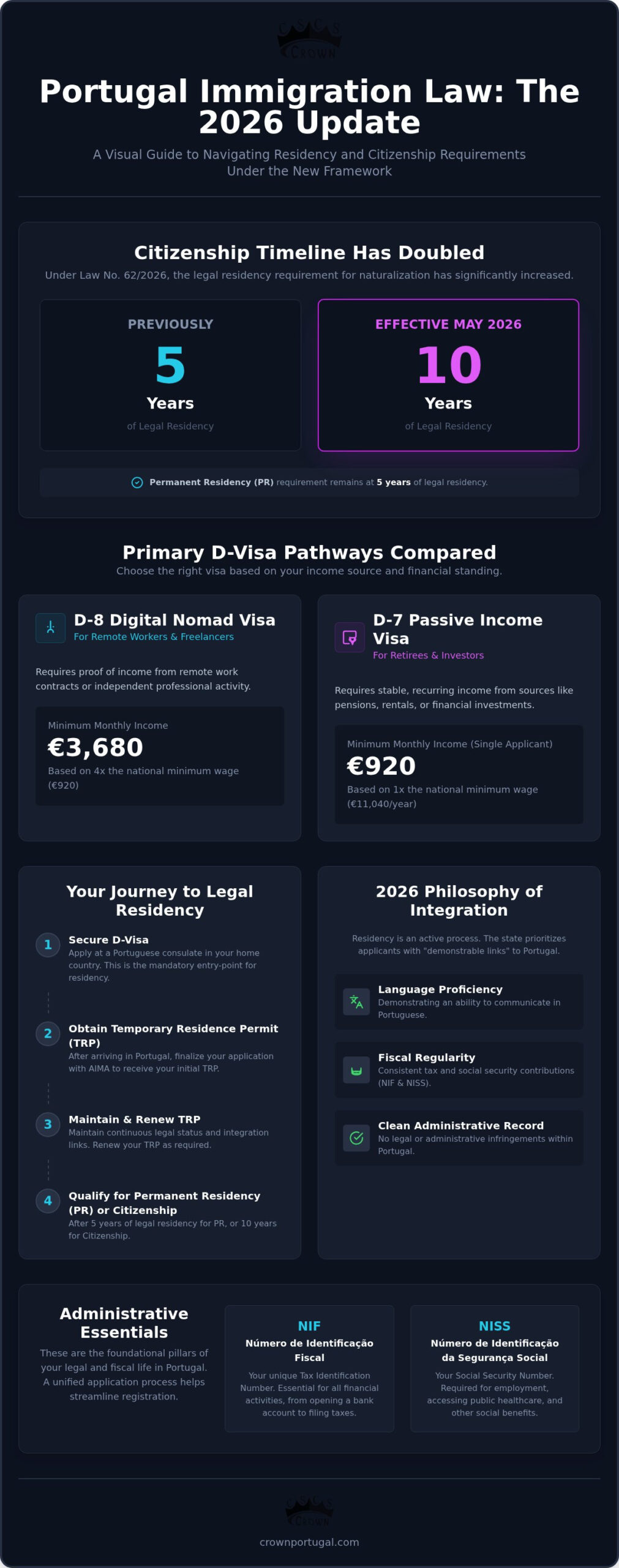
Understanding your status requires a clear grasp of legal categories. Short-stay visas are limited to 90 days within a 180-day period, while long-stay (D-series) visas are the prerequisite for residency. Once you enter the country on a D-visa, you’ll transition to a Temporary Residence Permit (TRP). Law No. 62/2026, which came into effect on September 11, 2026, has tightened these rules, mandating that all residency holders maintain continuous, documented legal status. While the requirement for Permanent Residency (PR) remains at five years, the path to citizenship has shifted significantly, making the maintenance of your TRP more critical than ever.
The 2026 Philosophy of Integration
The current legislative environment prioritizes “demonstrable links” to the Portuguese community. This includes language proficiency, fiscal regularity, and a clean administrative record. The state no longer views residency as a passive status but as an active process of integration. Crown Portugal serves as an authoritative intermediary in this landscape, providing expert consultancy to ensure your administrative record remains flawless. You can find more detailed updates on our YouTube channel. We help residents navigate the complexities of AIMA’s 90-day decision deadlines and the strict requirements of Portugal Immigration Law, ensuring that no detail is overlooked in your journey toward a stable future.
Primary Residency Pathways: D-Visas and Legal Articles
Selecting the appropriate entry pathway is the most critical decision in your relocation journey. Under the current Portugal Immigration Law, residency is categorized into specific D-series visas and legal “Articles” that define your rights and obligations. While many applicants focus solely on the most popular routes, understanding the full spectrum of Portugal residence permit types for immigrants ensures you select a path that aligns with your long-term goals and administrative capacity.
The D-Series Visa Spectrum
The Digital Nomad D-8 Visa remains a cornerstone for remote workers. In 2026, the financial threshold is strictly tied to the national minimum wage of €920. Applicants must demonstrate a monthly income of at least €3,680, which is four times the national minimum. This requirement must be supported by valid remote work contracts or proof of independent professional activity. For those with stable foreign income, the Passive Income D-7 Visa is the standard choice. It requires a minimum passive income of €920 per month, totaling €11,040 annually for a single applicant. A critical component of this application is the early acquisition of a Portuguese bank account and a funded balance that demonstrates financial self-sufficiency.
The Entrepreneur D-2 Visa serves those looking to establish or move a business. This path requires a comprehensive business plan and proof of sufficient capital. Applicants must show personal funds of at least €920 per month to cover living expenses, separate from business investment capital. If you’re unsure which financial criteria apply to your situation, you can review our detailed walkthroughs on the Crown Portugal YouTube channel. This resource helps clarify the specific documentation needed for each category.
Residency Articles for Students and Professionals
Beyond the standard D-visas, specific legal articles provide residency for specialized cases. Article 92 is designed for vocational students, requiring proof of enrollment in a recognized training program and financial means of at least €11,040 per year. For highly qualified professionals, the D-3 visa mandates a minimum monthly salary of €1,611.39, which is three times the Social Support Index (IAS). Article 122 provides essential coverage for specific residence permits, including the “K” variant for medical grounds and the “B” variant for other exceptional circumstances. Navigating these technical distinctions requires a process-oriented approach to ensure your application meets AIMA’s stringent standards. For personalized guidance on these complex requirements, you may wish to consult with an administrative expert who specializes in these specialized legal articles.
The 2026 Nationality Law: From 5 to 10 Years
The May 19, 2026, amendment fundamentally altered the residency requirement for naturalization. For most non-EU nationals, the eligibility period has increased from five to ten years. This change reflects a broader shift in Portugal Immigration Law, prioritizing long-term integration over rapid residency. EU and CPLP (Lusophone) nationals retain a slightly shorter pathway, with a seven-year requirement. It’s essential to recognize that applications filed on or before May 18, 2026, are still processed under the previous five-year rule, providing a clear cutoff for the administrative transition.
A critical administrative change involves how the state calculates your time in the country. Previously, there was ambiguity regarding whether the clock started at the time of application or issuance. Under the 2026 rules, the residency period for citizenship purposes officially begins only upon the issuance of the residence permit. This effectively eliminates the legal “grey zone” where applicants waited months or years for AIMA processing while hoping that time would count toward their citizenship goal. This methodical approach ensures that only periods of fully documented, permitted residency contribute to the naturalization timeline.
Impact on Golden Visa Holders
The D-9 category, commonly known as the Golden Visa, is not exempt from these extended timelines. Investors must now plan for a ten-year horizon before they can apply for a Portuguese passport. Maintaining eligibility requires strict adherence to the seven-day annual stay requirement. Families must carefully manage their residence permit renewals to ensure no gaps occur in their legal status over this decade-long period. This long-term strategic view is necessary because the D-9 category is now subject to the same general eligibility rules as other D-series visas under the updated Portugal Immigration Law.
Integration and Language Requirements
Beyond the extended timeline, the government has introduced more rigorous integration standards. While the CIPLE (A2 Level) Portuguese language exam remains a prerequisite, applicants must now demonstrate knowledge of “Portuguese National Symbols.” This includes an understanding of the national anthem, the flag’s history, and key historical figures. These requirements are designed to ensure that new citizens possess a deep, demonstrable connection to the state’s cultural identity. You can find updates on these evolving cultural requirements on the Crown Portugal YouTube channel. This platform provides ongoing coverage of how these integration standards are applied in real-world administrative interviews.
Administrative Compliance: NIF, NISS, and AIMA Logistics
Success under Portugal Immigration Law depends on the precise synchronization of fiscal registration and residency logistics. The administrative register is not merely a formality but a mandatory sequence of steps that establishes your legal footprint. Failing to secure these foundational numbers correctly can lead to significant delays in residence permit issuance and social benefit access. This methodical approach ensures that every facet of your residency is documented and compliant with the 2026 standards.
The Fiscal Foundation: NIF and NISS
The Tax Identification Number (NIF) is the absolute prerequisite for any economic activity, from signing a lease to opening a bank account. Since March 17, 2025, foreign residents have been able to apply for the NIF, Social Security Number (NISS), and National Health Service (SNS) user number through a single, unified application. This streamlining has reduced the complexity of the initial setup, though non-EU residents still require a fiscal representative to initiate the NIF process remotely before arrival. This representative acts as an intermediary with the Tax Authority until you establish a permanent local address.
As of April 2025, the NISS is mandatory for all new residence permit applications. This number ensures your integration into the social security system, providing the framework for healthcare access and future pension rights. You can find visual guides on managing these fiscal requirements and navigating the unified application portal on the Crown Portugal YouTube channel. Establishing this foundation early prevents administrative bottlenecks when you reach the biometrics stage.
Post-Arrival Administrative Tasks
Once you arrive in the country, the focus shifts to local registration and biometric data collection. Law No. 62/2026 mandates a structured approach to accommodation and residency verification. The “Atestado de Residência,” issued by your local Junta de Freguesia, serves as the primary proof of your physical residence and is essential for AIMA appointments.
- Step 1: NIF Acquisition. Secure your fiscal foundation before or immediately upon arrival to facilitate all legal contracts.
- Step 2: NISS Registration. Ensure your social security status is active, which is a requirement for both workers and entrepreneurs.
- Step 3: Address Registration. Register your accommodation to obtain the official certificate of residence for your local area.
- Step 4: AIMA Appointment. Attend your scheduled biometrics session where your physical data is collected for the residency card.
The statutory deadline for a decision on your residence permit application is 90 days, with a possible 30-day extension for complex cases. Professional document review is essential at this stage to prevent rejections based on technical errors in your submission. If you require expert assistance in managing this sequence and ensuring all documents meet the high standards of AIMA, you can secure our end-to-end administrative support to facilitate a smooth transition.
Navigating Portugal’s Legal Landscape with Crown Portugal
The 2026 updates to Portugal Immigration Law require a level of administrative precision that goes beyond simple form-filling. Crown Portugal acts as your authoritative guide through these legislative shifts. We map out every residency pathway for our clients, ensuring the transition from a temporary visa to a permanent permit is handled with absolute transparency. Our value lies in our disciplined professional approach, where we account for every detail to ensure your relocation remains stable and secure. We don’t just process applications; we manage the entire administrative register of your move.
Our Methodology and Expertise
Our firm brings a process-oriented mindset to every case. Since our establishment in 2018, we’ve developed a comprehensive understanding of the procedural requirements across the country. We prioritize clarity and exhaustive information, allowing our clients to feel secure in the hands of seasoned consultants. This “Welcoming Expert” persona combines local administrative expertise with a global professional standard. We break down broad topics into granular sub-categories, ensuring every facet of your residency is addressed and nothing is left to chance. This methodical arrangement lowers anxiety by presenting complicated tasks as a series of manageable, well-defined steps. Our national reach ensures that your documentation meets the standards of any regional AIMA office.
Consultancy and Resettlement Services
Managing the 2026 legal landscape involves a coordinated effort across fiscal, social, and logistical domains. We provide end-to-end support that standard government portals don’t offer. Our relocation services are designed to facilitate a smooth transition, combining technical knowledge with practical resettlement assistance. We focus on a predictable and logical flow of services to keep your journey on track. By acting as an active intermediary, we reinforce your legal compliance and official status throughout the relocation process.
Our comprehensive services include:
- Expert visa advisory for D-series pathways and meticulous document review to prevent AIMA rejections.
- Facilitation of NIF and NISS registration through the current unified application system.
- Professional assistance with Article 92 vocational permits and Article 122 residency cases.
- Logistical resettlement support, including airport pick up and assistance with finding accommodation.
Professional fees cover the entire scope of visa advisory, from the initial document audit to the final appointment scheduling. Whether you’re applying for a D-8 Digital Nomad visa or navigating the new 10-year citizenship rules, our expertise ensures your administrative record remains clean and compliant from day one. You can find more practical tips on managing your move on the Crown Portugal YouTube channel. To begin your relocation with expert clarity, you can Book a consultation with Crown Portugal to secure your 2026 residency path. Our team is ready to facilitate your entry into the community through a disciplined, expert-led approach that prioritizes your long-term residency rights.
Securing Your Future in the 2026 Portuguese Legal Landscape
The transition to the new ten-year naturalization timeline and the implementation of Law No. 62/2026 mark a new era for foreign residents. Success now depends on your ability to maintain a flawless administrative record from your first day in the country. You’ve learned how the unified fiscal registration system and specific residency articles, such as Article 92 and 122, create a structured path toward permanent status. Understanding the nuances of Portugal Immigration Law is no longer optional for those seeking long-term security. It’s a procedural necessity that requires a methodical approach to every filing and registration.
Since our founding in 2018, Crown Portugal has provided the comprehensive relocation support necessary to navigate these bureaucratic complexities. We specialize in ensuring your application meets the strict requirements of the 2026 legal framework. You don’t have to manage these procedural hurdles alone. Secure your Portuguese residency with Crown Portugal’s expert consultancy and begin your journey with absolute administrative clarity. We’re here to facilitate your successful integration into the community and ensure your residency rights are protected at every step.
Frequently Asked Questions
How long does it take to get Portuguese citizenship under the 2026 law?
Under the 2026 amendments, most non-EU nationals must complete ten years of legal residency before becoming eligible for citizenship. This is a significant increase from the previous five-year requirement. For EU and CPLP nationals, the threshold is now seven years. It’s important to remember that the residency clock officially begins only once your residence permit is issued, rather than at the date of your initial application.
Can I still apply for the Digital Nomad Visa in Portugal in 2026?
You can certainly apply for the Digital Nomad Visa, known as the D-8, in 2026. This pathway remains a core component of Portugal Immigration Law for remote workers. You’ll need to demonstrate a monthly income of at least €3,680, which represents four times the national minimum wage. This requirement applies to both short-stay and long-stay variants of the visa, provided you have a valid employment or service contract.
What is the biggest change in the 2026 Portugal Nationality Law?
The most impactful change is the extension of the general naturalization period from five to ten years for non-EU citizens. Additionally, the law now strictly defines the start of the residency period as the date your permit is granted. The new framework also introduces a requirement for applicants to demonstrate knowledge of national symbols and history, moving beyond the traditional A2 language proficiency to ensure deeper cultural integration.
Do I need a lawyer for my residency application in Portugal?
While you aren’t legally required to hire a lawyer for residency, navigating the administrative register requires precise expertise. Crown Portugal provides comprehensive relocation consultancy to manage your application process without the need for court representation. We ensure your documentation aligns with the latest requirements of Law No. 62/2026. This administrative support helps prevent common errors that lead to rejections or unnecessary delays during the AIMA review phase.
What happens if my AIMA appointment is delayed for several months?
If your AIMA appointment is delayed, your legal status is generally protected by the receipt of your application or your valid entry visa. Under Law No. 62/2026, the agency aims to provide a decision within 90 days, though complex cases can extend this by another 30 days. Maintaining a documented trail of your attempts to schedule and your fiscal regularity is essential for ensuring your rights remain intact during these waiting periods.
Is the A2 Portuguese language exam still required for residency?
The CIPLE (A2 Level) Portuguese language exam remains a mandatory requirement for those seeking permanent residency after five years or citizenship after ten years. This test evaluates your basic communication skills and is a key part of the integration process. In 2026, you’ll also need to prepare for additional questions regarding national symbols. We recommend starting your language studies early to ensure you’re prepared for this administrative milestone.
Can I get a NIF in Portugal without being physically present?
You can obtain a NIF without being physically present by appointing a fiscal representative to act on your behalf. This is a standard procedure for non-EU residents who need to open bank accounts or sign lease agreements before they arrive. Since March 2025, this process has been integrated into a unified system that eventually links your NIF with your social security and health numbers, creating a single administrative identity for your relocation.
What are the main differences between the D7 and D8 visas in 2026?
The primary difference lies in the source and amount of income required. The D7 visa is designed for passive income, such as pensions or rentals, requiring a minimum of €920 per month. In contrast, the D8 Digital Nomad visa is for active remote work income and requires a much higher threshold of €3,680 per month. Both pathways are essential parts of Portugal Immigration Law but serve different professional and financial profiles. For a detailed comparison of all available options, our guide on Portugal residence permit types for immigrants provides a meticulous breakdown of every pathway under the 2026 framework.