

Article 92 Portugal: Vocational Student Residence Guide
Could a vocational course lead to a temporary stay rather than a residence permit? Since 11 September 2026, Article 92 has a narrower scope in Portugal. Eligibility depends on the education pathway and the visa obtained before travel, not simply on enrolling in a vocational course.
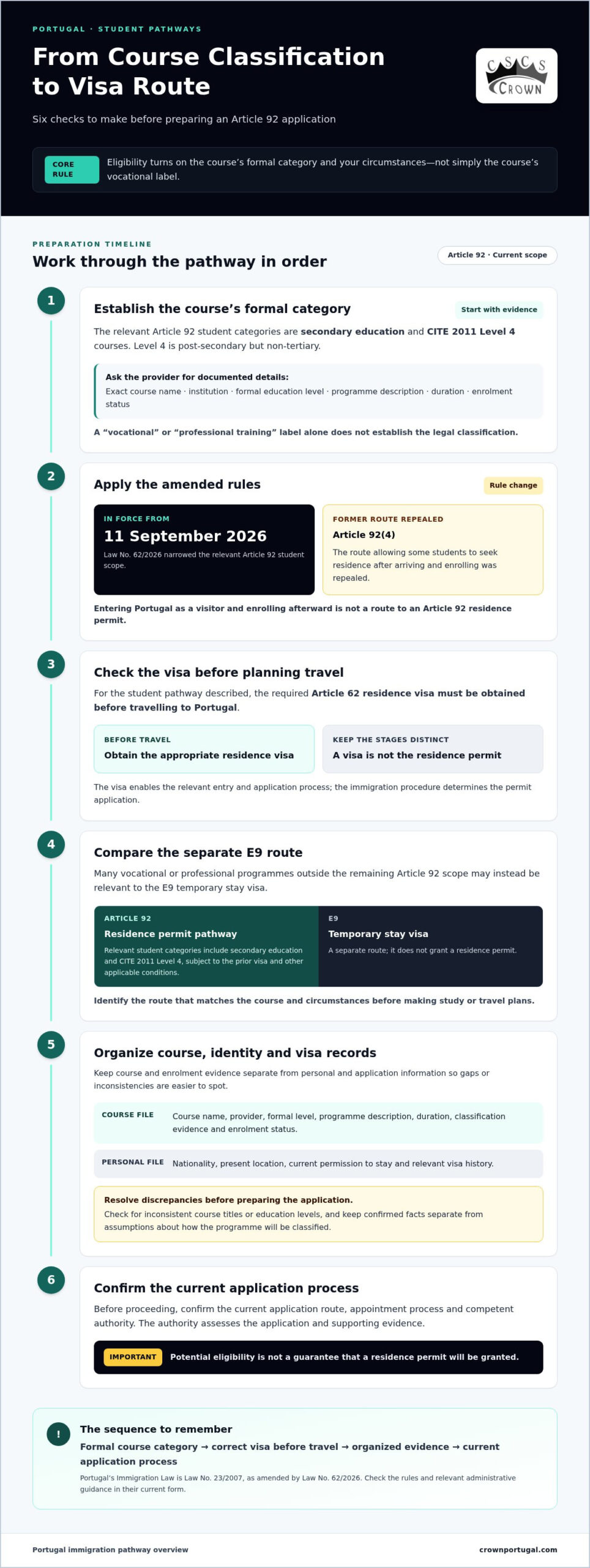
If you’re unsure whether your course and circumstances fit, start by separating the course’s everyday description from its formal education category. Portugal’s amended rules distinguish between students in secondary education or a CITE 2011 Level 4 course, who may qualify for an Article 92 residence permit if they hold the required prior visa, and many other vocational or professional training students, for whom the E9 temporary stay visa may be relevant. The former route that allowed some students to apply after arriving as visitors has ended.
This guide explains who Article 92 may cover, how it differs from the E9 route, and what to resolve before preparing an application. It also sets out which records to organize and how to spot gaps in course details, visa history and supporting documents. Crown Portugal assists with Article 92 applications through document review and application preparation. No preparation can guarantee an immigration decision, but understanding the current rules can help you avoid relying on an outdated pathway.
Key Takeaways
- Article 92 eligibility depends on the course’s legal category and your circumstances, not just the course’s vocational label.
- Identify the applicable visa pathway before planning travel or preparing a residence application.
- Sort course and enrolment evidence separately from identity and application documents so missing or inconsistent information is easier to spot.
- Confirm the current application route, appointment process and competent authority before taking the next step.
- Document review and structured application preparation can help surface inconsistencies and unanswered questions before submission.
What Is Portugal’s Article 92 Residence Permit for Vocational Students?
Article 92 is part of Portugal’s immigration framework, but it isn’t a general residence route for everyone enrolled in vocational training. As amended by Law No. 62/2026, in force from 11 September 2026, its relevant student scope is narrower than many older guides suggest.
In practical terms, Article 92 is a provision of Portugal’s immigration law that may allow eligible students in secondary education or a CITE 2011 Level 4 course to obtain a residence permit, subject to the required prior visa and other applicable conditions. This is a plain-language summary, not a quotation from the statute. Both the course category and the applicant’s circumstances matter.
How Article 92 Fits into Portugal’s Residence Permit Framework
Portugal’s Immigration Law, Law No. 23/2007, sets out rules for entry, stay and residence by foreign nationals. Its provisions must be read in their current form, including amendments introduced by Law No. 62/2026, and alongside relevant administrative guidance.
An entry visa and a residence permit are separate stages. For the student pathways described here, the applicant must obtain the appropriate residence visa under Article 62 before travelling to Portugal. The visa enables the relevant entry and application process; it is not itself the residence permit. The immigration procedure determines the permit application, so a course description alone does not establish an entitlement to reside.
Portugal has several residence permit pathways, each with its own legal basis and conditions. Comparing the broader categories in this Portugal residence permit types guide can help put a student application in context, but it doesn’t replace checking the rules for the specific pathway. For an overview of distinct statutory exceptions to the usual residence-visa requirement, see this Article 122 Portugal residency requirements guide.
Why Vocational Students Should Check the Legal Category
“Vocational,” “professional training” and “student” are broad descriptions. They may appear in course marketing, but the label alone doesn’t show how a programme is classified under immigration rules. Establish the course’s formal education level and category, then compare those details with the current legal criteria.
This distinction matters because the former Article 92(4) route, which allowed some non-EU nationals to seek residence after arriving in Portugal and enrolling in certain vocational courses, was repealed on 11 September 2026. Entering as a visitor and enrolling in a course afterward is no longer a route to an Article 92 residence permit.
Many vocational or professional programmes outside the remaining Article 92 scope may instead be relevant to the E9 temporary stay visa. That is a separate route and does not grant a residence permit. Before making study or travel plans, identify the course classification, the visa required before departure and the current application conditions. This helps distinguish general student terminology from the legal route being considered.
Who May Qualify for Portugal Article 92?
Eligibility depends on whether the applicant’s course and circumstances meet the rules currently in force. Under the amended framework, the relevant student categories are secondary education and CITE 2011 Level 4 courses, which are post-secondary but non-tertiary. Applicants must also hold the required residence visa before travelling and meet the other applicable conditions. A course marketed as “vocational” does not, by itself, establish eligibility.
Potential eligibility means that a student’s course and circumstances appear to fit the legal criteria; it doesn’t mean a residence permit will be granted. The competent authority assesses the application and supporting evidence. Establish the course category, visa route and individual facts separately rather than assuming enrolment settles all three.
Which Course Details Matter for an Article 92 Assessment?
Start with information the course provider can document: the exact course name, institution, formal education level, programme description, duration and your enrolment status. Request records that identify the course’s classification instead of relying only on a website description or informal explanation.
The legal category is decisive. Compare the documented level with the current criteria for secondary education or CITE 2011 Level 4 study. Keep confirmed facts, such as an enrolment certificate, separate from assumptions about how an authority will classify the programme. If documents use inconsistent course titles or levels, resolve the discrepancy before preparing an application.
How Personal Circumstances Can Affect Eligibility
The same programme may not lead to the same immigration route for every applicant. Nationality and current immigration status can affect which visa and application process applies. For the student route described here, the required residence visa must be obtained before travel to Portugal; arriving as a visitor and enrolling afterward does not replace that prior-visa requirement.
Record your nationality, present location, current permission to stay and relevant visa history before assessing the next step. These details help distinguish a planned application from an assumption that you can change status after arrival. They also help clarify which authority or process is relevant. For broader context on how Portugal’s rules fit together, consult the Portugal immigration law guide.
Assemble course and personal details in one file, then compare them with the current legal criteria and official guidance. Crown Portugal assists Article 92 applicants with document review and application preparation, helping identify inconsistencies and organize questions before submission. This support can structure your preparation, but the immigration authority makes the decision and approval isn’t guaranteed. Learn more about professional support for your application.
Article 92 Requirements: Organize Course and Application Evidence
Prepare documents as evidence for an assessment, not as a guaranteed checklist of everything an authority will request. Exact requirements can depend on the current application instructions, the route and your circumstances. Before submitting, compare your records with the latest official guidance. Separate documents that establish your course details from those that identify you and support the application.
A clear file structure makes missing pages, conflicting information and unresolved questions easier to spot. Begin with two folders:
- Course and enrolment evidence: records describing the programme, its level, provider and your enrolment status.
- Identity and application materials: personal identification, visa or status records, forms and other supporting evidence specified for your route.
Evidence Connected to the Vocational Course
Collect an enrolment confirmation and official information from the education provider that identifies the course and explains its level, content and duration. These details help assess whether the programme fits a legal category relevant to Article 92. Don’t infer the classification from promotional wording alone. Keep documented course facts separate from assumptions about how the programme will be treated under immigration rules.
Check that the course title and level match across the enrolment record and provider information. If the records use different descriptions, request a clear written explanation or corrected documentation from the provider. Assess the relevant category against the rules in force. Don’t assume that a particular accreditation or course format establishes eligibility without verification.
Preparing Personal and Supporting Records
Set aside identity documents and records relating to your visa, current immigration status and application history, where relevant to your circumstances. Follow the current official instructions for the exact documents, formats and submission method. This is a preparation framework, not a definitive list: requirements may differ by applicant and route.
Review each record for legibility and consistency. Names, dates of birth and passport details should correspond across documents. If there is a legitimate difference, such as a previous name, provide appropriate supporting evidence where required. Check whether the instructions request copies, originals or particular file formats.
Pay particular attention to documents issued outside Portugal. Translation, certification, legalisation and validity rules can depend on the document and the current instructions. Don’t assume translation or certification is required, or that it can be omitted. Verify the applicable requirement before arranging it, and check whether records must remain valid on the submission or appointment date.
For a final review, compare your file against the current application instructions and note anything missing, unclear or inconsistent. Crown Portugal provides document review and application preparation for Article 92 applicants, helping organize evidence and identify questions before submission. The review supports a more orderly application, but the competent authority makes the decision.
How to Prepare an Article 92 Residence Application Step by Step
Preparation has two parts: you organize and submit the evidence required for your case, while the competent authority manages the official application process and makes the decision. Use the sequence below to reduce avoidable gaps, but follow current instructions for your route rather than treating it as a fixed government checklist.
From Course Assessment to a Prepared Application File
First confirm that the documented course category appears to fit the current criteria. Then assemble course records and personal documents, check them for completeness and consistency, and identify anything that needs clarification. Before completing forms or arranging translations, consult the latest official requirements for your circumstances.
- Confirm the pathway. Compare the course’s formal level and details with the current eligibility criteria. Establish which visa and application route apply before making travel or submission plans.
- Collect supporting records. Gather the provider’s official course information and enrolment evidence, alongside the identity and status documents relevant to your case.
- Resolve discrepancies. Check names, dates and course descriptions across records. Obtain clarification or corrected documents where information conflicts, and verify any translation, certification or validity requirements.
- Check the application instructions. Review the current forms, document formats, submission method and appointment process for your route. Save a copy of the instructions you relied on.
- Conduct a final file review. Confirm that each requested item is present and legible, and that application details match the supporting evidence. Note unresolved questions instead of guessing at an answer.
Submission, Follow-Up, and Decisions
Before submitting, verify the competent authority and current procedure through official information. AIMA is Portugal’s immigration and asylum agency, but the correct submission channel and appointment arrangements can depend on the application route and current administrative instructions. Don’t assume a process described in older guidance remains available.
After submitting, retain copies of the application, supporting documents and any receipt or correspondence. Track official messages and respond to requests using the method and deadline specified in the communication. The authority assesses the file and decides the application. Preparation can make your evidence easier to review, but it can’t guarantee acceptance or a favourable outcome.
In short: confirm the route, verify the course, organize and check the evidence, follow current submission instructions, then retain records and monitor official correspondence. Appointment and decision times can vary, so rely on current authority information rather than an assumed timetable. Crown Portugal provides document review, application preparation and appointment scheduling for Article 92 applications. Find support preparing your application, with the understanding that the decision rests with the competent authority.
Get Professional Support with a Portugal Article 92 Application
Preparing a residence application involves more than collecting documents. You need to connect course information and personal records to the relevant pathway, identify inconsistencies and follow current administrative instructions. Structured support can help turn those tasks into a clear preparation plan, while the competent authority remains responsible for assessing eligibility and making the final decision.
What Structured Article 92 Support Can Address
Crown Portugal supports Article 92 applicants with document review, application preparation and appointment scheduling. A review can flag practical issues before submission, such as a course description that doesn’t clearly state its level, a spelling difference between personal records, or missing information that needs clarification. Identifying these questions early gives you time to organize your evidence and understand what remains to be addressed.
Application preparation can also put the process in a manageable order: organize applicant information, match supporting records to the application, and review relevant instructions and next steps. Appointment scheduling is part of the support, while appointment arrangements remain subject to the competent authority’s procedures.
Consultancy assistance helps with preparation; it doesn’t replace an authority’s assessment. Immigration rules and individual circumstances determine whether an application meets the applicable requirements, and no adviser can guarantee the outcome. A well-organized file can support a coherent application, but it cannot ensure approval.
Plan Your Next Steps with Crown Portugal
Before reviewing your case, gather details that make the discussion specific: the official course name and level, provider information, enrolment records, your nationality and current immigration status, and any relevant visa or application documents. Note discrepancies or unanswered questions rather than trying to resolve them through assumptions.
These details help focus the review on what is known, what needs clarification and which current instructions apply. Crown Portugal provides guidance and administrative preparation for Article 92 applications, helping applicants organize evidence and approach the process methodically. The competent authorities determine eligibility, and preparation support cannot promise a particular result.
If you’re considering this route, discuss your Article 92 application preparation with Crown Portugal. Having your course details and relevant records ready can make the next steps clearer.
Make Your Next Move with a Clear Plan
Before committing to travel or course arrangements, turn what you’ve learned into a short decision plan. Identify the pathway you believe applies, list the points that still need verification, and gather records that can answer them. This gives you a focused starting point for considering Article 92 and helps prevent assumptions from becoming application errors.
If your course category, visa route or supporting evidence raises questions, structured guidance can help you organize them and decide what to address next. Crown Portugal assists with document review and application preparation, while the competent authority remains responsible for assessing the application and making its decision.
Discuss your Article 92 application with Crown Portugal and take the next step with a clearer understanding of your preparation. A careful, informed approach can help you move forward with confidence.
Frequently Asked Questions
What is Article 92 in Portugal?
Article 92 is a provision in Portugal’s immigration framework connected to a residence route for certain students, including some vocational-study circumstances. Its scope changed under Law No. 62/2026, so older explanations may no longer reflect the rules in force. The article number identifies a legal basis, not an automatic entitlement. Assess the current criteria, application route and required evidence against your course and circumstances before relying on this provision.
Is Article 92 a visa or a residence permit?
They’re different permissions, even though people sometimes use the terms interchangeably. Under the amended rules, applicants in the relevant student categories must obtain the required residence visa before travelling to Portugal; the visa and residence permit are separate stages. The applicable process can depend on nationality, location and existing status. Confirm the route that applies to you and follow the relevant official instructions rather than assuming one process fits every applicant.
Can any vocational course qualify under Article 92?
No course title alone proves eligibility. Under the current scope, the relevant student categories include secondary education and CITE 2011 Level 4 courses, subject to the required visa and other conditions. A programme described as “professional training,” for example, may not fit those categories simply because it is vocational. Obtain official course information and enrolment evidence, then compare the formal classification with current legal requirements before making study or travel plans.
Can an Article 92 residence permit allow the holder to work?
Don’t assume that student enrolment or a residence document automatically authorizes employment. Work rights depend on the legal basis of the person’s permission, the rules in force and their specific status; different forms of work may also be treated differently. Before accepting paid work or signing an employment agreement, check current official guidance for your exact permit and circumstances, including whether a separate authorization or notification is required.
How long does an Article 92 application take in Portugal?
There isn’t one reliable end-to-end timeframe for every applicant. The wait may depend on the current appointment process, the completeness of the file and the competent authority’s workload. Appointment waits and application decision times are separate stages, so don’t treat an estimate for one as a promised decision date. Follow current official instructions, retain submission receipts and copies, and keep records of authority correspondence while waiting.
What happens if my course or personal circumstances change after applying?
A change may affect facts or conditions considered in your application, but its effect depends on the details and current rules. For example, a revised course level or a change in your immigration status could make earlier information incomplete. Review official instructions or messages promptly, preserve documents showing what changed and when, and seek qualified immigration guidance if you’re unsure how to respond. Don’t assume the application is automatically cancelled or remains unaffected.
Can my family apply for residence with me under Article 92?
Family members don’t automatically receive residence through a student’s application. Their options may fall under separate family residence provisions and can depend on your status, each relative’s circumstances and the requirements in force. For example, a spouse’s application may require its own assessment rather than being treated as part of the student’s course file. Check the relevant family route independently and use accurate information about the principal applicant’s status.
Portugal Residence Permit Types: A Comprehensive Guide – Crown Portugal at 10:53 am, October 12, 2026 -
[…] Article 92 Portugal: Vocational Student Residence Guide […]