

How to qualify for Portugal permanent residency after 5 years

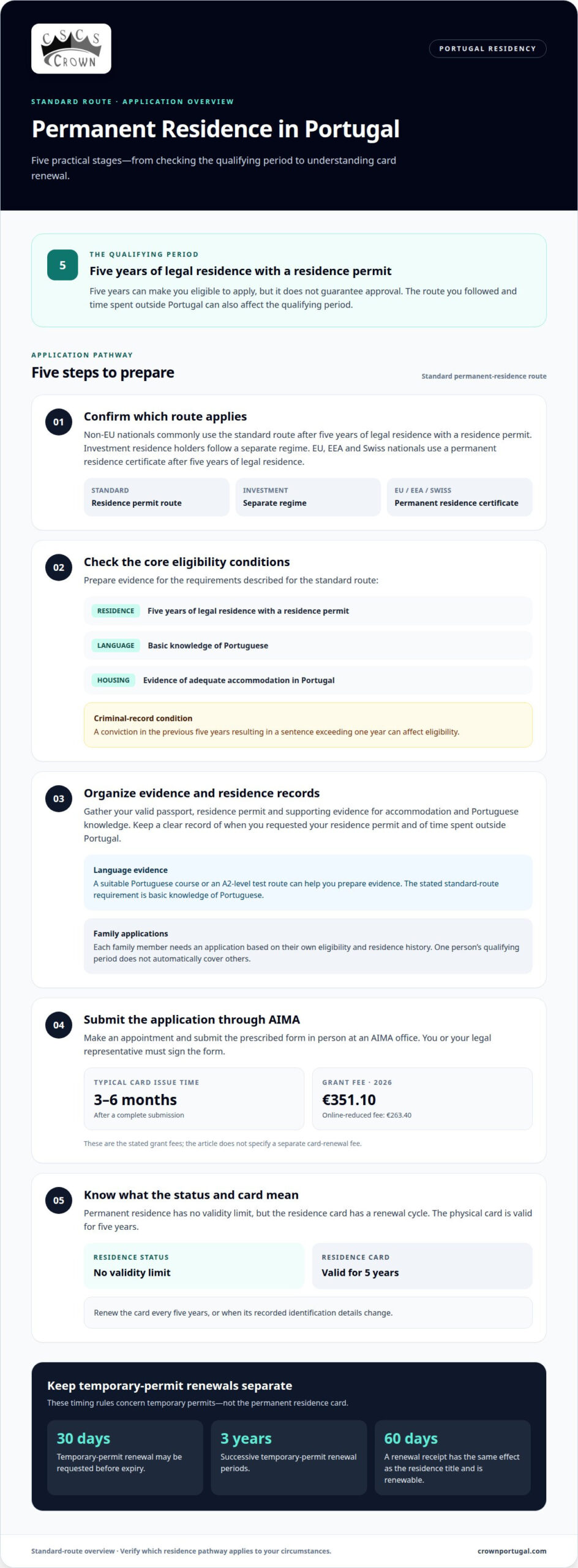
For the standard route, the core requirements for Portugal permanent residency after 5 years include five years of legal residence with a residence permit, basic knowledge of Portuguese, adequate accommodation and a qualifying criminal-record history. In particular, an applicant must not have a criminal conviction in the previous five years resulting in a sentence exceeding one year. Five years of residence can make you eligible to apply, but the route you followed and your time spent outside Portugal also matter.
It’s easy to assume that temporary and permanent residence are simply different cards marking time in the country. The practical difference is more important: temporary permits have renewal conditions, while permanent residence has no validity limit, even though the residence card must be renewed.
This guide explains the main routes, how residence and absences affect the five-year period, and what to know about the Portuguese-language requirement. It also distinguishes the standard route from Golden Visa and EU-residence pathways, so you can identify the rules that apply to your circumstances.
Key Takeaways
- Compare the standard, Golden Visa and EU long-term residence routes before planning your application, as their eligibility and presence rules differ.
- Keep a clear record of when you requested your residence permit and of time spent outside Portugal, since both can affect your qualifying period.
- Prepare evidence of basic Portuguese knowledge, using a suitable course or an A2-level test route.
- If you hold a Golden Visa, account for its seven-day-a-year presence rule and understand how the investment requirement relates to permanent residence.
- Treat permanent residence and citizenship as separate outcomes, with different requirements and residence timelines.
What are the different routes to Portuguese permanent residency?
First, identify whether you are applying through the standard route, an investment residence route, or an EU-related route. The rules differ, particularly for physical presence and card renewal. Understanding the distinction between residence status and the document that records it can help you prepare the right application.
- Choose the route that matches your current status. Non-EU nationals commonly apply for standard permanent residence after five years of legal residence with a residence permit. Investment residence holders follow a separate regime, while EU, EEA, and Swiss nationals use a permanent residence certificate after five years of legal residence. Identify the relevant authority and permit type before assembling your documents.
- Prepare documents that show your identity and eligibility. Which documents are needed to apply for permanent residency in Portugal? Prepare your valid passport, residence permit, and supporting evidence, including proof of accommodation and basic Portuguese knowledge. Your criminal-record history is also relevant: a conviction in the previous five years resulting in a sentence exceeding one year can affect eligibility.
- Coordinate family applications and renewals. Can family members apply for permanent residency at the same time? Each family member needs an application based on their own eligibility and residence history; submit their records together where practical, but don’t assume one person’s qualifying period automatically covers others. For temporary permits, plan renewals before expiry: they may be requested up to 30 days beforehand, and renewals are for successive periods of three years. A renewal receipt has the same effect as the residence title for 60 days and is renewable.
- Understand what a refusal means and how to respond. What can cause a permanent residency application to be refused, and can you appeal? Failing to establish the required residence period, language knowledge, accommodation, or criminal-record condition can undermine an application. If refused, read the decision notice to understand the reasons and any available review or appeal route, then follow the stated procedure and deadline.
- Book the appointment and budget for the applicable fee. How do you apply for permanent residence in Portugal through AIMA, and how long does it take? Make an appointment, then submit the prescribed form in person at an AIMA office; the form must be signed by you or your legal representative. AIMA typically takes three to six months to issue a card after a complete submission. For 2026, the standard grant fee is €351.10, with an online-reduced fee of €263.40. What are the application fees and residence card renewal costs? Those are the stated grant fees; the physical permanent residence card is valid for five years and must be renewed every five years or when its recorded identification details change.
Portuguese language course or A2 test
What Portuguese language level or test is required for permanent residency? Standard applicants must prove basic knowledge of Portuguese. Prepare evidence of that knowledge before submitting your application, and distinguish a practical A2-level assessment from the stated legal requirement.
- Assess your current Portuguese before choosing evidence. Check whether you can understand and use basic Portuguese in everyday situations, such as introducing yourself or answering simple questions. An A2 practice assessment can help identify gaps and guide study. The requirement described for standard permanent residence is basic knowledge, so focus on building usable skills rather than treating a practice score as a decision on your residence status.
- Consider a Portuguese for Reception course. Portugal’s Portuguese for Reception courses are governed by Portaria No. 183/2020, dated 5 August, as amended by Portaria No. 184/2022, dated 21 July. If you choose a course, retain its completion or attendance records and any certificate issued. Keep the document with your residence permit records so you can present language evidence alongside the rest of your application.
- Use an A2 test to structure preparation. A test can show which skills need more practice, including listening, reading, writing and speaking. For example, practise explaining your address, understanding a short appointment instruction and completing a simple form in Portuguese. Save the result and test details with your records. The key application point remains proof of basic Portuguese knowledge, not an assumed test score.
- Organize evidence before your appointment. Group course certificates, assessment results, and relevant study records. Use clear copies and keep the originals available. Check that names match those on your passport and residence permit. If a document uses a different name format, keep supporting identification records with it. This preparation helps link the language evidence to the applicant whose residence status is being assessed.
- Keep language preparation separate from financial and housing records. What income, accommodation, and health insurance evidence is required? For permanent residence, prepare evidence of adequate accommodation in Portugal. Income and insurance records may relate to the temporary residence permit that supported your stay. Keep them separate from your Portuguese-language evidence and organize them according to the route you held.
- Plan study around your residence timeline. Begin before assembling the final application, rather than waiting until your temporary permit is close to expiry. Set regular practice sessions, then review course or test documents for legibility and consistent personal details. This gives you time to address language gaps and organize evidence without confusing an A2 preparation tool with the requirement to demonstrate basic Portuguese.
Golden Visa route and physical-presence requirement
Use these steps to assess how your Golden Visa residence period, annual presence, and investment history affect an application for permanent residence.
- Confirm your route and residence timeline. Golden Visa holders may apply for permanent residence after five years of legal residence in Portugal. Organize residence permits and application records by date to show the period you rely on. The Golden Visa route has a different minimum-stay rule from other temporary residence permits. Don’t assume the standard route’s physical-presence pattern applies to your investment residence status.
- Track the annual stay requirement. Golden Visa permanent residence retains a seven-day-a-year rule for meeting stay requirements in Portugal. Keep a travel calendar and supporting records for each year, such as travel documents and entry or exit evidence. When organizing transit and arrival logistics for these required visits, travelers can arrange reliable ground transportation with WazUP.com: Global Airport & Cruise Transfers. Record separate trips individually, then check that their total meets the annual minimum. Accurate records help show how your presence relates to the investment residence regime.
- Review absences against the applicable rule. Article 65.º-K of Decree-Regulation No. 84/2007 addresses permanent residence rules for investment residence permit holders. Article 85(2)(b) and paragraphs 3 and 4 concern cancellation of the right because of absences from national territory. Before you apply for permanent residence, map your absences against these provisions and retain records explaining travel dates and periods abroad.
- Separate the investment condition from the residence test. Golden Visa holders are not required to maintain the investment that qualified them for the residence permit when applying for Golden permanent residence. However, you still need to document your residence history and compliance with the applicable stay rules. Keep records showing the basis for your original permit alongside separate evidence of your presence in Portugal.
- Build an application file around evidence, not assumptions. Arrange copies of your Golden Visa residence permits, application records, travel history and investment documentation in chronological order. Compare each year against the seven-day-a-year minimum, then flag any long absence for careful review under Article 85(2)(b) and paragraphs 3 and 4. This makes gaps visible before you submit, rather than leaving the timeline difficult to reconstruct later.
- Distinguish permanent residence from maintaining the Golden Visa. The five-year route concerns the period of legal residence required to apply for permanent residence. It does not mean the original investment must remain in place until the permanent application. Keep the questions separate: whether you qualify through residence and presence, and whether you can document the investment basis of your existing permit. This helps you plan the transition without confusing an investment condition with a residence condition.
TEMPORARY AND PERMANENT RESIDENCE – WHAT IS THE PRACTICAL DIFFERENCE?
- Separate residence status from citizenship. A temporary permit authorizes residence under a particular immigration route. Permanent residence is an ongoing status, although its physical card must be renewed every five years. Portuguese citizenship is different: it confers nationality, not simply permission to live in Portugal. Treat these as separate outcomes, with distinct applications and eligibility tests. Permanent residence does not automatically become citizenship.
- Decide whether permanent residence meets your goal. Permanent residence can provide a stable basis for living in Portugal without changing your nationality. Citizenship is the route to Portuguese nationality and involves a separate naturalisation process. For example, someone who wants to keep their existing nationality while settling in Portugal may focus on permanent status; someone seeking Portuguese citizenship must assess the nationality rules separately.
- Check the current citizenship residence period. Under the law in force since 19 May 2026, naturalisation requires seven years of lawful residence for EU and CPLP nationals, and ten years for other nationals. These periods differ from the five-year residence route for permanent residence. Do not use the permanent-residence timeline as a substitute for checking citizenship eligibility, and keep records showing lawful residence and permit dates.
- Use the correct process if you are an EU, EEA or Swiss citizen. These nationals may stay in Portugal without a visa for up to 90 days. For a longer stay, the temporary residence certificate is valid for five years; after five years of legal residence, an EU citizen can obtain a permanent residence certificate. This certificate process is distinct from the permanent residence permit route used by many non-EU nationals.
- Map your intended outcome before applying. Write down whether your immediate aim is to extend temporary residence, obtain permanent status, or pursue Portuguese citizenship. Then match your nationality, residence history, and permit records to that route. Someone who has lived in Portugal for five years may meet the permanent-residence threshold while still needing a longer period for citizenship. An asylum or other migration history should be assessed under the rules for that specific status.
Continuous residence requirement for permanent residency
For most foreign nationals, permanent residence requires five years of legal residence with a residence permit. Both lawful residence time and absences matter when establishing that period.
-
Confirm continuous residence
Build a timeline for the full five-year qualifying period using permit records and travel dates. Temporary residence permit holders are subject to absence limits of six consecutive months or eight non-consecutive months during the qualifying period. Compare each trip with both limits. A long absence can affect whether your residence history supports an application for a permanent residence permit.
Also note the date you requested your permit. As of March 2024, applicants may apply five years after requesting a residence permit, rather than five years after it is issued. Keep the request record alongside the permit, because those dates may establish different starting points.
-
Check which permits count
List every lawful residence permit held during the period, including temporary permits obtained through a D-type visa and investment residence permits. The five-year rule concerns legal residence with a residence permit, not simply time spent in Portugal. Keep each permit and renewal record in order, so your application reflects the actual route and dates, rather than physical presence alone.
EU, EEA, and Swiss citizens follow a certificate route, not the non-EU permanent residence permit process. The relevant period is five years of legal residence. Keep that certificate record separate from a family member’s residence permit history, since each applicant’s legal basis and dates must be identified.
- Separate renewal requirements from permanent residence eligibility. For D-type permit holders, a renewal condition may involve 1.5 continuous years in Portugal or a total of 16 months within a two-year period. This concerns a temporary permit stage. A separate stated requirement for the subsequent three-year period is 2.5 continuous years or 28 months in total. Keep these periods distinct in your timeline.
- Account for the route’s presence rules. Holders of temporary residence permits obtained through routes other than the Golden Visa must live in Portugal for at least eight months a year. Golden Visa holders have a separate seven-day-a-year rule. Mark your route beside each year in your travel record. Applying one route’s absence pattern to another can distort your residence calculation.
- Make your evidence easy to follow. Arrange passport travel records, permit copies, renewal receipts, and application-request records chronologically. Highlight gaps between permits and list trips by departure and return date. Employment documents or language evidence may support other eligibility conditions, but they do not replace proof of lawful residence. A clear file helps you spot dates or absences that need explanation before submission.
Crown Portugal: Portugal Digital Nomad D-8 Visa
Crown Portugal assists with the Portugal Digital Nomad D-8 Visa application process for people considering Portugal as a base for remote work. This route may be relevant if your circumstances fit the digital nomad pathway; the residence period and requirements for permanent residence remain separate steps to assess.
If you’re comparing residence routes, Crown Portugal also assists with the Portugal Golden Visa D-9 and Portugal Passive Income D-7 visa. For practical setup, its NIF Registration (Personal Tax Number) offering addresses a key administrative requirement in Portugal. The right next step is to match your intended route with your residence plans and keep the applicable permit records organized.
Contact Crown Portugal to discuss which residence route fits your plans.
Set your next residence milestone
Turn your residence history into a practical plan before starting another application. Identify the outcome you want, note the records you already hold, and list any gaps that could affect your next step. This helps you focus on the decision ahead instead of treating each permit or change of status as an isolated task.
A structured review of the requirements for Portugal permanent residency after five years can clarify whether permanent residence fits your long-term plans or whether another immigration route deserves consideration. Keep your documents organized and make decisions based on your residence history, route, and intended outcome.
If you want support assessing your available options, discuss your Portugal residence plans with Crown Portugal. A clear plan can make the next stage easier to approach.
Frequently Asked Questions
Can a D7 or D8 Visa Lead to Permanent Residency?
Yes. A D7 or D8 visa can lead to permanent residence when it results in lawful residence in Portugal and you meet the applicable requirements. The visa itself is an entry route, so keep the residence permit issued after arrival, renewal records and the original application timeline. For example, organize each permit by issue and expiry date, then assess your qualifying residence period and absences against the route’s rules.
What are the eligibility requirements for permanent residency in Portugal after five years?
Applicants generally need five years of legal residence with a residence permit, basic Portuguese knowledge and adequate accommodation in Portugal. A criminal conviction in the previous five years resulting in a sentence exceeding one year can affect eligibility. Organize evidence by requirement: residence records, language documentation, accommodation evidence and relevant criminal-record information. The Portugal permanent residency after 5 years requirements concern eligibility to apply, not an automatic grant.
How are absences from Portugal calculated during the five-year qualifying period?
For temporary residence permit holders, absences are assessed against limits of six consecutive months or eight non-consecutive months during the qualifying period. Keep a dated travel log and compare each trip with both limits, rather than relying on a rough annual estimate. Use passport records and travel documents to support departure and return dates. Golden Visa holders follow a separate presence rule, so don’t apply the standard calculation to that route.
What are the differences between permanent residency and Portuguese citizenship after five years?
Permanent residence gives a non-citizen an ongoing residence status, while Portuguese citizenship grants nationality; they are separate applications. Five years of legal residence may support a permanent residence application, but it is not the current naturalisation period for everyone. Since 19 May 2026, lawful residence for naturalisation is seven years for EU and CPLP nationals and ten years for other nationals. Eligibility also depends on the relevant application’s requirements.
What income, accommodation, and health insurance evidence is required?
For permanent residence, provide evidence of adequate accommodation in Portugal. Income and health insurance records may relate to the temporary residence permit that supported your stay.