

Portugal health grounds residence visa routes and healthcare access
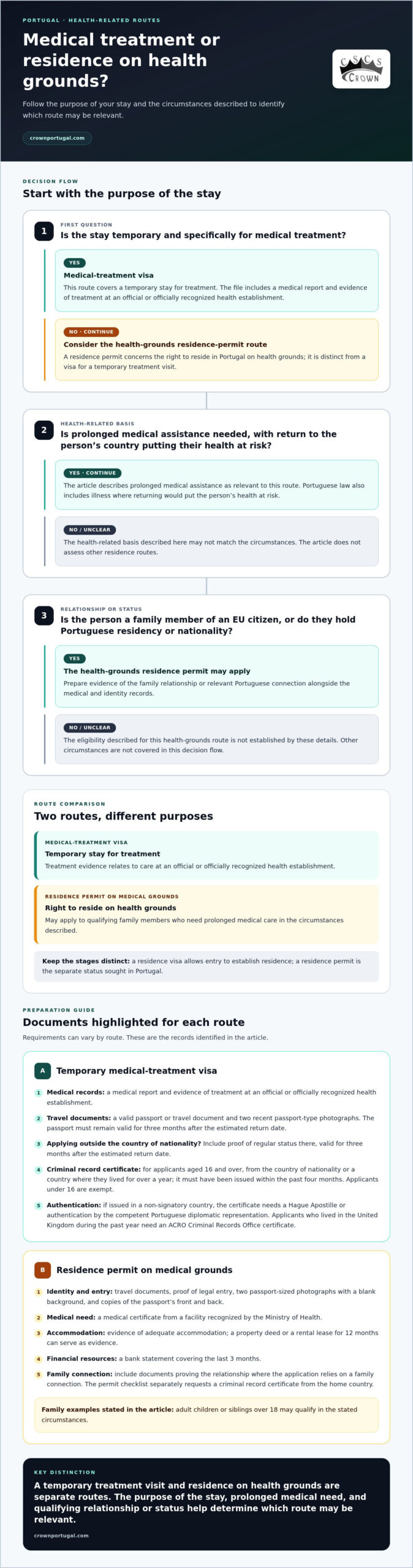
There are two distinct routes to understand: a temporary stay visa for medical treatment and a residence permit on medical grounds. A Portugal health grounds residence visa application concerns the residence-permit route, which may apply to someone who needs prolonged medical care and is a family member of an EU citizen or holds Portuguese residency or nationality. Portuguese law also includes illness that makes return a risk to the person’s health, according to Imprensa Nacional-Casa da Moeda, S.A.
It is understandable to see “visa” and “residence permit” used together, but they serve different purposes. A medical-treatment visa covers a temporary stay, while a residence permit concerns the right to reside in Portugal on health grounds. Neither route means automatic access to public healthcare: legal residents can register with Portugal’s National Health Service, the Serviço Nacional de Saúde (SNS).
This guide explains which route may fit, which documents applicants may need to prepare, how a visa differs from a permit, and how SNS access works. It clarifies the distinction between medical treatment and residence on health grounds, helping you identify which process relates to your circumstances.
Key Takeaways
- Distinguish a temporary stay for medical treatment from a residence permit based on health grounds; the relevant route depends on the purpose and circumstances of the stay.
- Prepare supporting records carefully, including medical evidence, travel documents, proof of accommodation and financial documents where required.
- Health insurance rules can vary by visa route and may include exemptions for some applicants covered by medical-assistance or mobility arrangements.
- Learn how temporary residence can progress toward longer-term status, and what legal residence means for accessing Portugal’s public healthcare system.
- Compare health-related routes with other residence categories, including work-based options such as Portugal’s Digital Nomad D-8 Visa.
Documents needed for residency in Portugal
Portugal’s medical-grounds residence permit may apply to qualifying family members who need prolonged medical care. Prepare documents that establish identity, legal entry, medical need, accommodation, finances and the family relationship.
General visa and permit paperwork
A residence visa allows entry to establish residence; a residence permit is the separate status sought in Portugal. Keeping these stages distinct helps you prepare the correct documents for each application.
For a residence visa, prepare a valid passport or travel document, two recent passport-type photographs and supporting evidence for the chosen purpose. The passport must remain valid for three months after the estimated return date. Applicants applying outside their country of nationality also need proof of regular status there, valid for three months after the estimated return date.
For a medical-grounds permit, the requested paperwork includes travel documents, proof of legal entry and evidence of adequate accommodation. A property deed or a rental lease for 12 months can serve as accommodation evidence. Prepare a bank statement covering the last 3 months to show financial resources.
Criminal records and purpose-based documents
A criminal record certificate is part of the medical-treatment visa documentation for applicants aged 16 and over. It must come from the applicant’s nationality country or a country where they lived for over a year, and must have been issued within the past four months. Applicants under 16 are exempt.
If issued in a non-signatory country, the certificate needs a Hague Apostille or authentication by the competent Portuguese diplomatic representation. Applicants who lived in the United Kingdom during the past year need an ACRO Criminal Records Office certificate. These rules concern the temporary medical-treatment visa; the medical-grounds permit checklist separately requests a criminal record certificate from the home country.
Other documents depend on the purpose of stay: D1 employment applicants need evidence of professional qualifications when their profession is regulated in Portugal. D2 applicants provide company articles or a service-provider contract, as applicable, and evidence of their project’s economic or social relevance. Vocational-study applicants may show admission to a National Qualifications Framework level 4 or 5 course, plus means, travel insurance and health insurance.
Medical needs and family applications
A Portugal health grounds residence visa application relates to a residence permit on medical grounds, not simply a short treatment visit. This route may apply to someone who is a family member of an EU citizen or holds Portuguese residency or nationality.
Qualifying needs involve prolonged medical assistance. Portuguese law includes illness requiring that assistance when returning to the person’s country would put their health at risk, according to Imprensa Nacional-Casa da Moeda, S.A. The permit documents include a medical certificate from a facility recognized by the Ministry of Health, two passport-sized photographs with a blank background, and copies of the passport’s front and back.
Family members may qualify, including adult children or siblings over 18 years old in the stated circumstances. Applicants should include documents proving their relationship, alongside the medical certificate and identity documents. These records help establish both the family connection and the health-related basis for the application.
How does temporary residency work in Portugal, and how can it lead to permanent residency?
A temporary residence permit gives its holder a defined period of legal residence, with renewal conditions that affect continued status. Requirements vary by route, particularly for health insurance, income and the purpose of the stay.
Depending on the visa category, applicants may need proof of funds, accommodation and health insurance. For medical treatment, the file includes a medical report and evidence of treatment at an official or officially recognized health establishment. This evidence concerns treatment arrangements, not a general medical referral.
Permit validity, renewal and absences
Temporary residence permits have a defined validity period and may be renewable. Plan renewal before the current permit expires.
Submit a renewal application no later than 30 days before expiry. Renewal requires evidence of means of subsistence and accommodation, plus compliance with Portuguese tax and contribution obligations. A permit may be refused renewal or cancelled if its holder is absent without an acceptable reason for six consecutive months or eight non-consecutive months.
After five years of legal residence, a resident can apply for permanent residence or EU long-term resident status. Permanent residence has its own conditions, including means of subsistence, accommodation and proof of basic knowledge of Portuguese. The change is not automatic: residents must apply for the relevant status and provide the required evidence.
Language, funds and accommodation requirements
Proof of funds and accommodation depends on the route. For a residence-permit application, a property deed or rental lease for 12 months may show adequate accommodation. Financial evidence can include bank statements; a medical referral is distinct from the medical report and proof of a treatment arrangement required for medical care.
Health insurance rules also vary. For Portugal’s temporary stay medical-treatment visa, insurance must provide at least €30,000 in medical coverage and remain valid for the full visa period, which can be up to one year and is renewable. Some beneficiaries of bilateral or international medical-assistance agreements, including holders of Brazil’s PB4 or the United Kingdom’s S1, may have a stated requirement waived.
Recognized higher-education students and researchers may be exempt from specified insurance, travel-insurance and subsistence requirements under Article 91-B of Law 23/2007. For medical-treatment applicants under the CPLP Mobility Agreement, a specified statement of responsibility can exempt them from travel insurance, proof of means and a return ticket.
Remote workers considering the D8 route face a separate income test: the monthly requirement is at least four times Portugal’s minimum wage, approximately €3,280 per month in 2026. This category is designed for overseas-source income, so evidence should demonstrate that income basis rather than medical treatment.
What is the difference between a residence visa and a residence permit?
A residence visa allows a third-country national to enter Portugal to establish residence; a residence permit is the separate status applied for after arrival. This distinction affects when you apply, how long each document is valid, and what healthcare cover you may need during the transition.
Purpose and validity of each document
A residence visa is requested in the applicant’s country of origin. For a third-country national seeking to establish residence, it is valid for four months, allowing entry to Portugal and time to apply for a permit. The visa does not guarantee that a residence permit will be granted.
A temporary stay visa for medical treatment serves a different purpose: it covers a short-term stay under one year. It is not the four-month residence visa used to enter Portugal and seek residence status. Match the document to the planned stay, whether it is a treatment visit or a move to establish residence.
After entering on a residence visa, the next step is to apply for a residence permit through AIMA. D visa holders have four months from entering Portugal to apply. The permit, rather than the entry visa, establishes the holder’s residence status in Portugal.
Passport, photographs and insurance
For a residence visa application, the passport or other travel document must remain valid for three months after the estimated return date. Applicants must also provide two recent passport-type photographs in good condition, including one for the form. These identity documents support the visa application before travel.
For a medical-treatment visa, travel insurance must have a minimum validity of six months from the appointment date. The medical-treatment visa checklist also requires insurance with at least €30,000 in medical coverage. These are separate details to account for when preparing cover for the application.
Health insurance for the D8 Digital Nomad Visa must remain valid for the full visa period, which can be up to one year and is renewable. By contrast, a residence permit holder may travel within the Schengen Area for up to 90 days in any rolling 180-day period. That travel allowance describes the permit holder’s stay in other Schengen countries; it does not define the territorial coverage of an insurance policy.
How the route differs by purpose
The visa category reflects the reason for travel. For example, workers may apply through an employment route, while applicants with recurring pension, rental or investment income may consider the D7 route. Medical treatment uses its own temporary visa documentation, while residence on medical grounds concerns a residence permit application.
Family members need their own applications and supporting documents, even when travelling with a principal applicant. Identifying whether the goal is treatment, employment, passive income or residence on medical grounds helps determine which visa process applies and which permit step follows.
Residence permit routes and visa categories
Portugal offers different residence routes according to purpose, including health grounds, employment, study and income. The right category determines the initial visa process, the permit application and the rights attached to residence.
Visa and permit distinctions
A residence visa allows a third-country national to enter Portugal and seek residence; the residence permit establishes residence status after arrival. This distinction matters because a visa alone does not guarantee a permit. D visa holders have four months from entering Portugal to apply for a residence permit through AIMA.
The residence-permit application decision period is 90 business days under Portuguese law, although actual processing may take several months. A residence visa for establishing residence is valid for four months. A temporary stay visa for medical treatment instead covers a short-term stay under one year.
The listed residence-permit application fee is approximately €83-€90, with an issuance fee of about €72. These are application and document fees, not a guarantee of approval. Applicants should distinguish the visa application from the later permit stage when planning submission and arrival.
Comparing health grounds and other routes
The health-grounds route concerns residence for prolonged medical assistance, while a medical-treatment visa covers a temporary treatment stay. Portuguese law includes illness requiring prolonged medical assistance when returning to the person’s country would put their health at risk, according to Imprensa Nacional-Casa da Moeda, S.A.
Other permits reflect different purposes. D1 is for employment, D2 for entrepreneurship, D3 for highly qualified work, D4 for study, D7 for passive income and D8 for remote work. Their evidence relates to employment, business activity, admission, income or overseas work, rather than the medical circumstances relevant to a health-based application.
For D1, an applicant must show professional qualifications when the profession is regulated in Portugal. D2 applicants provide company articles or a service-provider contract, as applicable, and show the project’s economic or social relevance. These requirements illustrate why an employment or business route cannot simply replace medical grounds.
A medical-treatment visa requires proof from an official or officially recognized health establishment that hospitalization or outpatient treatment is arranged. Under a cooperation agreement, applicants also provide a medical committee document and evidence of a scheduled appointment in Portugal. These treatment documents differ from evidence supporting residence on health grounds.
Residence-permit holders have the right to family reunification and may travel within the Schengen Area for up to 90 days in any rolling 180-day period. A residence permit is therefore relevant beyond entry: it establishes status in Portugal and permits specific associated rights. The route chosen determines the basis for that status and the evidence submitted.
Access to Portugal’s National Health Service
Legal residents of Portugal can register with the Serviço Nacional de Saúde (SNS) and access public healthcare facilities throughout the country. When planning a move for health reasons, distinguish immigration status from healthcare registration: permission to reside and registration with the national health service are related but separate steps.
Residence status and SNS registration
The SNS is Portugal’s National Health Service, and legal residence is the basis for registration described here. A residence permit and SNS registration serve different purposes: the permit establishes residence status, while registration connects a legal resident with public healthcare facilities.
Keep these steps distinct when planning care. A visa or application concerning medical treatment does not, by itself, establish SNS registration. The route matters because a temporary stay for treatment and legal residence in Portugal are different circumstances.
For someone seeking residence on health grounds, consider the process as two related administrative matters. First, the residence route concerns whether they may live in Portugal. Once legally resident, they can register with the SNS. The basis for health-related residence and access to public healthcare are separate decisions.
What access means in practice
Registration enables access to public healthcare facilities throughout Portugal. This countrywide scope is useful for residents whose accommodation or treatment arrangements involve different locations. It does not change the reason for a residence permit application or replace the evidence supporting it.
For example, someone who needs prolonged medical assistance may be considering a health-related residence route. Their medical documents support the immigration purpose; legal residence then provides the basis to register with the SNS. Keeping these purposes clear helps prevent confusion between immigration evidence and healthcare access.
Applicants should distinguish public healthcare access from private health insurance. The SNS is the national public system, while insurance is a separate form of cover. Visa categories may have insurance requirements, but those requirements do not establish SNS registration or residence status.
Planning the transition
Before relocating, plan the immigration and healthcare stages separately. Identify the route for your intended stay, the documents supporting that purpose, and when legal residence is established. Then consider SNS registration as a subsequent step for accessing Portugal’s public facilities.
This distinction also matters for family members. A relative’s connection to the principal applicant may be relevant to a residence application, but each person’s legal status affects their position. Once legally resident, a family member can register with the SNS and access public healthcare facilities in Portugal.
Keep the residence decision, medical evidence and SNS registration as distinct records. This clarifies the purpose of each document and prevents a treatment appointment from being mistaken for proof of residence or healthcare registration. The key point is straightforward: legal residents can register with the SNS, while the residence route addresses permission to live in Portugal.
Crown Portugal: Portugal Digital Nomad D-8 Visa
Crown Portugal assists applicants with its Portugal Digital Nomad D-8 Visa when their residence plan is based on qualifying remote work, rather than medical grounds. The distinction matters: a D-8 route is designed for people earning income from overseas sources, so it does not replace a health-related residence application.
If your circumstances involve remote work, Crown Portugal can support the D-8 visa application process. Applicants whose plans instead involve recurring passive income may consider the Portugal Passive Income D-7 visa; the Portugal Golden Visa D-9 is another distinct residence route. NIF Registration (Personal Tax Number) is also available for relevant tax-registration needs.
To discuss which route aligns with your plans, contact Crown Portugal.
Make your next step clear
Before proceeding, define the practical purpose of your stay and the outcome you need from your application. A concise timeline can help distinguish treatment arrangements, residence planning and when healthcare registration becomes relevant. Keep your plan consistent with the documents you intend to submit.
For a Portugal health grounds residence visa application, clarifying the route is a useful starting point, but your supporting records must tell the same story. Note any family relationship relevant to eligibility, identify the medical evidence available, and organise your questions about application stages. This preparation can make it easier to discuss your circumstances and understand the next administrative steps.
Crown Portugal assists with Portuguese immigration routes, including the Portugal Digital Nomad D-8 Visa, Portugal Golden Visa D-9 and NIF Registration (Personal Tax Number). If you would like guidance on your immigration plans, contact Crown Portugal. A considered next step can help you move forward with greater clarity.
Frequently Asked Questions
What type of residence visas are available for Portugal?
Portugal’s residence routes cover employment, entrepreneurship, highly qualified work, study, passive income, remote work and investment. Examples include D1 for employment, D2 for entrepreneurship, D3 for highly qualified work, D4 for study, D7 for passive income and D8 for remote work. Medical treatment has a temporary stay visa, while residence on health grounds concerns a permit route. Choose by the purpose and evidence supporting your stay.
Can you obtain a Portuguese residence permit while already living in Portugal?
Some applicants already in Portugal may apply for a residence permit through AIMA, but eligibility depends on the specific route. For the health-grounds permit, relevant circumstances include prolonged medical care and a qualifying family connection, alongside proof of legal entry. The applicant must schedule an AIMA appointment and attend in person with the required documents. A visa for another purpose does not automatically qualify someone for this permit.
Do you need a visa to live in Portugal?
People from outside the EU who plan to stay in Portugal for more than 90 days generally need the appropriate visa or residence status. A residence visa is used to enter and establish residence, followed by a permit application. EU, EEA and Swiss citizens follow a different registration process for longer stays. For example, EU citizens staying beyond 90 days must register with AIMA within 30 days of passing that threshold.
What are the rights and restrictions that come with residency in Portugal?
A Portuguese residence permit establishes the holder’s residence status and supports access to rights such as family reunification. Permit holders may travel within the Schengen Area for up to 90 days in any rolling 180-day period, but that allowance doesn’t mean they can reside or work in another country. Absences can also affect status: temporary permits may face renewal or cancellation issues after specified periods outside Portugal.
Where can you find reliable, up-to-date information on residency in Portugal?
Use AIMA information for residence-permit procedures and the Portuguese consular authority responsible for visa applications in your country. For healthcare access, consult information from Portugal’s Serviço Nacional de Saúde (SNS). Crown Portugal also publishes Portugal immigration news and daily updates. Compare practical summaries with relevant official information, especially when a change could affect your application route, required documents or appointment process.
What documents are required to apply for a Portugal residence visa on health grounds?
For a Portugal health grounds residence visa application, first distinguish the residence permit on medical grounds from a temporary medical-treatment visa. The permit file includes travel documents, proof of legal entry, a criminal record certificate from the home country, accommodation and financial evidence, plus a medical certificate from a facility recognized by the Ministry of Health. Documents proving the qualifying family relationship are also relevant to this route.
How do you apply for a Portugal health grounds residence visa from abroad?
The health-grounds route is a residence permit, not a separate residence visa category for entry from abroad. A person applying for a permit must meet the route’s eligibility conditions and provide proof of legal entry. For a temporary medical visit, the medical-treatment visa is the relevant route. Residence visas are requested in the applicant’s country of origin before travel to Portugal.
Where should applicants submit the application, and how do they book an appointment?
For a residence permit, applicants schedule an appointment with AIMA and attend in person to submit the required documents. Keep the appointment confirmation and organise the file by identity, legal-entry, medical and relationship evidence. Someone applying abroad for a visa follows the Portuguese visa application process in their country of origin. These are separate procedures, so establish whether the application concerns entry or residence before booking.