

D8 digital nomad visa income threshold and family requirements

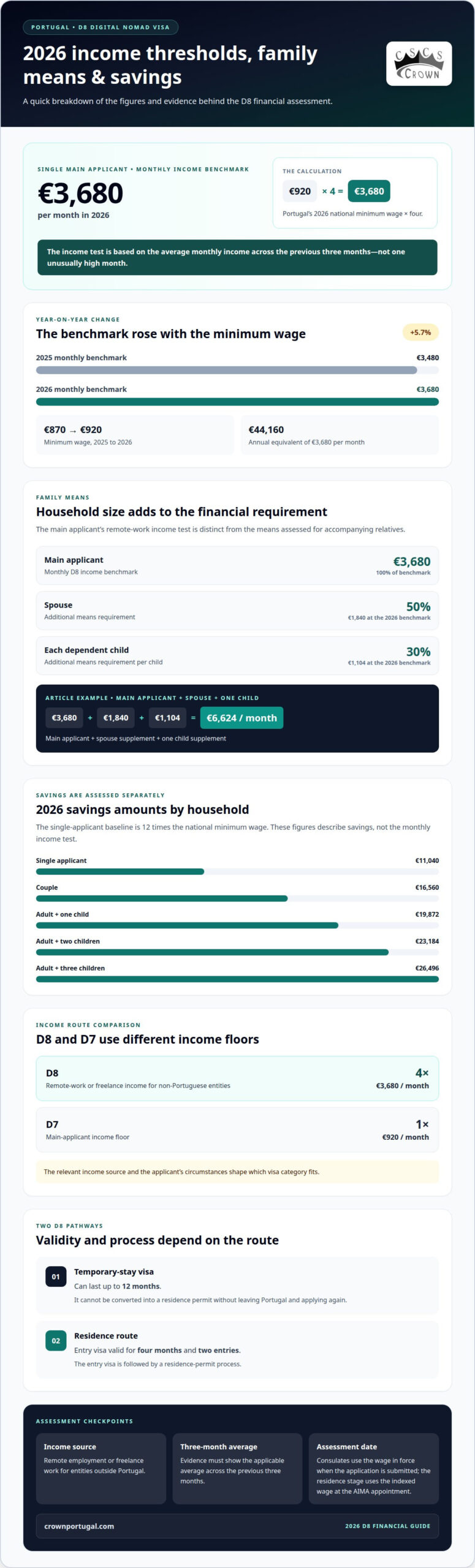
For 2026, the D8 digital nomad visa minimum income threshold is €3,680 per month for a single main applicant. This figure is based on four times Portugal’s 2026 national minimum wage of €920 per month. A spouse or dependent children increase the financial means required for a family application.
The calculation can be easy to misread: the main applicant’s remote-work income threshold and the means required for accompanying relatives are related, but family size changes the overall amount. For example, a main applicant, spouse and one child are listed at €6,624 per month.
This guide explains how Portugal’s minimum wage sets the 2026 threshold, how income is assessed, and what changes when a spouse or dependent children apply with you. It also outlines the distinction between the temporary-stay visa and the residence route, so you can understand which requirements apply to your plans.
Key Takeaways
- Portugal calculates the 2026 D8 income benchmark as four times the national minimum wage, so changes to that wage affect the threshold.
- Income must come from remote work or freelancing for non-Portuguese entities, and the assessment considers the average over the previous three months.
- Family size affects the financial means required: the calculation adds support for a spouse and for each dependent child.
- Distinguish between the temporary-stay visa and the residence visa, as their validity and application pathways differ.
- Crown Portugal supports Portugal Digital Nomad D-8 Visa applications, helping applicants understand how the requirements apply to their circumstances.
2026 Income calculations based on Portugal’s minimum wage
Portugal’s 2026 D8 income calculation starts with the national minimum wage of €920 per month. The main applicant’s benchmark is four times that amount, producing a minimum of €3,680 monthly. This is the 2026 D8 digital nomad visa minimum income threshold for one main applicant.
The minimum wage rose by €50, from €870 in 2025 to €920 in 2026, an increase of 5.7%. Because the D8 formula uses four times the wage, the threshold changed with that annual adjustment. The 2025 monthly benchmark was €3,480; the 2026 calculation is €3,680.
For a single applicant, multiplying €920 by four gives €3,680 per month, or €44,160 across a year. The income assessment also looks at the average monthly income over the previous three months. That means the relevant evidence needs to demonstrate the required level across the assessment period, rather than relying on one unusually high month.
The minimum-wage figure can depend on when the application is assessed. Consulates apply the wage in force on the date the D8 application is submitted. For the residence-permit stage, the indexed wage at the AIMA appointment is used to assess eligibility. An applicant planning both stages should distinguish the filing-date calculation from the later appointment assessment.
Family calculations add a separate financial requirement for accompanying relatives. The D8 income test applies to each applicant, while family members are assessed using Portugal’s general means-of-subsistence scale. The stated additions are 50% of the main threshold for a spouse and 30% for each dependent child.
For a family of four, including the main applicant, a spouse and two children, the calculation is:
- Main applicant: €3,680 per month.
- Two children: an additional 30% each, or €1,104 per child.
The required amount increases with household size. A main applicant, spouse and one child would need €6,624 monthly under the same calculation. These examples show why household size matters: each dependent changes the required financial picture beyond the single-applicant benchmark.
Portugal’s minimum-wage adjustment therefore affects both the central D8 calculation and the family amounts built from it. Applicants should separate the main applicant’s remote-work income evidence from the means assessed for accompanying relatives, then account for the applicable assessment stage.
What is the Portugal Digital Nomad Visa?
Portugal’s D8 route is for non-EU/EEA nationals working remotely for non-Portuguese entities. Applicants must demonstrate qualifying income and financial means for any accompanying family members.
The temporary-stay D8 visa is intended for a limited stay. The residence route uses an entry visa valid for four months and two entries, followed by a residence-permit process. The temporary-stay visa cannot be converted into a residence permit without leaving Portugal and applying again.
Income evidence must relate to remote employment or freelance work for entities outside Portugal. Applicants must show an average monthly income over the previous three months that meets the applicable threshold. One high-earning month alone does not establish the required average.
Savings are assessed separately from monthly income. The baseline amount is 12 times Portugal’s national minimum wage, or €11,040 for a single applicant in 2026. The listed amounts rise with household size: €16,560 for a couple, €19,872 for an adult and one child, €23,184 for an adult and two children, and €26,496 for an adult and three children. These figures describe savings, not the monthly income test.
D8 and D7 Income Requirement Comparison
The D8 income benchmark is four times Portugal’s 2026 minimum wage, while the D7 main-applicant income floor is one times that wage. At €920 per month, those calculations produce €3,680 for D8 and €920 for D7.
This difference matters when choosing the route: D8 is based on active remote-work or freelance income from non-Portuguese entities, while the D7 has a lower income floor. The relevant income source and the applicant’s circumstances therefore shape which visa category fits.
Income Threshold Duration and Refusal Reasons
D8 applicants must demonstrate the required average income across the previous three months. Evidence that fails to show the qualifying source, the required average, or adequate savings may leave key financial criteria unsupported.
For example, inconsistent records or income that cannot be linked to remote work for an entity outside Portugal may not establish eligibility. Address these practical weaknesses by ensuring income documents cover the same three-month period and savings evidence reflects the household size.
For the temporary-stay route, the visa can last up to 12 months; the residence route instead proceeds through an entry visa and residence-permit stage. Applicants should distinguish these pathways before assessing which validity period and application process applies to their plans.
Income thresholds for spouses and dependent children
For a 2026 D8 application, family members affect the financial means assessed alongside the main applicant. The main applicant’s income test is separate: accompanying relatives are assessed under Portugal’s general means-of-subsistence scale.
The family calculation adds 50% of the main threshold for a spouse and 30% for each dependent child. These additions help show how household composition changes the required total.
A couple applying together therefore needs to account for the main applicant’s threshold and the spouse supplement. Adding a dependent child means including another child supplement. For example, a main applicant, spouse and one child are assessed at €6,624 per month. The calculation grows with each additional dependent child.
These percentages describe the means-of-subsistence assessment for accompanying relatives. They do not replace the main applicant’s requirement to show qualifying remote-work or freelance income. Keep income evidence separate from the family-means calculation so each part of the household’s financial position is clear.
Family members applying alongside the D8 holder can travel and receive residence permits with the main applicant, without a separate waiting period. Different considerations apply when relatives join a sponsor already living in Portugal. Portugal’s Law No. 61/2025 entered into force on 23 October 2025 and changed family reunification rules.
For family members joining later, a sponsor generally needs a residence permit valid for at least two years before requesting reunification. A spouse or de facto partner may typically join after fifteen months if the relationship and cohabitation predate the sponsor’s arrival. Both the sponsor and spouse must be at least 18 when the request is made.
There is an exception for children: couples who already have minor or dependent children together face no waiting period to reunite with those children. This is a family-reunification timing rule, not an exemption from the financial assessment or D8 income criteria.
To calculate the household requirement, identify the main applicant, spouse and each dependent child, then apply the relevant supplement to the main threshold. Consider separately whether everyone is applying together or relatives will join later, as different timing rules apply. The relationship history, cohabitation before arrival, children’s status and sponsor’s residence-permit validity affect which family-reunification rule applies.
Applying for a D8 visa and residence permit
Portugal’s D8 process differs according to whether you apply for temporary stay or residence. The temporary-stay visa can last up to 12 months, while the residence route involves an entry visa followed by a residence-permit application. Identify your intended route before preparing the application, because the visas have different conditions.
For the residence route, the entry visa is valid for four months and permits two entries. After arriving in Portugal, the applicant proceeds to the residence-permit stage. The initial residence permit is valid for two years and can be extended for a further three years. These stages are distinct from the temporary-stay visa.
The temporary-stay visa has a stated decision deadline of 30 days and requires a return ticket. It can be renewed up to four times, but it cannot be converted into a residence permit without leaving Portugal and applying again. By contrast, the residence D8 visa does not require a return ticket.
Processing timelines also depend on the route and application stage. Processing times can vary by route and application stage, so applicants should allow for delays. The temporary-stay visa has a separate stated decision deadline, so applicants should not treat that deadline as the expected timeline for every D8 pathway.
Financial evidence remains central to the application. Organize proof of qualifying remote-work income across the required three-month assessment period. For a household application, keep the main applicant’s income evidence separate from the means assessed for accompanying family members. This helps show how each part supports the application.
Family members included in the original residence application can travel and receive residence permits alongside the main applicant, without a separate waiting period. This differs from relatives joining a sponsor later through family reunification. Choose the applicable family route before arranging travel or submitting related applications.
At the residence stage, eligibility is assessed using the indexed minimum wage in force at the AIMA appointment, rather than the wage in force when the initial application was filed. This timing can matter if the national minimum wage changes before the appointment. Align the income calculation with the assessment stage.
A practical preparation sequence is to:
- Choose the temporary-stay or residence route, based on the intended length and type of stay.
- Organize income evidence for the relevant three-month period and calculate accompanying-family means separately.
- For a residence application, plan for the entry-visa stage and subsequent AIMA appointment.
- For temporary stay, account for the return-ticket requirement and the rule against converting that visa into residence without leaving Portugal.
These route distinctions affect validity, renewal, travel arrangements and the next application stage. Choosing the correct pathway first helps keep the income calculation and family arrangements consistent with the visa sought.
2026 D8 visa minimum income threshold
The legal reference identified for Portugal’s remote-work residence visa is Law No. 23/2007, article 61.º-B. The 2026 amount is calculated from the national minimum wage, rather than expressed as a separate fixed figure in that reference.
For one main applicant, the calculation is four times Portugal’s 2026 minimum wage of €920 per month. This produces a required monthly income of €3,680, equivalent to €44,160 per year. The annual figure is the monthly threshold multiplied across twelve months, not an alternative monthly test.
The formula also explains the change from the previous year. Portugal’s minimum wage rose from €870 in 2025 to €920 in 2026, a €50 increase, or 5.7%. The corresponding D8 monthly threshold moved from €3,480 to €3,680. Applicants comparing older guidance with current figures should check which wage year its calculation uses.
Income is assessed as an average across the previous three months. For the 2026 monthly threshold, that means evidence should support an average of at least €3,680 per month during that period, or at least €11,040 across the quarter. A single month above the benchmark does not by itself demonstrate the required average.
The income must come from remote work or freelancing for non-Portuguese entities. That source condition matters alongside the amount: earnings from work that does not fit this description may not demonstrate the qualifying D8 income, even if the total appears sufficient. The application evidence should make the income source and assessment period clear.
Timing also affects which minimum-wage figure applies. Consulates use the wage in force on the application submission date. For residence-permit eligibility, the relevant figure is the indexed wage at the AIMA appointment, not the wage when the initial application was filed. A wage change between these stages can therefore affect the later calculation.
Use the applicable stage and wage year when checking a personal estimate. For example, an applicant assessed under the 2026 figure starts with €3,680 monthly, then confirms that the previous three months support the required average. Family means are calculated separately, so the main applicant’s income threshold should not be mistaken for the complete household assessment.
The practical takeaway is to treat €3,680 as the 2026 monthly benchmark for one main applicant, then match income evidence to the relevant three-month period and assessment date. For a residence application, the AIMA appointment wage can matter even when the application was submitted earlier. This distinction is central to interpreting Portugal’s 2026 calculation accurately.
Crown Portugal: Portugal Digital Nomad D-8 Visa
Crown Portugal supports applicants pursuing Portugal’s Digital Nomad D-8 Visa. It can be a useful next step when you’ve compared the income threshold, assessed your household’s financial requirements, and need help progressing with an application.
Before moving forward, clarify which D8 route you intend to pursue and organize evidence of qualifying remote-work income, savings, and any accompanying family members’ details. These factors shape how the requirements apply to your application. Crown Portugal also offers the Portugal Passive Income D-7 visa, which may be relevant if your income profile points toward that route instead.
For support with a Portugal D8 visa application, contact Crown Portugal or visit crownportugal.com.
Prepare your next step with confidence
Your next step is to organize the evidence around your work arrangement, income records, and intended residence route. Treat the D8 digital nomad visa minimum income threshold for 2026 as one part of that preparation, alongside clear documentation for any family members included in your plans.
Crown Portugal supports Portugal Digital Nomad D-8 Visa applications. Its other relevant services include the Portugal Golden Visa D-9 and NIF Registration (Personal Tax Number). The right support depends on the route and administrative tasks you’re pursuing, so keep your immediate application needs at the centre of your decision.
For guidance on your Portugal visa plans, contact Crown Portugal. A clear understanding of your next steps can help you move forward with a more organized application.
Frequently Asked Questions
What is Portugal’s D8 digital nomad visa minimum income requirement in 2026?
For one main applicant, the D8 digital nomad visa minimum income threshold in 2026 is €3,680 per month. The applicant must show qualifying income from remote work or freelancing for a non-Portuguese entity. Family members affect the household’s financial assessment separately. Before relying on an income estimate, distinguish the main applicant’s qualifying earnings from the means assessed for accompanying relatives.
How is the D8 visa income threshold calculated from Portugal’s minimum wage?
Portugal calculates the main applicant’s D8 benchmark at four times the national minimum wage. For 2026, the monthly wage is €920, so the calculation is €920 × 4, or €3,680 per month. The relevant wage can depend on the assessment stage: consulates use the figure in force when the application is submitted, while residence eligibility uses the indexed wage at the AIMA appointment.
What income documents are accepted for the Portugal D8 visa?
Income evidence should show the source, amount and timing of qualifying remote-work or freelance earnings. Organize records to demonstrate work for an entity outside Portugal and support the average over the previous three months. The financial test is about more than the total balance: the evidence should link earnings to the applicant’s work arrangement and make the assessment period clear.
Does the D8 visa require additional savings or proof of accommodation?
Yes, savings are assessed separately from monthly income. The baseline savings amount for a single applicant is €11,040 in 2026, and the required figure increases with household size. Accommodation evidence is a separate application-document consideration, not a replacement for income or savings evidence. Keep financial records distinct from documents relating to where you plan to stay in Portugal.
Do income requirements differ for D8 applicants with dependants?
Yes. The main applicant’s income test remains distinct, while accompanying relatives are assessed using Portugal’s general means-of-subsistence scale. For the 2026 calculation, the additions are 50% of the main threshold for a spouse and 30% for each dependent child. For example, a main applicant, spouse, and two children correspond to €7,728 per month under the stated family calculation.
Where and how do applicants submit a Portugal D8 visa application?
Applicants submit their visa applications through the Portuguese consulate handling the case. The consulate applies the minimum-wage figure in force on the submission date. For the residence route, the process also includes a later AIMA appointment, where the indexed wage is used to assess eligibility. Keep the chosen route clear, since temporary-stay and residence applications follow different pathways and conditions.