

Plan Accordingly: Moving to Portugal Checklist

“Accordingly” means more than “therefore.” It can show that an action follows from information or circumstances, or that something is done suitably. Its meaning depends on how it connects the ideas around it. In English, it is a formal adverb, so the sentence should make clear what it refers to.
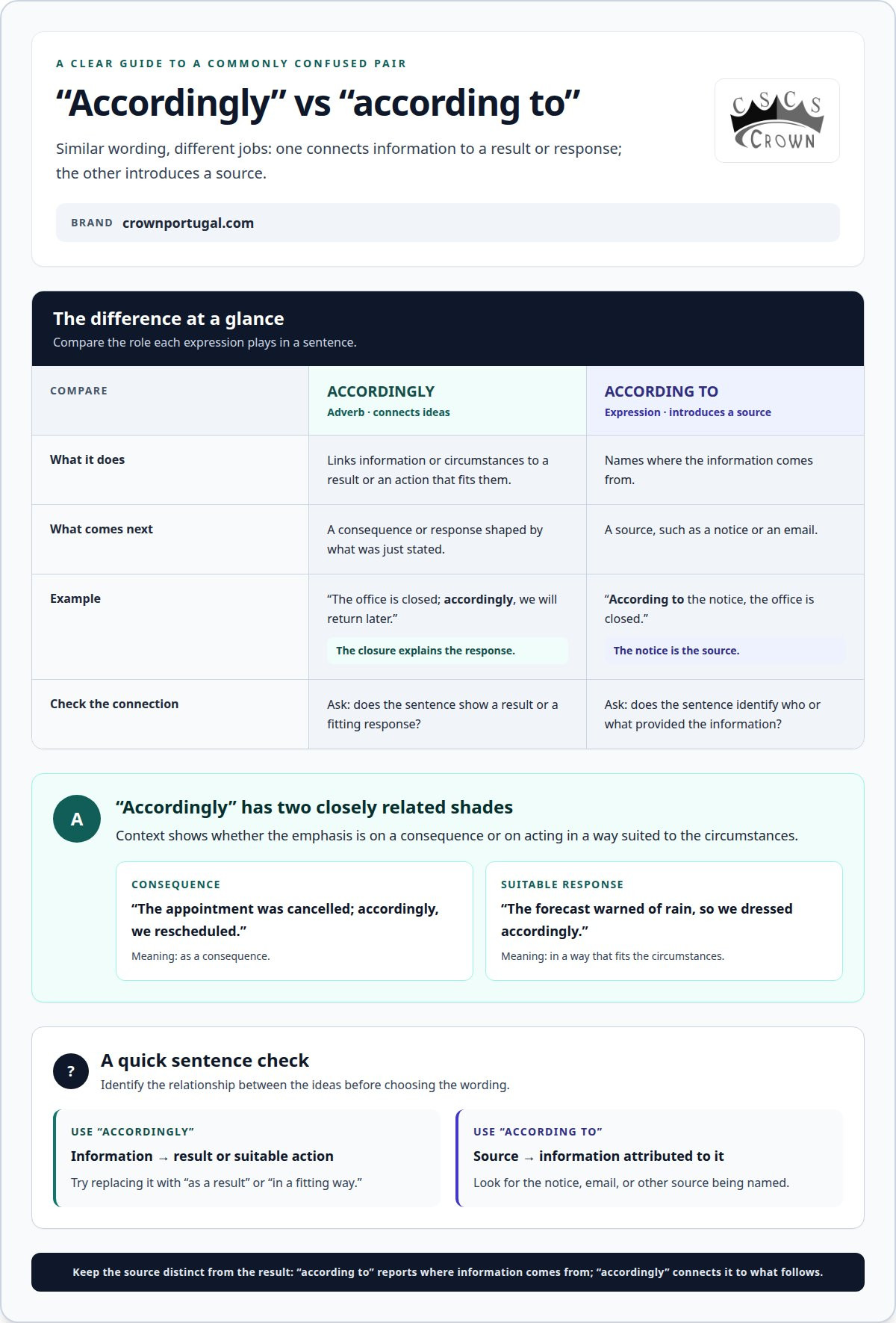
It’s easy to confuse “accordingly” with “according to,” but they serve different purposes: “according to” introduces a source, while “accordingly” connects a situation with a result or response. Use “accordingly” when the next action follows logically from the information already given.
This guide explains the word’s meanings, pronunciation, and position in a sentence, with practical examples and synonyms. It also covers English equivalents such as “therefore,” “in accordance,” and “appropriately,” helping you choose wording that suits the context.
Key Takeaways
- Identify whether the word signals a consequence or an action suited to the circumstances.
- Use context to make the connection between the situation and the response clear.
- Choose a synonym such as “consequently,” “therefore,” or “so” to match the formality of your sentence.
- Distinguish “according to,” which introduces a source, from a connector that expresses a result.
- Review the pronunciation guidance and sentence examples to use the word confidently in speech and writing.
Definitions of accordingly
Accordingly is an adverb that links an action or result to the circumstances described. In “The office was closed, so we returned accordingly,” it indicates a response shaped by the closure. To identify the relationship, look for information followed by a fitting consequence or action. The word connects the ideas rather than naming an object or person.
In “act accordingly,” it means behaving in a way that follows from what someone knows, feels, or has been told. For example, “The forecast warned of rain, so we dressed accordingly” links the warning with suitable clothing. The action should make sense in light of the information. Accordingly, when the reason and response are clear, readers can follow the connection without extra explanation.
In American English, the word can mean “therefore” or “so,” or describe an appropriate response. “The meeting moved online; accordingly, I joined from home” expresses a consequence. “The instructions changed, and the team adjusted accordingly” describes an action suited to the new situation. These meanings overlap, so the context shows whether the emphasis is on the result or the conduct.
In British English, “accordingly” also means “in an appropriate or suitable manner.” For example, “The plan was revised, and the schedule changed accordingly” describes a corresponding adjustment. It can also introduce a consequence: “The road was closed; accordingly, the bus took another route.” The word is used in both British and American English, though pronunciation may vary between accents.
The pronunciation is commonly rendered as “uh-KOR-ding-lee,” with the strongest emphasis on “KOR.” Say the opening sound lightly, stress the central syllable, and finish with “ding-lee.” In “Please respond accordingly,” the word follows the same spoken pattern. Practising it in a complete phrase helps connect pronunciation with the adverb’s function.
The relevant English senses include “as a consequence,” “in line with,” and “in a suitable way.” “As a consequence” fits a result, as in “The appointment was cancelled; accordingly, we rescheduled.” “In line with” can describe following a requirement, while “in a suitable way” describes an appropriate manner. The surrounding sentence determines which sense fits.
“According to” is a separate expression that introduces a source, while “accordingly” connects information with a result or response. Compare “According to the notice, the office is closed” with “The office is closed; accordingly, we will return later.” The notice is the source in the first sentence; the closure explains the response in the second. This distinction keeps the meaning precise.
Example sentences
An example sentence shows how a word connects ideas in context. In “The train was delayed, so Maya changed her meeting time accordingly,” the delay explains the adjustment. The final word signals that Maya’s response reflects the information she received. The example works because both the cause and the action are clear.
Sentence position can clarify the connection. At the beginning of a sentence, the word often introduces a consequence after a full stop or semicolon: “The appointment moved to Friday. Accordingly, Leo updated his calendar.” The second sentence presents a response to the new date. A comma separates the introductory connector from the main clause.
These practical examples show different patterns, from everyday decisions to workplace instructions:
- Schedule: “The client requested an earlier call; accordingly, Nina moved her lunch break.” The request explains the change.
- Weather: “Rain was forecast for the afternoon, so we packed umbrellas accordingly.” The preparation fits the forecast.
- Instructions: “The form requested a current address; accordingly, Sam entered his new one.” The instruction prompts an action.
- Work: “The report required a concise summary, and Priya edited accordingly.” Her revision reflects the requested format.
- Travel: “The gate changed, so passengers walked accordingly to the new departure area.” The changed information guides their movement.
- Study: “The vocabulary list focused on verbs; accordingly, Alex practised action words.” The list’s focus shapes the study choice.
To test an example, substitute “as a result” or “in a fitting way.” “The gate changed; accordingly, passengers used the new entrance” accepts the first substitution. “The room was formal, so Jordan dressed accordingly” accepts the second. The surrounding details determine which shade of meaning readers understand.
Keep “according to” distinct because it introduces a source. “According to the email, the seminar starts at noon” attributes information to the email. “The seminar starts at noon; accordingly, Mina changed her travel plan” links the stated time with her decision. Although the wording is similar, the expressions perform different jobs.
For precise writing, place the connector near the result it introduces and state the reason clearly. In a Portugal relocation note, “The appointment date changed; accordingly, I revised my calendar” makes the link explicit. A sentence such as “Accordingly, the appointment date changed” needs earlier context to explain what caused that change. Readers interested in relocation context can explore Portugal immigration articles and this checklist of essentials to carry when moving to Portugal.
Synonyms
A synonym is a word or phrase with a similar meaning in a particular context. For example, “consequently” can replace “accordingly” when a sentence expresses a result. Synonyms are not always interchangeable: the best choice depends on the relationship between the ideas and the formality of the sentence.
Consequently means “as a result” and is a close formal substitute when a cause leads to an outcome. “The appointment was postponed; consequently, Mara changed her travel plans” connects the postponement with its effect. A dictionary may group these terms, but the sentence’s logic determines whether the replacement works.
Therefore introduces a conclusion or result drawn from earlier information. “The office was closed; therefore, Luis returned the next day” gives a clear consequence. It can sound more analytical than “so,” making it useful in reports or formal explanations. Choose it when the second statement follows logically from the first.
So is a familiar, conversational word for introducing a result. “The bus was delayed, so Ana called the reception desk” sounds direct and natural in everyday speech. It can replace a formal connector, but may feel less suitable in a legal or academic passage. The tone changes even when the basic cause-and-effect relationship stays the same.
Then can show what happens next or what action follows a condition. “If the meeting ends early, then we’ll visit the museum” expresses a next step. It is not a universal substitute: “The road was closed; then, we took another route” may suggest sequence more strongly than consequence. Use it when timing or an instruction-response relationship matters.
As a result explicitly identifies an outcome caused by an earlier event. “The parcel arrived late; as a result, Priya rescheduled the installation” makes the link unmistakable. This phrase can be clearer than a single adverb, especially when readers might otherwise miss which detail caused the change.
In turn describes a consequence that becomes part of a further sequence. “The supplier changed the delivery date, which in turn affected the project schedule” shows one effect influencing another. It conveys a chain of consequences, so it does not fit every simple response.
Suitably and appropriately describe an action that fits the circumstances, rather than a result. “The room was formal, so Daniel dressed appropriately” shows this meaning. Here, the word choice describes how an action fits the situation, not merely what happened afterward. Use “accordingly” to connect an action to relevant circumstances, and choose a synonym only when its shade of meaning fits.
What is the pronunciation of accordingly?
The English pronunciation of “accordingly” is commonly rendered as “uh-KOR-ding-lee.” It has four spoken parts, with the strongest stress on “KOR.” Say the opening “uh” lightly, pronounce “KOR” clearly, then finish with “ding-lee.” This guide helps distinguish the stressed syllable from the softer sounds around it.
In British English, a common pronunciation is /əˈkɔːdɪŋli/. In American English, it is commonly represented as /əˈkɔːrdɪŋli/. The main difference shown here is the “r” sound after the vowel in the American form. Pronunciation guides can help show how to say the word, though their representations may vary.
Break the word into chunks before saying it at normal speed. Start with “uh,” add “KOR,” and follow with “ding” and “lee.” Then blend the parts: “uh-KOR-ding-lee.” This sequence gives English learners a practical way to practise the word without placing equal stress on every syllable.
Use a short sentence to practise the sound and its natural rhythm: “Please respond accordingly.” Say “respond” at a steady pace, then give the strongest emphasis to “KOR” in the final word. Next, try “The schedule changed, so we adjusted accordingly.” The sentence links the word to a clear meaning while you practise its pronunciation.
For a focused practice routine, follow these steps:
- Listen for stress: Identify “KOR” as the strongest part in “uh-KOR-ding-lee.”
- Speak slowly: Repeat each of the four parts separately before blending them.
- Use a sentence: Say “Maya planned accordingly” without pausing inside the word.
- Compare accents: Listen for the American “r” in “accordingly,” then repeat the British form without that pronounced “r.”
The spelling can mislead learners because it contains more letters than audible syllables. In “accordingly,” the ending “-ly” sounds like “lee,” while “-ing” forms the preceding “ding” sound. Practising those endings in a phrase such as “prepare accordingly” helps maintain a smooth rhythm instead of pronouncing each letter separately.
Accent can affect vowel quality and whether the “r” is pronounced, but the word’s stress pattern remains a useful guide. Keep the opening light, emphasize “KOR,” and let the final “ding-lee” flow naturally. For example, repeat “The instructions changed; we acted accordingly” in both British and American English, focusing on the central stress rather than imitating every accent feature.
Meaning can keep pronunciation connected to a sentence instead of making the word a sound exercise alone. In English, “accordingly” can mean acting in a way that is suitable or right for the situation. In American English, it can mean in a fitting and proper way or correspondingly. These meanings provide context for using the word while keeping its stress clear. Let the surrounding sentence carry its own emphasis, and pronounce “accordingly” with the same central stress described above.
Cambridge labels “accordingly” as formal in its English entry. Keep that register in mind when practising the word in a complete thought rather than saying it in isolation. Repeat a sentence at a measured pace, then say it at a natural conversational speed. Aim for a clear, fluent pronunciation without overemphasizing each syllable.
What does accordingly mean?
As a sentence connector, “accordingly” means “therefore” or “as a result.” It links one statement to a consequence that follows from it. For example, “The gallery was full; accordingly, visitors waited outside” connects the limited capacity with the resulting action. The second clause should follow logically from the first.
In American English, this connector can indicate a consequence or a response suited to the circumstances. “The instructions changed; accordingly, the staff revised the schedule” uses it to introduce a result. “The ceremony was formal, so guests dressed accordingly” instead describes appropriate conduct. In both sentences, the surrounding words clarify the intended meaning.
British English uses the same broad meanings: “therefore” for a consequence, and “in a suitable way” for an appropriate response. “The library closed early; accordingly, Eva returned her books the next morning” shows a consequence. “The room was quiet, and the students behaved accordingly” describes conduct that fits the setting.
These American and British uses overlap substantially, so rely on context rather than assuming the word has a different meaning in each country. Compare “The forecast changed; accordingly, the match was moved indoors” with “The forecast changed, so the team prepared accordingly.” The first expresses a result. The second describes a response suited to the new conditions.
As a connector, the word presents a relationship, not an opinion or a source. In “The committee reviewed the evidence; accordingly, it amended the recommendation,” the review explains the revision. By contrast, “According to the committee, the recommendation changed” attributes information to a source. This distinction clarifies whether a sentence gives a consequence or reports someone’s view.
Use this simple test when editing: identify the first statement, then ask whether the next clause follows from it. “The printer ran out of paper; accordingly, the copies were delayed” works because the cause explains the outcome. “The printer ran out of paper; accordingly, the meeting was pleasant” does not establish a clear connection. Replace the connector or add the missing reasoning.
Sentence position also affects emphasis. At the start of a sentence, “Accordingly, the editor shortened the report” presents the action as a consequence of information already given. After a semicolon, “The deadline moved; accordingly, the team adjusted its plan” joins closely related independent clauses. A comma normally follows the introductory connector.
In formal writing, use this connector when the logical relationship is clear and the tone suits the document. In conversation, “so” may sound more natural: “The café was closed, so we chose another place.” For readers planning a Portugal move, get guidance for planning your move as the next practical step.
“Accordingly” should not be filler; it should clearly connect a cause and effect or an instruction and response. Use it only when it has a meaningful relationship to the surrounding statement, not merely as a transition. It has a neutral-to-formal tone and is common in academic, legal, business, and technical writing.
Make sure it is clear which word or idea “accordingly” refers back to. A clear reference helps readers identify what prompted the result or response.
Crown Portugal
Crown Portugal supports people planning a move to Portugal with visa applications and related relocation services. Once you understand the language in this guide, the practical next step is to clarify which immigration process and administrative tasks fit your circumstances.
Support includes the Portugal Digital Nomad D-8 Visa, Portugal Passive Income D-7 visa, Portugal Golden Visa D-9, and NIF Registration (Personal Tax Number). These offerings address different needs, so the relevant pathway depends on your plans and situation. Crown Portugal can help you understand the application process and arrange relevant support as you prepare your move.
If you’re planning a move to Portugal and would like assistance, contact Crown Portugal.
Make Your Portugal Plan Practical
Language is useful when it supports a clear decision. Apply the same principle to your move: identify what needs attention first, separate essential decisions from later tasks, and connect each action to its reason. Accordingly, a change in your plans should prompt a review of the steps that depend on it, rather than a complete restart.
Before taking the next step, write down your intended move, the immigration pathway you are considering, and any administrative questions that remain. This gives any discussion a practical focus and helps keep separate issues from becoming one confusing list. The details that matter will depend on your circumstances and plans for living in Portugal. For help deciding what to carry when moving to Portugal, separate journey and arrival essentials from items in your household shipment.
Crown Portugal can support people considering Portuguese visa applications and related administrative matters. If you’re ready to discuss your plans, contact Crown Portugal for moving support. A clear starting point can help you approach the next decision with greater purpose.
Frequently Asked Questions
What does “accordingly” mean in English?
“Accordingly” means that an action or result follows from a stated situation or fits its circumstances. In “The application instructions changed, and Nina revised her checklist accordingly,” the revision responds to the updated instructions. The precise meaning depends on the sentence: it may signal a consequence or an appropriate response. Keep the reason nearby so readers can understand what the action follows from.
How do you pronounce “accordingly”?
Pronounce it “uh-KOR-ding-lee,” stressing the second syllable, “KOR.” Say the parts slowly, then combine them without pausing: “uh,” “KOR,” “ding,” “lee.” In American English, the “r” after the central vowel is pronounced; in common British pronunciation, it is not. Try saying “Please update the plan accordingly” to practise the sound in a natural sentence.
What are common synonyms for “accordingly”?
“Consequently,” “therefore,” “so,” and “as a result” can express a consequence, while “appropriately” can describe a fitting action. For example, “The departure time changed; therefore, Sam adjusted his calendar” uses a result-focused alternative. “The event was formal, so he dressed appropriately” describes suitable conduct. Choose a replacement by checking whether your sentence expresses an outcome or an action suited to its circumstances.
How do you translate “accordingly” into Portuguese?
“Accordingly” can be translated into Portuguese as “por conseguinte,” “em conformidade,” or “adequadamente,” depending on the context.
Where does the word “accordingly” come from?
“Accordingly” comes from Middle English, formed from “according” and the suffix “-ly.” The word dates to 1400-50.
Portugal EU Long Term Residence Permit: The 2026 Strategic Guide – Crown Portugal at 7:35 am, November 13, 2026 -
[…] Plan Accordingly: Moving to Portugal Checklist […]