

Portugal Citizenship Under Article 41(2): Full Guide

Article 41(2) TEU is a rule about EU budget financing, not a Portuguese citizenship route. It excludes expenditure resulting from measures with military or defence implications from financing from the EU budget. The similar numbering can cause confusion: the United Nations Charter’s Articles 41 and 42 concern measures the Security Council may decide to maintain or restore international peace and security.
If you’re trying to understand what the provision means, the key is to distinguish which treaty and legal context each reference belongs to. This guide explains the EU budget restriction, how measures under Articles 41 and 42 of the United Nations Charter relate to it, and how these provisions differ from Article 41 of the EU Charter, which addresses good administration and related procedural rights.
This guide explains the rule, its scope and the legal distinctions that prevent similarly numbered provisions from being confused.
Key Takeaways
- Understand why EU budget financing excludes expenditure resulting from measures with military or defence implications.
- Distinguish the EU treaty provision from similarly numbered articles in the EU Charter and the United Nations Charter.
- See how the UN Security Council’s measures under Articles 41 and 42 relate to maintaining or restoring international peace and security.
- Learn which conditions and legal context matter when interpreting the EU financing rule.
- For Portugal nationality information, find out how Crown Portugal’s support under its Portugal Nationality under new rules offering may fit your next steps.
What does Article 41(2) say in full?
Article 41(2) TEU is the European Union treaty rule limiting use of the EU budget for certain expenditure. In substance, it excludes expenditure resulting from measures with military or defence implications from financing from the EU budget. This identifies the rule’s subject, its trigger, and the funding source it excludes.
“Expenditure” means spending connected to a measure covered by the provision. The relevant question is not simply whether an activity involves public money. The connection must be between the expenditure and a measure with military or defence implications. Article 41(2) identifies the EU budget as the financing that is excluded.
A “measure” is an action taken within the applicable legal framework. The provision does not treat every measure as military or defence-related. Its scope depends on whether the measure has military or defence implications. For example, an EU action without those implications does not meet that stated trigger simply because it is an EU action.
“Military or defence implications” is the qualifying feature in Article 41(2) TEU. The phrase marks the category of measures whose resulting expenditure cannot be financed from the EU budget. The rule therefore addresses both the character of the measure and the relationship between that measure and the spending.
The United Nations Charter uses Articles 41 and 42 in a separate legal framework. Under the United Nations Charter, the Security Council may decide what measures to take under Articles 41 and 42 to maintain or restore international peace and security. The shared article numbers do not make those UN provisions part of Article 41(2) TEU.
That distinction matters because “Article 41” is not a unique identifier across legal instruments. The reference “Article 41(2) TEU” points to a specific EU treaty provision. By contrast, “Articles 41 and 42” in the United Nations Charter refers to Security Council measures. Naming the treaty or charter prevents readers from conflating the rules.
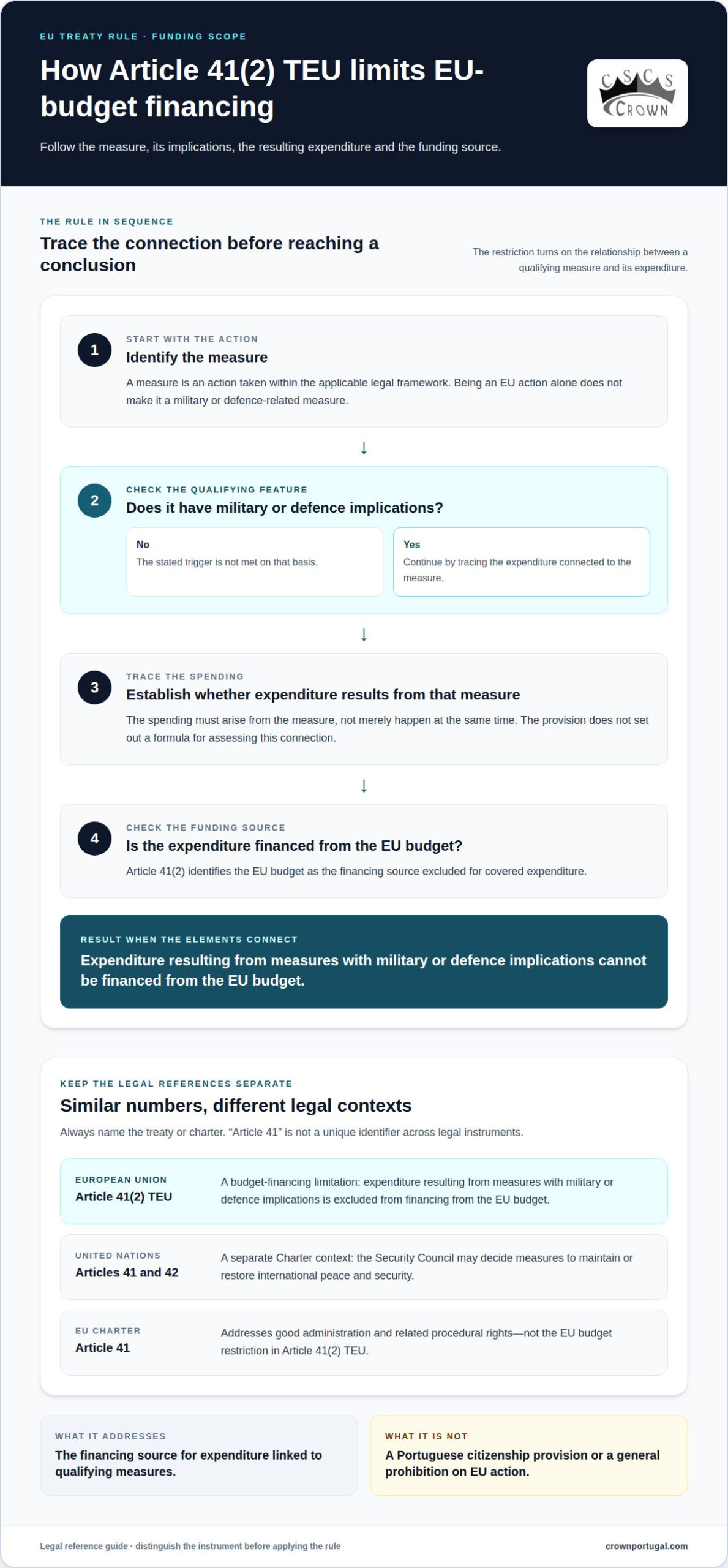
The funding restriction is not a general statement about whether the EU can act. It addresses financing from the EU budget for expenditure resulting from measures with military or defence implications. To apply it, identify the measure, assess its implications, and establish whether the expenditure results from it.
For example, if a measure has defence implications, the provision directs attention to whether the related expenditure is financed from the EU budget. This illustrates how the rule works, not the outcome for any specific measure. The wording links the exclusion to expenditure resulting from a measure with those implications.
Article 41(2) TEU should therefore be read as a budget-financing limitation, not as a citizenship provision. Its legal reference is the Treaty on European Union, and its central terms concern expenditure, measures, military or defence implications, and the EU budget. Those distinctions provide the foundation for understanding its scope.
What is the plain-language meaning of Article 41(2)?
Under Article 41(2) TEU, expenditure resulting from measures with military or defence implications cannot be financed from the EU budget. Put simply, the rule limits the funding source for that category of spending. It doesn’t describe every possible funding arrangement or decide whether a particular measure qualifies. Its application turns on the measure, its implications, and the expenditure connected to it.
A “funding source” is the budget or mechanism from which expenditure is financed. Article 41(2) identifies the EU budget as the source restricted for covered expenditure. This separates two questions: what kind of measure is involved, and which funds are being used. The rule concerns EU budget financing when the measure has military or defence implications.
“Resulting from” describes a connection between a measure and expenditure. In plain language, the spending must arise from the measure, not merely occur at the same time. For example, if a measure has military implications, the question is whether the expenditure results from that measure. The provision does not set out a formula for assessing this connection.
“Military or defence implications” identifies the feature that brings a measure within the funding restriction. The fact that an activity or expenditure is connected to the EU is not enough on its own. Consider two hypothetical measures: one without military or defence implications and one with them. The wording applies the restriction to expenditure resulting from the latter.
Under Article 41(2) TEU, the key issue is the link between qualifying measures, their resulting expenditure, and EU budget financing. A practical reading follows those elements in sequence: identify the measure, consider its implications, connect the expenditure to it, and identify the financing source. This approach avoids treating every security-related activity as automatically covered.
The provision concerns a source of funding, not a person’s immigration status or individual entitlement. It does not set out a Portuguese citizenship procedure, application step or nationality criterion. Anyone considering a Portuguese nationality pathway should distinguish that question from the EU treaty rule, which concerns expenditure linked to measures with military or defence implications.
Article 41(2) TEU is therefore a financing limitation, not a general prohibition on EU action. Its plain-language meaning rests on the specific connection between a measure and its expenditure, alongside the source used to finance that spending. Keeping those elements distinct helps prevent the provision from being mistaken for a citizenship rule or a blanket restriction on EU activity.
Who or what does Article 41(2) apply to?
Under Article 41(2) TEU, the provision’s scope concerns expenditure resulting from measures with military or defence implications. Its wording focuses on the connection between a measure and the spending associated with it. It does not identify a class of individual applicants or residents as its subject.
A “measure” is the action whose implications are assessed under the rule. The text does not name a particular institution, government or person as its sole subject. To understand the provision’s reach, identify the action itself rather than relying on a broad label such as “security activity.”
“Expenditure resulting from a measure” means spending connected to that action. The connection matters: the provision addresses expenditure arising from the measure, not every cost that happens to exist alongside it. If a policy includes several actions, distinguish the relevant action from the expenditure said to result from it.
The “EU budget” is the financing source named by Article 41(2) TEU. Identifying expenditure alone doesn’t complete the scope analysis; its funding source must also be considered. A clear assessment therefore records the measure, the expenditure connected to it, and whether the EU budget finances that spending.
The phrase “military or defence implications” identifies the qualifying feature of a measure. Both the measure’s character and its connection to the expenditure matter. Under Article 41(2) TEU, a public-sector action isn’t automatically covered simply because of the body involved. The relevant question concerns that specific measure and its implications.
Article 41(2) TEU doesn’t set out a Portuguese nationality test or citizenship application procedure. A person considering Portuguese citizenship shouldn’t treat this EU budget provision as a personal eligibility rule. Its stated subject is expenditure and financing, not an applicant’s residence history, documents, or nationality status.
The United Nations Charter also refers to Articles 41 and 42, but those provisions belong to a separate legal framework. Under Article 41(2) TEU, the scope must be read from the EU treaty reference, not inferred from similarly numbered articles elsewhere. Naming the legal instrument helps distinguish the provisions and their subjects.
To analyse the scope, identify the measure, describe its military or defence implications, connect the relevant expenditure to it, and identify the funding source. Each step addresses a separate part of the provision. Omitting one can lead to an overly broad interpretation or confusion with unrelated eligibility requirements.
Article 51 of the UN Charter concerns collective self-defense, which did not yet apply to the situation discussed on 28 February 2022.
What conditions must be met under Article 41(2)
Article 41(2) TEU concerns expenditure resulting from measures with military or defence implications. Its wording connects the restriction to the nature of a measure, the expenditure arising from it, and financing from the EU budget. These elements provide a practical way to examine the provision without adding a separate eligibility test.
A measure is the action whose implications are being considered. Identify it precisely instead of relying on a broad label such as “security policy.” If a programme includes several actions, determine which specific action is relevant before considering its associated spending.
Military or defence implications are the qualifying characteristics of the measure. The text makes those implications relevant to the funding restriction. Assessment should therefore focus on the measure itself, not just the department, institution or public body involved. An organisation’s name alone does not explain what a particular measure entails.
Resulting expenditure means spending connected to the measure. The wording makes this connection important: the expenditure must result from the relevant measure. If a wider initiative includes administrative and operational activities, distinguish spending connected to the specific measure from other expenditure within the initiative.
EU budget financing means that the funding source being examined is the EU budget. Article 41(2) identifies that source in its restriction. Identifying costs alone does not complete the analysis; the funding source also matters. A useful record would therefore describe the measure, the expenditure attributed to it, and the budget said to finance it.
These elements work together. If a measure has no military or defence implications, the stated qualifying feature is absent. If spending is unrelated to the measure, the required connection is absent. If the question concerns a different funding source, it does not address the particular financing restriction stated in Article 41(2) TEU.
This is a reading framework, not a claim that Article 41(2) lists a formal application process. It does not set out a citizenship application, personal document checklist, or Portuguese nationality criterion. A person considering Portuguese citizenship should keep that separate from the EU budget question, which concerns measures and expenditure.
Keep similarly numbered provisions distinct. Article 41 of the EU AI Act concerns a different instrument and subject; its common-specifications conditions should not be imported into Article 41(2) TEU. Likewise, Articles 41 and 42 of the United Nations Charter belong to a separate framework. Naming the legal instrument is an essential first step in applying the right conditions.
What rights or obligations does Article 41(2) create
Article 41(2) TEU creates a restriction on financing, not an individual procedural right. It excludes expenditure resulting from measures with military or defence implications from financing from the EU budget. The provision’s subject is EU budget expenditure. It does not set out a right for a person to challenge a decision or obtain funding.
A procedural right is a legal protection concerning how an authority handles a person’s case. The similarly numbered Article 41(2) of the EU Charter concerns rights of good administration, not the TEU budget rule. Identifying the instrument is essential: “TEU” refers to the Treaty on European Union, while “EU Charter” identifies a separate text.
Article 41(2) of the EU Charter identifies rights listed in points (a) to (c). One specified protection appears in Article 41(2)(a): the right to be heard before an individual measure adversely affecting a person is adopted. This concerns a person facing an adverse individual measure, rather than expenditure resulting from a defence-related measure.
The right to be heard means that a person must have an opportunity to present their views before an adverse individual measure is adopted. The timing matters: the opportunity comes before adoption, not merely after the decision. For example, a person affected by an individual administrative decision should distinguish this procedural issue from the EU budget financing restriction in Article 41(2) TEU.
The relationship between a right and an obligation is that a right held by a person can correspond to a procedural responsibility for the authority handling the matter. In the Charter example, the relevant point is the person’s opportunity to be heard before the adverse individual measure. That is distinct from Article 41(2) TEU, which addresses how specified expenditure may be financed.
These provisions answer different questions. The TEU provision concerns whether the EU budget can finance certain expenditure. The Charter provision concerns procedural rights when dealing with EU administration. A funding dispute does not, by itself, establish a right to be heard under the Charter. The described Charter protection relates to an individual measure that adversely affects a person.
For a Portugal citizenship question, neither reference should be treated as a nationality eligibility rule. Article 41(2) TEU does not provide citizenship criteria, and the Charter’s Article 41(2)(a) addresses a hearing before an adverse individual measure. Keep the legal instrument and the issue being assessed clear: budget financing, procedural treatment, and Portuguese nationality are separate matters.
Before drawing a conclusion, record the full reference. Note whether it cites the TEU or the EU Charter, then identify whether the issue concerns expenditure or an individual administrative measure. This distinction helps prevent a budget limitation from being mistaken for a personal right, or a Charter hearing right from being treated as a funding rule.
Crown Portugal: Portugal Nationality under new rules
Crown Portugal supports readers exploring Portugal nationality under new rules by helping them understand relevant immigration pathways and organize the next steps in their case. This is the appropriate point to seek guidance if you’re assessing nationality options, rather than relying on Article 41(2) as a citizenship provision. Crown Portugal also provides Portugal daily immigration news and articles, which can help readers follow developments relevant to their plans.
For readers considering residence before nationality, Portugal’s Digital Nomad D-8 Visa and Golden Visa D-9 are separate immigration options. The appropriate route depends on the reader’s circumstances and intended pathway. Clear separation between nationality questions and EU treaty provisions helps keep the process focused on the issue that matters.
For guidance on Portugal nationality under new rules, contact Crown Portugal.
Choose a clear next step for your Portugal plans
Keep the phrase “under Article 41(2)” in its correct legal context when reviewing documents or discussing an EU measure. For Portuguese nationality planning, focus instead on the immigration route relevant to your circumstances and the administrative steps connected to it. Separating those questions helps you direct your attention to the right process.
If your plans also involve residence in Portugal, Crown Portugal offers the Digital Nomad D-8 Visa, Golden Visa D-9, and NIF Registration (Personal Tax Number). These services address different needs, so the useful next step is to identify which issue you need to resolve first, whether that concerns nationality planning, a visa pathway, or tax registration.
For guidance on your Portugal immigration plans, contact Crown Portugal. A clear understanding of your next step can make the process easier to approach.
Frequently Asked Questions
Which law or treaty is Article 41(2) part of?
Article 41(2) TEU is part of the Treaty on European Union. The letters “TEU” identify the treaty and distinguish this provision from other instruments that also contain an Article 41(2). When reading a citation, check the letters after the article number: they clarify which legal text applies. This is particularly useful in documents discussing EU financing, where the provision concerns the EU budget rather than Portuguese citizenship eligibility.
How does Article 41(2) compare with related provisions?
Article 41(2) TEU concerns EU budget financing, while Article 41(2) of the EU Charter concerns specified good-administration rights, including the right to be heard before an adverse individual measure. The United Nations Charter’s Articles 41 and 42 address a separate Security Council framework. For example, a document citing “Article 41(2)” without naming its instrument needs context before its meaning can be identified.
How is Article 41(2) interpreted by courts or authorities?
Article 41(2) TEU is read as a limitation on EU budget financing: identify the measure, assess whether it has military or defence implications, connect the expenditure to it, and determine whether the EU budget finances that spending.
What are the consequences of violating Article 41(2)?
Expenditure resulting from measures with military or defence implications cannot be financed from the EU budget.
How can someone invoke or comply with Article 41(2)?
To assess compliance, identify the measure, consider its military or defence implications, determine whether the expenditure results from it, and check whether the EU budget is the funding source.
Portugal Visas: 30 Days from Receipt of Declarations – Crown Portugal at 10:48 am, November 20, 2026 -
[…] Portugal Citizenship Under Article 41(2): Full Guide […]