

Portuguese Nationality: 60-Day Decision Rule

The 60-day rule applies after the investigation phase of a Portuguese nationality application is complete: the registrar must issue a decision within 60 days. It does not mean the entire application must be decided within 60 days of submission.
It’s understandable to focus on the deadline while waiting for a nationality decision. The key is knowing when the period begins and what it covers, so you can distinguish the decision stage from the earlier review and investigation of an application.
This article explains how the 60-day period works, how it fits into the wider process, and what to understand about communication of the Agency’s decision. It also clarifies why the deadline should not be treated as a single final timetable for every Portuguese nationality application.
Key Takeaways
- Understand when the 60-day decision period begins and why it does not set a deadline for the entire nationality process.
- See how the initial review and information-gathering stages fit into the application timeline.
- Learn what the applicant’s role is while the registrar examines the file and gathers necessary information.
- Find out what an administrative action for delay can seek, and why it is distinct from asking a court to grant nationality.
- Clarify what the article explains about application fees and missed deadlines without assuming that delay automatically leads to a penalty.
The 60-day response period
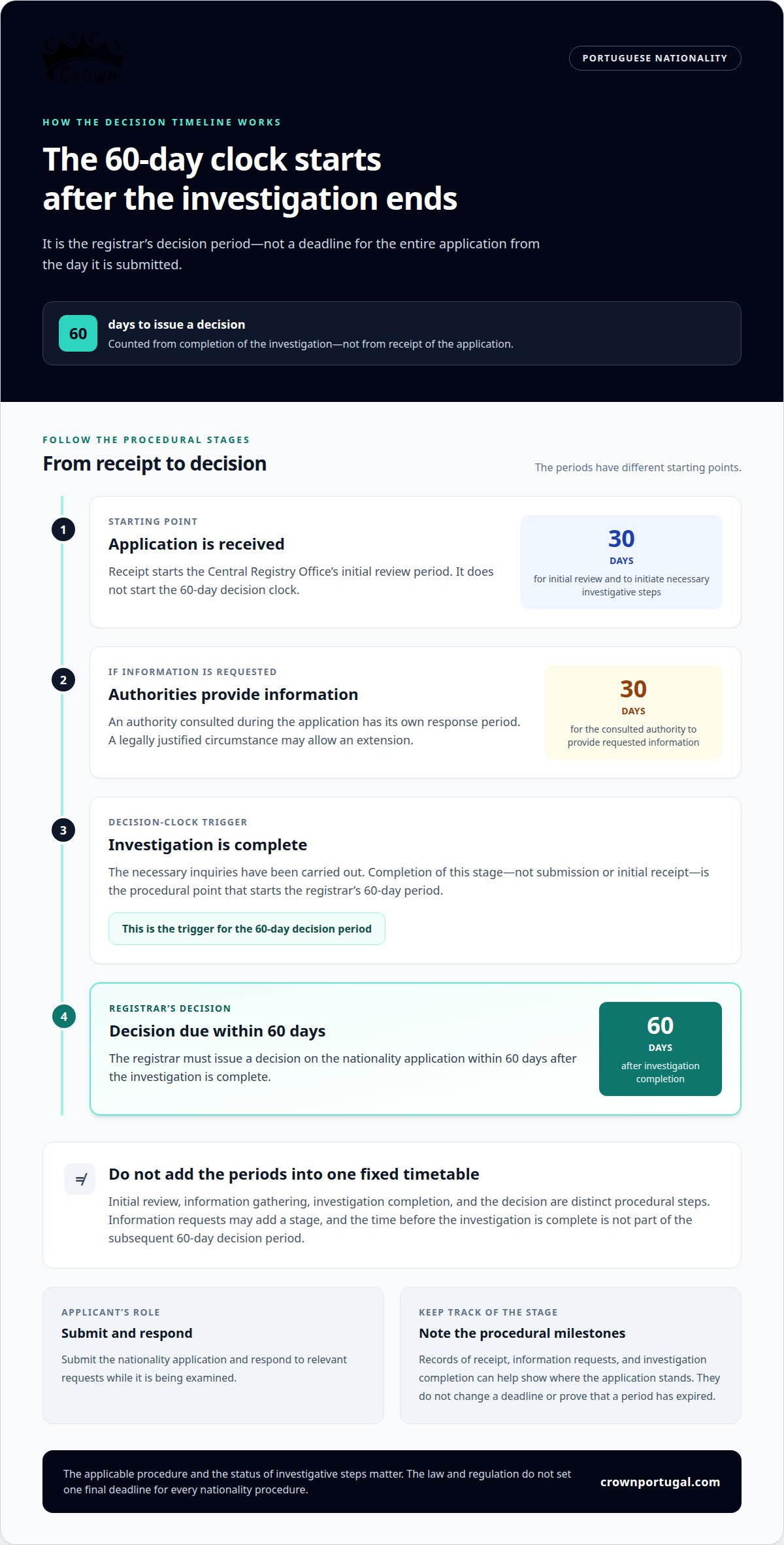
The 60-day response period is the time allowed for the registrar to decide a nationality application after its investigation is complete. In Portugal, the registrar must issue a decision within 60 days of that procedural point. The period does not begin simply because an application was submitted or received.
The investigation phase is the part of the procedure in which the necessary inquiries are carried out. Its completion is the event that starts the 60-day decision period. An applicant therefore needs to distinguish the investigation’s end from the application’s initial receipt. Those are separate steps, and the deadline applies to the later stage.
The initial review is the Central Registry Office’s first examination of a newly received nationality application. It must carry out that review and initiate necessary investigative steps within 30 days of receipt. This initial 30-day period is not the same as the registrar’s later 60-day period for issuing a decision. It begins at a different stage and serves a different procedural purpose.
Information requests can add another stage to the timeline. Authorities consulted during a nationality application have 30 days to provide requested information. A legally justified circumstance may allow an extension of that response period. For example, when an authority is asked to supply information during an investigation, its response timetable is separate from the registrar’s decision period.
These periods should not be added together as though every file follows one fixed schedule. The initial review, information gathering, completion of the investigation, and decision are distinct procedural steps. The time taken before the investigation is complete is not included in the subsequent 60-day decision period. As a result, the 60-day rule does not set a final deadline measured from the application’s receipt.
Portugal’s Portuguese Nationality Law and its Regulation do not establish one final deadline that applies to every nationality procedure. The 60-day period addresses the decision stage after an investigation, rather than promising that all nationality applications will follow an identical timeline. The applicable procedure and the status of its investigative steps matter when identifying which period is relevant.
A practical way to follow the timetable is to identify what starts each period: receipt of the application for the Central Registry Office’s initial review, a request for information for a consulted authority’s response, and completion of the investigation for the registrar’s decision. Records of these procedural steps can help you understand where an application stands. They do not change the deadline or prove that a particular period has expired.
What application or proceeding is subject to the 60-day decision deadline?
The 60-day decision deadline applies to a Portuguese nationality application after its investigation phase is complete. It concerns the registrar’s decision on that nationality proceeding, not every step connected with applying for citizenship. The key distinction is the type of application and the stage it has reached.
A nationality application is a request for Portuguese nationality that the competent registry processes under the nationality procedure. The rule covers the decision stage of that application once the investigation has concluded. It does not make the 60-day period a general timetable for every administrative request made in Portugal.
The proceeding covered is the administrative examination of an individual nationality application. For example, once the registrar has completed the investigation into an applicant’s file, the decision period applies to that file. The rule does not describe a separate proceeding about residence, a visa, or another immigration matter, because those are not nationality applications.
The decision deadline refers to the registrar’s determination, not every response or action taken while the file is being examined. A request for information from another authority is one investigative step. That authority’s response is not itself the registrar’s decision on whether the applicant qualifies for nationality.
Scope matters because Portugal’s Portuguese Nationality Law and its Regulation do not set one final deadline for every nationality procedure. The 60-day decision period therefore should not be applied automatically to any file that mentions nationality. The relevant question is whether the matter is a nationality application and whether its investigation has been completed.
The name or status of a procedure alone does not establish that the decision period has started. A submitted file may still be under review or investigation. For instance, an applicant waiting for information to be gathered is at a different procedural stage from someone whose investigation has concluded and whose file is awaiting a decision.
This distinction also separates an administrative nationality decision from a court proceeding about delay. An applicant may seek administrative action for failure to issue a decision, but that is a separate legal route. It can seek to require the administration to review and decide the application, rather than asking the court to grant nationality directly.
To identify whether the deadline applies, first establish that the matter concerns Portuguese nationality. Then identify whether the registrar is deciding the application after investigation, rather than handling an earlier step or a different proceeding. For guidance on preparing a Portuguese nationality application, consider support focused on the nationality process.
What steps must an applicant take before the registrar issues a decision?
An applicant’s role is to submit a nationality application and respond to relevant requests during its examination. The process then moves through the Central Registry Office’s initial review, any necessary investigation, and the registrar’s decision. Distinguish these stages rather than treating submission as the start of the final decision period.
Submission places the application before the registry for processing. Keep a copy of the application and any receipt or correspondence confirming delivery. These records help establish when the Central Registry Office received the file, which matters for the initial review timetable. Receipt does not mean the investigation has concluded or that the registrar’s decision period has begun.
The Central Registry Office must carry out an initial review and initiate necessary investigative steps within 30 days of receiving an application. For the applicant, this is the point to monitor official correspondence and ensure that messages about the file are not overlooked. The review and investigation are administrative steps; they are not decisions on whether nationality will be granted.
During the investigation, an authority consulted about the application may be asked to provide information. That authority has 30 days to respond, with a possible extension in legally justified circumstances. If the applicant receives a request for material, respond to the request using its stated instructions. Retain the request and response, so the file’s sequence remains clear.
For example, an application may be received, reviewed, and then investigated while information is sought from another authority. The authority’s response supports the investigation; it does not replace the applicant’s application or the registrar’s final decision. If you receive a request during this stage, follow its instructions and note what information or action it requires.
These procedural stages do not provide one checklist that applies to every nationality procedure. Follow the requirements communicated for your specific application, provide requested information, and keep the related records. Adding documents that were not requested does not establish that an investigation is complete or that a decision is due.
Once the investigation is complete, the registrar must issue a decision within 60 days. The applicant does not start this period by sending a follow-up message or by counting from the date of submission. Keeping the receipt, requests, responses, and later procedural notices together helps distinguish the applicant’s actions from the registry’s and consulted authorities’ steps.
If correspondence says that further information is needed, respond to that request before assuming the file has reached the decision stage. If no request is pending, the key procedural question is whether the investigation has been completed. That event, rather than a follow-up or the original receipt date, determines when the decision period applies.
Can the registrar’s decision be appealed or reviewed, and what are the deadlines?
An appeal is a formal challenge to an administrative decision, while a review asks for reconsideration. The 60-day decision period is neither: it sets the time for the registrar to decide after the investigation. It does not establish a deadline for challenging a decision that has already been issued.
For a Portuguese nationality application, distinguish a challenge to a decision from action over a failure to decide. The rule concerning delay describes an administrative action that can seek a court order requiring the administration to review and decide the application. It does not ask the court to grant nationality directly.
An administrative action for failure to issue a decision is a court proceeding aimed at obtaining a decision from the administration. It addresses inaction, not the registrar’s examination of eligibility. For example, if an application remains undecided after the relevant decision period, this action seeks an order to review and decide the file, rather than a court declaration granting nationality.
An injunction for the protection of rights, freedoms, and guarantees is a court remedy that requires evidence of an actual or imminent violation of a fundamental right. In Portugal, delay alone is insufficient for this injunction. The applicant must establish the required connection between the delay and a fundamental right, rather than relying only on the passage of time.
These routes address different situations. A registrar’s issued decision presents a decision to challenge or review. An unissued decision presents a delay issue. The 60-day period helps identify the latter stage, but it should not be treated as an appeal deadline or as proof that a court will grant nationality.
No appeal filing period follows from the 60-day decision rule itself. The 60 days relate to the registrar issuing a decision after investigation, not the applicant filing a challenge afterward. A person considering a challenge to an issued decision must distinguish that matter from the separate administrative action concerning failure to decide.
The practical sequence is to identify whether the registrar has issued a decision, then identify the issue being raised. If there is no decision, the administrative action described above seeks a review and decision from the administration. If there is a decision, the 60-day rule does not supply the deadline or procedure for challenging it.
For a delay-based court action, the key distinction is between seeking a decision and seeking nationality directly. An injunction requires evidence of an actual or imminent fundamental-right violation; delay alone does not meet that requirement. Keeping these remedies distinct avoids confusing the decision period with a separate review route or filing deadline.
Are there fees or penalties related to the application or missed deadline
An application fee is a charge connected with submitting or processing a nationality request. The 60-day decision rule concerns when the registrar must decide after investigation, not a fee amount. It does not itself state that the applicant must pay a charge or that a penalty follows when the deadline passes.
A penalty is a consequence imposed for a defined failure or breach. The rule about the registrar’s decision period does not establish a penalty payable by an applicant when a decision is late. Nor does it say that missing the deadline automatically grants nationality or requires a payment to the applicant.
Keep application charges separate from delay-related consequences. A charge connected with submitting a nationality application would be distinct from any court proceeding pursued because the administration has not decided the file. The 60-day period alone does not set either amount. Do not treat it as a schedule of costs or as a compensation rule.
A court action for failure to issue a decision may seek an order requiring the administration to review and decide the application. Its stated purpose is to obtain a decision, not nationality directly. The existence of this route does not establish a court fee, repayment, or compensation for delay.
An injunction for the protection of rights, freedoms, and guarantees is a separate remedy requiring evidence of an actual or imminent violation of a fundamental right. Delay alone is insufficient. This standard concerns the basis for the remedy, not a financial penalty or automatic payment arising from an overdue decision.
Consider two separate situations. An applicant submits a nationality file and later receives a charge under an applicable procedure. That charge is separate from the registrar’s decision timetable. If the registrar misses the decision period, that fact alone does not establish that the applicant owes a penalty or is entitled to compensation.
When reviewing a payment notice, identify the stated charge, the procedure it relates to, and the action or service it covers. Keep it separate from correspondence about the status of the nationality application. A notice about a charge does not, by itself, establish that the investigation has ended or that the decision period has begun.
In short, the 60-day rule is a decision timetable, not a fee schedule or an automatic penalty provision. For help understanding how a delay relates to your nationality application, request guidance on your Portuguese nationality application.
Crown Portugal
Crown Portugal assists with Portuguese immigration procedures, including nationality applications. Its guidance can help you distinguish a decision deadline from earlier application stages and understand questions raised by an official notice or request for information.
Turn to Crown Portugal when you need help understanding how the nationality process relates to your wider plans in Portugal. The consultancy also assists with immigration pathways such as the Portugal Digital Nomad D-8 Visa and Portugal Passive Income D-7 visa, alongside related services such as NIF Registration (Personal Tax Number).
For guidance on your circumstances and the relevant next steps, contact Crown Portugal.
Plan your next step with clarity
Use your understanding of the decision process to organize the next stage of your Portuguese nationality matter. Keep correspondence and application records together, and note any communication that changes the file’s status. This gives you a clearer basis for deciding what information or assistance would be useful as you proceed.
Keep the rule that the registrar must issue a decision within 60 days in perspective: it relates to a particular stage, while your next steps depend on your own circumstances and the status of your application. Clear guidance can help you interpret procedural information and consider how nationality planning fits with your wider plans in Portugal.
For support with your circumstances and Portuguese immigration procedures, contact Crown Portugal for guidance. Take the next step with a clearer understanding of the process and the questions that matter to you.
Frequently Asked Questions
Which law or regulation establishes the registrar’s 60-day deadline?
The deadline concerns the decision stage after the investigation of a nationality application, not one final processing period for every case. Portugal’s Portuguese Nationality Law and its Regulation do not establish one final deadline for every nationality procedure. This distinction matters when reading a legal reference: a procedural decision period should not be treated as a universal deadline covering every step from submission to outcome.
When does the 60-day period begin, and how are days counted?
The period begins when the investigation phase is complete, not when the application is submitted or received. The 60-day decision period is separate from the earlier review and information-gathering stages. To track the relevant starting point, retain correspondence that records the investigation’s status and any notice marking its completion. Do not use the application receipt date as the start date for this decision-stage period.
Can the registrar extend the 60-day decision deadline, and under what conditions?
The established extension relates to a different step: an authority consulted during the investigation may receive an extension to its 30-day information-response period in legally justified circumstances. That concerns providing requested information, not the registrar’s later decision period. Do not assume that an extension granted for an authority’s response automatically changes the deadline applying to the registrar after the investigation is complete.
What happens if the registrar does not issue a decision within 60 days?
A missed decision period does not itself grant nationality or establish an automatic payment to the applicant. An administrative action for failure to decide can seek a court order requiring the administration to review and decide the application. The requested outcome is a decision on the file, not a court order granting nationality directly. An injunction requires evidence of a fundamental-right violation; delay alone is insufficient.
Does the deadline apply to all applicants, cases, or jurisdictions?
No. The 60-day period concerns a Portuguese nationality application after its investigation phase is complete; it is not a general deadline for every immigration procedure or jurisdiction. For example, a residence-permit matter is not brought within this nationality decision period merely because it involves Portuguese authorities. The procedure and its stage determine whether the rule applies, while Portugal’s nationality procedures do not all share one final deadline.
What Happens After Portugal’s Evidentiary Phase? – Crown Portugal at 10:50 am, November 11, 2026 -
[…] Portuguese Nationality: 60-Day Decision Rule […]