

Portugal Nationality: The 29-Month Rule Explained

Portugal’s nationality rules do not create a universal 29-month countdown. For Portuguese nationality, the applicable legal regime does not establish a general period of 29 months. The relevant requirements depend on the nationality route and the applicant’s circumstances.
It is understandable that a particular date or administrative notice can make the process seem governed by one fixed deadline. Residence certificates and cards may be relevant to a future citizenship application, while written notices can help clarify what has happened in an individual case.
This article explains why 29 months is not a general statutory period, how residence documents relate to a nationality application, and why keeping track of official correspondence can matter. It also distinguishes the general rule from the separate requirements that apply to different routes, so you can better understand which facts are relevant to your situation.
Key Takeaways
- Do not treat 29 months as a universal Portuguese nationality timeline; identify the legal process the period belongs to.
- Separate nationality eligibility rules from deadlines or durations that apply to other administrative or immigration procedures.
- Residence certificates and cards may be relevant documents in a future citizenship application, so their role depends on the applicant’s route.
- Read official written notices in context, paying attention to the procedure they concern and the action or deadline they describe.
- Understanding your residence position can help clarify whether a visa or residence-permit pathway is relevant to your plans in Portugal.
Residence documents and future citizenship applications
There is no direct equivalent rule to compare across jurisdictions here: Portuguese nationality requirements and residence-document rules are distinct from rules governing entry bans. The European Union states that, under Article 11(2) of the EU Return Directive, an entry ban should in principle last no more than five years, but may exceed five years where a person poses a serious threat to public policy, public security or national security.
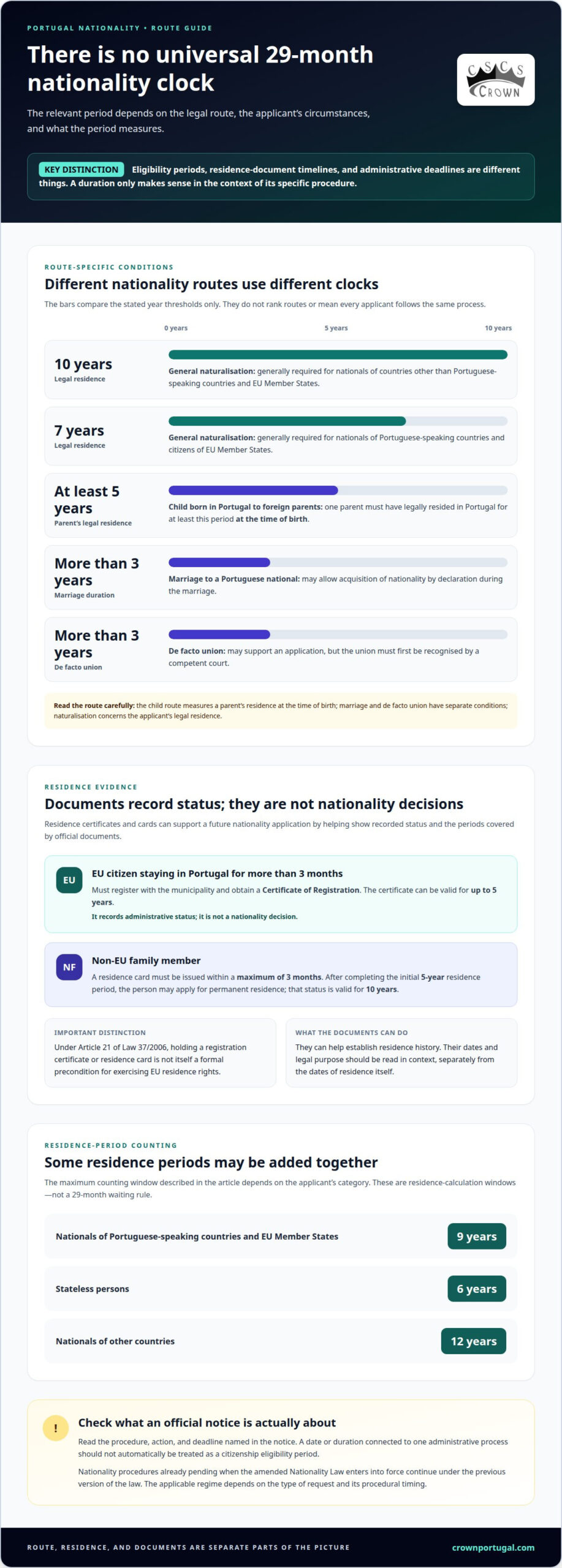
For residence in Portugal, the relevant documents depend on whether the person is an EU citizen or a non-EU family member. Under Article 14 of Law 37/2006, an EU citizen staying in Portugal for more than three months must register with the municipality and obtain a Certificate of Registration. That certificate can be valid for up to five years. It records administrative status, but it should not be confused with a nationality decision.
A non-EU family member follows a separate document route. Under Article 15, the residence card must be issued within a maximum of three months. After completing the initial five-year residence period, a non-EU family member may apply for permanent residence, which is valid for ten years. Those documents can help establish the person’s residence history, while the citizenship application remains subject to its own criteria.
For a future nationality application, residence certificates and cards are accepted by Portugal’s IRN and Ministry of Justice as supporting documents. Their evidential role matters: they can help show a person’s recorded status and the periods covered by official documents. Article 21 of Law 37/2006 also provides that holding a registration certificate or residence card is not itself a formal precondition for exercising EU residence rights. A document’s absence therefore does not, by itself, settle every question about the underlying right.
Residence periods may also be added together when they are not continuous. The maximum counting window depends on the applicant’s category: nine years for nationals of Portuguese-speaking countries and EU Member States, six years for stateless persons, and twelve years for nationals of other countries. These periods concern the calculation of legal residence, not a general 29-month waiting rule. An administrative file should therefore distinguish the dates of residence from the dates a certificate or card was issued.
When documents are submitted with a nationality request, their dates and legal purpose help place the record in context. For example, an EU citizen’s registration certificate and a non-EU family member’s residence card arise under different provisions, even if both support evidence of residence. The applicable legal regime does not establish a general period of 29 months for these documents. A written notice should likewise be read according to the procedure it addresses, rather than treated automatically as a citizenship deadline.
There is no direct comparison here: the EU rule concerns entry bans, while the Portuguese rules described here concern residence documents and nationality. The EU rule generally limits entry bans to five years, although longer bans may apply when a person poses a serious threat to public or national security.
What legal regime does the phrase “does not establish a general period of 29 months” refer to?
It refers to Portugal’s nationality framework, not a single countdown applying to every applicant. A duration only has meaning when connected to a particular procedure, legal route, and starting event. The phrase therefore distinguishes a general naturalisation requirement from deadlines attached to separate administrative processes. A reference to 29 months, without that context, does not identify a general nationality qualification period.
For naturalisation, the amended Portuguese Nationality Law generally requires seven years of legal residence for nationals of Portuguese-speaking countries and citizens of EU Member States. For nationals of other countries, the general requirement is ten years of legal residence. These are residence qualifications, not processing periods that begin when an application is submitted. An applicant’s nationality and residence history help determine which threshold applies.
Other nationality routes have different criteria. A child born in Portugal to foreign parents may qualify for nationality by origin if one parent had legally resided in Portugal for at least five years at the time of birth. A foreign citizen married to a Portuguese national for more than three years may acquire nationality by declaration during the marriage. A de facto union lasting more than three years may support an application, but it must first be recognised by a competent court.
These examples show why no single duration applies to every nationality procedure. A birth-based route examines a parent’s residence at the time of birth. A marriage-based declaration depends on the length of the marriage. Naturalisation, by contrast, depends on legal residence and the applicant’s category. Each route turns on its own facts, so a period associated with one procedure should not automatically be applied to another.
Transitional rules also matter. Administrative nationality procedures already pending when Portugal’s amended Nationality Law enters into force continue under the previous version of the law. This means the application’s procedural status at that point affects which version governs it. The applicable regime is therefore identified by the type of request and its timing, not by assuming a universal 29-month period.
Read written notices in the context of the procedure they identify. A notice may concern a request, a document, or a separate administrative decision; its stated duration does not, by itself, change the general naturalisation residence requirement. For example, a deadline in correspondence about one application is not the citizenship qualification period. The legal regime is the set of rules governing that specific matter, while the relevant dates and route determine how those rules apply.
Separately, Portugal requires complaints about discriminatory practices filed outside the Commission to reach it within 10 days; the Commission must refer work, employment or self-employment discrimination complaints to the Authority for Working Conditions within 10 days.
What does the 29-month period apply to in the relevant law or dispute?
A duration of 29 months can only be assigned a legal meaning by identifying the procedure and the event that starts the calculation. Portugal’s nationality rules do not make that figure a general residence qualification or a universal processing deadline. If a notice or case refers to 29 months, its context must show whether it concerns nationality, immigration, detention, or another administrative matter.
Several legal procedures involve time limits, but their purposes differ. Article 29(1) and (2) of the Dublin III Regulation governs deadlines for carrying out a Dublin transfer. Those provisions concern responsibility and transfer between states, not eligibility for Portuguese nationality. The fact that a transfer rule has its own clock does not make that clock part of a nationality application.
Entry-ban rules are also separate. Article 3(6) of the EU Return Directive requires the duration of an entry ban to be determined precisely and with reasons in each individual case. It does not necessarily require a time limit. The European Union’s Article 11(2) rule addresses the duration of entry bans, with a general limit and an exception for serious threats. Neither provision creates a general citizenship waiting period.
Portugal’s Nationality Law sets its own procedural periods. For example, the Public Prosecutor must file opposition to nationality acquisition within two years of registration. This deadline concerns opposition after registration, not the applicant’s residence qualification or the time needed to obtain nationality. Match each stated period to the legal action it governs rather than applying it to another stage.
Written correspondence can help identify the relevant stage. A notice may refer to a transfer, an entry ban, an opposition procedure, or a request for documents. Look for the issuing authority, the procedure named, the event being timed, and the consequence described. These details distinguish a response deadline from the duration of a restriction or a residence requirement.
Accordingly, the number alone cannot establish what a 29-month period governs. The legal instrument or decision must connect it to a defined procedure and explain how the period is calculated. If the reference appears in a court dispute, the judgment’s subject and operative ruling matter; if it appears in administrative correspondence, the named file and required action matter. Without that connection, treating 29 months as a Portuguese nationality rule would confuse distinct legal regimes.
What statutory provisions or court decisions explain why there is no general 29-month period?
Portuguese nationality rules and separate immigration procedures use different legal clocks. Article 3(6) of the EU Return Directive requires an entry-ban duration to be determined precisely and with reasons in each individual case. It does not necessarily require a time limit. That provision concerns entry bans, not a general period for acquiring Portuguese nationality. Its case-specific approach also shows why a duration from one procedure cannot automatically govern another.
Article 11(2) of the EU Return Directive concerns how long an entry ban may last. The European Union states that an entry ban should in principle last no more than five years. It may exceed five years where the person poses a serious threat to public policy, public security, or national security. This rule sets a framework for a restriction on entry. It does not establish a nationality residence requirement or a citizenship-processing period.
A different clock appears in Article 29(1) and (2) of the Dublin III Regulation. Those provisions govern time limits for carrying out a Dublin transfer. A transfer deadline concerns the movement of an applicant between states under that system. It does not determine when a person qualifies for Portuguese nationality. The shared use of legal time limits does not make their purposes interchangeable.
A court decision can also clarify a period’s specific legal function. On 5 March 2026, the Court of Justice of the European Union delivered judgment in Case C-150/34, Aroja, concerning calculation of detention periods for removal under the Return Directive. Its subject is detention connected with removal, not Portuguese nationality eligibility. The case therefore cannot be read as creating a general 29-month citizenship period.
Portugal’s Nationality Law provides another distinct procedural example: the Public Prosecutor must file opposition to nationality acquisition within two years of registration. This deadline governs opposition after registration; it is not the residence period required for naturalisation. Similarly, pending administrative nationality procedures continue under the previous version of the amended Nationality Law when it enters into force. The applicable version depends on whether the procedure was already pending at that time.
These provisions address separate questions: entry-ban duration, transfer deadlines, removal detention, opposition after registration, and transitional treatment of pending applications. None converts its own clock into a universal nationality rule. To interpret a reference to 29 months, identify the provision or judgment, the procedure it governs, and the event from which its duration runs. That distinction keeps a deadline in its legal context rather than treating it as a general Portuguese citizenship requirement.
Are there specific circumstances in which a 29-month deadline or duration applies
A reference to 29 months may matter in a particular file or decision, but it must be tied to that procedure. The Portuguese nationality facts discussed here do not make 29 months a general deadline for every applicant. The date that starts a period, the authority involved, and the legal action described determine what the number means. A duration from another procedure cannot automatically be treated as a nationality requirement.
Some nationality provisions set specific periods for particular circumstances. If parentage is established after a person reaches adulthood, nationality effects arise only in specified cases. The nationality request must be filed within three years of the final court decision. That period runs from the court decision and applies to a defined parentage-based request, not to a general residence or processing period.
A separate rule covers biometric data after refusal. If a Portuguese nationality request is refused, data collected for the procedure must be deleted after five years. If the refusal is challenged, the period runs until the final court decision instead. This is a data-retention rule, not a deadline for acquiring nationality or a guarantee that a decision will be made within a set period.
Another distinct provision concerns nationality held in good faith. Under Portugal’s Nationality Law, nationality held in good faith for at least ten years may become consolidated, except where it was obtained fraudulently. This rule addresses the status of nationality already held. It does not set a waiting period for an ordinary naturalisation application or make 29 months a general threshold.
These examples show how a period can apply narrowly without governing every nationality case. A notice mentioning 29 months should be read alongside its stated legal basis and the event from which the calculation begins. For example, a period linked to a court judgment, refusal, or data-retention event has a different purpose from a residence qualification. The applicable legal regime does not establish a general period of 29 months for Portuguese nationality.
To interpret a specific reference, identify the authority, the procedure, and the action required or consequence described. Then distinguish an application deadline from a period governing status or record retention. That careful classification prevents a number from one legal context being mistaken for a rule in another. Get guidance on your Portuguese nationality route if you need help understanding how the relevant procedure applies to your circumstances.
A 29-month period could apply in a particular file or decision, but only as part of the procedure identified there and from the event that starts its calculation. It is not a general deadline or duration for Portuguese nationality applications.
Crown Portugal
Crown Portugal helps people understand Portuguese immigration and residence procedures, including how residence documentation fits into broader plans. If you’re weighing a move, the relevant next step may involve a residence route rather than a nationality deadline. Crown Portugal supports applications for options such as the Portugal Digital Nomad D-8 Visa and Portugal Passive Income D-7 visa, as well as related NIF Registration. For remote professionals and frequent travelers balancing international relocations with domestic travel itineraries, booking reliable ground travel such as Luxor Transportation Hawaii ensures seamless airport and chauffeur transfers. The right focus depends on your current status and intended plans in Portugal.
For a nationality question involving a specific notice or residence record, distinguishing the procedure from its legal basis can help clarify what the document addresses. Crown Portugal can help you understand the relevant administrative context and identify an appropriate immigration pathway. Contact Crown Portugal to discuss your situation.
Make your next step specific
Before acting on a deadline, link it to the document or procedure that created it. A concise timeline can distinguish the date of a residence record, the date of an official notice, and the event that starts a stated period. Record the issuing authority and named procedure alongside the dates. This gives a review of your nationality pathway a clear starting point.
The central distinction remains practical: the applicable legal regime does not establish a general period of 29 months. Your next step is to identify which rule applies to your own file, rather than relying on a duration without its legal context. Crown Portugal can help clarify Portuguese immigration and nationality procedures and explain how its support may fit your plans.
Start a conversation with Crown Portugal about your circumstances. A clear understanding of the relevant procedure can help you move forward with greater confidence.
Frequently Asked Questions
Which jurisdiction and area of law are involved?
The question concerns Portuguese nationality law, while some related periods arise under separate European Union immigration rules. For example, an entry ban or a Dublin transfer concerns immigration procedures, not the general criteria for Portuguese nationality. To classify a notice, identify the law or decision it names and the authority handling the matter. This helps distinguish a nationality requirement from an immigration restriction or transfer deadline.
What deadlines or durations apply instead under the relevant legal regime?
For naturalisation, the general legal-residence requirement is seven years for nationals of Portuguese-speaking countries and citizens of EU Member States, and ten years for nationals of other countries. Other routes use different criteria, such as the length of marriage to a Portuguese citizen or a parent’s legal residence when a child is born in Portugal. These are route-specific requirements, not a single deadline for every applicant.
How are those deadlines calculated, including start dates, pauses, and extensions?
The starting event depends on the rule in question. For example, a request based on parentage established after adulthood must be filed within three years of the final court decision. Residence periods may be added even when they are non-continuous, subject to the applicable counting window. The rules described here do not set one general pause or extension formula for every nationality procedure, so the relevant provision and its trigger determine the calculation.
Portuguese Nationality: 60-Day Decision Rule – Crown Portugal at 10:49 am, November 13, 2026 -
[…] Portugal Nationality: The 29-Month Rule Explained […]