

Portugal Visas: 30 Days from Receipt of Declarations

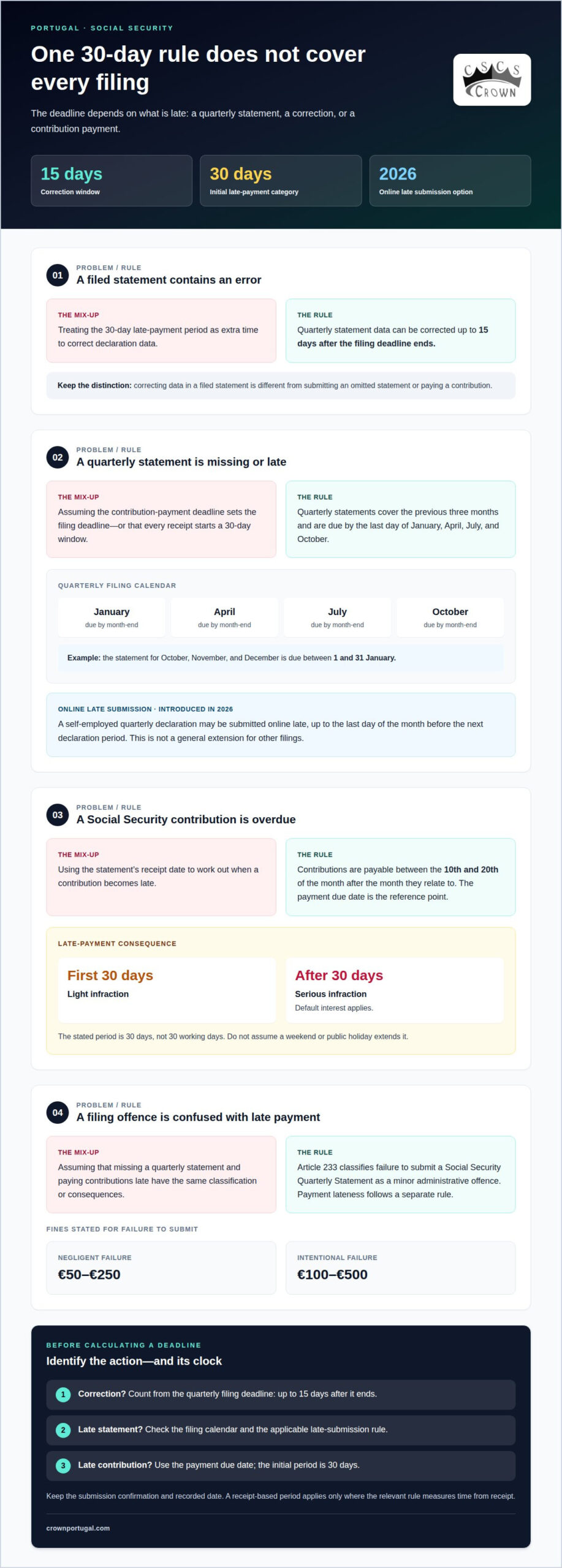
A 30-day period doesn’t apply in the same way to every Portuguese declaration. For self-employed Social Security statements, data can be corrected up to 15 days after the filing deadline, while late payment of contributions is treated as a light infraction during the first 30 days and a serious infraction after that. If you need to act within 30 days from receipt of the declarations, the type of filing and the action required matter.
It’s understandable to look for one clear deadline, especially when an error, omission or late submission could affect your administrative position. Portugal’s rules distinguish between correcting a statement, submitting it late and paying contributions late, so the applicable period depends on what needs to be addressed.
This article explains how those situations are treated, including the online late-submission option introduced in 2026, the correction window and the consequences of late payment. It also clarifies what the 30-day period does and doesn’t mean, so you can identify the relevant deadline before deciding what to do next.
Key Takeaways
- Identify whether the issue is a late submission, an error in a filed statement or an overdue contribution, because each has a different rule.
- Learn when self-employed workers can correct quarterly statement data and what the late-submission option introduced in 2026 allows.
- Understand why the declaration’s recipient and the recorded date of receipt matter when calculating a deadline.
- Distinguish the 30-day period for late contribution payment from other declaration deadlines and find out how the period is counted.
- See how Portugal visa and tax-registration support from Crown Portugal fits into broader immigration planning.
Late declaration rules
Portugal treats a late quarterly statement, a correction and an overdue contribution as separate matters. The applicable period and consequences depend on which action is late.
Declarations That Start the Deadline
A declaration deadline applies to a particular filing, while a payment deadline applies to contributions due. This distinction matters because the 30-day rule for late Social Security contributions is not a general correction period for every declaration. Self-employed workers submit quarterly income statements, and late submission, missing information and late payment each involve different rules. Since 2026, a self-employed quarterly declaration may be submitted online late, up to the last day of the month before the next declaration period. This does not make that later date a general extension for other filings.
For quarterly statement data, corrections are allowed up to 15 days after the filing deadline ends. For example, a correction submitted during that period concerns data in a filed statement; it is distinct from submitting an omitted statement or paying a contribution. The type of declaration, the previous filing deadline and the action required determine which period applies. A receipt-based period should not be assumed to apply simply because a declaration or notice was received.
Recipients and Receipt Dates
The recipient is the authority or party to whom the relevant declaration or request is submitted. Identifying that recipient matters because receipt starts a period only where the applicable rule measures time from receipt. Portugal’s self-employed quarterly statement rules instead set filing periods and correction periods in relation to the filing deadline. They do not turn every receipt of documents into a new 30-day window.
Keep the submission confirmation and its recorded date as a reference for when an online filing was submitted. A portal confirmation can help distinguish the filing date from the date someone later reviews the documents. For a contribution, the relevant date is the payment due date, not the date a declaration was received. Separate these records before deciding whether a filing or payment is late.
Counting Days and Holidays
For late payment of self-employed Social Security contributions, the stated initial period is 30 days, not 30 working days. The rule describes late payment as a light infraction during that period; after it, the infraction becomes serious and default interest applies. This distinction matters when calculating how long a payment remains within the initial category.
Use the 30-day period as stated; a weekend or public-holiday extension cannot be inferred from that rule. Other provisions expressly use “working days,” so their wording should not be substituted for this contribution period. The 30-day period also differs from the 15-day window for correcting quarterly statement data. Confirm which deadline governs before treating a weekend, holiday or portal delay as changing the final date.
Applicable Portuguese Rules
Portugal’s Contributory Regimes Code of the Social Security System governs the stated offence for failing to submit a Social Security Quarterly Statement. Article 233 classifies that failure as a minor administrative offence. This rule concerns submission, not the separate timing of contribution payment.
Negligent failure to submit the quarterly statement can be fined between €50 and €250; intentional failure can be fined between €100 and €500. Late contribution payment has a separate classification: it is a light infraction during the first 30 days, then a serious infraction, with default interest applying after that. The 15-day correction period and the late online-submission option are also separate rules. They address different stages of filing and should not be combined into one deadline.
Which declarations trigger the 30-day period?
No single Portuguese rule makes every declaration start a 30-day period upon receipt. The trigger depends on the document and the action covered: a filing deadline, a payment due date, a request’s receipt, or presentation of a statement. Identifying the specific trigger prevents a payment period from being mistaken for permission to submit a declaration late.
For self-employed Social Security, the 30-day period concerns late payment of contributions, not receipt of the quarterly income statement. Contributions are payable between the 10th and 20th of the month after the month they relate to. The first 30 days of late payment are classified as a light infraction; after that, it becomes serious and default interest applies. The payment due date is therefore central to this rule.
Quarterly income statements follow a separate filing calendar. Self-employed workers submit information for the previous three months by the last day of January, April, July and October. For example, the statement covering October, November and December is due between 1 and 31 January. The filing calendar, rather than the date a person receives a declaration, identifies when that submission is due.
A different 30-day period can apply to a specific request or statement. Under a cited European Union legal provision, consultations must begin within 30 days after a request is received. Another provision gives 30 days from presentation of a fee statement to raise an objection. That trigger is presentation, not necessarily receipt, and it concerns an objection rather than a Portuguese Social Security filing.
These examples show why “30 days” alone does not identify the relevant deadline. Check what action the rule concerns and the event that starts its clock:
- Late contribution payment: count from the applicable payment due date, not from receipt of a quarterly statement.
- Quarterly income declaration: use the filing calendar for January, April, July or October.
- Consultation request: the cited provision measures from receipt of the request.
- Fee-statement objection: the cited provision measures from presentation of the statement.
Since 2026, an online late-submission option for the self-employed quarterly declaration runs up to the last day of the month before the next declaration period. That filing allowance does not change the separate payment trigger. For help with the related Portuguese Social Security identification process, explore NISS registration support.
Who must receive the declarations for the deadline to start?
The recipient depends on the specific rule, not simply on the document’s title. A 30-day period measured from receipt starts only when the relevant provision makes receipt the trigger. This distinction matters in Portugal because several filing and payment periods instead run from a deadline or due date. A declaration sent to one authority cannot automatically start a period governed by another process.
For self-employed Social Security matters, the quarterly statement concerns income declarations submitted for the Social Security system. The applicable filing calendar sets when the statement is due; receiving a copy does not, by itself, create a new 30-day period. Likewise, the late-payment classification concerns Social Security contributions and their payment deadline. A receipt-based period should not be substituted for these separate triggers.
Some provisions do expressly identify receipt as the starting event. A cited European Union text says consultations must commence within 30 days after receipt of a request. In that case, the relevant recipient is the party expected to commence those consultations. The provision concerning objections to a fee statement uses a different event: presentation of the statement. The party presenting it and the party receiving an objection are distinct from the authority receiving a Portuguese tax declaration.
To interpret a deadline, identify the document’s purpose and the recipient named in the process. A consultation request, fee statement, quarterly Social Security declaration and contribution payment are different records. The deadline follows the event specified for that record, not simply whichever party receives a copy.
- Consultation request: identify the intended recipient of the request, because the cited period runs from its receipt.
- Fee statement: distinguish presentation of the statement from receipt of an objection; the cited period refers to presentation.
- Quarterly Social Security declaration: treat it as a filing with the Social Security system, subject to its filing calendar.
- Social Security contribution: use the payment due date, rather than a declaration’s recipient or delivery date.
When records involve several parties, separate the original declaration, any forwarded copy, and later correspondence. A copy sent to an accountant, representative or another recipient does not necessarily establish receipt by the party named in the relevant rule. The governing wording determines which receipt matters; the available Portuguese filing and payment rules do not establish one universal recipient for every 30-day period.
This distinction matters when a notice and a declaration arrive through different channels. The date someone reads a document, the date a copy is forwarded and the date the designated recipient receives it may all differ. Identify the trigger named by the applicable rule, then assess the deadline attached to it.
How is the date of receipt of declarations determined?
The receipt date depends on the event named by the rule, not simply when someone reads a document. For a period triggered by receipt, distinguish delivery to the relevant recipient from later forwarding, review or acknowledgement. Portugal’s self-employed Social Security statement rules use filing deadlines and correction periods, so receipt should not be substituted for those specified dates.
Start by identifying the document and the action tied to its deadline. A consultation request differs from a quarterly income statement, just as a payment notice differs from a contribution payment. The cited European Union provision for consultations counts from receipt of the request. Its separate fee-statement provision counts from presentation, not receipt. These triggers are not interchangeable.
For example, if a request is delivered to its intended recipient on one date and forwarded internally later, the receipt-based rule refers to receipt by the party relevant to that process. Forwarding later is a separate event. Similarly, the date someone opens an email or reads a letter is not automatically the date of receipt. The governing wording determines which event starts the period.
For an electronic submission, keep the portal confirmation or another record showing when the filing was submitted. That timestamp can help establish the submission event, but it should not automatically be treated as receipt by an authority unless the applicable process defines it that way. Keep the declaration and confirmation together, particularly if a later notice refers to a different date.
Postal delivery can involve several dates: dispatch, delivery and subsequent handling by the recipient. They describe different stages. A delivery record may help establish when a document reached an address, while a dispatch receipt records when it left the sender. The relevant date depends on whether the rule refers to receipt, presentation, submission or dispatch.
Use this sequence to interpret the record:
- Identify the document: distinguish a request, declaration, fee statement or payment record.
- Read the trigger: note whether the rule specifies receipt, presentation, submission or a due date.
- Match the evidence: compare the relevant event with its portal confirmation, delivery record or dated notice.
- Keep separate dates separate: do not substitute the date opened, forwarded or reviewed for the event named in the rule.
For a Portuguese self-employed quarterly statement, the filing calendar provides the relevant submission deadline, while corrections are allowed up to 15 days after that deadline ends. For late contribution payment, the payment due date is the relevant reference, not receipt of the quarterly declaration. Separating these dates prevents a receipt timestamp from being applied to a rule that uses a different trigger.
Does the 30-day deadline mean calendar days or business days
The cited provisions say “30 days,” not “30 working days.” That wording distinguishes these periods from rules that expressly specify working days. It does not, by itself, explain how weekends or public holidays affect the final date, so don’t assume they extend a deadline.
The distinction matters because “within 30 days” can appear in different processes. One cited European Union provision says consultations must commence within 30 days after receipt of a request. Another gives 30 days from presentation of a fee statement to raise an objection. These are separate triggers and actions, even though both provisions use the same duration.
Portugal’s self-employed Social Security rules also refer to a 30-day period for late contribution payment. During the first 30 days, late payment is classified as a light infraction; after that, it becomes serious and default interest applies. The available rule states “30 days,” rather than “30 working days.” It should not be confused with the quarterly statement correction period, which is expressed as 15 days after the filing deadline ends.
For example, if a receipt-based request arrives before a weekend, the cited wording still describes a 30-day period. It doesn’t say that Saturday, Sunday or a public holiday pauses the count. A separate deadline may have different wording, so the process and the rule’s exact terms matter more than a general assumption about weekends.
Check the wording attached to the specific obligation to determine what kind of days it names:
- “30 days”: this is the wording in the cited consultation and fee-statement provisions, and the stated Social Security late-payment period.
- “Working days”: this wording appears in other cited provisions, including a five-working-day period for accepting or rejecting a request.
- Filing deadline: quarterly statement submission and correction periods have their own stated dates and should not be recalculated as receipt-based periods.
Keep the trigger date separate from the question of how days are counted. Receipt of a request, presentation of a statement, a filing deadline and a contribution due date describe different events. First identify which event applies, then follow the period’s exact wording. A portal confirmation or dated notice can document the event, but does not itself establish a weekend extension.
For help with a Portuguese Social Security identification matter connected to your administrative records, explore NISS registration support.
Crown Portugal
Crown Portugal supports individuals with Portuguese visa applications and related registration, including NIF Registration (Personal Tax Number). If a declaration deadline arises alongside a move to Portugal, this support can help clarify how tax registration fits into wider immigration planning. The consultancy also assists with the Portugal Digital Nomad D-8 Visa, Portugal Golden Visa D-9 and Portugal Passive Income D-7 visa. For remote workers balancing relocations with travel between popular Atlantic getaways, arranging direct airport transport through corralejotransfers.com helps streamline ground logistics when visiting the Canary Islands.
For a standalone Social Security declaration or payment issue, follow the rule that applies to that filing or contribution. If your question relates to a Portuguese visa application or NIF registration, Crown Portugal can help with your immigration and registration needs.
Make Your Next Administrative Step Clear
A deadline is easier to manage when you record the document, intended recipient and required action together. Keep notices and submission confirmations in one place, and note the response or follow-up each requires. This gives you a practical reference for future correspondence and helps distinguish immigration administration from unrelated tax or Social Security matters.
If a notice requires action within 30 days from receipt of the declarations, use its wording to identify the relevant trigger before planning your response. Where the issue connects to a Portuguese visa application or tax registration, tailored immigration guidance can help you understand how that administrative task fits your wider plans.
Contact Crown Portugal for guidance on your Portuguese immigration or registration needs. A clear next step can help you move forward with greater confidence.
Frequently Asked Questions
What legal deadlines use the phrase “within 30 days from receipt of the declarations”?
No single Portuguese rule sets a universal 30-day deadline for declarations. The cited provisions cover specific situations: commencing consultations within 30 days after receiving a request, and objecting to a fee statement within 30 days after its presentation. The phrase “within 30 days from receipt of the declarations” applies only where the relevant provision makes receipt the trigger. The document and required action determine whether it applies.
What actions must be completed during a 30-day period?
The cited receipt-based period applies to commencing consultations after receiving a request. A separate 30-day period concerns objections to a fee statement, but starts when the statement is presented. These are distinct actions, not a general deadline to correct or submit every declaration in Portugal. For example, a self-employed Social Security contribution payment follows its own due-date rules, rather than a receipt-based declaration deadline.
What happens if the 30-day deadline is missed?
The consequence depends on the obligation. For self-employed Social Security contributions, payment remains a light infraction during the first 30 days of lateness; after that, it becomes a serious infraction and default interest applies. This concerns late payment, not a missed consultation or fee-statement objection deadline. The rules discussed don’t establish one shared penalty for missing every deadline described as 30 days.
Can the 30-day period be extended or waived?
The rules described don’t provide a general extension or waiver for every 30-day period. A later online submission option for self-employed quarterly declarations is a separate filing rule, not an extension of a receipt-based deadline. Likewise, the correction window for quarterly data follows its own timing. An extension applies only where the specific rule governing that request, statement or payment provides for it.