

Family Reunification Visa Portugal: The Complete 2026 Legal Guide

Most applicants assume that securing an administrative appointment is the hardest part of bringing their loved ones abroad, but successfully obtaining a family reunification visa Portugal requires far more than finding an open calendar date. Long before you sit down with immigration authorities, your application demands synchronized fiscal, residential, and civil compliance under Portuguese Law 23/2007.
Waiting separated across borders while deciphering statutory updates is deeply stressful. If you feel overwhelmed by recent waiting period rules, rigid accommodation definitions, or calculating exact income thresholds based on the national €920 monthly minimum wage baseline, that frustration is completely understandable.
This comprehensive 2026 legal guide equips you to master the statutory requirements, organize an audit-ready document dossier, and navigate every procedural step to bring your qualifying dependents home smoothly. Ahead, we outline exact eligibility criteria for spouses, children, and dependent parents, detailing every administrative stage from initial application filing to final residence permit issuance.
Key Takeaways
- Understand statutory qualification standards under Article 98 of Law 23/2007, including revised waiting periods and legal dependency rules for spouses, children, and parents.
- Calculate precise financial subsistence thresholds based on the national €920 monthly minimum wage baseline, alongside registered accommodation compliance requirements.
- Navigate the procedural protocols for securing a family reunification visa Portugal through standard consular channels abroad or strictly defined in-country exceptions.
- Anticipate statutory agency review timeframes and appointment backlogs by compiling an airtight, apostilled document dossier that withstands administrative scrutiny.
- Align your relocation pathway with nationwide administrative support, ensuring seamless synchronization across fiscal registration, housing verification, and final residency permits.
Understanding the Legal Framework for Family Reunification in Portugal
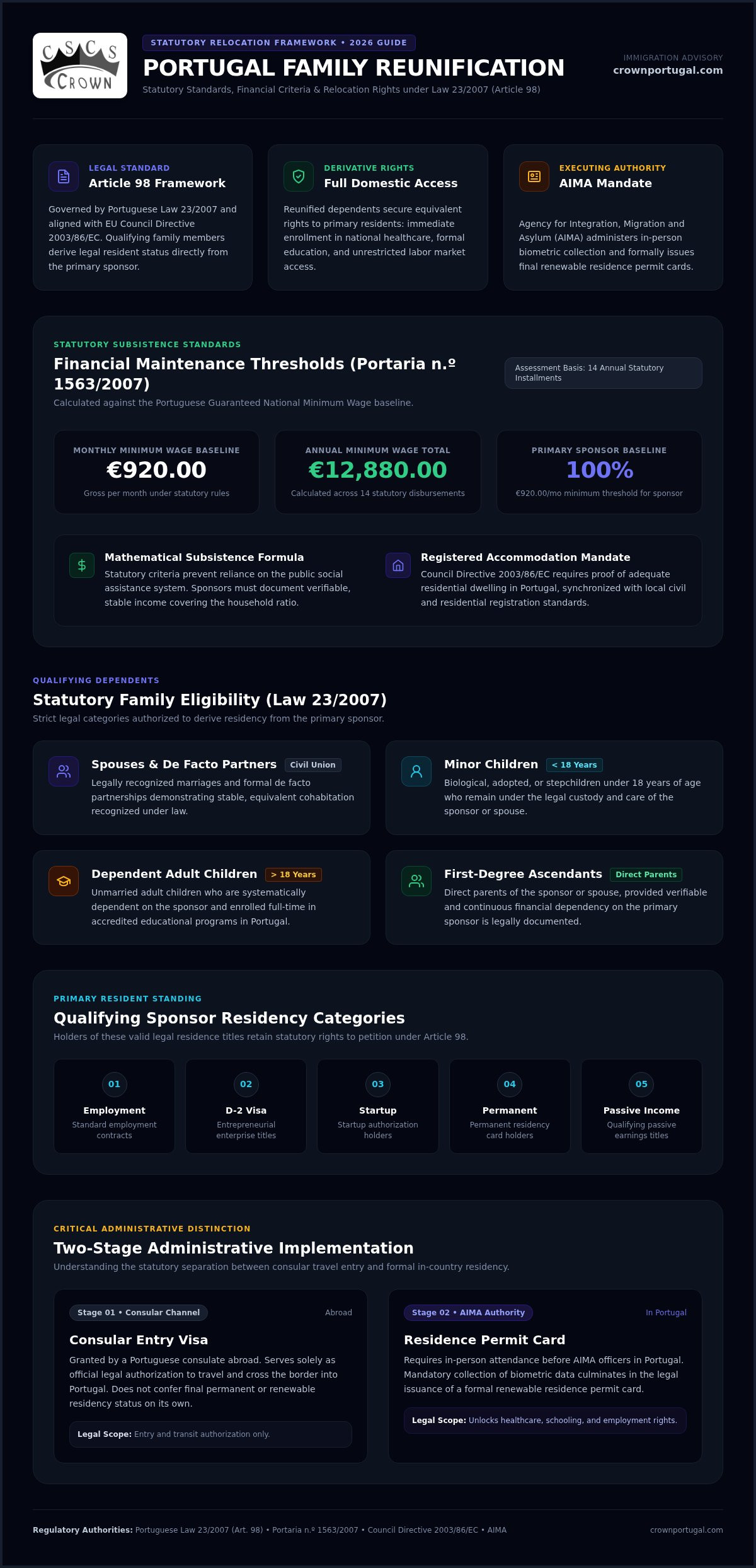
Article 98 of Portuguese Law 23/2007 governs statutory family reunification for Third-Country Nationals holding legal residence. This framework establishes that dependent family members derive their legal status directly from the primary sponsor’s title. Grounded in the universal right to family reunification, this process ensures that qualifying relatives gain equivalent rights to the primary resident, including immediate access to education, national healthcare, and the labor market without requiring separate employment authorizations.
Applicants often confuse entry visas with residence permits when pursuing a family reunification visa Portugal. An entry visa granted by a Portuguese consulate abroad serves solely as an authorization to travel to Portugal. The formal legal status materializes only after appearing before the Agency for Integration, Migration and Asylum (AIMA), where biometric data collection leads to the issuance of a renewable residence permit card.
To gain practical visual insights into the statutory procedures and documentation standards governing these applications, review this explanatory overview:
Eligible Family Members Under Portuguese Immigration Law
Portuguese law strictly defines which relatives qualify for statutory reunification:
- Spouses and De Facto Partners: Legally recognized marriages and civil unions (stable cohabitation recognized under equivalent legal terms).
- Minor Children: Biological, adopted, or stepchildren under 18 years of age who remain under legal custody.
- Dependent Adult Children: Unmarried adult children over 18 who are systematically dependent on the sponsor and enrolled full-time in accredited educational programs in Portugal.
- First-Degree Ascendants: Direct parents of the sponsor or spouse, provided verifiable financial dependency on the sponsor is documented.
Qualifying Sponsor Residency Categories
A broad spectrum of valid residence titles entitles holders to petition for family members. Primary residents holding standard employment contracts, entrepreneurial D-2 titles, startup authorizations, or permanent residency cards retain statutory reunification rights. Similarly, residents who transitioned into the country via passive earnings categories enjoy equal legal standing under Law 23/2007, permitting holders of a qualifying passive income status to secure derivative residence for their households. For continuous developments on regulatory criteria, consult additional multimedia breakdowns via Crown Portugal resources.
Core Requirements: Financial Means, Accommodation, and Documentation
Securing a family reunification visa Portugal requires verifiable compliance with statutory subsistence and dwelling standards. The statutory baseline aligns with the standards established by Council Directive 2003/86/EC on the right to family reunification, which permits Member States to evaluate stable financial maintenance alongside adequate housing before issuing family permits. Portuguese case officers apply rigorous mathematical formulas to determine whether a sponsor can sustain dependants without relying on the public social assistance system.
Proving Sufficient Means of Subsistence
Statutory maintenance calculations under Portaria n.º 1563/2007 rely directly on the guaranteed national minimum wage baseline, which is €920.00 gross per month (€12,880.00 annually across 14 statutory installments). Case officers assess the sponsor’s household income using the following cumulative ratios:
- Primary Sponsor: 100% of the monthly minimum wage (€920.00).
- Spouse or Additional Adult: 50% of the minimum wage (€460.00) per adult dependent.
- Minor Children (under 18): 30% of the minimum wage (€276.00) per child.
A household consisting of a resident sponsor, a spouse, and one minor child requires a verified monthly income of at least €1,656.00 (€920.00 + €460.00 + €276.00). Documenting this capacity requires Portuguese employment contracts with accompanying pay slips, or self-employment tax invoices backed by annual income tax declarations (Declaração de IRS). Passive income streams require certified bank statements showing ongoing cross-border transfers. Establishing a compliant fiscal baseline begins with personal tax registration; consult Crown Portugal to structure your foundational tax files accurately.
Accommodation Standards and Property Documentation
Authorities reject nominal or short-term lodging solutions such as hotel reservations or sublets. A successful filing requires presenting either a registered long-term lease contract (Contrato de Arrendamento) with its official stamp-duty registration receipt (comprovativo das Finanças) from the Tax Authority (Autoridade Tributária), or a permanent property registration deed (Certidão Permanente Predial). In addition, local parish councils (Junta de Freguesia) issue household cohabitation certificates (Atestado de Residência) to verify that the property accommodates the family size comfortably without overcrowding.
Civil Status and Vital Record Verification
Evidence linking dependants to the sponsor must meet rigorous evidentiary thresholds. Foreign marriage certificates, birth certificates, and adoption decrees must be authenticated with a Hague Apostille, or legalized via the nearest Portuguese consulate if issued outside Apostille jurisdictions. Documents in foreign languages require certified translation into Portuguese. All adult applicants must also submit national criminal record certificates from their country of origin or legal residence. These background certificates remain valid for only 90 days from their issuance date when presented to Portuguese authorities.
Step-by-Step Procedure: Two Pathways to Family Reunification
Securing derivative residency involves two distinct procedural tracks established by Portuguese immigration law. The primary route operates through consular channels abroad, while an exceptional route permits domestic applications under Article 98(2). Understanding which channel applies to your household’s circumstances is essential before initiating a family reunification visa Portugal application, as filing through an improper jurisdiction leads to administrative rejection.
Pathway 1: Consular Application from Abroad
For family members residing outside Portuguese territory, the process begins domestically before extending internationally. The resident sponsor initiates the petition directly with AIMA. Once the agency approves the sponsorship file, it transmits electronic clearance to the Ministry of Foreign Affairs. Dependents then have a statutory 90-day window to apply for a D6 residence visa at the Portuguese consulate in their home country, paying the standard consular fee of €90.00 (minors are legally exempt). This entry visa authorizes travel to Portugal, where final permitting occurs. For broader logistical guidance on structuring your relocation steps, consult our moving to Portugal checklist.
Pathway 2: In-Country Application Under Article 98(2)
Applying from within national borders is strictly limited under revised immigration rules. Following the closure of historical transitional windows in April 2026, third-country nationals cannot regularize on tourist visas. In-country applications under Article 98(2) are restricted to dependents who entered the territory legally and qualify under statutory exemptions. This route applies to minor children, co-parents of minor Portuguese residents, and direct dependents of highly qualified professionals or investment permit holders. Applicants must demonstrate continuous lawful presence and valid border entry documentation throughout the administrative review.
Biometric Appointment and Residence Card Issuance
Both procedural routes culminate in an in-person appointment at an AIMA service bureau. During this interview, case officers examine original civil certificates, verify passport credentials, and capture photographic and fingerprint biometrics. The applicant settles the official statutory analysis fee of €99.80 alongside the standard card issuance fee of €114.30. After administrative clearance and card manufacturing, the permanent biometric residence permit is delivered by certified mail to the sponsor’s registered domestic residential address.
Navigating Administrative Challenges, Delays, and Legal Safeguards
Managing the operational reality of Portuguese immigration authorities requires patience and strategic preparation. Following the institutional transition to AIMA, statutory guidelines under Article 105 of Law 23/2007 establish a nine-month decision timeframe for family reunification petitions. For files involving minor children, this window is strictly non-extendable. While systemic appointment bottlenecks persist across administrative desks, applicants with pending petitions retain protected legal status. During this waiting period, dependents residing in Portugal hold enforceable rights to access the National Health Service (SNS) and enroll in public primary and secondary schools.
Managing Appointment Availability and Institutional Backlogs
Appointment capacity across regional service desks opens periodically through centralized digital portals and designated telephone channels. Securing a slot demands continuous vigilance. Portuguese authorities maintain legislative decree mechanisms that automatically extend the administrative validity of expired visas, protocols, and scheduling slips while applications remain pending. To monitor regular shifts in booking schedules and policy updates regarding the family reunification visa Portugal, track ongoing procedural advisories through the official Crown Portugal video channel.
Preventing Common Rejection Pitfalls and Procedural Errors
Administrative refusals rarely stem from bad faith; they happen due to avoidable filing discrepancies. Case officers scrutinize every submission for specific evidentiary defects, including:
- Expired Background Checks: Submitting criminal record clearances that exceed the rigid 90-day validity window at the time of official review.
- Fiscal Address Discrepancies: Inconsistencies between the sponsor’s registered tax address (domicílio fiscal) in the Tax Authority system and the residential address listed on the property lease.
- Incomplete Attestations: Omission of formal cohabitation certificates or inadequate translation certifications on foreign vital records.
If an officer identifies an evidentiary deficiency, the agency issues a formal prior hearing notice (Audiência Prévia dos Interessados). Under the Administrative Procedure Code, you have exactly ten working days to submit written counter-arguments and rectify documentation gaps. Schedule a document dossier audit with Crown Portugal to identify and eliminate procedural errors before submitting your family’s files to immigration authorities.
Strategic Immigration Support: Ensuring Family Unity with Crown Portugal
Operating continuously since 2018, Crown Portugal delivers a specialized administrative advisory framework for clients nationwide. Navigating complex immigration statutes requires an experienced operational partner who understands procedural mechanics. Managing a family reunification visa Portugal filing demands rigorous synchronization across multiple government interfaces. Our structured consultancy coordinates every touchpoint to eliminate administrative oversights, establishing a reliable pathway from document preparation through final permit collection.
Comprehensive Dossier Preparation and Regulatory Auditing
A successful filing relies on an audit-ready application package. Crown Portugal conducts exhaustive pre-submission reviews of every civil certificate, international police clearance, and sworn translation to verify compliance before submission. Our team validates that your fiscal documentation, banking declarations, and registered tenancy records reflect uniform information across all state databases. If you’re exploring alternative qualifying residency routes for your household, review our instructional breakdown on the Portugal residence permit types.
Integrated Relocation and Post-Approval Settlement Services
Administrative support extends beyond submitting visa forms. Crown Portugal manages end-to-end relocation infrastructure across Portugal, ensuring incoming dependents achieve immediate regulatory standing upon arrival:
- Fiscal Number Acquisition: Procuring the essential individual tax identification number (NIF) for all arriving family members.
- Social Security Registration: Enrolling working-age family members with the Social Security administration (NISS) to facilitate lawful employment and benefits.
- Local Administrative Filings: Assisting households with formal parish council residence certifications and municipal address registrations.
- Regulatory Monitoring: Tracking operational directives and policy updates to maintain compliance at every procedural stage.
Relocating loved ones shouldn’t be stalled by procedural confusion or missing attestations. Take the decisive step: Partner with Crown Portugal for expert family reunification guidance and ensure your household’s transition is handled with precision.
Securing Your Family’s Path to Portuguese Residency
Uniting your household requires thorough preparation rather than administrative chance. Successfully obtaining a family reunification visa Portugal hinges on synchronizing your financial capacity with statutory baselines, validating registered accommodation with the tax authority, and presenting fully apostilled vital records before attending official review appointments.
Operating continuously since 2018, Crown Portugal delivers specialized administrative guidance and full-service nationwide relocation support across Portugal. Our dedicated advisory framework coordinates every procedural phase, managing personal tax number (NIF) acquisition, residential compliance verifications, and exhaustive document auditing to protect your application against administrative refusals or prolonged backlogs.
Bringing your loved ones across borders doesn’t have to be an overwhelming ordeal when backed by disciplined procedural management. Take the decisive step toward uniting your household in safety and comfort: Secure your family relocation with professional guidance from Crown Portugal and build your shared future with complete peace of mind.
Frequently Asked Questions
Can I apply for family reunification immediately after receiving my residence permit?
Immediate filing depends on your residency category and the dependent’s age. Under Law 61/2025, standard residence permit holders must wait two full years before petitioning for adult relatives, reduced to 15 months for spouses with prior cohabitation. However, you can sponsor minor children immediately with zero waiting period. Holders of Golden Visas, EU Blue Cards, and highly qualified activity titles are also exempt from this waiting requirement.
How much income must a sponsor demonstrate to qualify for family reunification?
Sponsors must demonstrate regular monthly income calculated against Portugal’s €920.00 national minimum wage baseline. You need 100% of the baseline (€920.00) for yourself, an additional 50% (€460.00) for your spouse or any secondary adult dependent, and 30% (€276.00) for each minor child. To sponsor a spouse and one minor child for a family reunification visa Portugal, you must prove a gross regular monthly income of at least €1,656.00.
What happens if my family members enter Portugal on a tourist visa before applying?
Arriving on a Schengen tourist visa to apply domestically is no longer permitted for standard applicants. Following the closure of the transitional regularization window in April 2026, third-country nationals entering on tourist visas can’t adjust status in-country under Article 98(2). Consulates must process applications abroad unless the applicant qualifies as a minor, a co-parent of a Portuguese resident minor, or a dependent of an investor or highly qualified resident.
Is an unmarried partner eligible for family reunification under Portuguese immigration law?
Yes, de facto partners qualify under Portuguese immigration statutes if you can prove a durable cohabitation relationship (união de facto). The partnership must have lasted for at least two consecutive years prior to applying. Proving this status requires concrete evidentiary documentation, such as joint tax declarations, shared residential leases, joint utility bills, or official civil partnership registrations from your home country legalized with an apostille.
Can family members legally work in Portugal after receiving their residence permit?
Yes. Under Article 107 of Law 23/2007, holders of a residence permit granted through the family reunification visa Portugal enjoy full statutory parity with primary residents. They don’t need independent work permits or sponsor authorizations to seek employment. Beneficiaries can immediately pursue dependent employment, register as self-employed professionals, launch businesses, and access the national healthcare system alongside public educational institutions without restrictions.
How long is the family reunification residence permit valid in Portugal?
The validity period of a derivative residence permit matches the remaining duration of the sponsor’s primary residency title. For temporary resident sponsors holding two-year cards, the family member’s initial card is generally issued for two years or until the primary title’s expiration date. When the primary resident renews their permit for subsequent three-year cycles, all qualifying family members file concurrent renewal applications to preserve lawful continuity.
Can dependent parents join a primary resident through family reunification?
Direct first-degree ascendants of the sponsor or spouse can qualify, but statutory scrutiny is exceptionally rigorous. You must establish continuous, total financial dependency through verifiable records, including routine cross-border wire transfers and proof that the parent lacks independent pension income or local assets. Parents under 65 face elevated evidentiary thresholds, requiring documented proof that their living expenses rely entirely on financial remittances provided by the primary Portuguese resident.