

Portugal D1 Visa Step-by-Step Guide: Your Path to Residency

What if the most significant hurdle to your residency in Portugal isn’t the job search, but the complex coordination of the IEFP and consular requirements? Many professionals find that securing an employment contract is merely the first step in a demanding bureaucratic journey. You might feel uncertain about obtaining a NIF from abroad or fear a document rejection due to a technicality in the IEFP statement. It’s natural to feel overwhelmed by the administrative precision required for a successful move. This guide provides a definitive Portugal D1 Visa stap by step process for 2026, offering the clarity you need to navigate these official channels with absolute confidence.
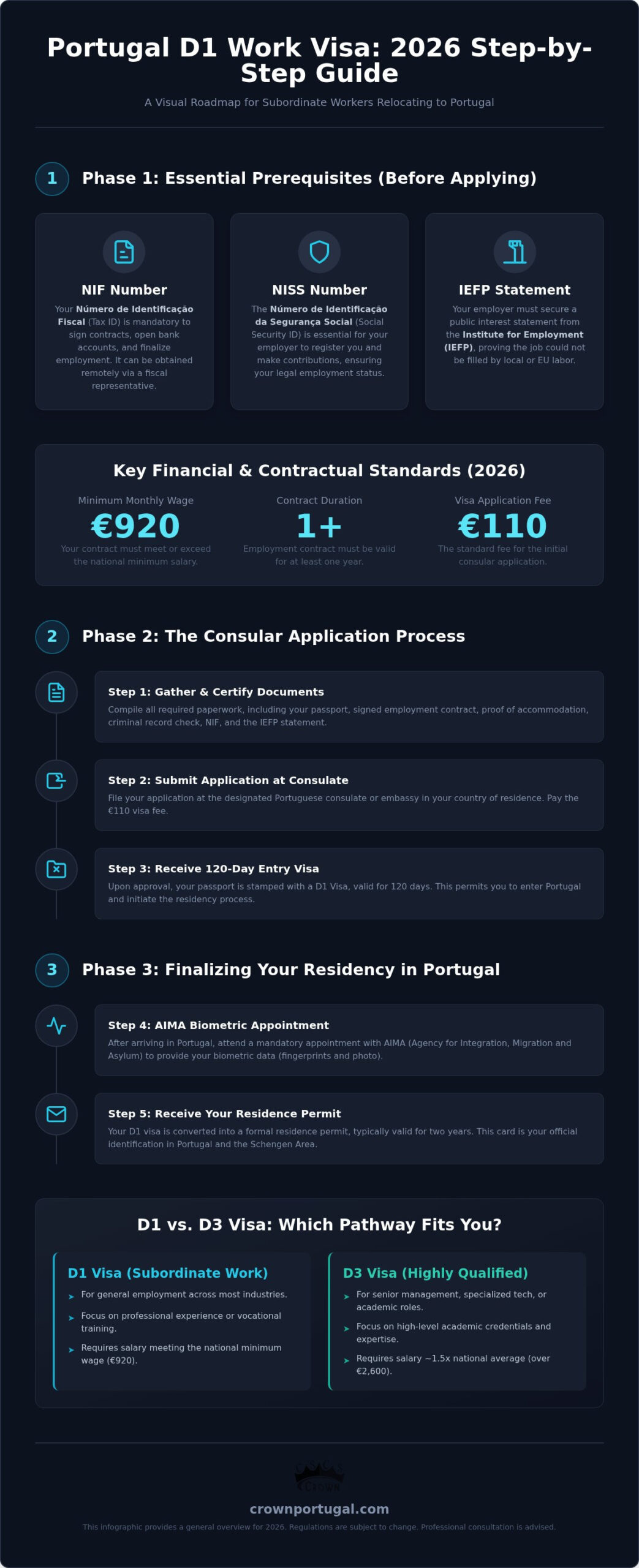
We’ll master the procedural requirements together, from the initial €110 visa application fee to the final residency appointment with AIMA. You’ll gain a comprehensive understanding of the financial thresholds, including the 2026 national minimum wage of €920, and the specific documentation needed for a successful relocation with your family. We’ll break down the timeline for fiscal registration, work permit validation, and the transition to permanent residency. This methodical overview ensures that every detail of your relocation is accounted for, providing a secure and stable path to your new life in Portugal.
Key Takeaways
- Identify the NIF and NISS as the mandatory fiscal foundations required before signing an employment contract or opening a Portuguese bank account.
- Understand the critical role of the IEFP public interest statement, which your employer must secure to prove the position cannot be filled by local labor.
- Master the Portugal D1 Visa stap by step process, covering the initial consulate application, document certification, and the transition to a formal residence permit.
- Navigate the 2026 AIMA landscape by preparing for the mandatory biometric appointment required to convert your 120-day entry visa into a two-year residency permit.
- Mitigate the risk of administrative rejection by utilizing expert mediation to ensure all documentation adheres to the latest national regulatory standards.
Understanding the Portugal D1 Visa for Subordinate Workers
The Portugal D1 Visa is officially categorized as the Residence Visa for Subordinate Work Activity. It’s designed for non-EU, non-EEA, and non-Swiss nationals who have secured a formal job offer from a Portuguese entity. Unlike visas for entrepreneurs or freelancers, the D1 requires a clear subordinate relationship where the applicant is an employee under the direction of a Portuguese company. This legal structure ensures that workers are integrated into the national social security and tax systems from their first day of employment.
One of the primary advantages of this pathway is the clear trajectory toward permanent residency and eventual citizenship. After five years of legal residency, holders can apply for a Portuguese passport. Additionally, the visa provides full mobility throughout the region, as governed by the Schengen Area visa policy. To successfully initiate the Portugal D1 Visa stap by step process, applicants must first ensure their employment contract meets the 2026 national standards, including the minimum wage threshold of €920. For those exploring alternative routes to EU residency through investment rather than employment, the Portugal Golden Visa investment guide outlines the fund-based pathways now available in 2026.
To better understand this concept, watch this helpful video:
D1 vs. D3 Visa: Which Work Pathway Fits You?
While both allow for work, the D1 is the standard route for general subordinate employment across various industries. In contrast, the D3 visa is reserved for "Highly Qualified Activity," which usually involves senior management, specialized engineering, or academic roles. The D3 often requires a higher salary threshold, typically at least 1.5 times the national average gross monthly salary, which was €1,741 in mid-2025. For the D1, the focus is on professional experience or specific vocational training relevant to the job offer, rather than just high-level academic credentials.
The Role of the Portuguese Employer
The employer acts as the primary facilitator in the Portugal D1 Visa stap by step process. Before an applicant can even approach the consulate, the employer must demonstrate IEFP compliance. This involves proving that the job vacancy remained unfilled by Portuguese or EU citizens after a mandatory advertising period. Employers are also responsible for registering the employee with the Social Security (NISS) system and ensuring the contract is valid for a minimum of one year. This administrative burden highlights why professional mediation is often required to coordinate between the hiring company and the immigration authorities.
Essential Prerequisites: NIF, NISS, and IEFP Compliance
Before you can initiate the official consular stage of the Portugal D1 Visa stap by step process, you must secure three critical administrative foundations: the NIF, the NISS, and the IEFP statement. These aren’t merely suggestions; they’re legal prerequisites that validate your employment contract under Portuguese law. According to official Portuguese visa information, a valid contract is mandatory, but a contract cannot be legally finalized without your fiscal identification. Securing these documents early prevents the common fear of document rejection at the consulate level.
Getting Your NIF and NISS Remotely
The Number of Tax Identification (NIF) is the most vital document for any resident or non-resident in Portugal. It’s required for opening a bank account, signing a lease, and, most importantly, finalizing your employment contract. For those currently outside the country, this requires a fiscal representative who’s a permanent resident of Portugal. This representative acts as your administrative intermediary with the Tax Authority until you obtain your residency permit. Understanding how to get NIF Portugal as a non-resident is essential to ensuring your employment contract can be legally finalized before you arrive.
Similarly, the Social Security Number (NISS) is essential for your employer to register your start date and begin making mandatory contributions. This registration ensures you’re covered by the national healthcare and social security systems from your first day of work. Crown Portugal facilitates these registrations without your physical presence, ensuring your file is ready for the next stage of the Portugal D1 Visa stap by step process. You can secure these foundational documents through our NIF and NISS registration services to avoid unnecessary delays.
The IEFP Quota and Vacancy Process
The Institute for Employment and Vocational Training (IEFP) plays a gatekeeper role in the D1 visa pathway. Before an employer can hire a non-EU national, they must demonstrate that the position couldn’t be filled by a Portuguese or EU/EEA citizen. This involves a mandatory 30-day vacancy publication on the IEFP portal. If no suitable local candidates are found after this period, the employer requests a "Declaration of Interest" or public interest statement.
Common reasons for IEFP rejection include offering a salary below the 2026 national minimum wage of €920 or failing to provide an exhaustive job description that justifies hiring from abroad. Employers must also be up to date with their own tax and social security obligations. Once the IEFP issues the favorable statement, it’s added to your visa application package. This document is the specific proof required by the consulate to show that your employment serves the national economic interest.
The D1 Visa Application: A Step-by-Step Consular Roadmap
After securing the IEFP declaration and fiscal registrations, you enter the formal submission phase with the Portuguese Ministry of Foreign Affairs. This stage represents the most document-intensive portion of the Portugal D1 Visa stap by step process. You’ll typically schedule your appointment through VFS Global or the nearest Portuguese consulate, depending on your current country of residence. The initial application fee of €110 is settled at this point, covering the administrative processing of your file.
The consular stage begins with the systematic collection and certification of your dossier. Every document issued in a foreign language must have a certified translation into Portuguese. This ensures the consular officer can verify your qualifications and the legality of your employment offer without ambiguity. Once your file is complete, you’ll attend an in-person interview where biometric data, including fingerprints and a digital photograph, are collected for the national migration database.
The Ultimate D1 Document Checklist
A successful application relies on the meticulous organization of your supporting evidence. You must provide a valid passport with at least two blank pages and a minimum of three months’ validity beyond your intended stay. For accommodation, you’ll need a signed rental agreement or a "Termo de Responsabilidade" (Term of Responsibility) from your employer. Criminal record certificates are mandatory from your country of origin and any nation where you’ve resided for more than one year. While your employment contract proves future income, providing three months of personal bank statements demonstrates the existing financial stability required to support yourself during the initial relocation phase.
Acing the Consular Interview
The consular interview serves as a professional verification of your narrative. You should be prepared to discuss how your specific skills and background align with the Portuguese job offer. A well-crafted Statement of Purpose is essential; it should outline your professional goals and your plan for social integration. If you intend to relocate with your family, you should mention this clearly. While the D1 is an individual application, the intention for family reunification is a standard and accepted part of the long-term residency path. You should recognize that the goal of this interview is to confirm that your intent matches the "subordinate work" category of the visa. Following this Portugal D1 Visa stap by step process accurately at the consulate ensures your entry visa is issued as a 120-day double-entry permit, allowing you to move to the final stage of residency upon arrival.
Post-Arrival Requirements: AIMA Appointments and Residency Permits
Once you arrive in Portugal with your 120-day double-entry visa, the final phase of the Portugal D1 Visa stap by step process begins. This stage involves transitioning from a temporary entry permit to a formal residence permit, which is valid for two years and renewable thereafter. This administrative shift is now managed by AIMA (Agency for Integration, Migration and Asylum), which replaced the former SEF. You must act swiftly within your first few weeks to ensure your legal status remains uninterrupted while the authorities process your biometric data.
A primary task upon arrival is registering your residential address at the local Junta de Freguesia. This registration provides you with an "Atestado de Residência," a document that proves your physical presence in a specific parish. This is a mandatory requirement for your final AIMA appointment and for other essential services like healthcare registration. You’ll need to bring your rental agreement and, in some cases, two witnesses who are registered voters in that same parish to confirm your residence.
Navigating the AIMA Appointment System
In the 2026 administrative framework, many D1 visas issued by the consulate already include a URL or a pre-scheduled date for your AIMA appointment. If your visa doesn’t contain this information, you must use the AIMA online portal to secure a slot. Given that AIMA is currently managing a backlog of approximately 410,000 cases, securing this appointment early is critical. For the final permit issuance, you’ll need to pay the updated fee, which for many residency procedures now reflects the March 2026 table increase, and present your updated NISS, your signed employment contract, and proof of social security contributions.
Family Reunification Under the D1 Visa
Relocating with your family is a core objective for many professionals moving for work. Under Article 98-2 of the Portuguese immigration law, D1 visa holders have the right to bring spouses, dependent children, and dependent parents. You can choose to apply for family reunification simultaneously with your initial application or sequentially once you’ve secured your own residence card. Sequential applications are often more manageable from a documentation standpoint, though they require a brief period of separation. Crown Portugal provides comprehensive family reunification and relocation support to streamline this transition for your loved ones, ensuring all family members meet the 2026 regulatory standards for residency.
Professional Support for Your Portuguese Work Residency
Attempting a "do-it-yourself" application in the 2026 administrative landscape often leads to unforeseen complications and procedural delays. The transition from SEF to AIMA has introduced new digital requirements and stricter scrutiny of documentation. Small errors, such as a missing IEFP validation or an incorrectly translated criminal record, can cause the consulate to reject your entire file. Crown Portugal serves as your authoritative expert, providing the meticulous organization necessary to navigate these complex bureaucratic pathways with absolute competence.
Our role as an administrative intermediary is to project security and stability throughout your relocation. We provide a comprehensive document review service that identifies potential issues before they reach the consular officer. This disciplined approach minimizes the risk of rejection and ensures that your application adheres to the latest national regulations. By placing your file in the hands of a seasoned consultant, you ensure that no detail is left to chance during the Portugal D1 Visa stap by step process.
End-to-End Consultancy Services
Crown Portugal offers end-to-end support that covers every facet of the residency journey. We provide expert guidance on employment contract clauses to ensure they meet the specific standards required for a subordinate work visa. This includes verifying that your salary meets the 2026 minimum threshold of €920 and that the contract duration is legally sufficient. Our consultancy includes the facilitation of essential fiscal registrations, such as the NIF and NISS, which are required long before you set foot in the country. We also assist with securing suitable accommodation, ensuring you have a valid rental agreement for your local registration at the Junta de Freguesia.
Starting Your Journey with Crown Portugal
The first step toward a successful relocation is a professional immigration consultation. During this session, we map out a personalized roadmap based on your professional background and country of origin. This strategic planning helps lower anxiety by presenting the move as a series of manageable, well-defined steps. To stay updated on the latest shifts in immigration policy, you can access our daily news and updates on the Crown Portugal YouTube channel. This resource is essential for understanding real-time changes in AIMA processing times and documentation standards. Engaging our services provides you with a steady, knowledgeable partner dedicated to facilitating a smooth transition into the Portuguese workforce.
Securing Your Future in the Portuguese Workforce
Navigating the administrative landscape of a new country requires a disciplined approach and an exhaustive understanding of local regulations. We have mapped out the entire Portugal D1 Visa stap by step process, highlighting the critical role of fiscal registration and the absolute necessity of IEFP compliance before your consular interview. Success in 2026 depends on your ability to coordinate effectively between your employer, the Ministry of Foreign Affairs, and the post-arrival biometric requirements managed by AIMA.
Established in 2018, Crown Portugal provides the professional authority needed to manage these complex bureaucratic tasks. We offer expert guidance on NIF and NISS acquisition, meticulous document review, and comprehensive relocation support for you and your family. This methodical arrangement ensures that every detail of your residence permit is accounted for, providing a sense of security and stability during your transition. Book your expert D1 Visa consultation with Crown Portugal today to begin your journey with a knowledgeable partner. Your path to residency in Portugal is a series of manageable steps when backed by professional expertise.
Frequently Asked Questions
How long does the Portugal D1 visa process take in 2026?
In 2026, the timeline for the Portugal D1 Visa stap by step process typically spans four to six months from the initial job offer to visa issuance. This includes the mandatory 30-day IEFP vacancy period and an average of 60 to 90 days for consular processing. Post-arrival, the wait for an AIMA appointment to secure your final residence permit depends on current backlogs, which remain high with over 400,000 pending cases nationally.
Can I apply for a D1 visa if I am already in Portugal as a tourist?
No, the standard D1 visa must be obtained from the Portuguese consulate in your country of legal residence before you travel. While some applicants explore the "Manifestation of Interest" pathway under Article 88.2 while in Portugal, this is a distinct administrative route with different requirements. For the most secure and predictable results, you should complete the consular application process abroad and enter the country with the correct National Visa type.
What is the minimum salary required for a D1 visa application?
The minimum salary requirement for a D1 visa application in 2026 is €920 per month. This figure corresponds to the national minimum wage in mainland Portugal effective as of January 1, 2026. Your employment contract must clearly state a gross salary that meets or exceeds this threshold. Consular officers verify this amount to ensure you possess sufficient financial means to sustain yourself and any dependents without needing social assistance.
Do I need to speak Portuguese to qualify for a D1 worker visa?
There is no mandatory language requirement for the initial D1 visa or the subsequent two-year residence permit. Your employer determines if your language skills are sufficient for the specific role offered. However, demonstrating a basic A2 level of Portuguese is required if you intend to apply for permanent residency or citizenship after five years. Learning the language is highly recommended to facilitate professional integration and navigate local administrative tasks with greater ease.
Is the D1 visa a path to Portuguese citizenship?
Yes, the D1 visa provides a clear trajectory toward Portuguese citizenship. After five years of legal residency, you’re eligible to apply for naturalization. The Portugal D1 Visa stap by step process ensures you maintain a continuous legal status, which is a prerequisite for the citizenship application. You will also need to prove a clean criminal record and pass a basic Portuguese language exam to finalize your transition from a resident to a national. Investors pursuing an alternative residency route should note that the Portugal Golden Visa investment guide for 2026 details how recent Nationality Law amendments have extended the citizenship timeline for that program to 10 years.
What happens if my employment contract is terminated early?
If your employment ends before your residence permit expires, you must notify AIMA of the change in your professional status. You generally have a grace period to secure a new contract with another Portuguese employer to maintain your residency. Once you sign a new contract, you must update your details with the immigration authorities. Maintaining a continuous subordinate work relationship is essential for the successful renewal of your residency card every two years.
Can I bring my family with me on a D1 visa?
You have the legal right to bring your spouse, dependent children, and dependent parents through the family reunification process. This can be done simultaneously with your initial application or sequentially after you arrive. You must demonstrate that your income, which should exceed the €920 minimum wage, is sufficient to support all family members. You must also provide proof of adequate accommodation for the entire household to meet 2026 regulatory standards.
What is the difference between a D1 visa and a residence permit?
The D1 visa is a temporary entry document issued by a consulate abroad, usually valid for 120 days. Its purpose is to allow you to enter Portugal for your mandatory AIMA appointment. The residence permit is the formal identification card you receive after your biometric data is processed in Portugal. While the visa allows for two entries, the residence permit grants you the right to live, work, and travel within the Schengen Area for two years.
Portugal D7 Visa Passive Income: The Definitive 2026 Residency Guide – Crown Portugal at 11:03 am, August 21, 2026 -
[…] Portugal D1 Visa Step-by-Step Guide: Your Path to Residency […]
Portugal Startup Visa Requirements: The 2026 Comprehensive Guide and Comparison – Crown Portugal at 10:45 am, August 22, 2026 -
[…] Portugal D1 Visa Step-by-Step Guide: Your Path to Residency […]
Portugal Residency Through Investment: A 2026 Comparison of Golden Visa vs. D2 Options – Crown Portugal at 10:49 am, August 27, 2026 -
[…] interested in how these entrepreneurial paths differ from standard employment, you can explore the Portugal D1 Visa Step-by-Step Guide for additional context on work-related […]
How to Get a NIF in Portugal: The Complete 2026 Fiscal Guide – Crown Portugal at 10:58 am, August 31, 2026 -
[…] both the D7 and D8 visa categories. Beyond banking, your fiscal number is essential for obtaining a Social Security Number (NISS). If you intend to work or operate as a freelancer, your NIF and NISS must be linked to ensure legal […]
Portugal Immigration Consultancy Services: The 2026 Professional Guide – Crown Portugal at 8:45 pm, September 17, 2026 -
[…] independent submissions lack. This specialized knowledge is particularly effective for securing Portugal D1 Visa appointments where timing is critical for success. Establishing your fiscal presence through a How […]
Proud to share that Dharmjit Singh Saini, CEO of Crown Portugal, participated in Startup Summit Lisbon 2026 – Crown Portugal at 10:47 am, September 19, 2026 -
[…] a reliable path to residency for many international workers. You can find more information in our Portugal D1 Visa Step-by-Step Guide. Understanding these differences is essential for a smooth relocation. Proud to share that Dharmjit […]