

Portugal Residency Through Investment: A 2026 Comparison of Golden Visa vs. D2 Options

The most expensive investment route isn’t always the most secure path to a European future. While many high-net-worth individuals default to the Golden Visa, the D-2 Entrepreneur pathway offers a level of active control that often proves more reliable in a shifting regulatory environment. If you’re seeking Portugal residency through investment in 2026, you’re likely concerned about complex bureaucratic requirements and the fear of choosing a route that might be phased out before your application is finalized.
We understand that navigating these administrative landscapes requires precision and a clear roadmap. This comparison provides a detailed analysis of the D-9 and D-2 options to help you identify the strategy that best supports your long-term relocation goals. You’ll gain a comprehensive understanding of physical stay mandates, capital obligations, and the specific steps required to secure your path to Portuguese citizenship. We’ll break down the procedural nuances of each visa category, ensuring you have the expert guidance needed to move forward with absolute confidence.
Key Takeaways
- Distinguish between the passive capital deployment of the D-9 Golden Visa and the active business infrastructure development required for the D-2 Entrepreneur pathway.
- Evaluate why the D-9 “7-day rule” remains the most flexible option for individuals seeking a European residency status without immediate full-time relocation.
- Compare the capital outlay of the Golden Visa against the more flexible investment thresholds found in the D-2 business-led route.
- Analyze how different stay requirements and investment types influence your long-term roadmap to obtaining Portugal residency through investment and eventual citizenship.
- Identify the professional administrative services required to navigate complex bureaucratic procedures and mitigate the risk of application rejection.
Defining Portugal Residency Through Investment in 2026
Portugal residency through investment is a structured legal framework designed to attract non-EU capital into the national economy. It functions as a reciprocal agreement where the investor provides financial resources or business development, and the state grants legal residency status. This system has evolved significantly to meet new economic priorities, moving away from stagnant assets toward productive capital that supports national growth and innovation.
The 2026 regulatory environment maintains a strict distinction between passive and active engagement. Passive investment is characterized by the D-9 Golden Visa, where the applicant’s primary responsibility is the transfer of capital into regulated financial vehicles. In contrast, active investment via the D-2 visa requires the applicant to demonstrate entrepreneurial intent, either by starting a new business or investing in an existing Portuguese company. Both routes offer a secure legal standing, but they demand different levels of operational involvement and capital commitment.
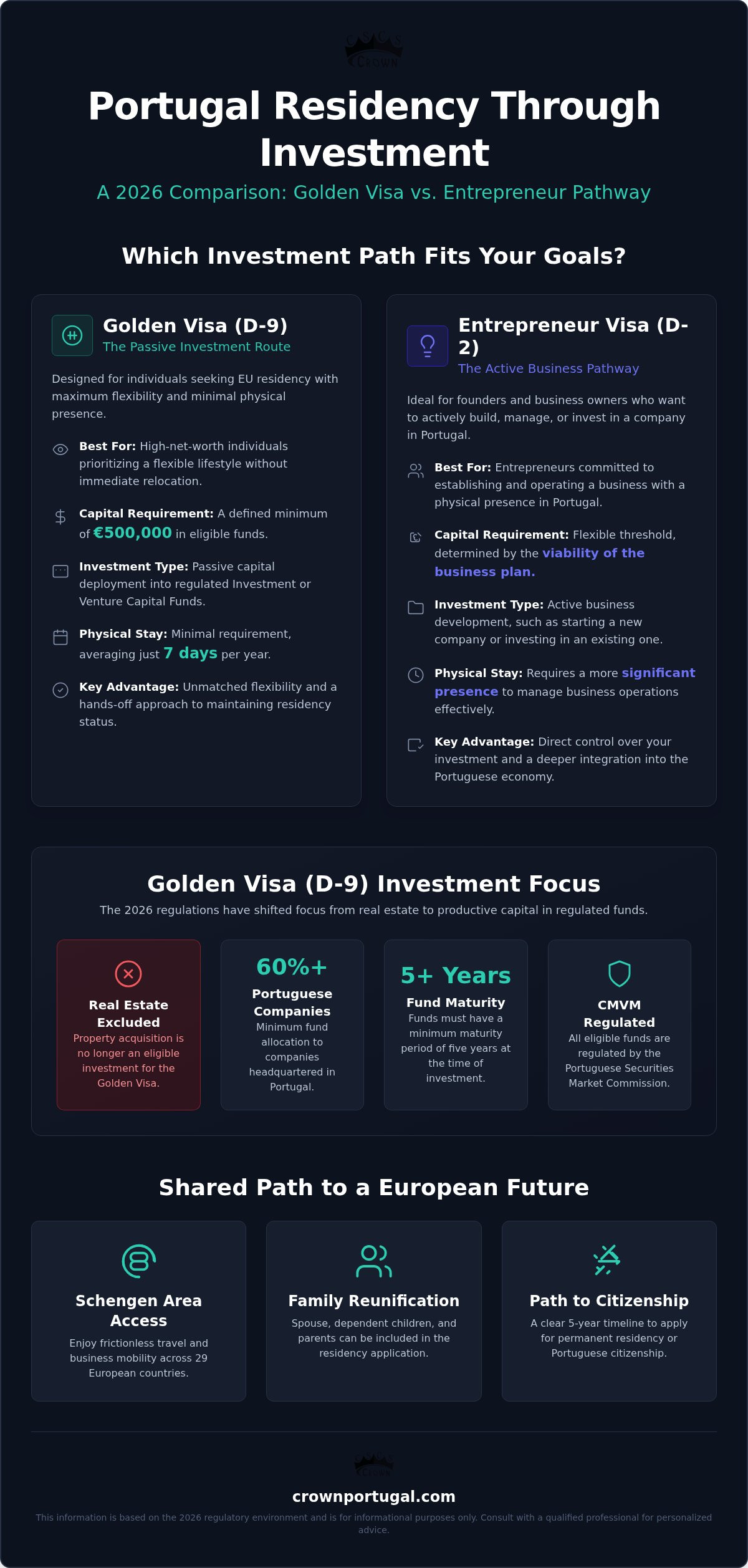
The advantages of these programs extend beyond simple residency. Holders of these permits enjoy full access to the Schengen Area, allowing for frictionless travel across 29 European countries. Additionally, the right to family reunification ensures that spouses, children, and dependent parents can also obtain residency under the same application. Perhaps most importantly, these pathways provide a clear five-year timeline to permanent residency or Portuguese citizenship, provided all legal requirements and language proficiencies are met.
The Shift from Real Estate to Diversified Portfolios
The legislative changes enacted in late 2023 and early 2024 fundamentally redefined what constitutes a valid investment. Real estate acquisition, once the cornerstone of the Golden Visa, is now entirely excluded from the program to address national housing concerns. This shift has directed capital toward Venture Capital and Private Equity funds that support local innovation and corporate growth. These funds are heavily regulated by the CMVM (Portuguese Securities Market Commission), offering a layer of institutional oversight that traditional property investments often lacked.
As of 2026, eligible investment categories include capital transfers for public research, support for artistic production, recovery of national cultural heritage, and the subscription of units in investment funds or venture capital funds dedicated to the capitalization of companies.
Why Investors Choose Portugal: Stability and Access
Portugal’s appeal as an investment destination is rooted in its consistent performance in global safety and peace indices. It’s recognized as one of the most stable nations in the European Union, which is a critical factor for those seeking a reliable secondary residence or a permanent relocation. For global entrepreneurs, the residence permit serves as a strategic asset for business mobility. It allows for the establishment of a European base of operations while maintaining the flexibility to manage global interests without the constant friction of visa applications.
Detailed technical requirements and a step-by-step breakdown of the passive route are available in our Portugal Golden Visa Investment Guide: The Complete 2026 Roadmap.
The Golden Visa (D-9): The Premier Passive Investment Route
The Golden Visa (D-9) stands as the most versatile mechanism for obtaining Portugal residency through investment. It’s specifically designed for individuals who require legal status within the European Union but aren’t yet prepared to establish a full-time residence. The core appeal lies in its minimal physical stay requirement, often referred to as the “7-Day Rule,” which allows participants to maintain their global lifestyle while building a five-year path toward citizenship. This passive approach is ideal for those who prioritize flexibility over immediate relocation.
Investment Fund Options and Capital Requirements
In the 2026 landscape, the primary vehicle for the D-9 is the subscription of units in investment or venture capital funds. The minimum capital requirement is €500,000. These funds must meet specific criteria to be eligible for residency purposes:
- A minimum of 60% of the fund’s capital must be invested in Portuguese-based commercial companies.
- The fund must have a maturity period of at least five years at the time of the investment.
- Management must be conducted by professional entities regulated by the CMVM.
Investors should prioritize thorough due diligence when selecting a fund. The risk-return profile varies significantly across the market, ranging from conservative private equity to higher-risk venture capital. While the goal is residency, the underlying financial performance remains a critical component of a sound capital strategy. For a comprehensive breakdown of how to identify and evaluate compliant Portugal Golden Visa investment funds, including the mandatory CMVM regulatory frameworks and eligible venture capital criteria, our dedicated investor guide provides the technical detail required for informed decision-making. For those seeking lower entry points, alternative D-9 routes include a €250,000 investment in cultural production, which specifically targets the recovery or maintenance of national cultural heritage. There is also a €500,000 commitment option for scientific research activities conducted by public or private institutions.
The Residency Obligations: Flexibility for Global Citizens
The D-9 program’s stay requirements are remarkably low compared to other visa categories. Investors are only obligated to spend 14 days in Portugal every two-year residency cycle. This structure facilitates a reliable “Plan B” strategy. It allows families to secure a foothold in Europe without inadvertently triggering tax residency, which typically occurs after 183 days of physical presence within a single year. This distinction is vital for professionals whose primary income is generated in other jurisdictions.
Maintaining this status requires meticulous record-keeping of your travel dates and entry points. This flexibility ensures that your professional and personal life outside of Portugal remains uninterrupted. You can find detailed video explainers on D-9 stay requirements and procedural updates on our YouTube channel. Engaging with professional consultants early in the process helps ensure your chosen fund aligns with both your financial goals and the legal requirements for Portugal residency through investment.
The Entrepreneur (D-2) Path: Active Investment in Business
The D-2 Immigrant Entrepreneur Visa serves as a robust alternative for those who prefer an active role in their capital deployment. While the D-9 focuses on passive fund subscription, the D-2 is a strategic path for Portugal residency through investment that targets the development of national business infrastructure. It’s particularly suited for investors who intend to establish a new company or expand an existing international branch into the Portuguese market. This route provides a high degree of control over the investment’s performance and operational direction.
Securing a D-2 visa requires a comprehensive business plan that demonstrates clear economic, social, or cultural impact. The Portuguese authorities evaluate the feasibility of the project based on its potential to generate revenue, contribute to local innovation, or provide essential services. Unlike the Golden Visa, there’s no fixed statutory minimum investment for the D-2. Instead, the capital provided must be sufficient to support the specific business plan submitted. This flexibility allows for a more tailored financial strategy, though it places a higher burden of proof on the applicant to justify their budget and projected growth. Working with a qualified Portugal investment residency consultant is essential to ensure your business plan meets the precise documentation standards required by Portuguese authorities.
D-2 Visa: Investing in Your Own Portuguese Entity
The operational phase of the D-2 involves several critical administrative steps. You’ll need to complete the company formation process and open a business bank account within the country. A significant factor in the success of a residency application is the creation of local employment opportunities. Demonstrating a commitment to hiring Portuguese residents strengthens the case for the business’s social and economic relevance. For those interested in how these entrepreneurial paths differ from standard employment, you can explore the Portugal D1 Visa Step-by-Step Guide for additional context on work-related pathways.
The Startup Visa: Innovation-Led Investment
The Startup Visa is a specialized subset of the entrepreneurial route designed specifically for tech-focused investors and innovators. This program requires the participation of certified incubators that provide the necessary mentorship and infrastructure to scale the business. It prioritizes projects that focus on technology and high-growth potential. When comparing the Startup Visa to the standard D-2, the primary difference lies in the endorsement from an accredited incubator, which can often streamline the residency process for qualified innovative projects. This path is ideal for entrepreneurs who wish to leverage the growing reputation of the country as a European technology hub.
Comparative Analysis: Which Investment Path Fits Your Goals?
Deciding on the optimal strategy for Portugal residency through investment requires a precise evaluation of your liquidity versus your availability. The Golden Visa (D-9) demands a higher upfront capital commitment of €500,000 for fund subscription, but it rewards the investor with unparalleled freedom of movement. Conversely, the D-2 pathway allows for more flexible initial capital deployment, yet it necessitates an active commitment to business operations and a substantial physical presence in the country.
Stay requirements represent the most significant operational divergence. The D-9 requires only 14 days of presence every two years. In contrast, the D-2 entrepreneur route, similar to the D-7 and D-8 categories, generally requires residents to spend at least 183 days per year in Portugal to maintain their status and avoid complications during renewal. This makes the D-2 a relocation tool, while the D-9 functions as a strategic insurance policy for global mobility.
Direct Costs vs. Indirect Investment Requirements
Beyond the investment itself, applicants must account for government processing fees and professional administrative support. While the D-9 has higher direct investment costs, the D-2 involves ongoing operational expenses like payroll, social security (NISS) contributions, and corporate tax filings. The “cost of living” factor also weighs more heavily on D-2 holders, as they are expected to make Portugal their primary home. For those who find the capital requirements of investment-based visas prohibitive, it’s worth reviewing the Digital Nomad Visa Portugal Requirements to see if a remote work-based strategy is more appropriate.
Path to Citizenship: Comparing the Timelines
A critical advancement in the 2026 landscape is the full implementation of the 2024 legislative update. This change allows the five-year countdown to citizenship to begin on the date the residency application is officially submitted, rather than the date the first permit is issued. This effectively shortens the wait time for all investment-based applicants. Regardless of the route chosen, all individuals must pass an A2 CIPLE Portuguese language exam to qualify for permanent residency or citizenship.
Success in these applications depends on meticulous documentation and administrative precision. Common pitfalls often include insufficient proof of funds or business plans that lack clear economic impact. To ensure your strategy aligns with current regulatory standards, you can consult with Crown Portugal for a comprehensive assessment of your eligibility and a roadmap to successful relocation.
Navigating the Application: Professional Support with Crown Portugal
The administrative complexity of securing Portugal residency through investment requires more than just capital. It demands a rigorous adherence to procedural timelines and document standards. Even minor discrepancies in a residency dossier can lead to significant delays or immediate rejection by AIMA (Agency for Integration, Migration and Asylum). As a professional intermediary, Crown Portugal provides the necessary technical oversight to ensure that every requirement is satisfied before submission. This includes facilitating fiscal representation, which is a non-negotiable prerequisite for any investment activity within the country. Before engaging any firm, investors should understand how to evaluate and select a qualified Portugal investment residency consultant to avoid hidden costs and ensure a fully managed application process.
Our role as a welcoming expert is to handle the friction of bureaucratic processes so you can focus on your relocation. We manage the entire lifecycle of your application, from the initial advisory stage to the final resettlement logistics. This comprehensive approach mitigates the uncertainty often associated with shifting regulations and ensures that your chosen investment route remains compliant with the 2026 legal framework.
Document Preparation and Administrative Compliance
Our methodology is organized into a clear, logical progression to minimize the administrative burden on the applicant. We follow a disciplined three-step process to prepare your file for submission:
- Step 1: We conduct an initial consultation to determine the optimal investment route based on your specific capital structure and lifestyle goals.
- Step 2: Our team coordinates the gathering of required documentation. This includes apostilled criminal records, certified financial statements proving the source of funds, and comprehensive health insurance that meets Portuguese regulatory standards.
- Step 3: We manage the coordination of the AIMA appointment. We guide you through the biometric submission process, ensuring that all physical presence requirements are met during your visit.
Beyond the Visa: Resettlement and Fiscal Setup
A successful move involves more than just a residence permit. Our end-to-end approach addresses the logistical and fiscal realities of living in a new jurisdiction. We facilitate the remote acquisition of your NIF (Personal Tax Number) and NISS (Social Security Number), which are essential for opening bank accounts or hiring employees under a D-2 structure. Additionally, we assist in identifying accommodation that satisfies the legal requirements for a registered address in Portugal.
For those who prefer a lifestyle supported by existing wealth rather than new business ventures, our Portugal D7 Visa Passive Income Guide offers a comprehensive analysis for retirees and passive earners. To complete the transition, we provide practical support such as airport pick-up services and resettlement guidance. This holistic strategy ensures that your path to Portugal residency through investment is both legally secure and logistically efficient.
Securing Your European Future in 2026
The choice between the D-9 Golden Visa and the D-2 Entrepreneur pathway depends on your desired balance of capital liquidity and physical presence. While the Golden Visa offers unparalleled flexibility for global citizens, the D-2 route provides a direct, active role in the national economy. Both strategies offer a stable legal framework and a clear five-year path toward citizenship under the latest 2024 regulatory updates. It’s a strategic decision that aligns your financial resources with your long-term lifestyle objectives.
Navigating the requirements for Portugal residency through investment requires a methodical approach to ensure administrative compliance and fiscal security. With over six years of expertise, Crown Portugal serves as your authoritative guide to the 2026 visa landscape. We provide bespoke relocation services, including remote NIF acquisition and housing support, to facilitate a seamless transition for you and your family. You can Contact Crown Portugal for a Professional Investment Residency Consultation to begin mapping your relocation strategy today. Your European residence is a manageable objective when supported by disciplined professional guidance.
Frequently Asked Questions
Can I still get Portugal residency through real estate investment in 2026?
No, you can’t obtain residency through real estate acquisition in 2026. Legislative reforms enacted in late 2023 ended the property-based route to address national housing challenges. Investors seeking Portugal residency through investment must now choose between capital transfers into regulated investment funds, scientific research, or the recovery of national cultural heritage. These modern pathways focus on productive capital that supports the broader economy rather than static property assets.
What is the minimum investment for the Portugal Golden Visa in 2026?
The minimum investment for the Portugal Golden Visa (D-9) depends on the chosen vehicle. Fund subscription requires a minimum of €500,000 in eligible venture capital or private equity funds. Alternatively, you can invest €250,000 in the maintenance or recovery of national cultural heritage. Scientific research activities require a €500,000 commitment. Every investment must be verified by the relevant Portuguese authorities to ensure compliance with current regulatory standards.
How long does it take to get a residency permit through investment?
Processing times for residency permits vary based on the current administrative workload of AIMA. While the initial approval can take several months, a critical 2024 law change now allows your five-year timeline to citizenship to begin the moment you submit your application. This change provides greater certainty for long-term planning. Our team monitors these timelines closely to provide the most accurate updates throughout your specific application process.
Do I need to live in Portugal full-time if I have a Golden Visa?
You don’t need to live in Portugal full-time to maintain a Golden Visa. The program requires a physical presence of only 14 days every two years. This minimal requirement is a primary differentiator from the D-2 or D-8 visas, which generally require a stay of six to eight months per year. It’s an ideal structure for global professionals who need European residency without the immediate obligation of relocation.
Can my family be included in my investment residency application?
Your family can be included in your application through the family reunification process. This typically covers your spouse or legal partner, minor children, and dependent adult children who are full-time students. Dependent parents from either side of the family may also qualify for residency. Each family member receives the same rights as the primary investor, including the ability to live, work, and study within Portugal.
What is the difference between the D-2 and the Golden Visa for investors?
The primary difference lies in the nature of your involvement. The Golden Visa is a passive capital strategy requiring fund subscription and minimal physical stay. The D-2 visa is an active entrepreneurial path that requires the development of a Portuguese business and a commitment to reside in the country for most of the year. While the D-2 has a lower capital entry point, it involves significantly higher operational and residency obligations.
Is it possible to apply for Portuguese citizenship after 5 years of investment?
It’s possible to apply for Portuguese citizenship after five years of legal residency. This applies to all paths for Portugal residency through investment, provided you maintain your investment and meet the legal requirements. One essential condition is demonstrating an A2 level of proficiency in the Portuguese language through the CIPLE exam. The five-year clock now starts from the date of your initial residency application submission.
What are the main tax implications of becoming a resident through investment?
Becoming a resident through investment doesn’t automatically make you a tax resident. Tax residency is generally triggered if you spend more than 183 days in Portugal during a single calendar year. If your physical stay remains below this threshold, you’re typically only liable for taxes on income generated within Portugal. We recommend a professional fiscal consultation to understand how your specific residency path interacts with international tax treaties and your global income.
Choosing a Portugal Investment Residency Consultant: The 2026 Buyer’s Guide – Crown Portugal at 10:53 am, August 28, 2026 -
[…] Portugal Residency Through Investment: A 2026 Comparison of Golden Visa vs. D2 Options […]
Portugal Golden Visa Investment Guide: The Complete 2026 Roadmap – Crown Portugal at 10:53 am, August 28, 2026 -
[…] Portugal Residency Through Investment: A 2026 Comparison of Golden Visa vs. D2 Options […]
Portugal Golden Visa Investment Funds: The Complete 2026 Investor Guide – Crown Portugal at 10:53 am, August 29, 2026 -
[…] Portugal Residency Through Investment: A 2026 Comparison of Golden Visa vs. D2 Options […]