

Portugal Startup Visa Requirements: The 2026 Comprehensive Guide and Comparison

What if the primary obstacle to launching your innovative venture in Europe wasn’t your business model, but a single administrative oversight regarding the Portugal startup visa requirements? For many global founders, the prospect of entering the Portuguese tech ecosystem is often overshadowed by the sheer density of procedural mandates. You’ve likely encountered the frustration of confusing terminology or the uncertainty of selecting an incubator that aligns with IAPMEI standards. These hurdles, combined with the complexity of managing tax and social security registrations, can make the process feel unnecessarily daunting.
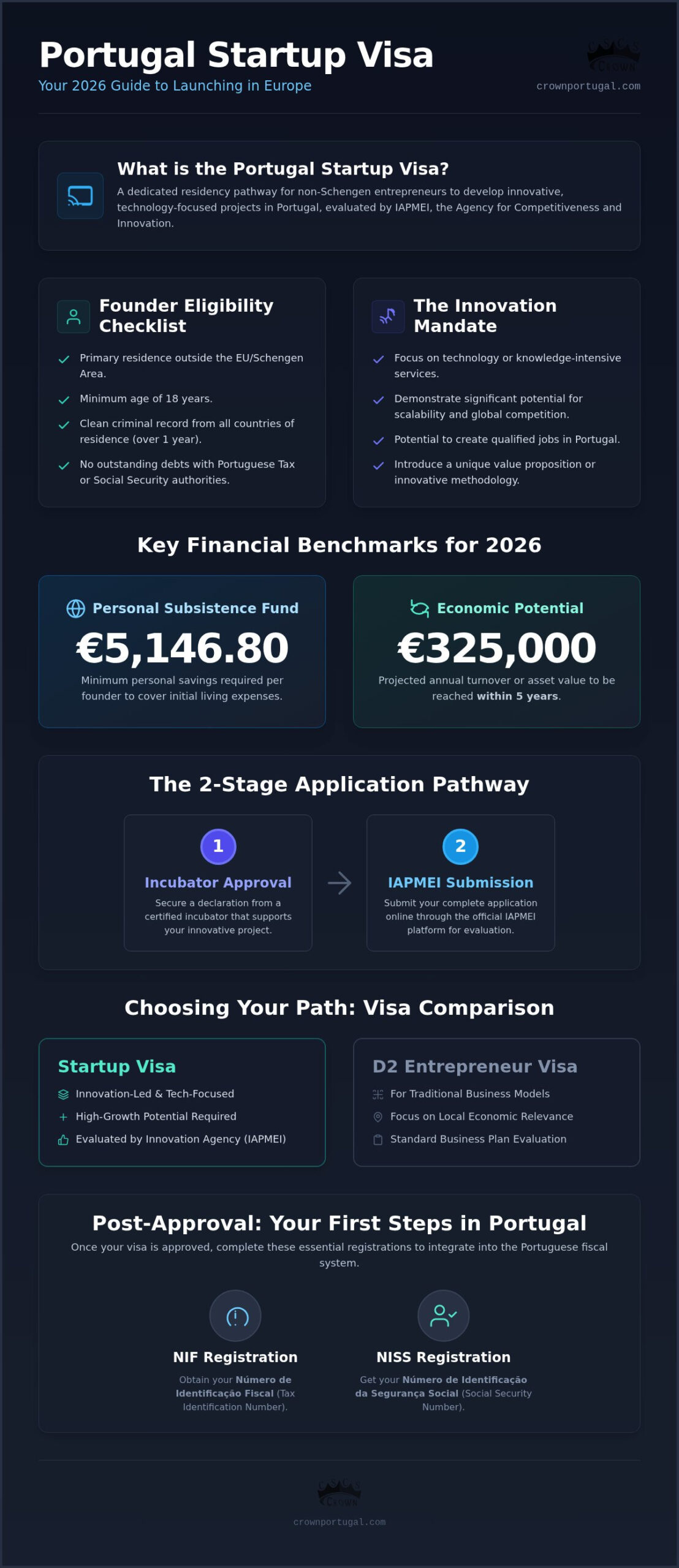
This comprehensive guide provides a disciplined roadmap to navigate the technical landscape in 2026. You’ll gain a clear understanding of eligibility criteria, including the €5,146.80 subsistence fund and the specific valuation benchmarks your startup must reach within five years. We also provide a detailed comparison between the Startup Visa and the D2 Entrepreneur Visa to help you identify the most secure residency path. By following this methodical breakdown, you can move forward with the confidence that every regulatory detail is accounted for, ensuring a stable transition for your business.
Key Takeaways
- Identify the specific financial subsistence thresholds for 2026, including the requirement to prove a minimum of €5,146.80 in personal savings.
- Learn how to successfully navigate the Portugal startup visa requirements by securing a declaration from a certified incubator and submitting your project through the IAPMEI platform.
- Understand the economic evaluation criteria, specifically the mandate to demonstrate potential for an annual turnover or asset value of €325,000 within five years.
- Compare the innovation-led Startup Visa with the D2 Entrepreneur Visa to determine which residency path aligns with your specific business model.
- Master the essential post-approval administrative steps, such as NIF and NISS registration, to ensure a seamless transition into the Portuguese fiscal system.
Understanding the Portugal Startup Visa: Scope and Eligibility
The Portugal Startup Visa serves as a structured residency pathway designed specifically for non-Schengen entrepreneurs who intend to develop innovative projects within the national territory. This program functions as a strategic bridge between international founders and the Portuguese innovation ecosystem. Unlike standard residency permits, the evaluation process is centralized under IAPMEI, the Portuguese Agency for Competitiveness and Innovation. This governing body assesses the technical merit and the economic viability of each submission. The primary goal is to attract high-qualified talent that can contribute to the modernization of the national economy through the creation of specialized employment.
Mastering the technical Portugal startup visa requirements is the first step toward establishing a long-term presence in Europe. A Startup Visa provides a legal framework for founders to reside in Portugal while they scale their ventures. It’s an ideal solution for entrepreneurs who lead tech-focused projects with high growth potential. By aligning with this program, you aren’t just applying for a visa; you’re entering a regulated environment designed to support high-impact business models.
To better understand this concept, watch this helpful video:
Who Qualifies as an International Entrepreneur?
To be eligible, applicants must maintain their primary residence outside the European Schengen Area at the time of the initial application. The program is open to individuals who are at least 18 years of age and can provide proof of a clean criminal record. This requirement extends to all countries where the applicant has resided for a period exceeding one year. Additionally, fiscal compliance is a mandatory prerequisite. Founders must not have any existing debt or unresolved issues with the Portuguese Tax Authority or Social Security. These administrative standards ensure that the residency path remains reserved for individuals with a verified history of legal and fiscal responsibility.
The Innovation Mandate: What Projects Qualify?
The core of the application lies in the innovation mandate. IAPMEI prioritizes technology-based products or knowledge-intensive services that fill a gap in the current Portuguese market. Projects must demonstrate significant scalability and the potential to compete on a global scale. This involves presenting a clear plan for market entry and growth. The evaluation focuses on whether the project can realistically attain a high turnover and create qualified jobs within a five-year period. It isn’t enough to offer a traditional service; the business must introduce a unique value proposition or an innovative methodology that isn’t already prevalent in the local economy. This focus on “newness” and scalability is what distinguishes the Startup Visa from more traditional entrepreneur pathways.
Core Portugal Startup Visa Requirements for 2026
Adhering to the Portugal startup visa requirements involves meeting both quantitative financial thresholds and qualitative innovation standards. For the year 2026, the Portuguese Agency for Competitiveness and Innovation (IAPMEI) maintains strict benchmarks to ensure that only viable, high-potential ventures enter the ecosystem. These requirements aren’t merely bureaucratic hurdles; they serve as indicators of a founder’s ability to sustain themselves and their business during the critical early years of operation. Demonstrating this readiness is essential for a successful residency application.
Financial subsistence is a primary pillar of the application. Each founding member must provide evidence of personal savings amounting to at least €5,146.80. This figure is intended to cover basic living expenses during the initial residency period. Beyond personal funds, the business itself must demonstrate significant economic potential. Your startup must have the capacity to attain an annual turnover of over €325,000 within five years of the incubation period. If the business is capital-intensive, IAPMEI also accepts an alternative criterion where the company reaches an asset value exceeding €325,000 within that same timeframe. These projections must be realistic and backed by a robust market analysis.
Detailed Financial Documentation Needed
The application requires a meticulous collection of financial records. You’ll need to submit recent bank statements for all co-founders, typically covering the last six months, to prove the availability of the required subsistence funds. If you’re relocating an existing project, you must provide evidence of established intellectual property or proprietary technology. Your business plan projections should focus on a five-year growth trajectory, detailing how you’ll reach the €325,000 benchmark. Precise documentation is essential to avoid common pitfalls during the review process. Founders often benefit from reviewing expert administrative guidance to ensure their records meet IAPMEI standards before submission.
Evaluating Management and Team Capacity
IAPMEI looks beyond the numbers to evaluate the human capital behind the venture. The management team’s collective experience and academic background are scrutinized to determine the project’s likelihood of success. A key criterion is the “relevance of the applicant,” which assesses whether the founding team possesses the specific technical and managerial skills necessary to execute the business plan. The startup must also show potential for creating “qualified employment.” This means your business should aim to hire Portuguese residents for high-value roles that require specialized skills, such as software development, engineering, or specialized research. Demonstrating this commitment to the local labor market strengthens your application by showing a direct contribution to Portugal’s knowledge economy. Every role planned for the first five years should be clearly defined within your submission to prove long-term viability.
The Two-Stage Application Pathway: IAPMEI and Incubators
Successfully meeting the Portugal startup visa requirements necessitates a methodical approach to the two-stage application process. This pathway filters projects through both private business experts and government evaluators. First, founders must register their project on the IAPMEI online platform. They provide comprehensive data about the founding team and the business model. Once the profile is active, it becomes visible to certified incubators across the country. These entities review the proposal to determine if it aligns with their specific industry focus.
After a founder secures a declaration of interest from at least one certified incubator, the project moves to the formal evaluation stage. IAPMEI then conducts a final review based on the technical merits of the startup. If approved, the agency issues a certificate. This document is essential for the final step. It allows the founder to apply for a residence visa at a Portuguese consulate or, if they’re already in the country, through AIMA (Agency for Integration, Migration and Asylum).
Selecting a Certified Incubator
Finding the right partner is a strategic decision that goes beyond simple administrative compliance. Founders should consult the National Network of Incubators (RNI) list to identify organizations that specialize in their sector. It’s standard practice to request detailed quotations and service agreements from multiple incubators to compare their offerings. During the mandatory incubation period, these organizations provide more than just a physical address. They offer mentorship and localized business support. Securing a signed declaration of interest is the most critical milestone. It confirms the incubator’s willingness to host the project for the required duration.
The IAPMEI Evaluation Criteria
The formal assessment focuses on three qualitative pillars. The degree of innovation is scrutinized to ensure the project offers a unique solution that isn’t already saturated in the Portuguese market. Evaluators also examine market potential by identifying the target audience and the existing competitive landscape. Finally, scalability is assessed to determine if the business can grow its revenue exponentially without a proportional increase in operational costs. A project that demonstrates high innovation but lacks a clear path to scalability may face rejection. Founders often find that detailed process reviews help them refine their pitch to meet these specific government standards.
Choosing Your Path: Startup Visa vs. D2 Entrepreneur Visa
Selecting the correct residency path requires a precise understanding of how your business model aligns with Portuguese immigration law. While the Portugal startup visa requirements emphasize innovation and scalability, the D2 Entrepreneur Visa offers a broader framework for traditional business activities. Choosing between these options isn’t merely a matter of preference; it’s a strategic decision based on your project’s current maturity and its long-term economic objectives. Understanding the specific Portugal startup visa requirements allows you to contrast them with the D2 requirements, which focus more on the immediate capitalization of the business. Entrepreneurs who want a comprehensive overview of all available pathways can benefit from a dedicated Portugal business visa advisory to identify the most tax-efficient and legally sound option for their situation.
The Startup Visa focuses on the future potential of the venture. IAPMEI evaluates whether the startup can reach a turnover or asset value of €325,000 within five years. Conversely, the D2 visa requires proof of immediate viability and sufficient personal financial means, often pegged to the 2026 national minimum wage of €920 per month. Additionally, the Startup Visa mandates a formal contract with a certified incubator. The D2 pathway allows entrepreneurs to operate independently, providing more autonomy for those with established business models that don’t require the specialized support of an innovation hub.
When to Choose the Startup Visa
If your business is in the pre-revenue stage but possesses significant intellectual property, this pathway is often the most efficient. It provides direct access to the Portuguese tech ecosystem and a network of certified incubators that can facilitate market entry. This route is particularly advantageous if your long-term plan involves utilizing the Portugal D1 Visa to hire highly skilled workers as your operations expand. It’s a path designed for founders who prioritize rapid growth and technological development over immediate profitability.
When the D2 Pathway is More Suitable
The D2 Entrepreneur Visa is the preferred choice for service-based businesses, such as those in the hospitality, retail, or consulting sectors. It suits entrepreneurs who have significant capital to invest immediately and prefer to operate without the oversight of an incubator. This pathway doesn’t require the same innovation threshold as the Startup Visa, making it more accessible for established business models. If you intend to launch a local company with a traditional structure, the D2 provides a stable and predictable residency route. Founders should carefully weigh these criteria before initiating their application. For a detailed assessment of your project’s eligibility, you can consult with Crown Portugal’s business advisory team to ensure your documentation aligns with current regulations.
Navigating Resettlement: Post-Visa Administrative Success
Approval of the Startup Visa is a significant milestone, but it’s merely the entry point into the Portuguese administrative system. Once the initial Portugal startup visa requirements are satisfied at the consular level, the focus shifts to the practicalities of legal residency and fiscal integration. Transitioning from a consulate-issued visa to a full residence permit requires a methodical approach to local registrations. Founders must prioritize their fiscal and social security setup to ensure the business remains compliant from its first day of operation. These steps are as critical as the Portugal startup visa requirements themselves, as they form the legal foundation for your life and work in the country.
Fiscal and Social Security Registration
The NIF (Número de Identificação Fiscal) is the primary tax identification number and serves as the most important document for any resident. It’s mandatory for signing lease agreements, establishing utility contracts, and registering the company with the Commercial Registry. Founders can often obtain this remotely through a fiscal representative before their arrival to expedite the process. Similarly, registering for a NISS (Número de Identificação de Segurança Social) is essential to enable legal hiring and personal social benefits. This registration ensures that both the founders and their future employees are integrated into the Portuguese welfare and healthcare systems.
Opening a Portuguese business bank account is the next logical step in the resettlement process. Banks typically require the company’s permanent certificate, the NIFs of all shareholders, and proof of address. While timelines can vary between financial institutions, having a complete set of apostilled or certified documents is necessary to avoid repeated appointments. This fiscal infrastructure allows for the transparent management of the startup’s capital, which is a key requirement for future residency renewals and financial audits.
Professional Consultancy for Entrepreneurs
Crown Portugal acts as a dedicated partner during this resettlement phase, offering end-to-end support that extends beyond the initial visa approval. Our consultancy services include a rigorous document review to prevent application rejections during the final AIMA appointment. We understand that relocating a founding team involves significant logistical coordination. Therefore, we provide assistance with accommodation searches and airport transfers to ensure a stable start in a new environment. This comprehensive approach allows entrepreneurs to focus on business development while we manage the intricacies of fiscal and social security registrations.
Long-term success in Portugal depends on maintaining continuous compliance with residency regulations. This includes timely renewals and the accurate filing of tax returns. For ongoing guidance and real-time information on the evolving legal landscape, you can watch our YouTube channel for daily immigration updates and news. Staying informed helps founders navigate the transition from a temporary startup visa to permanent residency with absolute confidence, ensuring every administrative detail is handled with professional precision.
Establishing Your Innovative Venture in Portugal
Navigating the Portugal startup visa requirements demands a methodical approach, from the initial IAPMEI submission to the final residency permit. Success depends on aligning your business model with specific innovation standards and proving your project’s potential for high turnover. Beyond the visa approval, the stability of your venture relies on a proactive approach to fiscal and social security registrations. These administrative steps ensure that your business operates within the legal framework from its first day in the country.
Since 2018, Crown Portugal has served as a steady partner for international founders, providing expert guidance on document review and end-to-end relocation support. Whether you require assistance with NIF registration or a comprehensive analysis of the D2 versus Startup Visa pathways, our professional consultancy ensures no administrative detail is overlooked. We’re committed to mapping out every procedural step to help you secure a stable foundation for your business and family in a new environment.
Contact Crown Portugal for Expert Startup Visa Consultancy and begin your transition with absolute confidence. Portugal’s tech ecosystem offers immense potential for your innovation, and we’re ready to facilitate every step of your journey.
Frequently Asked Questions
What is the minimum investment for the Portugal Startup Visa?
The Startup Visa does not require a specific minimum capital investment into the business. Instead, the program focuses on the project’s innovation and scalability potential. Applicants must prove they possess personal subsistence funds of at least €5,146.80 to cover living expenses. This distinguishes it from the D2 visa, where proof of investment in the company is often expected. The primary financial benchmark is the startup’s ability to reach a €325,000 turnover within five years.
How long does the Startup Visa application process take in 2026?
The timeline for the application process generally spans four to six months. This period accounts for the two-stage pathway: securing an incubator declaration and receiving IAPMEI approval, followed by the residence visa application at a Portuguese consulate. While administrative processing times can vary based on the volume of applications, the IAPMEI evaluation typically concludes within 30 days of submission. Efficiently managing the Portugal startup visa requirements and documentation can help prevent delays caused by technical errors.
Can I bring my family to Portugal with a Startup Visa?
Yes, founders can include their family members through the family reunification process. This allows a spouse, dependent children, and sometimes dependent parents to reside in Portugal. You must demonstrate additional financial means for each dependent: 50% of the main applicant’s subsistence amount for a spouse and 30% for each child. Providing these funds ensures that the entire family meets the necessary financial Portugal startup visa requirements for a stable resettlement in the country while maintaining legal compliance.
Do I need to speak Portuguese to apply for the Startup Visa?
Proficiency in the Portuguese language is not a requirement for the initial visa application. Most communications with IAPMEI and certified incubators can be conducted in English. However, if you intend to apply for permanent residency or citizenship after several years, you must demonstrate a basic knowledge (A2 level) of Portuguese. For the startup phase, the focus remains entirely on the technical merit and economic viability of your business project rather than on your linguistic skills.
What happens if my startup does not reach the €325,000 turnover target?
The €325,000 turnover target is a benchmark for evaluation rather than a strict condition for immediate permit revocation. IAPMEI monitors the project’s progress through periodic reports during the incubation period. If the target isn’t met due to market conditions, the agency assesses whether the startup still demonstrates scalability and innovation. However, a total lack of business activity or failure to create qualified employment may complicate the renewal of your residence permit after the initial two-year period.
Is an incubator contract mandatory for the Startup Visa?
Securing a contract or a declaration of interest from a certified Portuguese incubator is a mandatory requirement. Your project cannot be approved by IAPMEI without the support of an entity from the National Network of Incubators (RNI). The incubator provides the necessary mentorship and infrastructure to help your business scale within the local economy. This partnership is a defining feature of the program, ensuring that international founders have access to localized expertise and professional networks.
Can I switch from a Digital Nomad Visa to a Startup Visa?
It’s possible to transition from a Digital Nomad Visa (D8) to a Startup Visa if you decide to launch an innovative venture. This process typically involves a new application through the IAPMEI platform and a subsequent appointment with AIMA to update your residency status. You must ensure that your business project meets all the innovation and scalability criteria. Consulting with a professional advisor can help you manage the transition while maintaining legal compliance with your current residency permits.
Does the Startup Visa lead to Portuguese citizenship?
The Startup Visa provides a pathway to permanent residency and citizenship. Under the law in effect since May 19, 2026, holders of a residence permit can apply for permanent residency after five years. For citizenship, the requirement has increased to ten years for most non-EU nationals. For nationals of Portuguese-speaking countries, the requirement is seven years. You must also meet other legal standards, such as maintaining a clean criminal record and demonstrating basic Portuguese language proficiency.
Entrepreneur Visa Portugal Process: The 2026 Comprehensive Guide to the D2 Pathway – Crown Portugal at 10:50 am, September 5, 2026 -
[…] to scale. For a detailed breakdown of these specific standards, you can consult our guide on Portugal Startup Visa Requirements: The 2026 Comprehensive Guide. A primary requirement is obtaining a contract with a certified incubator. This incubator provides […]
Portugal Business Visa: 2026 Guide for Entrepreneurs – Crown Portugal at 10:52 am, September 6, 2026 -
[…] Entrepreneur Visa Portugal Process: The 2026 Comprehensive Guide to the D2 Pathway – Crown Portugal on Portugal Startup Visa Requirements: The 2026 Comprehensive Guide and Comparison […]
Portugal Company Formation: 2026 Step-by-Step Guide – Crown Portugal at 11:09 pm, September 16, 2026 -
[…] setup to reflect the economic viability of your project. Alternatively, some founders may find the Portugal Startup Visa Requirements more suitable if their business is innovation-led and eligible for incubator support. While the D2 […]