

Portuguese Golden Visa donation option: costs and routes
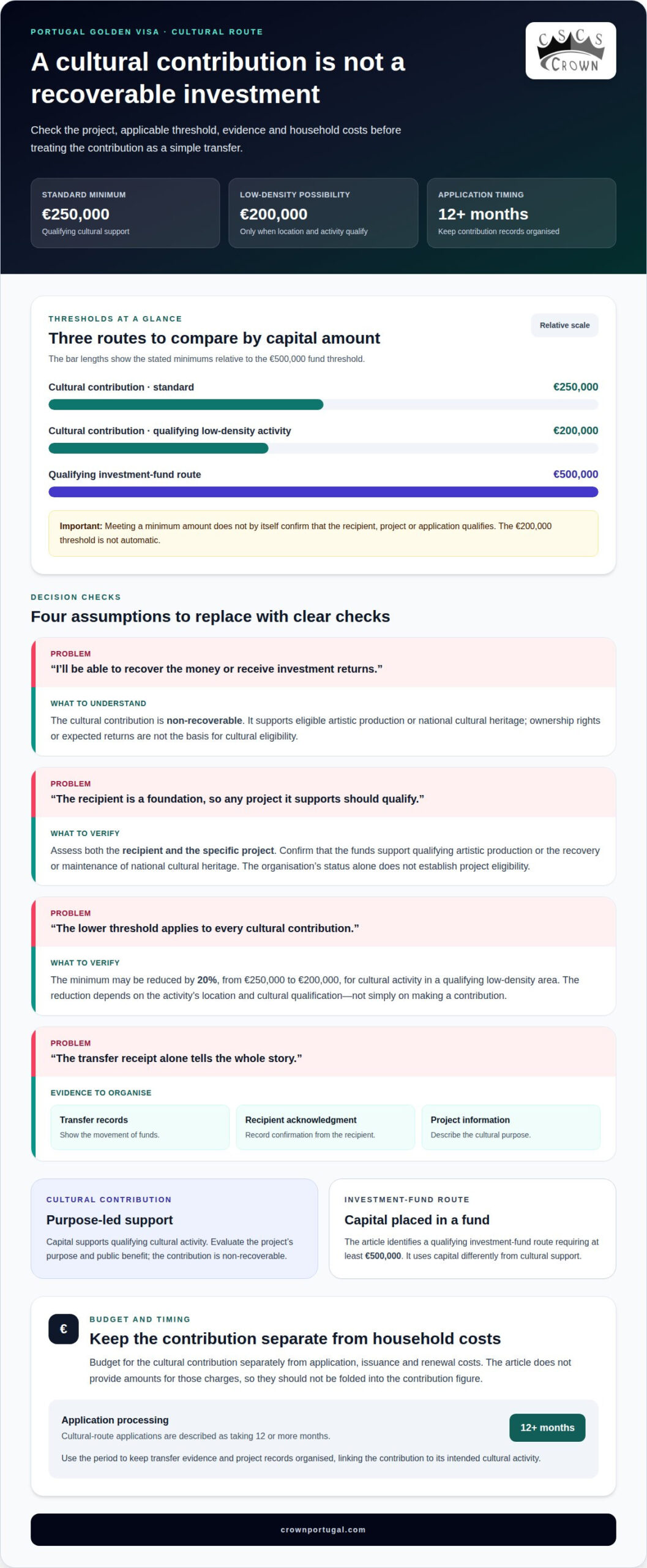
The Portuguese Golden Visa donation option requires a contribution of at least €250,000 to support qualifying cultural heritage or artistic production. The minimum may fall to €200,000 for an investment in a low-density area. Portugal’s 2023 reform removed the real estate and simple capital transfer routes while preserving qualifying cultural support.
A contribution is non-recoverable, so the decision involves more than comparing its minimum amount with other routes. This guide explains how cultural funding reaches Portuguese foundations, how the route differs from qualifying investment funds, and which application and renewal costs can affect a family’s budget.
It also explains why identifying an eligible project matters, how the donation route fits within Portugal’s Golden Visa options, and what to consider when estimating costs for a family of four. Use these points to compare the cultural route with a fund investment and understand the financial commitment involved.
Key Takeaways
- Understand which cultural and heritage projects can qualify, and why the receiving foundation and project both matter.
- Compare a non-recoverable cultural contribution with a qualifying investment-fund route requiring at least €500,000.
- Build a family budget that separates the contribution from application, issuance, and renewal costs.
- See how eligible family members may be included and which dependency conditions apply to children under 25.
- Learn how funding reaches Portuguese foundations and what makes identifying an eligible project an important part of the route.
Portugal Golden Visa Changes – What’s New in 2026?
In 2026, Portugal’s cultural route remains a pathway for non-EU nationals seeking residence through eligible cultural support. Its practical focus is the destination and documented purpose of the capital.
Cultural Contribution as a Golden Visa Route
A cultural contribution is a Golden Visa route in which capital supports artistic production or national cultural heritage. It may suit applicants who want their funds to support a cultural purpose rather than an asset held for personal use.
The route links an immigration application with philanthropic support for public-benefit cultural work. Funding may support artistic initiatives or the recovery and maintenance of heritage. The recipient and project therefore matter as much as the transfer amount. Understand what activity the contribution will support and how it relates to the route’s cultural purpose.
Donation Eligibility and Legal Basis
Eligibility rests on the contribution’s qualifying cultural purpose and the legal framework for the investment residence permit. According to Diário da República, the cultural-support route requires a capital transfer of at least €250,000 applied to investment or support for artistic production or the recovery or maintenance of national cultural heritage.
The investment residence permit, known as the ARI, is regulated by Article 90.º-A of Law No. 23/2007. A general philanthropic gift alone does not establish that the funds support an eligible activity. For cultural activity in a qualifying low-density area, the minimum contribution may be reduced by 20 percent, to €200,000. The reduction depends on the activity’s location and cultural qualification, rather than applying automatically to every contribution.
The project’s purpose and location help determine how the contribution route applies. Cultural funding may go to public-benefit foundations engaged in heritage or cultural production, but the organisation’s status alone does not establish that the funded project qualifies.
Proof, Refunds, and Application Timing
Documents that can demonstrate a qualifying contribution include transfer records, acknowledgment from the recipient, and project information describing its cultural purpose. Together, these materials show the movement of funds and their connection to artistic production or heritage work.
The contribution is non-recoverable, so refusal does not make it refundable. Cultural-route applications are described as taking 12 or more months. Applicants can use that period to keep the transfer evidence and project records organised, ensuring the file clearly links the contribution to its intended cultural activity.
Is the Cultural Golden Visa an investment or a donation?
Portugal’s cultural pathway uses a capital transfer for a defined public-benefit purpose, rather than a conventional asset purchase. Assess the project, use of funds, and your financial objectives separately.
How the contribution differs from investment
A conventional investment is assessed partly by its financial exposure and potential return. A cultural contribution is assessed by whether the funds support eligible artistic production or national heritage activity. This distinction shapes how to evaluate the route: project purpose and public benefit are central, while ownership rights or expected returns are not the basis for cultural eligibility.
Before choosing this pathway, consider whether you want to direct capital towards a defined cultural activity or hold an investment asset. For example, an applicant seeking exposure to a managed portfolio may find that the cultural route does not fit. Someone motivated by supporting Portuguese arts or heritage may weigh the project’s purpose more heavily than financial performance.
The route’s label can be confusing: the rules describe a capital transfer, while applicants often call it a donation. The key question is how the funds are used and whether the activity qualifies, not which informal label is used.
Minimum contribution and threshold
The minimum contribution is a threshold, not proof that the project or application meets every requirement. Distinguish the amount you plan to transfer from whether the recipient and activity fit the cultural pathway.
Project location can also affect which threshold applies. First identify the cultural activity, then establish its location and assess the applicable contribution level. This prevents a budget assumption from being mistaken for confirmation that the project qualifies.
Separate the contribution from application expenses and family-related charges. Keeping these categories distinct makes it easier to compare the total financial commitment with other residency pathways, without treating the cultural contribution as an investment account or source of personal income.
Stay requirements and permit renewal
The contribution’s financial character is only one part of the decision. Consider whether you can meet the residence permit’s presence and renewal obligations alongside your work, family, and travel plans in Portugal.
A practical approach is to map expected trips against permit periods, then note who in the family will travel and when. This planning does not change the cultural project criteria, but helps you judge whether the residence pathway fits your circumstances. Weigh the project’s purpose, household commitments, and ongoing residence obligations together.
Cultural route or investment fund?
Portugal’s cultural route and investment-fund pathway differ in how they use capital and what applicants receive in return. The donation route supports cultural activity; the fund route places money in an investment vehicle.
Donation Route and Fund Investment Compared
A cultural contribution is non-recoverable, while a qualifying investment-fund route requires at least €500,000. This distinction matters when deciding whether your priority is supporting cultural heritage or investing capital. The fund route must be maintained for at least five years, so its holding period also affects financial planning.
Neither structure guarantees a successful financial outcome or an approved residence permit. A fund’s performance depends on its investments, while the cultural contribution is not intended to generate a return. The practical comparison is between a non-recoverable contribution and capital exposed to fund performance over a required holding period.
Project availability is another difference. The cultural production route can be difficult to source and has a low success rate. Applicants must identify a project that fits the cultural purpose, rather than simply choosing any charitable recipient. A structured comparison should consider project eligibility, capital commitment, and how each route aligns with residency plans.
For an applicant prioritising cultural support, the contribution route may better match their purpose. Someone prioritising investment exposure may prefer to assess a qualifying fund, while accounting for the required holding period and investment risk. The routes use different financial models, even though both can form a Golden Visa pathway.
Donation Route Compared With Other Eligible Options
Other eligible routes direct capital toward research, business activity, or job creation instead of cultural heritage. The scientific-research route requires at least €500,000, while company capitalisation also requires at least €500,000. These alternatives may better suit applicants whose objectives involve research or commercial activity.
Portugal’s job-creation route requires at least 10 full-time jobs. Its business-creation route requires at least €500,000 and five permanent jobs. These criteria make the route choice depend on the applicant’s intended activity, not only the amount of capital available.
Compare routes by asking what the capital must achieve. A cultural contribution funds eligible artistic production or heritage recovery; research capital supports qualifying research activity; business routes involve company investment and employment criteria. Each route has distinct requirements, so one route’s contribution cannot substitute for another’s qualifying activity.
For your decision, compare three factors: whether the funds are recoverable, what project or activity they must support, and which continuing obligations apply. This clarifies whether cultural support, a fund investment, research, or business activity best matches your intended pathway to Portuguese residency.
Estimated total costs for a family of four
A family budget needs to separate the cultural contribution from government charges and other application expenses. The estimate below uses the standard €250,000 contribution and covers a five-year period, so it provides a clearer planning baseline than the contribution alone.
For each applicant, Portugal’s government application and processing fee is €605, and the initial issuance fee is €6,045. Renewal fees also apply after year 2 and year 4.
- Contribution: The estimate includes €250,000 for the cultural route.
The estimate excluding the contribution helps separate administrative and related expenses from the non-recoverable cultural amount. These totals are estimates, not a single government charge.
Government fees are different from legal or professional costs. Those costs depend on the work involved, including preparing the family application and organising supporting records. The figures above do not provide a separate legal-fee amount, so avoid adding an assumed figure to your family budget.
Who can be included?
Eligible family members may apply alongside the main applicant. Dependent children under 25 can be included when they meet the applicable dependency and study or residence conditions. A family of four might comprise the main applicant, a spouse, and two qualifying dependent children; each person’s eligibility affects the application and its per-person fees.
Family inclusion affects the budget because application, processing, and issuance fees apply per person. For example, four applicants incur four application fees and four initial issuance fees, rather than one charge for the household. The five-year family estimate is therefore more useful than multiplying only the cultural contribution.
Portugal no longer accepts real estate investment under the Golden Visa programme. Families comparing routes should weigh the cultural estimate against each route’s separate qualifying requirements, rather than treat it as a universal cost for every Golden Visa application.
Funding directed to Portuguese foundations
Portuguese foundations are one destination for funding through the cultural Golden Visa pathway. More than €22 million has been directed to foundations for cultural heritage restoration or maintenance and artistic production programmes. Nearly 40 Portuguese foundations have received funding through the programme, showing that support has reached multiple organisations and cultural activities.
These figures provide context for how contributions support cultural work in Portugal. The funding supports programmes, not an applicant’s personal use of a foundation’s assets. A project focused on restoring cultural heritage differs in purpose from one supporting artistic production, even when both are managed by foundations.
GEPAC coordinates a preliminary assessment of the receiving entity and project. It considers whether the entity is eligible and whether the project qualifies as artistic production or cultural heritage preservation. This focuses attention on two related questions: who receives the funds, and what the supported programme does.
A foundation’s name alone does not explain which activity receives support. Understand the project’s scope and how its stated work relates to cultural production or heritage. A foundation may support several programmes, each with a different purpose. The relevant programme, rather than the organisation’s general profile, shows where the contribution is directed.
The programme links migration decisions with public cultural objectives. Applicants considering this route support work intended to benefit culture in Portugal while pursuing a residence permit through the qualifying pathway. It may appeal to people who want a defined cultural destination for their capital rather than an unrestricted philanthropic gift.
Funding may support preservation, maintenance, restoration, or artistic production. These categories describe different kinds of cultural activity: heritage work concerns the care of cultural assets, while artistic production supports cultural initiatives. The project’s stated purpose explains how the proposed funding fits the programme.
Portugal’s Golden Visa concerns residence, not immediate citizenship. Keep these goals distinct when considering the cultural route: a foundation project determines the contribution’s destination, while nationality is a separate legal process with its own residence conditions.
Focus on the specific foundation programme connected to the contribution. GEPAC’s preliminary assessment considers both the receiving entity and the project, helping distinguish eligible cultural activity from support that does not fit the programme’s purpose.
Crown Portugal: Portugal Golden Visa D-9
Crown Portugal supports applicants pursuing the Portugal Golden Visa D-9, including those assessing the cultural contribution route. Once you’ve weighed its non-recoverable contribution, project eligibility, and family costs, the next step is to organise the application requirements around your chosen pathway.
Crown Portugal also provides NIF registration (Personal Tax Number), which is typically needed before making a cultural contribution, and Social Security Number (NISS) services where relevant to your wider plans in Portugal. These are separate administrative matters, so the assistance you need depends on your circumstances and application stage.
If you’re considering the cultural route or comparing it with another qualifying pathway, contact Crown Portugal to discuss your Portugal Golden Visa D-9 application.
Choose the next step that fits your plans
Consider how Portuguese residency fits your wider plans: whether cultural support is central, whether you need a different visa pathway, and which administrative tasks come first. Treat the route choice as part of a longer-term plan, not just an application decision. The Portuguese Golden Visa donation option may suit applicants who want their contribution directed towards cultural purposes; another pathway may better match different priorities.
Crown Portugal offers Portugal Golden Visa D-9 and Portugal Digital Nomad D-8 Visa support, as well as NIF Registration (Personal Tax Number). These services address different immigration and administrative needs, so the right discussion starts with your intended route and circumstances. Contact Crown Portugal to discuss your options and identify a practical next step for your Portugal plans.
With a clear route and organised priorities, you can move forward with greater purpose and confidence.
Frequently Asked Questions
Is the Portuguese Golden Visa donation option still available in 2026?
Yes, Portugal’s cultural contribution route remains available in 2026. The 2023 reform removed real estate and simple capital transfer routes, but preserved qualifying cultural support. Applicants still need to connect their contribution to an eligible cultural purpose and meet the route’s investment conditions. This pathway is distinct from the removed property route, so owning property in Portugal does not replace the cultural contribution requirement.
What cultural or artistic donation qualifies for Portugal’s Golden Visa?
A qualifying contribution must support artistic production or the recovery, maintenance, or preservation of national cultural heritage. For example, funding a heritage restoration project may fit the purpose, while an unrestricted gift to a charity does not establish cultural eligibility on its own. Contribution records and the project description should show how the funds support the qualifying activity, not merely identify a charitable recipient.
What is the minimum donation amount for the Portuguese Golden Visa?
The minimum contribution is €250,000. It may be reduced by 20% to €200,000 when the qualifying cultural activity takes place in a low-density area. The reduced threshold depends on both the project’s cultural purpose and its location, so applicants should not assume that every cultural contribution qualifies for the lower amount. The contribution is non-recoverable, which is important when planning the funds.
Which Portuguese institutions and projects are eligible to receive Golden Visa donations?
Eligible recipients include qualifying public-benefit foundations involved in cultural heritage or cultural production. GEPAC coordinates a preliminary assessment of the receiving entity and project, including whether the project fits artistic production or cultural heritage preservation. Nearly 40 Portuguese foundations have received programme funding. Applicants should distinguish the institution’s eligibility from the project’s purpose, since both are relevant to the cultural route.
What are the residence and stay requirements for Portugal’s Golden Visa through donation?
Golden Visa holders must spend 14 days in Portugal during each two-year period to maintain their residence permit. Residence cards are valid for two years, and holders may live and work in Portugal and travel within the Schengen Area. This limited stay requirement still needs to be planned around permit renewals. Keep travel records organised by permit period to document time spent in Portugal.
Can family members be included in a Portuguese Golden Visa donation application?
Yes, eligible family members can apply alongside the main applicant. Dependent children under 25 may be included if they meet the applicable dependency and study or residence conditions. For example, a family application should account for each child’s dependency status and supporting evidence, rather than assuming age alone establishes eligibility. Because fees apply per applicant, adding family members also changes the total application budget.
What are the tax, renewal, permanent-residency, and citizenship rules for Golden Visa donation applicants?
The cultural contribution does not itself set an applicant’s personal tax treatment; tax position is separate from the residence route. Renewal fees are €3,023 after year 2 and €3,023 after year 4. Permanent residency may be available after five years from residence card issuance. Under the revised Nationality Law, most foreign nationals must complete ten years of residence for citizenship; nationals of EU and Portuguese-speaking countries must complete seven years.