

Portugal Venture Capital Fund Visa Consulting for Families

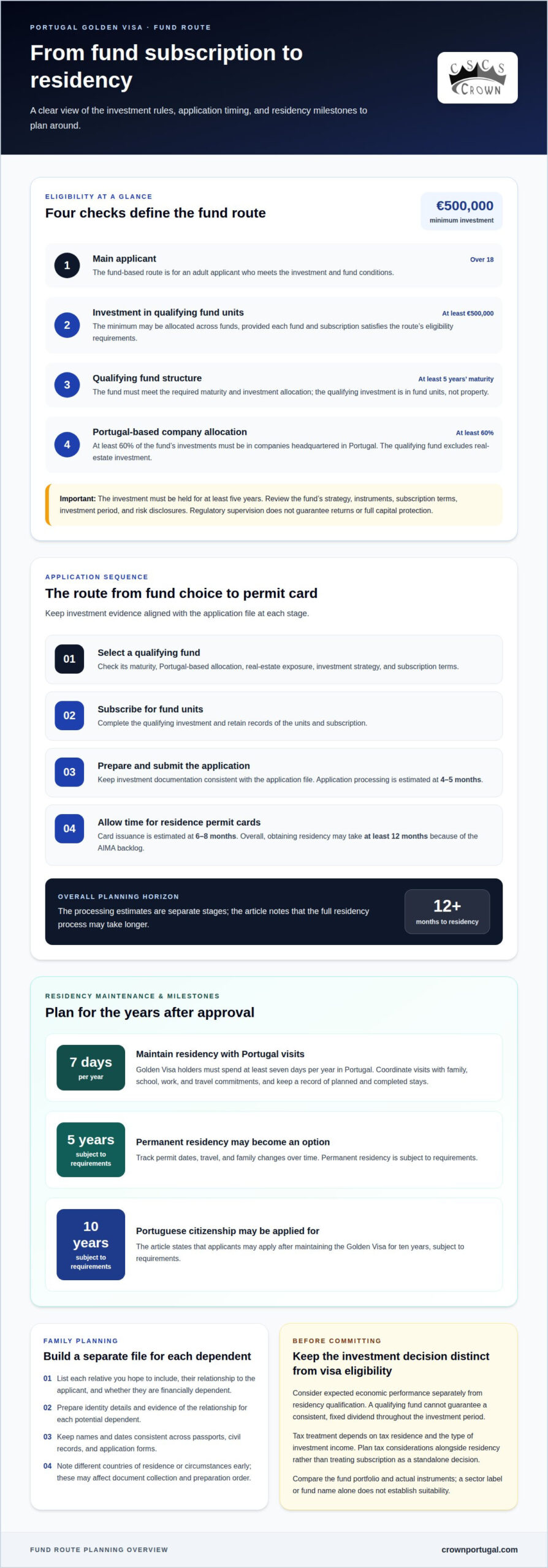
The fund route is defined by investment rules, not by a property purchase. A Portugal venture capital fund visa consultant can help applicants understand whether they meet the main criteria: the applicant must be over 18, invest at least €500,000 in fund units, and choose a qualifying fund that excludes real-estate investment. According to Diário da República, the fund must have a maturity of at least five years and invest at least 60% in companies headquartered in Portugal.
The investment threshold is only one consideration when planning a family Golden Visa application. This article explains who may qualify for the fund-based route, which family members may be included, and how residency planning fits the application. It also covers key fund conditions and practical factors to weigh when deciding whether this pathway suits your circumstances.
Key Takeaways
- Understand the core fund-route threshold and how the fund’s investment focus and maturity affect eligibility.
- Plan residency around the minimum stay requirement and consider how family inclusion fits your household’s needs.
- Learn how to assess Portugal-based fund options and identify the details that matter when reviewing eligibility.
- Compare the fund route with other investment pathways, including job creation, scientific research, and cultural investment.
- See how Crown Portugal’s Golden Visa D-9 support can help organize your application planning and next steps.
Who can apply for the Portugal Golden Visa through a fund investment?
The fund route is for an adult applicant who meets the investment threshold and chooses a qualifying investment fund. Eligibility depends on the fund’s structure and investment allocation, as well as the applicant’s ability to complete the required investment and application steps.
Qualifying Fund Investment Eligibility
The main applicant must be over 18 and invest at least €500,000 in qualifying fund units. According to Diário da República, the venture-capital-fund route requires a fund maturity of at least five years and at least 60% of investments in companies headquartered in Portugal. The listed fund options exclude investment in real estate, so property exposure is not the qualifying investment itself.
Check the fund’s regulatory status as part of your due diligence. Supervision does not guarantee returns or full capital protection. Review the fund’s private equity or other economic strategy, instruments, subscription terms, and investment period alongside its Golden Visa eligibility. The investment must be held for at least five years.
Application and Residence Permit Process
The process moves from selecting a qualifying fund to subscribing for units, documenting the investment, and submitting the Golden Visa application. Application processing is estimated at four to five months, while residence permit cards are estimated to take six to eight months. Overall, obtaining residency may take at least 12 months because of the AIMA backlog.
Keep investment records aligned with the application file, including evidence of the fund units and subscription. These are administrative fees, separate from the investment.
The minimum investment is €500,000 across the qualifying investment fund route. This allows allocation across funds, but each fund and subscription must fit the route’s eligibility requirements. Compare investment strategy, maturity, and real-estate exposure before committing.
For the Lince Innovation Fund, assess its stated innovation strategy, subscription terms, instruments, investment period, and risk disclosures. The fund’s name alone does not establish eligibility; what matters is whether its structure meets Golden Visa rules. Consider expected economic performance separately from residency qualification. A qualifying fund cannot guarantee a consistent, fixed dividend throughout the investment period.
Tax treatment depends on tax residence and the type of investment income. Portuguese tax residents may face tax on capital income, while non-resident treatment differs. The investor’s residence status and income category determine the relevant analysis. Plan for tax considerations alongside residency, rather than treating fund subscription as a standalone decision.
Golden Visa residency can provide a route toward citizenship, subject to requirements. Applicants may apply for Portuguese citizenship after maintaining the Golden Visa for 10 years. That period makes it important to consider the investment’s duration, family plans, and longer-term residence objectives before subscribing.
Residency planning and eligible family members
Residency planning connects the main applicant’s investment timeline with each family member’s intended role. Start by listing every relative you hope to include, their relationship to the applicant, and whether they are financially dependent. This family map helps organise personal records and identify which applications or supporting documents need separate preparation.
For each potential dependent, prepare a clear file with identity details and evidence of the relationship. Keep names and dates consistent across passports, civil records, and application forms. Record differences in a dependent’s circumstances, such as a different country of residence, early in the process. This can affect document collection and the sequence for preparing the family’s applications.
Residency maintenance also requires a workable Portugal travel plan. Golden Visa holders must spend at least 7 days per year in Portugal to maintain residency. Coordinate those visits with the family’s school, work, and travel commitments, then retain an annual calendar of planned and completed stays. A household may need to organise travel differently if dependents cannot accompany the main applicant on every visit.
Think beyond the first residence permit. Permanent residency may become an option after 5 years, subject to requirements, while Portuguese citizenship may be applied for after 10 years of maintaining the Golden Visa, subject to requirements. These milestones make it useful to keep a long-term record of permit dates, family changes, and travel. Each family member’s plans may differ, so track their status separately.
Review fund sectors separately from family eligibility. Examine the fund’s policy and portfolio to see which economic activities it targets, how it selects companies, and whether its allocation meets the Golden Visa route’s requirements. Eligible funds may focus on private equity or innovation, but a sector label alone does not establish suitability. Review the actual instruments and portfolio approach, including any exposure to real estate.
In Portugal, the relevant sector test concerns the fund’s qualifying allocation to companies headquartered in the country. Consider how the portfolio could change during the investment period, rather than relying only on a marketing description. A regulated fund’s documents can explain its strategy, risks, and subscription terms, but supervision by the public commission does not remove investment risk or guarantee capital protection.
Before choosing a fund, align three plans: the investment portfolio, the family’s residency schedule, and the documents needed for each applicant. This can reveal practical conflicts, such as a dependent’s travel constraints or a fund strategy that does not match the household’s financial priorities. Treat a Portugal Golden Visa family plan as a set of connected decisions, not separate paperwork tasks.
Which Portugal-based venture capital funds are eligible for Golden Visa investment in 2026?
A Portugal Funds directory snapshot dated 27 October 2026 lists 134 Golden Visa-classified funds. That figure is a useful starting point, not an individual fund recommendation. Classification alone does not describe a fund’s current subscription status, strategy, or suitability for a particular investor.
Assess each candidate against its current fund documents and the Golden Visa investment conditions. Review its registration and supervision status, maturity, Portuguese company allocation, investment strategy, and subscription terms. The fund documents should also explain its instruments, risks, and investment period. Check each fund individually rather than assuming all funds in a directory have identical terms.
Historical Portugal Venture Capital Initiative (PVCi) funds offer examples of Portuguese venture-capital activity, but they should not be read as a current subscription list. The PVCi programme is under liquidation and no longer receives fund applications. Seven funds selected through the initiative generated €370.2 million in investments into 53 companies, with reported investment figures as of 31 December 2024.
- Explorer III: invested €99.1 million in Portugal; its signature date was June 2010.
- Fundo Inter-Risco II: invested €51.6 million in Portugal; its signature date was November 2010.
- Vallis Sustainable Investments I: invested €58.9 million in Portugal; its signature date was November 2011.
- Pathena: invested €37.9 million in Portugal, based on data as of 31 December 2024.
- SC1 Private Equity Fund: invested €35.8 million in Portugal; its signature date was September 2013.
- Oxy Capital Mezzanine Fund I: invested €54.5 million in Portugal, based on data as of 31 December 2024.
- HCapital I: invested €32.5 million in Portugal, based on data as of 31 December 2024.
These historical figures show investment activity, not present-day availability or guaranteed Golden Visa eligibility. For a 2026 decision, distinguish a fund’s track record from its current legal and subscription position. Confirm the exact fund name and share class in the relevant documents, then review the fund’s latest allocation and terms before making an investment decision.
The Portugal Future Fund is another named option in the current market information. Its subscription period is 21 months from registration with CMVM. Those details describe that fund’s stated terms; they should not be generalized to other investment funds.
A practical shortlist separates three things: current Golden Visa classification, fund-level eligibility conditions, and whether subscriptions are open. The dated directory count and PVCi examples can help frame the search, while each fund’s current documents provide the details investors need to assess.
How do I choose a reputable Portugal Golden Visa consultant for a venture capital fund application?
Start by assessing whether the consultant can explain the immigration process and the fund-related evidence your application depends on. A Portugal venture capital fund visa consultant should distinguish immigration guidance from investment advice and clarify which tasks they handle. Ask for a written scope covering document preparation, application coordination, and communication about investment evidence. The roles of the consultant, fund manager, and applicant should remain clear.
Look for a process that turns eligibility criteria into specific document checks. The consultant should explain how the fund’s registration, investment allocation, maturity, subscription records, and applicant documents relate to the application. For example, a subscription confirmation supports evidence of investment, while the fund’s governing documents describe its strategy. Clear answers matter more than broad statements about experience.
Review the proposed workflow before sharing sensitive records. It should identify the information needed from the main applicant and dependents, how records are organised, and what happens when a document needs updating. For example, a passport renewal during preparation may require identity details to be reconciled across forms and supporting records. Ask how outstanding items and changes to the application file are tracked and communicated.
- Scope: Check that the written engagement describes the immigration tasks and identifies work handled by the fund manager.
- Fund evidence: Ask how subscription documents and fund records are incorporated into the application file.
- Family coordination: Confirm that the process accounts for each dependent’s documents and circumstances.
- Communication: Establish how progress, missing records, and next steps will be communicated.
- Claims: Reject assurances of guaranteed approval, fixed returns, or full capital protection.
Fund oversight and investment performance are separate questions. CMVM supervision does not guarantee returns or full capital protection, so a consultant should not present it as a promise of financial results. Likewise, immigration support should not be described as assurance of a residence permit or citizenship. Explanations should distinguish procedural assistance from decisions made by the relevant authorities and commercial outcomes controlled by the fund.
Finally, assess whether the consultant’s explanations remain consistent across a sample case. If a family plans to include a dependent, the consultant should describe how that person’s records fit the application sequence. If the proposed fund uses a private equity strategy, the consultant should identify the fund documents relevant to the eligibility review without claiming to predict returns. A clear, documented process helps you understand responsibilities before the application advances.
Choose a consultant whose scope, communication, and document workflow you can understand in practical terms. Before engagement, record the agreed responsibilities, the documents to be prepared, and any questions still requiring resolution. This provides a useful reference for coordinating the application and fund subscription without confusing immigration guidance with investment management.
How does Portugal’s venture capital fund route compare with other Golden Visa investment options
Portugal’s Golden Visa investment routes differ in what the applicant funds or delivers. The venture capital fund route invests in fund units, while other options focus on job creation, scientific research, or cultural activity. Compare each route’s qualifying conditions, investment structure, and connection to your objectives before deciding.
A qualifying fund investment gives the applicant exposure to a managed portfolio rather than a single direct project. The fund’s strategy, instruments, maturity, and subscription terms shape the investment decision. This structure may suit someone comfortable assessing fund documents and accepting investment risk. It does not promise a fixed return, and CMVM supervision does not guarantee returns or full capital protection.
Other routes have different qualifying tests. The options include creating at least 10 jobs in Portugal, investing at least €500,000 in scientific research, or investing at least €250,000 in arts, cultural heritage, or cultural production. These paths differ from a fund subscription because they focus on a defined economic contribution or activity rather than participation in an investment fund.
- Venture capital fund: Assess the fund’s portfolio, investment strategy, terms, and eligibility documents.
- Job creation: Consider whether creating at least 10 jobs aligns with your business plans and ability to manage an operating activity.
- Scientific research: Review whether an investment of at least €500,000 in research matches your objectives and preferred contribution.
- Arts and cultural activity: Consider the qualifying investment of at least €250,000 in arts, cultural heritage, or cultural production.
The practical distinction is where responsibility sits. With a fund, the applicant selects and subscribes to fund units, then retains investment records for the application. A job-creation route requires an employment outcome. Scientific research and cultural routes direct investment toward their respective activities. Each option therefore calls for a different evidence trail and a different assessment of the applicant’s involvement.
Compare your priorities in sequence: identify the type of commitment you can make, assess the documents and ongoing responsibilities, then consider the risks of the investment or activity. For example, an applicant seeking a managed portfolio may examine a fund, while an entrepreneur intending to build a Portuguese operation may assess the job-creation route. Neither preference replaces the route’s formal criteria.
Family and residency plans matter too. Consider whether the chosen route fits your travel schedule, household documentation, and longer-term plans for Portugal. A consultant can help organise immigration requirements, but investment selection calls for careful attention to the fund or activity itself. Keep those roles distinct when comparing alternatives.
There is no single best route for every applicant. Use the differences in investment structure, required contribution, and supporting evidence to narrow your options. Then assess the selected pathway against your financial objectives and practical capacity to meet its requirements.
Crown Portugal
Crown Portugal helps applicants plan Portuguese immigration applications, including the Portugal Golden Visa D-9. If you’re assessing the fund route, it can help organise the residency application steps and related documentation, while fund selection and investment risk remain separate considerations. This support is useful when you need to coordinate the main applicant’s file with family members’ documents or understand how your wider Portugal plans fit together.
If the fund route doesn’t match your circumstances, Crown Portugal also handles other pathways, including the Portugal Digital Nomad D-8 Visa and Portugal Passive Income D-7 visa. The appropriate route depends on your situation and the relevant eligibility requirements. For help planning your next steps, contact Crown Portugal.
Set a Clear Direction for Your Portugal Plans
Your next step is to bring your investment plans, family priorities, and intended residence pathway into one practical discussion. A Portugal venture capital fund visa consultant can help clarify the immigration planning involved and organise the questions to address before proceeding with an application. Keep investment decisions distinct from immigration support, and focus on a plan that fits your household’s circumstances.
Crown Portugal supports applicants with the Portugal Golden Visa D-9, the Portugal Digital Nomad D-8 Visa, and NIF Registration (Personal Tax Number). These offerings may be relevant at different stages of your plans in Portugal, depending on the route you are pursuing.
Contact Crown Portugal to discuss your plans and consider the next steps with greater clarity. A well-organised plan gives your family a constructive starting point.
Frequently Asked Questions
What are the legal requirements for Portugal Golden Visa investment funds?
Portugal’s fund-based Golden Visa investment must meet both immigration and fund conditions. At least €500,000 must be invested in fund units; the fund must have a maturity of at least five years and allocate at least 60% to companies headquartered in Portugal, according to Diário da República. Eligible options exclude real-estate investment, and funds are registered with and supervised by CMVM. These checks concern eligibility, not investment returns or capital protection.
What is Portugal’s venture capital fund route to residency under the Golden Visa program?
It is a residency pathway based on subscribing to qualifying investment fund units rather than purchasing property. The main applicant must be over 18 and provide evidence of the subscription as part of the application. The route may accommodate family applications, with application and residence card fees assessed per family member. Applicants should plan their investment records, application documents, and travel commitments as connected parts of the process.
What are the minimum investment amount and eligible fund requirements for Portugal’s Golden Visa?
The minimum investment is €500,000 in qualifying fund units. A qualifying fund must meet the Portuguese company allocation and maturity conditions, and real-estate investment is excluded. Fund subscription terms and strategy remain important considerations alongside immigration eligibility.
How can I verify that a Portuguese venture capital fund qualifies for the Golden Visa?
Review the fund’s registration and supervision status, governing documents, investment allocation, maturity, and subscription evidence. Check that its terms match the route’s requirements, rather than relying only on a marketing label or directory classification. Crown Portugal provides immigration consultancy for Portuguese visa applications, including document review, application preparation, and appointment scheduling. Its support can help organise the immigration-related review, while fund documents provide the details needed to assess investment structure and risks.
What are the application steps and required documents for Portugal’s venture capital fund Golden Visa?
First, subscribe to qualifying fund units and retain documents showing the investment. Then prepare the application file and attend the required appointment when scheduled. Applicants are usually asked for a passport with at least six months’ validity and police clearance certificates from countries where they lived for more than one year. Family members have separate application and residence card fees, so organise each person’s records individually.
How long does Portugal Golden Visa processing take, and what are the current appointment delays?
Application processing is estimated at four to five months, while residence permit cards are estimated to take six to eight months to issue. Obtaining residency may take at least 12 months because of the AIMA backlog. These estimates describe different stages, not a specific appointment waiting period. Keep the investment and application records ready while planning for the appointment and subsequent card issuance.
What are the residency, stay, renewal, and citizenship rules for Portugal Golden Visa fund investors?
Golden Visa holders must spend at least 7 days per year in Portugal to maintain residency. Track each visit and retain supporting travel records for your personal file. Permanent residency may be available after 5 years, subject to requirements, while Portuguese citizenship may be applied for after 10 years of maintaining the Golden Visa, also subject to requirements. Renewal timing depends on the residence permit’s applicable process.
What are the risks, lock-up periods, and exit options for Portuguese Golden Visa venture capital funds?
Fund investments carry financial risk, and CMVM supervision does not guarantee returns or full capital protection. Investors must hold Golden Visa fund assets for at least five years. Exit timing and procedures depend on the fund’s documents and terms, so review redemption provisions, maturity, and any transfer restrictions before subscribing. A fund cannot guarantee a consistent, fixed dividend throughout the investment period.