

How to check which activities your Portugal D4 visa allows
A Portugal D4 visa is for eligible study, research, internship and volunteering activities, not unrestricted employment. The D4 research and study visa in Portugal allows research at a Portuguese institution for up to one year, and internships or volunteering for up to six months. Check the conditions attached to your residence status before taking up work.
It’s understandable to want a clear picture of what your visa permits before committing to a course or making plans to move. This guide explains how to match your intended activity to the D4 route, how study residence relates to longer-term eligibility, and which documents to prepare for your application.
You’ll also find practical steps for checking your admission or placement details, organising supporting documents and understanding what to do after arrival. Focus on the purpose of your stay and the conditions attached to your residence status; don’t assume every activity is automatically covered.
Key Takeaways
- Match your planned study, research, internship or volunteering activity to the purpose of the D4 route before preparing your application.
- Understand how time spent studying in Portugal may relate to longer-term residence eligibility, and why the applicable residence rules matter.
- Organise your admission or placement evidence, proof of funds, accommodation details and identity documents as a coherent application file.
- Check the application steps, consular fee and processing time that apply to the country where you submit your application.
- Review the conditions for working alongside your studies separately from the activities permitted by your study status.
What is the D4 Student Visa?
Common reasons for refusal include incomplete documents, an unclear study purpose, or insufficient evidence of funds, accommodation or insurance. If your application is refused, address the reasons given in the decision and follow its instructions for appealing, including the applicable deadline.
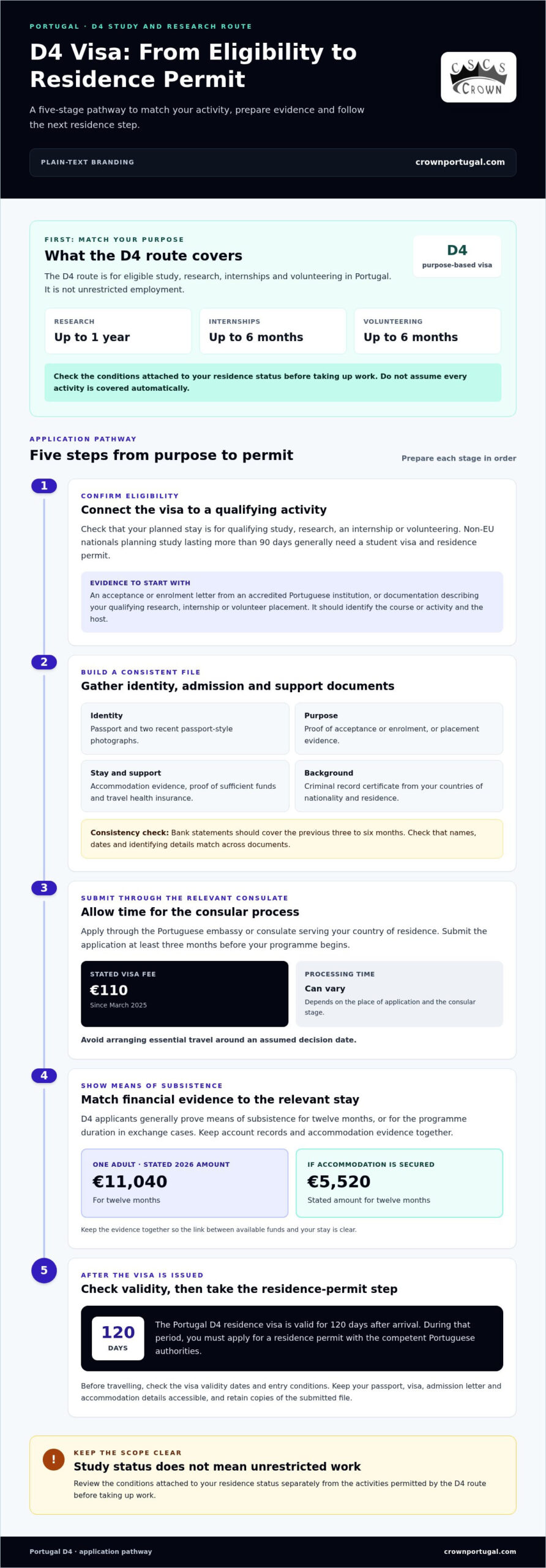
- Confirm that the D4 route matches your purpose and planned stay. It covers qualifying study, research, internships and volunteering in Portugal. Non-EU nationals planning study lasting more than 90 days generally need a student visa and residence permit. Begin with an acceptance or enrollment letter from an accredited Portuguese institution, or documentation describing your qualifying research, internship or volunteer placement. The letter should identify the course or activity and the host.
- Prepare a consistent application file with your passport, two recent passport-style photographs, proof of acceptance or enrolment, accommodation evidence, proof of sufficient funds, travel health insurance and a criminal record certificate from your countries of nationality and residence. Bank statements should cover the previous three to six months. Check that names, dates and identifying details match across documents, so your application presents a coherent study plan.
- Apply through the Portuguese embassy or consulate serving your country of residence. Submit the application at least three months before your programme begins, allowing time for the consular process. The stated visa fee is €110 since March 2025. Processing times can vary depending on the application and consular stage. The actual processing period depends on the place of application and the consular stage, so avoid arranging essential travel around an assumed decision date.
- Organise financial evidence for the relevant period of study. D4 applicants generally prove means of subsistence for twelve months, or for the programme duration in exchange cases. The stated 2026 amount for one adult is €11,040. If accommodation is secured, the stated amount may be €5,520 for twelve months. Keep account records and accommodation evidence together, making the connection between available funds and your stay clear.
- After the visa is issued, check its validity dates and entry conditions before travelling. The Portugal D4 residence visa is valid for 120 days after arrival, during which you must apply for a residence permit with the competent Portuguese authorities. Keep your passport, visa, admission letter and accommodation details accessible during travel. Retain copies of the submitted file so you can refer to the same information when completing the next residence step.
Study time and eligibility for permanent residence and citizenship
- Track your residence-permit dates from the first permit issued for study. In Portugal, you may apply for permanent residence after five years of residence permits. However, student residence counts as half the period used to qualify for long-term or permanent residence. Time spent studying therefore may not count towards eligibility in the same way as time under other residence categories. Keep copies of your permits and renewal records to calculate your qualifying period accurately.
- Keep the permanent-residence calculation separate from the citizenship timeline. Citizenship eligibility depends on the applicable residence and other requirements, so check the rules for your circumstances. Don’t assume the five-year threshold for permanent residence also applies to citizenship. Create a timeline of your first permit, each renewal period and any changes in residence status. This helps distinguish time physically spent in Portugal from time counted under the relevant eligibility rules.
- Keep evidence that your study residence remained connected to your course. Store enrolment confirmations, transcripts, attendance records and correspondence from your school alongside each residence permit. These documents can help establish the nature and continuity of your stay if you later assess eligibility for permanent residence or citizenship. Retain proof of address and accommodation records too, as they can document your residence history and clarify gaps between permits or study periods.
- Plan your post-graduation status before your student basis ends. Graduates who receive a job offer may request a residence-permit conversion under Article 122. After graduating, a student may ask AIMA to change the basis of their residence permit to work without leaving Portugal. Keep the job offer and graduation evidence together with your current permit, then organise the change-of-status application around the end of your course.
- Assess family applications separately from your own eligibility. For a student’s family reunification application, the sponsor must have held a residence permit for two years. If you plan to include a spouse, factor this requirement into your timeline rather than assuming their residence follows automatically from your student status. Keep separate records for each family member, including permits and accommodation evidence, to support future residence planning.
What Activities are Allowed on a D4 Visa Portugal?
The D4 research and study visa Portugal route covers qualifying study, research, internships and volunteering. D3 is for highly qualified professional activity, while D5 applies to eligible higher-education mobility from another EU country.
- Match your main purpose in Portugal to an eligible D4 activity. The route covers university and language students accepted by an accredited Portuguese institution, as well as qualifying researchers, interns and volunteers. For applicants comparing study routes, the D4 research and study visa Portugal pathway is intended for people whose principal purpose fits one of these activities. The institution’s acceptance letter should identify the course or placement clearly.
- Check that your study programme fits the relevant education category. The eligibility checklist identifies levels 2 and 3 of the International Standard Classification of Education for qualifying secondary-school study. Applicants for secondary-school study or vocational education must be between 14 and 21 years of age. For vocational education, relevant Portuguese National Qualifications Framework levels are 4 or 5. Match your programme documents to the applicable category before filing.
- Document research, internship or volunteer activities through the host organisation. Research at a Portuguese institution may be covered for up to one year. Internships at a Portuguese company or organisation, and volunteering at a Portuguese organisation, may each be covered for up to six months. Include an agreement or invitation that identifies the host, purpose and expected duration. Researchers should explain how their proposed work relates to the Portuguese institution.
- Distinguish D4 from mobility and short-stay routes before preparing your application. A higher-education student joining a Portuguese mobility programme from another EU country may use D5 for up to 360 days. The D4 research and study visa Portugal route applies to qualifying activities based in Portugal, while a short-stay visa serves brief visits. Choose according to your status, host institution and planned activity, not just the course title.
- Keep study permission separate from employment permission. A D4 visa doesn’t itself provide unrestricted work rights. Eligible students may work part-time alongside their studies, subject to AIMA authorisation and provided work doesn’t interfere with their academic schedule. If employment is part of your plan, treat it as a separate permission issue. A course acceptance or internship agreement doesn’t automatically authorise other employment.
- Assemble evidence that supports the activity you selected. Students should retain acceptance or enrollment evidence; researchers, interns and volunteers should keep host documents or agreements. Include the criminal record certificate in the visa file, and ensure its details align with your identity and activity records. A consistent application helps show why the D4 category fits your intended stay.
Why Study in Portugal?
On a D4 study or research visa, don’t assume your visa alone authorises employment. Student residence-permit holders may be able to work alongside their studies, subject to applicable authorisation and conditions.
- Check your residence status and authorisation before accepting paid work. Non-EU students may work subject to authorisation from SEF, while D4 student residence-permit holders must meet the conditions applicable to their permit. The permission to study and permission to work are separate considerations. Keep your residence documents available and make sure the proposed employment or self-employment fits the relevant authorisation.
- Plan your weekly schedule around the course and any stated work limit. Eligible students may be able to work alongside their studies, subject to the conditions attached to their residence status and authorisation. The Act’s Article 97.º allows employed or self-employed activity alongside studies, without stating a fixed hours cap. Treat the specific conditions attached to your status and authorisation as decisive, rather than assuming every student has identical work rights.
- Protect your academic progress when arranging shifts or contracts. D4 part-time work must not interfere with your academic schedule, so compare proposed hours with classes, research commitments and attendance requirements. For example, a student with fixed laboratory sessions should avoid work that repeatedly conflicts with those sessions. Retain your timetable and employment records to show how work fits alongside studies at your Portuguese institution.
- Distinguish a course-related internship from an unrelated job. A qualifying internship is tied to the placement activity and its host agreement, while regular employment raises separate work-authorisation questions. Before starting, establish whether the activity is part of your approved study or placement and whether your residence status permits the proposed work. An internship document is not blanket permission for other employment.
- Plan a status change if you intend to remain employed after graduation. A student residence basis is linked to studies, so assess the next residence route before relying on student-related work conditions. Graduates with a job offer may request a change to a work basis under Article 122. Keep graduation and employment documents organised to support the transition, and avoid treating a study residence visa as permanent work permission.
- Factor family plans into your longer-term study decision. Family reunification has separate residence requirements, so don’t assume a spouse can automatically work under your student status. Consider how study, employment and family residence applications interact before making plans to settle permanently in Portugal. Keep each family member’s permit and supporting records organised for their own application.
Passport, criminal record, insurance and accommodation documents
Prepare a consistent file with identity, admission, funds, accommodation, insurance and criminal-record evidence. Requirements may depend on where you submit your application, so organise the documents according to the consulate handling your case.
For a Portugal D4 research or study visa, prepare your passport, acceptance or enrollment evidence, proof of funds, accommodation details, travel insurance and criminal record certificate. Add official translations or authentication where the consulate’s instructions require them.
-
Gather Passport and Criminal Record Documents
Check that your passport details match your acceptance letter and application form. For a D4 application submitted in New Delhi, the passport must have been issued within the previous 10 years and have at least 3 months of validity. Applicants over 16 must provide a criminal record certificate; the police clearance certificate must have been issued within the previous three months. Keep clear copies with the originals.
-
Prepare Insurance and Accommodation Documents
Collect travel insurance showing minimum coverage of 30,000 Euro, as required for the D4 application. Pair it with accommodation evidence that identifies where you plan to live in Portugal, such as a documented housing arrangement. Check that names and dates align with your passport and planned study period. An exchange student should keep accommodation evidence consistent with the exchange dates and host institution’s records.
- Prepare official documents for use in the country where you apply. If a certificate or supporting record is not in English or Portuguese, follow the relevant consulate’s instructions on translation. The same applies to apostilles and other authentication: prepare them when the receiving consulate requires them, rather than assuming every document follows the same process. Keep original and translated versions together for easy comparison.
- Group study and financial evidence by purpose. Put the institution’s acceptance or enrolment letter with the course details, then keep bank statements and sponsor records in a separate section. Place accommodation evidence and the insurance certificate nearby. This organisation helps officials assess how your study plan, available funds and intended residence fit together.
- Before submitting, check the complete file against the consulate’s checklist. Confirm that each document is legible, current where required, and consistent in spelling, dates and identity details. For example, a difference between the name on your passport and admission letter can complicate the review. Keep a copy of the submitted application and supporting documents for reference during your residence-permit process.
Crown Portugal: Portugal Digital Nomad D-8 Visa
Crown Portugal assists with the Portugal Digital Nomad D-8 Visa, a relevant route to discuss if your plans involve remote work rather than study or research. The D4 route is designed around qualifying education, research, internships and volunteering, so it may not fit someone whose primary purpose is working remotely. Clarifying your main activity can help you focus on the appropriate residence pathway.
If your circumstances instead involve passive income, investment or tax registration, Crown Portugal also assists with the Portugal Passive Income D-7 visa, Portugal Golden Visa D-9 and NIF Registration (Personal Tax Number). These are distinct matters, so consider them only where they match your situation. Contact Crown Portugal to discuss which application pathway relates to your plans.
Plan Your Next Step With Confidence
Consider how your intended activity fits into your wider plans for living and working in Portugal. The D4 research and study visa is a study-based route, so your next step is to make sure your chosen pathway reflects your actual purpose and future direction. If those plans change after graduation, treat the transition as a separate part of your residence planning, not an automatic extension of student status.
Before taking action, organise your questions around your course or research purpose, intended timeline and plans afterwards. A clear plan makes it easier to discuss the relevant application pathway and identify practical next steps without losing sight of your longer-term goals.
Contact Crown Portugal for visa support to discuss your Portugal immigration plans. With a well-considered pathway, you can move forward with greater clarity.
Frequently Asked Questions
How Long is the D4 Visa Valid For?
The D4 residence visa is valid for 120 days after arrival in Portugal. Use that period to apply for a residence permit with the competent Portuguese authorities. The visa and residence permit are separate stages, so don’t treat the entry visa’s validity as the duration of your longer-term student residence. Keep track of the visa dates and arrange your residence-permit application within the permitted period.
What are the Benefits of a D4 Visa?
A D4 visa provides a route to Portugal for qualifying study, research, internships or volunteering, according to the activity and supporting documents. It can also support a longer-term plan: student residence counts as half of the period used to qualify for long-term or permanent residence. Eligible students may work alongside their studies subject to the applicable authorisation. These permissions have conditions and aren’t unrestricted work rights.
Can I apply from Portugal after entering as a tourist?
A tourist entry doesn’t replace the D4 residence-visa application. Applicants apply through the Portuguese embassy or consulate in their home country, so plan the visa process before travelling for a long-term course. For example, a visitor who has received a university acceptance letter should use the appropriate residence-visa application route rather than assume tourist status will cover extended study or be converted automatically.
Can my family apply at the same time?
A spouse may apply for a residence visa at the same time as the student, with the required means increased by 50%. A spouse, minor children and dependent parents may be included in a D4 application. Family members need their own supporting documents, so prepare separate identity and relationship records alongside the student’s file. Family applications and later reunification have distinct requirements; don’t assume one automatically satisfies the other.
D4, D5 or temporary stay visa: which one do you need?
Choose D4 for qualifying study or research in Portugal, and consider D5 if you’re a higher-education student joining a Portuguese mobility programme from another EU country. That mobility route can cover up to 360 days. D3 is for highly qualified activity, not a study category. For a short study visit, assess the short-stay route; D4 is generally relevant when study exceeds 90 days.
Do I need to pay the tuition fee before the visa?
Admission or enrollment evidence is central to a D4 application, but the requirement to show tuition payment depends on the applicable institutional conditions. Evidence of subsistence means and tuition payment isn’t required for higher-education students admitted to an institution approved under Ordinance No. 111/2019, of April 12. For example, confirm that your admission relates to that approved institution before relying on this exemption.
What is Portugal’s D4 residence visa for research and study?
Portugal’s D4 residence visa is the route for eligible non-EU nationals coming for qualifying study or research, as well as certain internships and volunteer placements. The D4 research and study visa in Portugal connects the stated purpose of travel with an acceptance, enrollment or host document. For example, a researcher should present evidence from the Portuguese institution describing the research activity, rather than relying only on a general travel itinerary.
Who is eligible for a Portugal D4 visa, including researchers, PhD students, and university students?
University students accepted by an accredited Portuguese institution and researchers hosted by a Portuguese institution may qualify, subject to their activity and application evidence. PhD students should show whether their Portugal stay is based on university enrollment, research activity, or both. Some internships and volunteer placements may be relevant to a D4 application. A clear acceptance letter or host agreement should make the applicant’s role and purpose in Portugal understandable.