

Portugal Citizenship: Administrative Timeframes Explained

A projected date is not a citizenship decision. In Portugal, an administrative or estimated timeframe, or any other merely administrative or estimated timeframe, should not be treated as proof that an application has been approved or that a procedural action is complete. The useful distinction is between a recorded action that has happened, a step that remains in progress, and an estimate of how long a process may take.
It’s understandable to focus on dates when a citizenship application affects important plans. But estimates can be easy to misread, especially when they don’t describe the status of a specific application. This article explains how to distinguish completed actions from ongoing ones, interpret administrative timeframes, and understand why estimates offer limited insight into progress. With that distinction in mind, you can read updates carefully and understand what a timeframe does and doesn’t tell you.
Key Takeaways
- Separate a completed administrative action from a step that is still in progress; neither is the same as an estimated completion date.
- Assess what a timeframe actually describes before using it to judge the status of a citizenship application.
- If a timeframe passes, focus on the recorded status and the next procedural step rather than treating the estimate as a decision.
- Understand that an extension depends on the rules that apply to the specific deadline, not simply on an estimated timeframe passing.
- Use clear distinctions between actions, ongoing steps and estimates to make more measured plans while an application is being processed.
What happens if an authority exceeds an administrative or estimated timeframe?
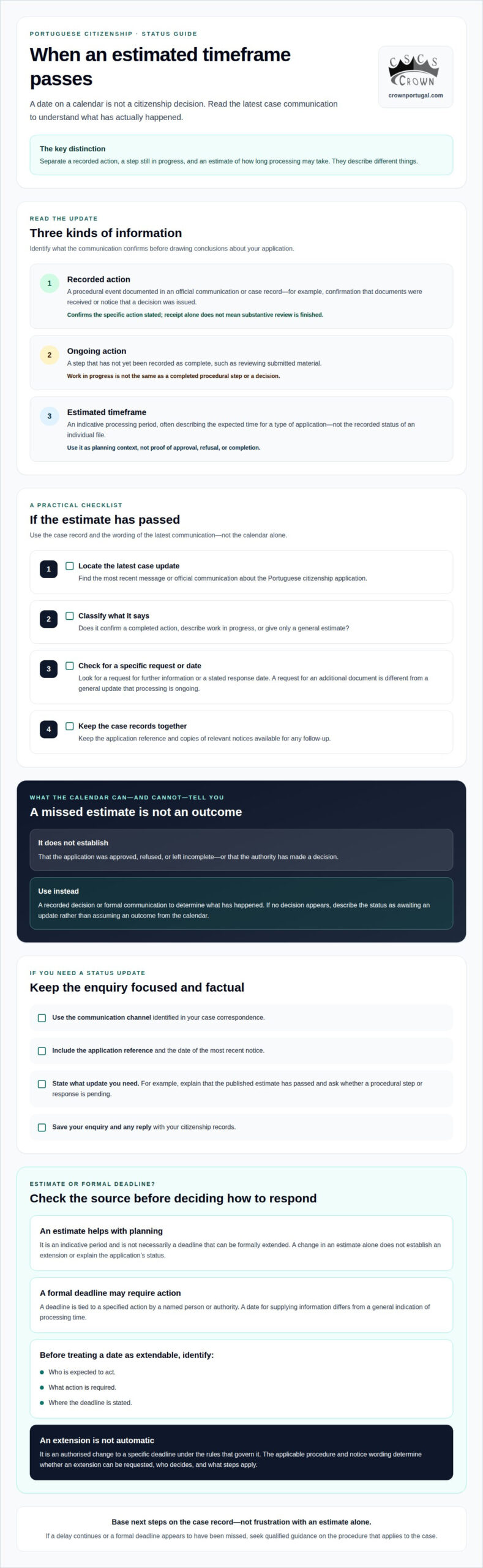
An estimated timeframe is an indicative processing period, not proof that an individual citizenship application has reached a decision. An administrative timeframe relates to a procedural step, and its effect depends on the rule or notice that sets it. If an estimate passes, that alone doesn’t tell you whether the application was approved, refused, or left incomplete. First identify what the stated period measures.
A published estimate is a planning reference, not an update on an individual case. For example, a general estimate may describe the expected processing period for a type of Portuguese citizenship application, while your file may have a different recorded status. Treat the estimate as context only. Compare it with the latest communication about your application, and distinguish a general timeframe from a date or deadline stated in a formal notice.
A recorded action is a procedural event documented in an official communication or case record. Examples include confirmation that documents were received or notice that a decision was issued. An ongoing action is a step not yet recorded as complete, such as reviewing submitted material. These categories matter because confirmation of receipt does not establish that substantive review is finished. Read each update for the specific action it confirms.
If an estimate has passed, use this sequence to understand your situation:
- Locate the latest message or case update concerning the Portuguese citizenship application.
- Identify whether it confirms a completed action, describes work in progress, or gives only a general estimate.
- Check whether the communication sets a specific response date or requests further information.
- Keep the application reference and copies of relevant notices together for any follow-up.
This sequence helps distinguish a delay from a request that needs action. For instance, a message requesting an additional document is different from a general update that processing is ongoing. The message determines what you need to do next.
A missed estimate does not, by itself, establish that the authority has made a decision. Nor does the passage of an expected period show that an application has been refused. For a Portuguese citizenship application, rely on a recorded decision or formal communication to determine what has happened. If no decision appears, describe the status as awaiting an update rather than assuming an outcome based on the calendar.
Use the communication channel identified in your case correspondence to enquire about the status. Include the application reference, the date of the most recent notice, and a concise description of the update you need. Keep the message factual: explain, for example, that the published estimate has passed and ask whether a procedural step or response is pending. Save your enquiry and any reply with your citizenship records.
Distinguish an estimate from a formal deadline before deciding how to respond. An estimate helps with planning; a deadline in a notice may require a response by a specified date. If a Portuguese citizenship communication sets a date for submitting information, follow that instruction rather than relying on a broader processing estimate. If the wording is unclear, seek advice on that specific notice before treating the dates as interchangeable.
Base escalation on the case record, not frustration with an estimate alone. First, establish what the latest official communication confirms. Then make a focused status enquiry through the stated channel and keep its reference. If the delay continues or a formal deadline appears to have been missed, seek qualified guidance on the procedure that applies to the case. This approach distinguishes an administrative delay, an unfinished step, and a recorded outcome.
Separate rules in other contexts should not be treated as requirements for a Portuguese citizenship file. Additional requirements apply to ensure collection of the U.S. estate tax on qualified domestic trusts with assets exceeding $2 million. For unavailable lodging at a temporary duty location, an agency may authorize or approve a maximum per diem rate of up to 300% of the rate for the location where lodging is obtained. Under 5 U.S.C § 5702, the GSA Administrator has authority to establish the system for reimbursing federal employees’ subsistence expenses on official travel. Federal travelers must provide receipts for lodging and for authorized expenses costing more than $75, unless they give their agency an acceptable reason for not providing a receipt.
Can an administrative or estimated timeframe be extended, and under what rules?
An estimated timeframe is an indicative period, not necessarily a deadline that can be formally extended. For a Portuguese citizenship application, first determine whether a date comes from a general estimate or a specific communication about the case. If it is only an estimate, asking whether it has been “extended” may confuse a planning expectation with a procedural rule. The estimate may change, but that alone does not establish a formal extension or explain the application’s status.
A formal deadline is a date by which a named person or authority is expected to take a specified action. It may come from a notice, a procedural rule, or another official communication about the application. The wording matters: a date for supplying information differs from a general indication of processing time. Before treating a date as extendable, identify who must act, what action is required, and where the deadline is stated.
An extension is an authorised change to a specific deadline under the rules that govern it. Extra time does not follow automatically when a date passes. In a citizenship matter, the applicable procedure and the notice wording determine whether an extension can be requested, who decides, and what steps apply. Don’t assume that a general processing estimate can be extended through the same process as a response deadline.
A revised estimate is an updated expectation of when work may be completed. It can help with planning, but it is not a decision on a Portuguese citizenship application. For example, a change to an estimated processing period does not, on its own, show that a decision has been issued or that the authority has formally changed a deadline. Keep estimates separate from notices requiring action.
When a communication gives a specific date, use this sequence to understand what it means:
- Identify the document or message that states the date.
- Record the action required and the person or authority expected to take it.
- Look for wording about extension, postponement, or a revised date.
- Follow the stated method for seeking clarification or requesting more time, if the communication provides one.
For example, a notice asking for a document by a stated date requires attention to that instruction. A general estimate in an information update does not, by itself, create the same task. Keep the original notice and any later reply together to preserve a clear record.
A suspension is a pause in a process, but the term alone does not explain its effect on a particular application. If a Portuguese citizenship communication says processing is paused, read the reason and instructions provided. Check whether it identifies a required action, a new date, or a condition for work to continue. Don’t infer that every pause extends every deadline; the document’s wording and applicable procedure determine the effect.
For a time-sensitive notice, prepare a concise record before seeking clarification. Include the application reference, the date of the communication, the exact action requested, and any later correspondence. Ask whether the stated date is a formal deadline, whether an extension route applies, and how to submit a request. These details help distinguish a deadline question from a request for an updated estimate, without assuming either has been granted.
Keep proof of each step, including the original notice, any submitted request, and the authority’s reply. A later message may clarify whether the date changed or whether the applicant still needs to act. If the document’s meaning remains unclear, seek guidance on Portuguese citizenship procedures before relying on an assumed extension. A missed estimate and a missed formal deadline are different issues, so classify the date before deciding what to do next.
Every timeline operates under its own legal procedure and should not be treated as an extension unless the applicable rules say so. Rules from another process cannot establish the rule for a Portuguese citizenship application. For comparison, in a U.S. bankruptcy case, a U.S. bankruptcy court may extend the deadline for a Chapter 13 fee installment for cause shown, but the final installment must be paid no later than 180 days after the petition is filed. That specific limit applies to the stated bankruptcy context; it does not supply an extension rule for citizenship matters. Check the authority and procedure named in the communication before relying on an extension.
Crown Portugal
Crown Portugal helps people understand Portuguese immigration procedures and prepare for relevant applications. If you’re assessing a citizenship update, the distinction between a recorded action, an ongoing step, and an estimate can help you frame the issue clearly. Crown Portugal’s support covers immigration matters such as the Portugal Digital Nomad D-8 Visa, Portugal Golden Visa D-9, Portugal Passive Income D-7 visa, and NIF Registration (Personal Tax Number). These services address other immigration and administrative needs, rather than changing the status of a citizenship application.
Crown Portugal provides immigration consultancy and related administrative support. If you need guidance on your application, share the notice or update that prompted your question so the issue can be understood in context. Contact Crown Portugal to discuss your next step.
Use the next update to plan with confidence
While a Portuguese citizenship application is pending, keep your next decision grounded in information tied to your own case. Treat an administrative estimate, or any other merely administrative or estimated timeframe, as a planning reference rather than a substitute for a formal update. A clear record of notices and correspondence can help you explain what you need to understand and identify the right next question.
Crown Portugal supports people with Portuguese immigration and administrative matters, including the Portugal Digital Nomad D-8 Visa, Portugal Golden Visa D-9, and NIF Registration (Personal Tax Number). These services address related needs, while citizenship application updates must be understood in their own procedural context.
Contact Crown Portugal for guidance on your next step. With a focused question and the relevant case information, you can move forward with greater clarity.
Frequently Asked Questions
What does “or any other merely administrative or estimated timeframe” mean in legal language?
Here, the phrase describes a period presented as administrative guidance or an estimate, rather than a deadline that itself determines legal rights. The phrase alone doesn’t establish the rule governing a Portuguese citizenship application. For example, a general estimate in an information notice differs from a date in a formal request. The document and applicable legal provision give the wording its practical meaning.
Does an administrative or estimated timeframe create a binding deadline?
Not automatically. A binding deadline must be based on an applicable rule or formal notice identifying the required action and relevant time limit. For example, an estimated completion window does not, by itself, require an applicant to act by its final day. If correspondence sets a submission date, assess it separately by identifying who must act, what is required, and the basis stated in the communication.
How does this phrase distinguish estimated timelines from statutory deadlines?
The distinction is in the source and function: a statutory deadline comes from legislation governing a specified action, while an estimated timeframe indicates an expected duration. If a citizenship update gives an expected processing period, that wording alone does not make the period statutory. To classify a date, check whether the communication refers to a legal provision or directs someone to take a particular action by that date.
Portuguese Nationality: 60-Day Decision Rule – Crown Portugal at 10:52 am, November 14, 2026 -
[…] Portugal Citizenship: Administrative Timeframes Explained […]