

What Happens After Portugal’s Evidentiary Phase?

Evidence on the file isn’t automatically decisive. Once the evidentiary/instruction phase is completed, the court assesses the evidence relevant to the disputed facts and moves the case toward a decision. In Portugal, Article 411 of the Civil Procedure Code makes the judge responsible for carrying out or ordering the steps needed to establish the truth and fairly resolve the dispute over facts the judge may consider.
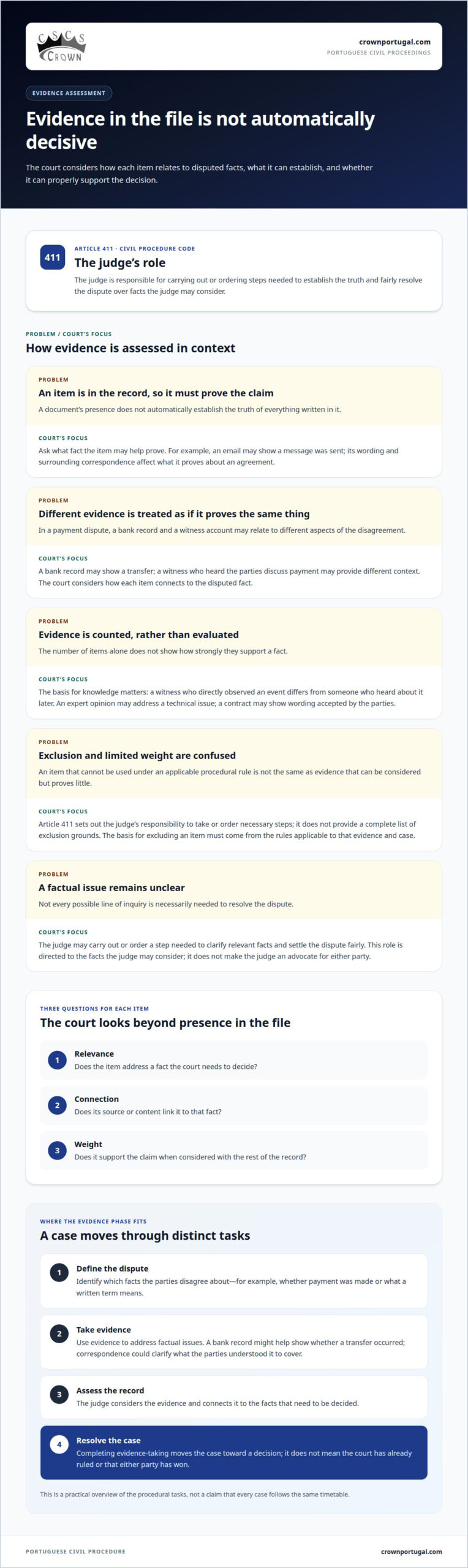
It is natural to expect that every document, statement or other item admitted during a case will be considered equally. In practice, the court controls how evidence is assessed: the judge may consider its relevance to the disputed facts and decide whether it can properly support the judgment.
This article explains how that control works in Portuguese civil proceedings, including how evidence may be assessed or excluded and where the evidentiary phase fits into the wider procedure. It also explains what completing this phase means for the case, without confusing the end of evidence-taking with the court’s final decision.
Key Takeaways
- Completing evidence-taking moves a civil case toward a decision, but it does not mean the court has already ruled.
- Under Article 411 of Portugal’s Civil Procedure Code, the judge may carry out or order steps needed to clarify relevant facts and resolve the dispute fairly.
- The court’s assessment focuses on how evidence relates to the facts in dispute and whether it can support the decision.
- Understanding the stages of civil procedure helps you distinguish the evidentiary phase from the steps that follow.
- Crown Portugal can assist with eligible Portuguese immigration matters, including visa applications and NIF registration, rather than court representation.
Court powers to control and exclude evidence
In Portugal, Article 411 of the Civil Procedure Code gives the judge responsibility for carrying out or ordering steps needed to establish the truth and fairly resolve the dispute over facts the judge may consider. This duty places the court’s evidentiary role within the case itself. The judge is not limited to treating every item in the file as equally relevant or decisive.
That control begins with the facts in dispute. A document, witness statement or expert opinion matters because of the particular fact it may help prove. For example, in a dispute over whether payment was made, a bank record may show a transfer, while a witness who heard the parties discuss payment may provide different context. The question is how each item relates to an issue the court must decide.
Article 411 does not mean that the judge must pursue every possible line of inquiry. The statutory responsibility concerns steps needed to ascertain the truth and settle the dispute fairly, within the facts the judge may know. The court’s assessment therefore focuses on the case’s disputed facts and the evidentiary material connected to them. A request that does not help clarify a relevant fact may have a different practical value from one that addresses a central issue.
Relevance, reliability, and evidentiary weight
Controlling evidence involves more than deciding whether an item is in the record. The court must consider what it can establish and how much weight it deserves alongside other evidence. A signed receipt, for example, may support the claim that money changed hands. If the parties dispute what the payment covered, the receipt alone may not resolve that separate question.
An item’s reliability also depends on its connection to the disputed fact. A witness who directly observed an event has a different basis for knowledge from someone who heard about it later. An expert opinion may address a technical issue, while a contract may show the wording accepted by the parties. These examples show why evidence is assessed in context, not simply counted.
Exclusion and limited weight are different outcomes. If material cannot be used under an applicable procedural rule, the court’s assessment differs from a situation where it can be considered but proves little. The supplied Portuguese rule, Article 411, establishes the judge’s responsibility to order or carry out necessary steps; it does not set out a complete list of exclusion grounds. The specific basis for excluding an item must therefore come from the rules applicable to that evidence and case.
- Relevance: Does the item address a fact the court needs to decide?
- Connection: Does its source or content link it to that fact?
- Weight: Does it support the claim when considered with the rest of the record?
These distinctions explain why a document’s presence does not automatically establish the truth of everything written in it. An email, for example, may show that a message was sent, but its wording and the surrounding correspondence affect what it proves about an agreement. The court evaluates the evidence in relation to the issue in dispute, rather than treating each item as a complete answer.
Article 411 also places the judge’s role within a fair settlement of the dispute. If an important factual issue remains unclear, the court may carry out or order a step that helps establish it. This does not turn the judge into an advocate for either party. The purpose is to clarify relevant facts so the dispute can be decided on an adequate evidentiary basis.
Once the evidentiary/instruction phase is completed, the court’s control remains important: evidence-taking has ended, but the judge still has to assess the material and connect it to the facts that need to be decided. The outcome depends on what the evidence establishes, what remains contested and whether each item can properly be used. The end of this phase does not automatically mean either party has won.
Under Rule 32.1 of England’s Civil Procedure Rules, a judge may direct which factual issues require evidence, the type of evidence required, and how it should be presented. This gives the judge control over the issues requiring proof, the form of evidence, and its presentation.
Methodological phases of civil procedure
Portuguese civil procedure is easier to understand as a sequence of tasks than as one continuous hearing. The court first identifies what the parties dispute. Evidence then helps address those factual issues, and the judge considers the record when resolving the case. This is a practical overview, not a claim that every case follows the same timetable.
The first analytical task is to define the dispute. In a contract disagreement, for example, one party might say payment was made while the other denies receiving it. That factual disagreement is different from a dispute about what a written term means. Separating the issues helps identify which evidence could assist with each question.
Evidence-taking serves the next task: connecting the material in the case to facts that need to be established. A bank record might help show whether a transfer occurred, while correspondence could clarify what the parties understood the payment to cover. An item’s value depends on the factual issue, not simply on its presence in the record.
Article 411 of Portugal’s Civil Procedure Code places an active role on the judge. The judge is responsible for carrying out or ordering steps needed to ascertain the truth and fairly settle the dispute concerning facts the judge may know. In practical terms, the provision ties procedural management to the factual questions that require resolution.
This responsibility does not make the evidentiary phase a separate decision about who wins. It is one part of the wider procedure: the court identifies disputed facts, considers relevant evidence, and then determines how those facts affect the dispute. Proof that a transfer occurred, for example, may not settle whether it fulfilled a particular contractual obligation.
A useful way to follow the case is to distinguish these tasks:
- Define the issue: Identify the disputed fact, such as whether a payment was received.
- Relate evidence to it: Consider what a bank record, contract, or message may establish.
- Assess the record: Determine what the evidence supports and what remains unresolved.
- Resolve the dispute: Apply the established facts to the questions the court must decide.
This sequence also explains why the end of evidence-taking is a transition, not an automatic judgment. Once the evidentiary/instruction phase is completed, the court still needs to assess the record against the disputed facts. If a receipt shows that money changed hands, the judge may still need to consider the contract and surrounding correspondence to understand the payment’s purpose.
Article 411 matters throughout this framework because it addresses the judge’s responsibility to take or order steps needed for truth-finding and fair resolution. It does not, by itself, mean every suggested investigative step must occur. The connection between a proposed step and a fact the judge may consider remains central to understanding its procedural role.
For someone following a civil case, the key distinction is between gathering evidence and deciding the dispute. A witness statement, expert report or contract may contribute to the factual picture, but each must be considered in relation to the issue it addresses. The court moves from the record to findings, then uses those findings to resolve the case.
Even when a transaction fulfills a particular obligation, the court must still consider how the record bears on that issue. Procedural systems also provide ways to address gaps or clarify what remains contested. Under art. 117 of Italy’s Codice di Procedura Civile, a judge may order the parties to appear personally and question them about the facts of the case. Under art. 118 of Italy’s Codice di Procedura Civile, a judge may request inspections, and under art. 61 of Italy’s Codice di Procedura Civile, a judge may request expert evidence. These measures can help connect the evidence to the factual questions the court must decide.
Other rules describe judicial authority to shape the evidentiary record. Under Art. 370 of Brazil’s Civil Procedure Code, a judge may determine, ex officio or at a party’s request, the evidence necessary for a decision on the merits. Under art. 429 of Spain’s Ley de Enjuiciamiento Civil, a judge may indicate evidence to the parties when the evidence they presented may be insufficient to establish the facts. Under §278 II 2 of Germany’s Zivilprozessordnung, a judge may expose the remaining facts to be proved after evidence has been produced, potentially allowing the parties to add to or correct their evidence. These examples show that identifying unresolved factual questions may remain important even after evidence has been presented.
Crown Portugal
Crown Portugal assists with Portuguese immigration and related administrative matters, which are separate from court proceedings. If your concern is a civil case, this article explains the evidentiary process. Crown Portugal’s immigration support may be relevant if you are also planning a move or managing residence-related requirements in Portugal.
Depending on your circumstances, support may relate to a Portugal Digital Nomad D-8 Visa, Portugal Passive Income D-7 visa, Portugal Golden Visa D-9, or NIF Registration (Personal Tax Number). These services address immigration and tax-registration needs, not representation in court. Keeping those matters distinct helps you identify the appropriate support for each issue. For information about a separate nationality matter, see the Portuguese nationality 60-day decision rule.
For assistance with a Portuguese immigration or registration matter, contact Crown Portugal.
Plan Your Next Step With Clarity
Once the evidentiary/instruction phase is completed, keep your attention on the court’s next communication and any steps it sets out for your case. Civil proceedings and immigration administration are separate matters, so consider each according to its own requirements. If you’re also planning a move to Portugal, Crown Portugal can assist with immigration and administrative matters, including the Portugal Digital Nomad D-8 Visa, Portugal Golden Visa D-9, and NIF Registration (Personal Tax Number).
For support with your Portugal-related plans, contact Crown Portugal. A clear understanding of the process can help you approach your next decision with confidence.