

Portugal Nationality Article 41(1): Central Registry Guide

A nationality application can remain pending beyond the deadlines for the Registry’s initial review and decision. Article 41(1) of the Portuguese Nationality Regulation provides that the Central Registry Office must check whether the file is properly instructed and begin the necessary investigative steps within 30 days of receiving it. That deadline starts a procedural stage; it doesn’t mean the whole application must be completed within 30 days.
It’s understandable to expect a clear end date when the rules set deadlines. The key distinction is that Article 41 sets time limits for separate stages, while the final decision depends on the procedure and any applicant-attributable deficiencies or irregularities. The Ombudsperson reported that the average analysis of nationality procedures took more than 2 years in its 2022 annual report.
This guide explains how residence-based naturalisation requirements, Central Registry rules and processing deadlines fit together. It also outlines how Portugal’s nationality amendments affect applicants and what registry records can show about nationality reacquisition, helping you understand what a pending file does, and does not, indicate.
Key Takeaways
- Residence-based naturalisation has different minimum residence periods depending on the applicant’s nationality, and the applicable rules depend on when the application is made.
- The Central Registry Office’s initial review checks whether a nationality file is properly instructed and whether further investigation is needed.
- The review and decision deadlines cover separate procedural stages; they do not mean every application will be completed within either deadline.
- Article 41(1) concerns the administration of a nationality application, while registry entries and annotations serve to record nationality events.
- For EU citizens and their non-EU family members, the relevant residence permit process is separate from residence-based naturalisation.
Naturalisation through legal residence
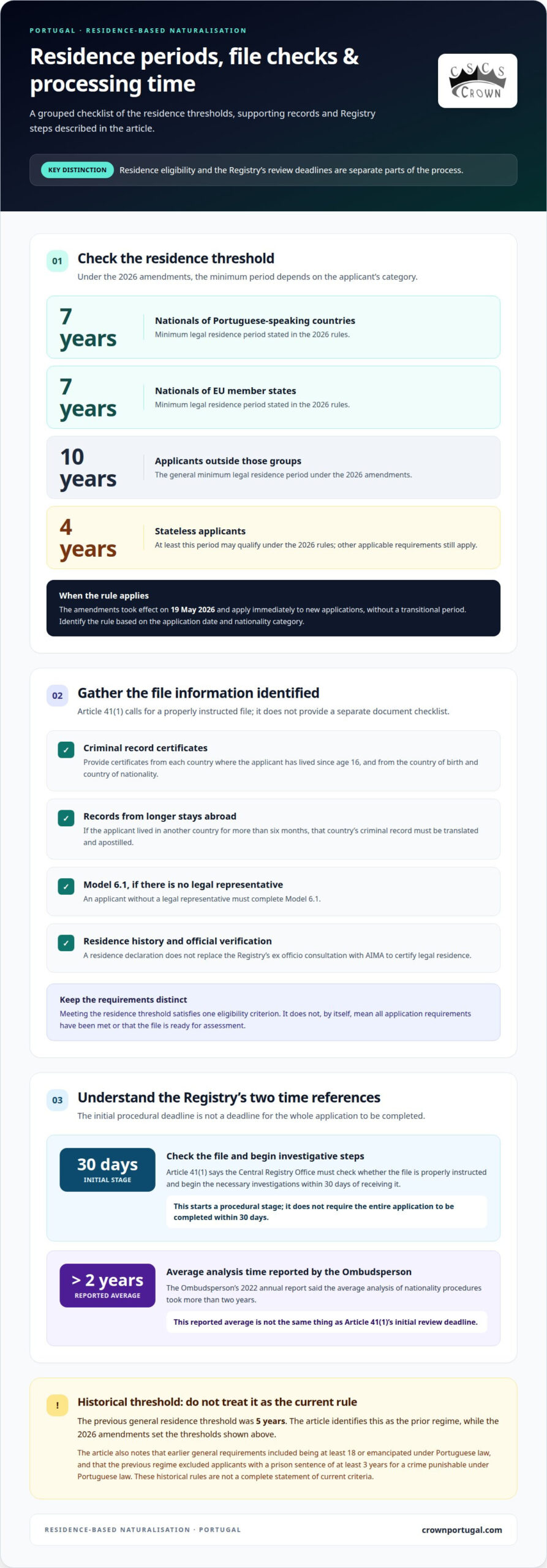
For naturalisation by legal residence, Portugal’s 2026 amendments set a minimum of 7 years for nationals of Portuguese-speaking countries and EU member states. Applicants outside those groups generally need 10 years of legal residence. These thresholds took effect on 19 May 2026 and concern the residence period, not the Registry’s review deadlines.
Stateless applicants may qualify after at least 4 years of legal residence under the 2026 rules. They must meet the other applicable requirements, except the age-of-majority and sufficient-means-of-subsistence requirements. For a stateless applicant, therefore, the residence period is shorter, but it does not remove every condition for naturalisation.
The general residence threshold was 5 years under the previous regime. The 2026 amendments apply immediately to new applications from their entry into force, without a transitional period. An applicant preparing a new file must therefore identify the rule that applies on the application date and the applicant’s nationality category.
Earlier general requirements also included being at least 18 years old or emancipated under Portuguese law. The previous regime excluded applicants with a prison sentence of at least 3 years for a crime punishable under Portuguese law. These are historical rules, so they should not be treated as a complete statement of the current criteria.
Which documents or information must be submitted under Article 41(1)? Article 41(1) requires a properly instructed file, rather than setting out a separate document checklist. Naturalisation applicants must provide criminal record certificates from each country where they have lived since age 16, as well as from their country of birth and nationality.
If an applicant lived in another country for more than six months, that country’s criminal record must be translated and apostilled. An applicant without a legal representative must complete Model 6.1. These records and application details help the Central Registry Office assess whether the file is complete enough to proceed.
Residence evidence matters, but attaching a residence declaration does not replace the Central Registry Office’s ex officio consultation with AIMA to certify legal residence. The Registry considers the file alongside that official inquiry, so both the applicant’s residence history and the information available to the authorities are relevant.
How was Article 41(1) amended, and when did the changes take effect? The 2026 amendments to Portugal’s Nationality Act took effect on 19 May 2026 and changed naturalisation eligibility, including residence periods. Article 41(1) concerns the Registry’s file review and investigative steps; the stated residence changes do not alter those procedural duties.
The distinction is practical: meeting the residence threshold does not, by itself, mean every application requirement has been met. For example, an applicant who has completed the required period still needs the relevant criminal records and a file the Registry can assess. The residence period satisfies one eligibility criterion; the documentation and investigation address separate parts of the process.
Portuguese nationality law and regulations
Portuguese nationality law distinguishes acquiring nationality from recording that event in the civil registry. Portuguese courts can review administrative conduct, but an action for failure to decide seeks an order requiring the Administration to review and decide the application. It does not ask the court to grant nationality directly.
The principal statute is Lei n.º 37/81, as successively amended. Its rules identify different ways to obtain nationality, while the Portuguese Nationality Regulation sets out administrative procedures for applications and registry records. Article 41(1) concerns the Central Registry Office’s review of whether a nationality file is properly instructed.
For nationality by origin, Article 1 provides that a child born abroad to a Portuguese citizen is Portuguese by origin if the birth is entered in the Portuguese civil register or the child declares a wish to be Portuguese. The birth record or declaration therefore matters to how the person’s status is established and recorded.
Marriage is a separate route. Under Article 3, a foreign citizen may acquire Portuguese nationality after being married to a Portuguese citizen for at least three years. The marriage must be registered in the Portuguese legal system, and proof of registration is required. A de facto union must be recognised by a court before it can support acquisition by declaration.
For a spouse or de facto partner, the effective-connection assessment generally does not apply after the marriage or union has lasted more than six years. The assessment is also waived for a couple with children together who hold Portuguese nationality. These exceptions relate to the connection requirement; they do not remove the need to establish the qualifying relationship.
Registry provisions explain how nationality events are evidenced. Under Article 19, acts resulting in attribution, acquisition or loss of nationality must be registered or endorsed. Article 22 provides that acquisition and loss are proved by their registrations or resulting annotations in the margin of the birth certificate. In practice, this makes the civil record central when establishing whether nationality was acquired or lost.
Other provisions address evidence for particular statuses. Article 21(1) states that original nationality for people covered by Article 1(1)(a), (b), (f) and (g) is proven by their birth certificate. Article 22(2) applies the same proof rule to acquisition through adoption. Article 24 allows the Central Registry Office to issue a nationality certificate at an interested person’s request, whether or not registration exists.
These provisions distinguish a person’s legal basis for nationality from the records used to prove it. A birth certificate, a registry annotation and a nationality certificate have different evidentiary roles. Reading the relevant statute and regulation together helps identify the record that applies to an event of origin, acquisition or loss.
Processing deadlines for residence-based naturalisation
Article 41(1) of the Portuguese Nationality Regulation provides that the Central Registry Office must conduct its initial review and begin necessary investigative steps within 30 days of receiving an application. This deadline concerns the opening stage, not the final outcome. Article 41(2) sets a separate 60-day period for the registrar’s decision, starting after the investigation phase is complete.
The two periods apply at different stages. The first begins when the Central Registry Office receives the file. The second cannot begin until the investigation is complete. A request for information from another authority may be part of that investigation and add a procedural step.
Under Article 27, authorities consulted in a nationality application have 30 days to provide requested information. A legally justified circumstance may allow an extension. For example, if the Central Registry Office requests information from an authority, that authority’s response period is distinct from the Registry’s review period and the registrar’s later decision period.
For a naturalisation file without deficiencies or irregularities attributable to the applicant, the legal time limit for taking a final decision is at least 3.5 months. This is a legal minimum timeframe, not a date by which every file will necessarily be decided. Applicant-related deficiencies or irregularities affect how the timeframe applies.
Actual processing may take longer. The Ombudsperson reported in its 2022 annual report that the average analysis of nationality procedures took more than 2 years. That reported average is not a substitute statutory deadline. The Regulation does not establish a general 29-month period in place of the duties in Article 41.
These milestones help show which stage a pending file has reached:
- Receipt: The Central Registry Office receives the application, starting the 30-day initial review period.
- Investigation: The Registry conducts necessary inquiries, which may include requests to other authorities under Article 27.
- Decision: After the investigation ends, Article 41(2)’s 60-day period applies to the registrar’s decision.
Article 41(1) of the Portuguese Nationality Regulation provides that the Central Registry Office must start the required investigative steps within its initial deadline. That duty remains distinct from the later decision stage. A long wait alone does not identify which inquiry is outstanding or whether the investigation has concluded.
An administrative action for failure to issue a decision seeks a court order requiring the Administration to review and decide the nationality application. It does not ask the court to grant nationality directly. An injunction protecting fundamental rights, freedoms and guarantees is urgent and exceptional: delay alone is not enough, and an actual or imminent violation of a fundamental right must be shown.
Which version of the Portuguese Nationality Regulation contains Article 41(1)?
Article 41(1) is a provision of the Portuguese Nationality Regulation. It directs the Central Registry Office to check whether a nationality application is properly instructed and to begin necessary investigative steps. The article number identifies the procedural rule; it is distinct from Portugal’s Nationality Act, Lei n.º 37/81.
That distinction matters because amendments to the Nationality Act do not, by themselves, identify a different version of the Regulation. Portugal’s 2026 amendments to the Nationality Act entered into force on 19 May 2026. They changed nationality rules, including residence requirements for naturalisation, but the fact of those amendments alone does not establish that Article 41(1) was replaced or renumbered.
For a nationality file, the practical reference is therefore Article 41(1) of the Portuguese Nationality Regulation, read alongside the related provisions governing the procedure. Article 41(2) addresses the registrar’s decision after investigation. Article 27 concerns information requested from other authorities. Each provision governs a different part of the administrative process.
The distinction also prevents confusion between eligibility rules and procedural rules. Lei n.º 37/81 governs Portuguese nationality and has been successively amended. Article 41(1), by contrast, addresses how the Central Registry Office handles a file. A change to the residence period for naturalisation concerns eligibility; it does not itself tell the Registry how to conduct its initial review.
When describing a pending application, cite the specific stage rather than referring vaguely to an “old” or “new” regulation. For example, an applicant may refer to the initial review under Article 41(1), the investigation phase, or the decision stage under Article 41(2). That identifies the relevant duty without suggesting a version change unsupported by the cited amendment.
The same care applies to time limits. Article 41 sets deadlines for procedural stages, while the general 3-month final-decision limit applies to nationality cases other than naturalisation, absent deficiencies or irregularities attributable to the applicant. The separate naturalisation timeline should not be described as though that 3-month rule governs it. For a comparison with a distinct rule, see this guide to Article 41(2) and the separate 30-day deadline.
Nor does the Regulation establish a general 29-month period as a replacement for Article 41 duties. A long wait and a statutory stage deadline are different matters: the former describes elapsed processing, while the latter concerns an administrative obligation. Naming Article 41(1), Article 41(2), or Article 27 makes clear which procedural rule is being discussed.
In short, identify Article 41(1) as part of the Portuguese Nationality Regulation, and distinguish it from Lei n.º 37/81 and its 2026 amendments. That framing keeps the legal reference precise: the Act addresses nationality rules, while Article 41(1) governs the Registry’s initial handling of the application.
What is the legal purpose of the procedure described in Article 41(1)?
Article 41(1) establishes an initial control point in Portuguese nationality proceedings. The Central Registry Office must verify whether the application is properly instructed and initiate necessary investigative steps within 30 days of receipt. Its purpose is procedural: to assess the file and move the case into investigation, not to decide nationality at that first stage.
“Properly instructed” concerns whether the application contains the materials needed for its examination. For a naturalisation file, criminal record certificates are relevant evidence, including records from countries where the applicant lived since age 16. If an applicant lived elsewhere for more than six months, that country’s certificate must be translated and apostilled. These examples show why file review and substantive eligibility are distinct checks.
The initial review allows the Registry to identify investigative steps rather than relying only on the papers submitted. For residence-based naturalisation, the Central Registry Office must consult AIMA ex officio to certify legal residence, even if the applicant attaches a residence declaration. This official inquiry helps assess the residence information.
Article 41(1) therefore does not itself grant nationality, refuse the application, or guarantee a decision within 30 days. It starts a defined administrative stage. Once investigation is complete, Article 41(2) gives the registrar 60 days to issue a decision. Keeping those duties separate clarifies what the initial review requires and when the later decision period begins.
Other procedural rules can support that investigation. Under Article 27, authorities consulted in a nationality application have 30 days to provide requested information, with a possible extension in legally justified circumstances. That response period concerns the consulted authority. It does not replace the Registry’s own initial review duty under Article 41(1).
The procedure also helps distinguish an incomplete file from a delay arising elsewhere in the process. Deficiencies or irregularities attributable to the applicant can affect the applicable decision timeframe. By contrast, a request for information from another authority is an investigative step. Identifying what is pending gives a clearer picture of the file’s procedural status.
If the Administration fails to issue a decision, an administrative action for failure to decide seeks a court order requiring it to review and decide the nationality application. It does not ask the court to grant nationality directly. Article 41(1) is therefore relevant to the administrative duty, while the remedy addresses failure to decide.
For help understanding how nationality procedures apply to your circumstances, explore Portuguese nationality guidance.
Crown Portugal: Portugal Residence permit For EU national and their non-Eu families
Crown Portugal assists with residence permits for EU nationals and their non-EU family members. This is a separate administrative pathway from Portuguese nationality: a residence permit concerns residence status, while naturalisation involves acquiring nationality. Knowing which process applies helps families focus on the appropriate application.
Turn to this service when an EU national’s non-EU family member needs support with a Portuguese residence permit. Crown Portugal also publishes Portugal immigration news and articles, including developments relevant to residence and nationality procedures.
If your immediate concern is a pending nationality application, the residence permit service is not a substitute for the Registry’s decision process. For support with residence permits for EU nationals and their non-EU family members, contact Crown Portugal.
Choose the right pathway for your next step
Before acting on a pending nationality file, identify whether your immediate need concerns the Registry process or a separate immigration application. Article 41(1) of the Portuguese Nationality Regulation provides that the Central Registry Office must review the file and initiate necessary investigation; it does not replace guidance tailored to your wider plans in Portugal.
Crown Portugal supports people pursuing other Portugal-related administrative needs, including the Portugal Digital Nomad D-8 Visa, Portugal Golden Visa D-9 and NIF Registration. These offerings address distinct circumstances, so the relevant next step depends on the application you intend to pursue.
For guidance on your Portugal application pathway, contact Crown Portugal. A clear understanding of your objective can help you move forward with greater confidence.
Frequently Asked Questions
Can the IRN Leave a Nationality Application Pending for Years?
Yes, nationality applications can remain pending for years, although procedural deadlines still apply. The Ombudsperson reported that average analysis of nationality procedures took more than 2 years in its 2022 annual report. That average does not establish how long a particular application will take. For a specific pending file, distinguish elapsed time from the stage reached, such as investigation or the registrar’s decision stage.
What Does the Law Provide for Each Type of Nationality Application?
The applicable deadline depends on the application type. The final-decision time limit for nationality cases other than naturalisation is 3 months, absent applicant-attributable deficiencies or irregularities. Naturalisation follows a different timeline: its stated legal minimum for a final decision is at least 3.5 months under the same absence-of-deficiencies condition. Article 41 also sets separate review and post-investigation stages; those periods are not completion guarantees.
What is the exact wording of Article 41(1) of the Portuguese Nationality Regulation?
A concise English paraphrase, rather than a verbatim statutory translation, is: the Central Registry Office must verify whether the nationality file is properly instructed and initiate the necessary investigative steps within 30 days of receipt. This wording captures the procedural duty and timeframe. It should not be treated as an official translation or quoted as the exact original text of the Portuguese provision.
What must the Central Registry Office do under Article 41(1)?
Article 41(1) requires the Central Registry Office to assess whether the file is properly instructed and start necessary investigation. For a residence-based naturalisation application, that includes an ex officio consultation with AIMA to certify legal residence, even when the applicant submits a residence declaration. This official inquiry is a distinct part of the review, not a replacement for the applicant’s supporting documents.
What deadlines apply to the Central Registry Office under Article 41(1)?
The initial review and start of investigative steps are due within 30 days after receipt. The related decision-stage deadline is different: Article 41(2) gives the registrar 60 days after the investigation phase ends. Separately, authorities consulted under Article 27 generally have 30 days to provide requested information, with a possible legally justified extension. These deadlines govern different actions and do not guarantee overall completion within either Article 41 period.
How does Article 41(1) relate to the Portuguese Nationality Law?
Lei n.º 37/81, as amended, sets the substantive framework for Portuguese nationality, including routes to nationality and eligibility rules. Article 41(1) belongs to the Nationality Regulation and concerns how the Central Registry Office processes an application. For example, a residence requirement concerns eligibility under nationality law, while checking whether the file is properly instructed is a procedural task under the Regulation.
What happens if the Central Registry Office does not comply with Article 41(1)?
Failure to meet a procedural duty does not itself grant nationality. An administrative action for failure to issue a decision seeks an order requiring the Administration to review and decide the application, not to confer nationality directly. An urgent injunction protecting fundamental rights is exceptional: delay alone is insufficient, and the applicant must show an actual or imminent violation of a fundamental right.
How was Article 41(1) amended, and when did the changes take effect?
The 2026 amendments took effect on 19 May 2026 and changed naturalisation eligibility, including the required residence periods. They did not alter Article 41(1)’s procedural duties: the Central Registry Office must review the file and begin necessary investigations within 30 days.
Law No. 62/2026: Guide to Portugal’s New Nationality Rules – Crown Portugal at 10:49 am, November 8, 2026 -
[…] Portugal Nationality Article 41(1): Central Registry Guide […]