

How to apply for a Portugal dependent child visa and understand the costs
The first step is often not at the consulate. For a child living abroad, a Portugal dependent child visa application begins with the sponsor’s request for family-reunification approval from AIMA; after a favourable decision, the child applies for a residence visa at a consular post. If the child is already in Portugal, the applicable route can differ.
It’s understandable to be unsure where the application belongs, particularly when eligibility and fees depend on the child’s circumstances and the sponsor’s residence status. Children under 18 may qualify, while an adult child generally needs to be unmarried, studying and financially dependent on the sponsor.
This guide explains who may qualify for a Portugal dependent child visa application, where to apply and how the process works. It also covers how long a family member’s residence permit lasts, when an independent permit may be possible and which costs may apply.
Key Takeaways
- Identify the sponsor’s residence category first, because it can affect eligibility and when a family reunification request may be filed.
- For an adult child, assess financial dependency alongside enrolment and marital status, as these factors can determine eligibility.
- Plan the application route around where the child is living: family members abroad generally apply for a residence visa after reunification approval.
- Prepare relationship documents for submission, including the required legalisation and Portuguese translation of foreign civil records.
- Estimate the permit period and application costs from the sponsor’s status and the procedure used, rather than assuming one duration or fee applies to every family.
Who is eligible for the Family Reunion Visa in Portugal?
Start by identifying the sponsor’s residence status and the child’s relationship to them. Portugal’s family reunification rules differ for foreign residents, Portuguese or EU citizens and Golden Visa investors.
-
Check the Sponsor’s Residence Status
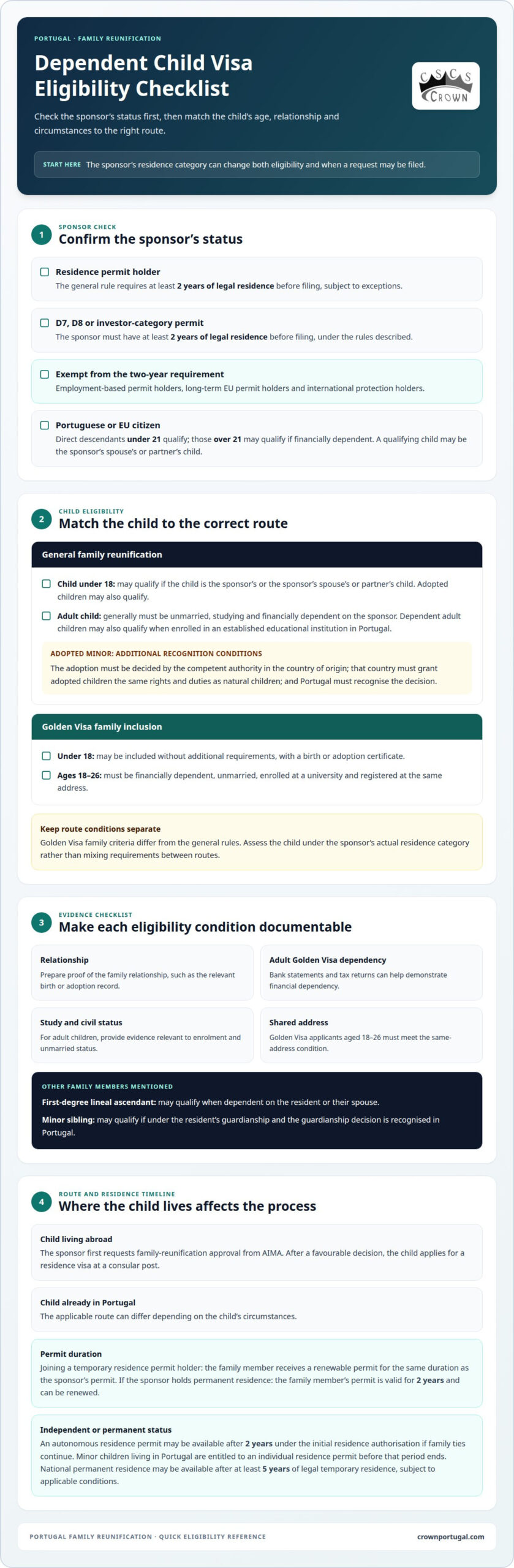
Confirm the sponsor’s Portuguese status before assessing which family reunification rules apply. A residence permit holder may apply for eligible family members, but the general rule requires at least two years of legal residence, subject to exceptions.
Under the rules described, sponsors with D7, D8 or investor-category permits must have at least two years of legal residence before filing. Employment-based permit holders, long-term EU permit holders and international protection holders are exempt from that two-year requirement. These distinctions matter: the same child’s application may follow a different eligibility route depending on the sponsor’s permit category.
For Portuguese or EU citizens, direct descendants under 21 qualify; those over 21 may qualify if financially dependent. A qualifying relative can include a child of the sponsor’s spouse or partner, not only the sponsor’s biological child.
-
Identify Eligible Dependent Children
Classify the child by age, relationship and legal status before assembling the application. Children under 18 of the sponsor or the sponsor’s spouse or partner may qualify, including adopted children. An adopted minor may qualify when the adoption was decided by the competent authority in the country of origin, that country grants adopted children the same rights and duties as natural children, and Portugal recognises the decision.
Adult children generally face additional conditions. Under general family reunification rules, an adult child must be unmarried, studying and financially dependent on the sponsor. Dependent adult children may also qualify when enrolled in an established educational institution in Portugal.
Golden Visa family inclusion has distinct criteria. Children under 18 may be included without additional requirements, with a birth or adoption certificate. Adult children aged 18 to 26 may qualify if financially dependent, unmarried, enrolled at a university and registered at the same address. Don’t apply the general route’s conditions automatically to a Golden Visa case.
-
Confirm Dependency and Permanent Residence Eligibility
Match evidence of dependency to the child’s circumstances. For adult Golden Visa applicants, bank statements and tax returns can help demonstrate financial dependency. University enrolment, proof of unmarried status and registration at the same address are also relevant to this route.
Other family relationships may qualify under separate conditions. A first-degree lineal ascendant who depends on the resident or their spouse may be eligible. A minor sibling may qualify if under the resident’s guardianship and the guardianship decision is recognised in Portugal.
Consider longer-term status separately from initial family reunification. Family members may qualify for national permanent residence after at least five years of legal temporary residence, subject to applicable conditions. A prison sentence exceeding one year during the qualifying residence period affects eligibility. Permanent status does not follow automatically from a child’s initial family permit.
How long does the residence permit last and when do family members become independent?
Assess the sponsor’s permit alongside the family member’s circumstances. Together, these determine the family permit’s duration, the documents required and when a separate residence status may become available.
- Match the family member’s permit to the sponsor’s status. A family member joining a temporary residence permit holder receives a renewable permit for the same duration as the sponsor’s permit. If the sponsor holds permanent residence, the family member’s permit is valid for two years and can be renewed.
Record the sponsor’s current permit type and expiry date before preparing the application. These details help identify the relevant permit period and prevent confusion between the renewal schedules for temporary and permanent residence.
- Assess whether an independent permit is available. A family member may obtain an autonomous residence permit after two years under the initial residence authorisation if the family ties continue. Minor children living in Portugal are entitled to an individual residence permit before that two-year period ends.
For an adult child, enrolment and civil status remain relevant to family eligibility. Under the general rules, a dependent child over 18 must be unmarried and enrolled as a full-time student. For a Golden Visa family application, adult children aged 18 to 26 must also meet the route’s university enrolment, financial dependency and shared-address conditions.
- Organise the child’s identity and relationship documents for the applicable route. Applications require documents proving the family relationship and required conditions, copies of travel documents, and a criminal record certificate when applicable. A passport must have at least six months of validity; children under 16 do not need to provide a criminal record certificate.
For a Golden Visa applicant aged 18 to 26, the professional handling the file can organise evidence of university enrolment, unmarried status and registration at the same address. These records should support the eligibility basis presented in the application, rather than leave a required condition undocumented.
- Crown Portugal can review documents and help prepare and coordinate the application. Family reunification applications are submitted to SEF with evidence of the relationship, eligibility conditions, travel documents and applicable criminal record certificates. Organising the file clearly makes it easier to identify missing or inconsistent information before submission.
Foreign civil registry documents must be apostilled or legalised and translated into Portuguese. A professional can review the civil documents for these formalities and organise the submission set. For guidance on the family reunification process, the application route and the sponsor’s permit status can be assessed together.
Residence application steps and processing times
For a child abroad, a professional coordinates the sponsor’s family reunification request with AIMA before the child applies for a residence visa at a consular post. The visa application follows a favourable reunification decision.
-
Prepare and submit the residence application with professional support
Ask a professional to establish the correct route from the child’s location and the sponsor’s residency status. For a child abroad, the sponsor submits the family reunification request to AIMA; after approval, the child applies for a residence visa at the Portuguese consular post serving the country of origin.
Organise evidence of the family relationship and eligibility, copies of travel documents and any applicable criminal record certificate. The order matters: lodging the visa application before the reunification decision can put the stages out of sequence. A child already in Portugal may be subject to different rules, so the route should reflect where the child applies.
-
Monitor processing and appeal deadlines with professional support
Have the professional track each stage separately rather than treating the process as one appointment. Family reunification visa applications normally take around 60 days to process, while typical administrative processing for a family reunification application is 3-9 months. The overall timeline can vary depending on the route and how the application progresses.
These figures describe different stages, not interchangeable promises. The route, the stage being measured and the progress of the application all affect the timeline. After a refusal notification, applicants generally have 30 days to lodge an administrative appeal. A professional can monitor notifications and the deadline so the response is prepared within the applicable period.
- Confirm the responsible authority and submission location before filing. The sponsor’s request for a family member living abroad goes to AIMA. After a favourable decision, the family member submits the residence visa application at a consular post. The child’s location determines whether the process begins with a sponsor-side request or follows a different in-country route.
For a child joining a spouse or parent, align the sponsor’s evidence with the child’s visa-stage documents. Keeping the two submissions consistent helps the authorities assess the same family relationship and eligibility basis at each stage.
- Track the file through each decision and update. Record submission dates, monitor requests and notifications, and identify which stage remains pending. The sponsor’s temporary or permanent residence status helps determine the applicable family route.
Processing time can be affected by the authority’s review stage, the submission route and whether the required evidence supports the application. The professional can organize the response to document requests and track the decision that allows the next stage to proceed. If refused, the 30-day appeal period makes prompt review of the notification essential.
What counts as a dependent child?
A Portugal dependent child visa is a family-reunification residence route for an eligible child joining a resident. Children under 18 may qualify; adult children generally need to meet study, marital-status and financial-dependency conditions.
- Identify the child’s relationship to the sponsor and their age before assessing financial dependency. Family reunification can cover minor children of the sponsor or the sponsor’s spouse or partner, including adopted children. Adult children face additional conditions, so age alone does not establish eligibility.
For an adopted minor, the adoption must be decided by the competent authority in the country of origin. The country’s law must grant adopted children the same rights and duties as natural children, and Portugal must recognise the decision. These conditions establish the legal relationship for immigration purposes.
- For an adult child, match the dependency evidence to the applicable eligibility conditions. Under general family reunification rules, an adult child must be unmarried, studying and financially dependent on the sponsor. Enrolment at an established educational institution in Portugal may be relevant when the child applies as a dependent student.
For a Golden Visa family application, children over 18 must provide evidence of financial dependency. Bank statements and tax returns are examples of supporting records. For applicants aged 18 to 26, university enrolment, unmarried status and registration at the same address also matter under this route.
- Document the sponsor’s ability to support the household in Portugal. A family reunification sponsor must prove sufficient means of subsistence for themselves and their family members and provide evidence of accommodation. The records should address both the household’s financial position and where the child will live.
For 2026, Portugal’s guide gives €920 per month as the minimum-wage benchmark for assessing family-reunification financial means. Treat this as the stated benchmark, not as a visa fee. The sponsor’s evidence must relate to the family members included in the request.
- Organise evidence under separate headings for relationship, dependency, finances and housing. For an adult student, for example, the file could include university enrolment evidence, bank statements or tax returns, and documents showing the sponsor’s means and accommodation. Each record should support the condition it is intended to establish.
Keep travel and identity documents separate from evidence of dependency. A passport establishes identity for travel, while education records and financial documents address different eligibility requirements. A well-organised file makes clear how the child’s circumstances relate to the sponsor’s family reunification request.
Application fees and related costs
A child’s eligibility for a visa-fee exemption may depend on their relationship to the sponsor.
- Separate the child’s visa fee from other charges. The visa fee applies only to a spouse or ascendant applying for family reunification, not to an eligible child in this category.
This distinction helps avoid budgeting the general visa charge for every family member. For example, a child joining a parent who holds a Portuguese residence permit falls under the descendants’ exemption. The relationship to the sponsor and the sponsor’s status therefore affect which visa fee applies.
- Allow for AIMA processing emoluments separately from the visa charge. This is a variable administrative cost, not one fixed charge for every family reunification case.
The procedure and the applicant’s circumstances determine where the amount falls within that range. Keep the AIMA emolument separate from any visa fee, even when both relate to the same family reunification process. This makes the expected government charges easier to understand.
- Plan around the stages that affect timing. A family-reunification visa application normally takes around 60 days to process. The typical administrative processing period for a family-reunification application is 3-9 months, and the end-to-end process typically takes six to fourteen months.
These periods refer to different stages. The consulate processes the visa application after a favourable family reunification decision, so the visa-stage estimate does not cover the full process. A child applying from another country may need to allow for both the sponsor’s request and the subsequent consular application.
- Keep government charges separate from document preparation costs. Foreign civil records may require an apostille or legalisation and a Portuguese translation. Requirements depend on the child’s relationship to the sponsor and the route used, so preparation costs can vary without changing the stated government fee exemptions.
For a clearer view of the family-reunification stages and applicable charges, request Portugal family reunification support. This can help organize the child’s eligibility evidence, submission route and expected government costs before filing.
Crown Portugal
Crown Portugal helps people understand Portuguese immigration procedures and organise their next steps. For a child joining a resident, the key questions are the sponsor’s status, the child’s eligibility, the correct submission route and the supporting documents. Professional guidance can bring these elements together into a coherent application plan, particularly when family records come from another country or the child’s circumstances need closer assessment.
Turn to Crown Portugal when you need help understanding how your family’s situation fits Portugal’s residence pathways. The consultancy also assists with the Portugal Digital Nomad D-8 Visa, Portugal Golden Visa D-9, NIF Registration (Personal Tax Number) and Portugal Passive Income D-7 visa. Contact Crown Portugal to discuss your Portugal immigration questions and possible next steps.
Plan the next step with clarity
Plan a Portugal dependent child visa application around the child’s circumstances and the sponsor’s residence route. Start by establishing the family relationship and eligibility basis, then identify the supporting records to assemble. When details span different countries or routes, a focused review can help organise the next steps.
Crown Portugal can help you understand the relevant immigration pathway and plan how to proceed with your family’s case. Discuss your questions about the child’s circumstances, the sponsor’s status or the application route. Contact Crown Portugal to discuss your family’s needs and plan the process.
Contact Crown Portugal for application support, and take the next step with a clearer plan.
Frequently Asked Questions
Do family members apply at the consulate or inside Portugal?
For a child living abroad, the sponsor first requests family reunification approval from AIMA. After a favourable decision, the child applies for a residence visa at the Portuguese consular post responsible for the country where the child lives. The child’s location is central to choosing the route. A child already in Portugal may face different procedures, so distinguish an overseas application from an in-country case.
What are the main eligibility requirements?
Eligibility depends on the sponsor’s status, the child’s relationship to the sponsor, and the child’s age and circumstances. A minor child of the sponsor or their spouse or partner may qualify. An adult child generally needs to be unmarried, studying and financially dependent. For Portuguese or EU citizens, direct descendants under 21 qualify; older descendants may qualify if financially dependent.
Can dependent children join a parent with a Portuguese residence permit through family reunification?
Yes. A parent who holds a Portuguese residence permit may apply for family reunification for eligible children. The sponsor’s permit category can affect when the request may be filed, as the general rule includes a two-year legal-residence requirement and exceptions apply to some permit holders. For example, employment-based permit holders are exempt from that waiting period under the rules described.
What documents are required for a Portugal dependent child visa application?
The file generally includes evidence of the parent-child relationship, the child’s passport and documents supporting the relevant eligibility conditions. A passport must have at least six months of validity. Foreign civil registry documents need apostille or legalisation and Portuguese translation, which can be arranged through professional language providers such as NADORMED TRADUCTION & INTERPRÉTATION. Children under 16 do not need a criminal record certificate. For an adult student, include evidence that addresses study and dependency.
Where can a professional submit a Portugal dependent child visa application on your behalf?
The submission location depends on where the child lives. For a child abroad, the sponsor’s family reunification request goes to AIMA first. After approval, the child applies at the Portuguese consular post serving their country of residence. Crown Portugal can help organise and coordinate the application stages and supporting documents, while the formal process follows the authority and location appropriate to the case.
Are there age limits or dependency requirements for children applying to join parents in Portugal?
Yes, the applicable age and dependency tests vary by route. Children under 18 may qualify as dependent family members. Adult children generally need to be unmarried, studying and financially dependent. Under the Golden Visa family route, an adult child aged 18 to 26 may qualify if the applicable dependency, university-enrolment, shared-address and unmarried-status conditions are met.
Do children need parental consent, custody documents, or the other parent’s authorization to move to Portugal?
Immigration eligibility and parental authority are separate questions. A birth certificate can evidence the parent-child relationship, while an applicable custody or guardianship order may clarify who has authority concerning the child. Portugal’s family reunification rules specifically recognise certain minor siblings under a resident’s legally recognised guardianship. Where parents share custody, relevant legal records can help explain the child’s circumstances in the application file.
What income, housing, and health insurance requirements apply to sponsoring a child in Portugal?
The sponsor must show sufficient means of subsistence for themselves and their family members, and provide evidence of accommodation. The 2026 guide gives €920 per month as the minimum-wage benchmark for assessing family-reunification means. Treat financial proof and housing evidence as separate parts of the file. Any health coverage documents should also be kept distinct, rather than used as a substitute for either requirement.