

Portugal nationality law: what new rules mean for pending applications

A pending Portuguese nationality application isn’t automatically assessed under the newest rules: a December 2025 Constitutional Court ruling said pending procedures are governed by the rules in force when the application was made. Portugal’s amended Nationality Law entered into force on 19 May 2026, so the filing date matters when understanding which requirements apply.
It’s understandable to wonder whether a change in residence periods also changes the position of an application already underway. The answer depends on the applicable transition rules and the route to nationality. The new requirements under Portugal’s nationality law also raise separate questions about residence periods, Portuguese at A2 level and civic knowledge.
This article explains how the rules affect pending applications, what changed for residence-based applications, and why the 2018 changes remain relevant. It also outlines where the A2 requirement fits, so you can distinguish the rule that applies to your case from changes affecting other nationality routes.
Key Takeaways
- For a pending nationality application, the rules in force when it was filed may determine how it is assessed, following a Constitutional Court ruling in December 2025.
- Under the amended law, naturalisation residence periods differ by applicant group, so identify the category that applies before calculating eligibility.
- The Portuguese language requirement sits alongside new references to culture, history and civic knowledge; understand how these elements affect your route.
- Nationality claims through Portuguese parents or grandparents follow distinct conditions, so residence-based naturalisation isn’t the only route to consider.
- The 2018 changes remain relevant to nationality for children born in Portugal to foreign parents, including the parent’s lawful residence at the time of birth.
Naturalisation residence periods
Portugal nationality law’s new rules and requirements set different naturalisation residence periods according to an applicant’s nationality. The applicable period depends on the applicant’s category and legal residence status.
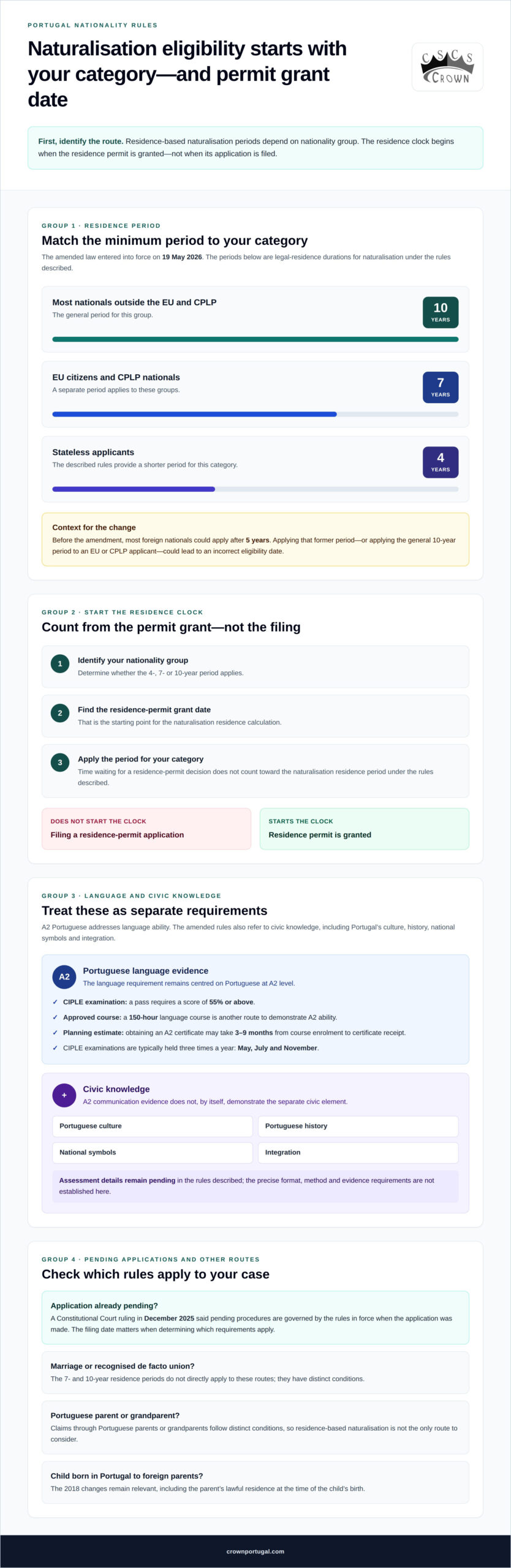
Most nationals of countries outside the European Union and the Community of Portuguese Language Countries (CPLP) now require 10 years of legal residence. Before the amendment, most foreign nationals could apply after 5 years. EU citizens and CPLP nationals require 7 years, while stateless persons may apply after 4 years under the described rules.
The amended law entered into force on 19 May 2026. These longer periods make an applicant’s category and residence record central to the eligibility calculation. The 7-year and 10-year periods don’t directly apply to nationality applications based on marriage or a recognised de facto union. Those routes have distinct conditions, so residence-based naturalisation shouldn’t be treated as the only possible basis for Portuguese nationality.
Proposed Periods by Nationality
Residence periods are the minimum legal-residence durations for naturalisation, and the threshold varies by nationality group. This distinction matters because applying the general 10-year period to an EU or CPLP applicant, or relying on the former 5-year period, can produce an incorrect eligibility date.
For example, an applicant from outside the EU and CPLP falls under the 10-year requirement; an EU or CPLP national falls under the 7-year requirement. Stateless applicants have a 4-year period under the described rules. Identifying the correct category is a practical first step in assessing which of Portugal’s nationality law requirements applies.
Counting Residence and Administrative Delays
Under the rules described here, the residence clock for naturalisation starts when the residence permit is granted, not when the application is filed. Time spent waiting for a decision before the permit is approved does not count toward the naturalisation residence period.
For example, filing a residence-permit application doesn’t itself start the 7-year or 10-year calculation. The permit grant date is the starting point. Administrative processing can therefore affect the calendar date when an applicant reaches the threshold, even if they have lived in Portugal while awaiting a decision.
Keep residence-permit processing separate from nationality processing. A pending permit application and a pending nationality application are different administrative situations. For naturalisation, the calculation concerns legal residence from the permit grant date, not simply time spent in the country or time since immigration paperwork was submitted.
To assess a timeline, identify the nationality group, establish the residence-permit grant date, then apply the corresponding 4-year, 7-year or 10-year period. This helps distinguish Portugal’s new nationality law requirements from the former 5-year rule and prevents treating a filed permit application as the start of legal residence.
Has the A2 Portuguese language requirement changed?
The language requirement remains centred on Portuguese at A2 level, while the amended rules also refer to civic knowledge. These are separate elements: language evidence addresses communication, while the civic component concerns Portugal’s culture, history, national symbols and integration.
Applicants can demonstrate A2 Portuguese through a CIPLE examination or an approved 150-hour language course. A CIPLE pass requires a score of 55% or above under the described requirements. The course option gives foreign applicants another route to show language ability, rather than relying only on an examination result.
Preparation time can affect an application timeline. The described estimate for obtaining an A2 certificate is 3-9 months from course enrolment to certificate receipt. CIPLE examinations are typically held three times a year, in May, July and November. Applicants planning around a naturalisation filing should account for these intervals when deciding whether to take an exam or complete a course.
The new civic requirement is broader than a Portuguese-language test. The law refers to Portuguese culture, history, national symbols, civic knowledge and integration. A person may communicate at A2 level yet still need to address the separate civic element. Treating language and civic knowledge as one test could therefore lead to misunderstanding what naturalisation requires.
Portugal is introducing a civics component for naturalisation, but its assessment details remain pending in the described rules. That means the precise format, assessment method and evidence requirements aren’t established here. Parliament’s adoption of the broader criteria signals that applicants should distinguish the existing A2 language evidence from the additional civic subjects.
A practical way to organise the requirements is to separate the evidence into two groups:
- Portuguese language: an A2 certificate, supported through CIPLE or an approved 150-hour course.
- Civic knowledge: preparation concerning Portuguese culture, history, national symbols and integration.
This distinction also helps applicants assess their situation. Someone who already holds an A2 certificate has addressed the language element, but should not assume that it also proves civic knowledge. Someone still preparing for CIPLE can consider the course route and the exam calendar, while keeping the separate civics criteria in view.
For a clearer view of how these requirements fit a naturalisation route, reviewing your nationality application pathway can help connect language evidence with the other criteria.
How long to live in Portugal for citizenship?
Portuguese nationality through family ancestry can follow a different route from residence-based naturalisation. A claim through a Portuguese parent or grandparent may depend on the family relationship, a declaration and effective ties, rather than the general residence-period calculation.
A foreign national may acquire Portuguese nationality by declaration after being married to a Portuguese citizen for more than three years. A long-term de facto partnership may also qualify after recognition by a civil court, provided the partnership has lasted more than three years.
For a grandparent claim, the relevant relationship is an ascendant in the second degree of the direct line. A person with at least one Portuguese grandparent may declare their wish to be Portuguese, provided they also have effective ties to the national community. The grandparent is in the second degree because the direct line runs from grandparent to parent to applicant.
This route differs from a claim based on a Portuguese parent. The family relationship determines the applicable basis for nationality, so applicants should distinguish a parent from a grandparent before treating the claim as naturalisation. A residence permit and naturalisation residence requirements are not automatically central to an ancestry-based declaration.
Portugal’s described rules also refer to descendants up to the third degree, who may qualify for nationality after 5 years of residence. That route has a residence condition, unlike a claim based on having a Portuguese ascendant in the second degree, which is described through declaration and effective ties. The degree of relationship and the legal basis therefore matter when assessing whether residence is relevant.
Applicants claiming through a Portuguese grandparent may need to meet separate criminal-record conditions. This is a separate criterion from proving the family relationship or demonstrating effective ties. It should not be confused with the general residence period for naturalisation, which applies to a different route.
Since May 2015, a person born abroad with a Portuguese ascendant in the second degree of the direct line may qualify as Portuguese by origin when the stated conditions are met. A grandchild born outside Portugal may therefore have a route to citizenship that does not begin with moving to Portugal or holding a residence permit.
Children and grandchildren should not assume that every family connection leads to the same outcome. A Portuguese parent, a Portuguese grandparent and a more distant direct-line ancestor involve different legal relationships. Identifying the precise relationship first helps clarify whether the route concerns nationality by origin, a declaration requiring effective ties, or residence-based naturalisation.
Pending applications and transition rules
The Constitutional Court ruled in December 2025 that pending nationality procedures follow the rules in force when filed. This makes the application date central to understanding how Portugal nationality law new rules requirements apply to an existing case.
Transition Rules for Pending Applications
Transition rules determine which version of nationality law applies to an application awaiting a decision. They matter because the residence thresholds changed, and a pending case is not automatically assessed under requirements introduced after it was filed.
The revised law was published on 18 May 2026 and entered into force on 19 May 2026. The December 2025 Constitutional Court ruling states that pending procedures follow the rules in force when filed. An estimated 40,000-60,000 nationality cases remained pending as of April 2026, making each applicant’s filing date an important reference point.
Keep the application route and filing date clear when assessing eligibility. Naturalisation, a claim through a Portuguese parent and a claim involving a child born in Portugal may rely on different provisions. The transition rule concerns the procedure filed, not simply when someone began living in Portugal.
CPLP and EU Applicant Timelines
The revised rules set a 7-year legal-residence period for EU citizens and CPLP nationals. This matters particularly for CPLP applicants, whose earlier residence period was 3 years under the rules described before the revision.
For a case filed before the new rules took effect, the filing date helps establish which requirements apply. For a new naturalisation application under the revised law, EU and CPLP applicants fall under the 7-year period. This distinction is central to how Portugal nationality law new rules requirements affect pending applications and later filings.
Application Risks and Official Guidance
Application risks include relying on the wrong filing-date rule, nationality category or legal route. The amended law and the Government’s implementing regulation are official materials for understanding the applicable framework. The Government has 90 days from publication to issue the updated implementing regulation.
The criminal-record threshold is another eligibility factor: under the revised rules, a sentence of 3 years or more disqualifies an applicant from naturalisation. Applicants should also keep supporting evidence relevant to their route, such as residence records or family relationship documents. For a child born in Portugal, the applicable birth-nationality rules depend on the parents’ nationality and legal residence.
The 2018 changes to nationality rules
Portugal’s 2018 nationality amendment changed how a child born in the country to foreign parents could qualify for Portuguese nationality. The applicable requirements for a child born in Portugal may depend on a parent’s legal residence status when the child is born. This birth-based route differs from naturalisation, which concerns an individual’s own residence and eligibility.
The change matters because a child’s place of birth alone doesn’t explain whether Portuguese nationality follows. The relevant detail is the parent’s legal residence at the time of birth. For example, if a child was born in Portugal and one parent had legally resided there for 5 or more years, the 2018 rule may be relevant to assessing that child’s claim.
The 2018 amendment was described by the Minister as breaking a consensus that had lasted decades. That history helps explain why the rules for children born in Portugal have changed over time. It also cautions against applying a rule from one period to a birth or application governed by another version of the law.
The later framework introduced different residence thresholds for children born in Portugal to foreign parents. Under the revised rules described, a child born to CPLP-national parents acquires nationality at birth only if the parents had been legal residents for at least 3 years. For parents of other nationalities, the applicable threshold depends on the version of the rules in force. These conditions differ from the 2018 rule’s 5-or-more-year threshold.
The key is to identify the child’s birth date, the parents’ nationality and legal-residence history, then establish which version of the law applies. A European parent, a CPLP-national parent and a parent from another country may fall under different provisions. Assess the family’s situation against the applicable legal period, rather than relying on a single residence figure.
These birth-based provisions also differ from naturalisation requirements for adults. An adult applying through naturalisation faces residence and other eligibility criteria, while a child’s claim may depend on the parents’ status at birth. A Golden Visa or another residence route does not, by itself, determine whether a child qualifies. The applicable nationality rule depends on the child’s circumstances.
Portugal’s amended rules also refer to applicants’ effective ties to the national community and integration. These concepts belong to the broader nationality framework, but should not be confused with the specific parent-residence conditions for a child born in Portugal. The route and the applicable date are essential starting points when considering the changes.
To understand how the 2018 rule fits your family’s nationality route, review your Portuguese nationality options.
Crown Portugal: Portugal Residence permit For EU national and their non-Eu families
Crown Portugal supports people assessing Portuguese nationality routes and residence permit applications for EU nationals and their non-EU family members. If your next step concerns nationality under the new rules, Crown Portugal can help you understand how the relevant route fits your circumstances.
For readers whose priority is residence rather than nationality, Crown Portugal also assists with the Portugal Digital Nomad D-8 Visa and Portugal Golden Visa D-9. These are distinct immigration pathways, so the appropriate option depends on the goal and circumstances involved.
Contact Crown Portugal to discuss your Portuguese nationality or residence application.
Plan your next step with clarity
Start by identifying the nationality route that matches your circumstances and organising the relevant application information around it. Understanding Portugal nationality law’s new rules and requirements can help you frame the right questions, whether your case concerns residence, family ancestry or a pending application. A nationality route and a residence or relocation service address different needs.
Crown Portugal also supports related immigration and administrative needs, including the Portugal Digital Nomad D-8 Visa, Portugal Golden Visa D-9 and NIF Registration. These services may be relevant if your plans involve establishing residence or handling tax registration alongside a longer-term move, rather than pursuing nationality alone.
For guidance on the appropriate next step for your circumstances, contact Crown Portugal. A clear understanding of your route can make it easier to plan your Portugal application with confidence.
Frequently Asked Questions
What happens to citizenship applications already in progress?
Pending nationality procedures are governed by the rules in force when each application was made, according to a Constitutional Court ruling issued in December 2025. So an application filed before the amended law took effect isn’t automatically assessed under its newer requirements. The filing date and the legal route claimed are key details when understanding how a case is treated during the transition.
Do you need to speak Portuguese?
Yes. Naturalisation applicants need to demonstrate Portuguese at A2 level. The language requirement can be met through a CIPLE examination or an approved 150-hour Portuguese course. For CIPLE, the described pass threshold is 55%. Language evidence addresses Portuguese proficiency; it should be considered separately from the new references to civic knowledge, culture, history and national symbols.
How long do you need to live there?
For naturalisation, the required legal-residence period depends on your nationality: 10 years for most applicants outside the EU and CPLP, and 7 years for EU citizens and CPLP nationals. Stateless persons have a 4-year period under the described rules. These periods don’t directly apply to nationality claims through marriage or a recognised de facto union, which follow a separate route.
I’m Brazilian, does the new 7-year CPLP timeline apply to me?
Yes. Brazil is a CPLP member country, so Brazilian applicants pursuing naturalisation fall under the 7-year legal-residence period in the revised rules. The earlier rules described a 3-year period for CPLP nationals before the revised law. For an application already filed, the transition rule makes the requirements in force on its filing date relevant.
I’ve already been here for 5 years, can I still apply under the old rules?
Five years of residence alone does not establish eligibility under the former rule. The transition depends on whether you filed your nationality application while that rule applied, because pending procedures are governed by the rules in force when filed. If you have not applied, your nationality group and route determine the applicable requirements, including the revised legal-residence period for naturalisation.
Is it already in effect?
Yes. Portugal’s amended Nationality Law entered into force on 19 May 2026. Applications made after that date are considered under the revised framework, while applications already pending are governed by the rules in force when filed, as stated in the December 2025 Constitutional Court ruling. The date an application was submitted therefore matters when identifying which requirements apply.
What are Portugal’s latest nationality law changes and when do they take effect?
The amended law extended naturalisation residence periods to 10 years for most non-EU, non-CPLP nationals and 7 years for EU and CPLP nationals. It also introduced references to Portuguese culture, history, national symbols and civic knowledge. The amendment entered into force on 19 May 2026. These naturalisation periods don’t directly govern applications based on marriage or a recognised de facto union.
What are the current residence requirements for naturalisation in Portugal?
The current period is 10 years of legal residence for most applicants outside the EU and CPLP, and 7 years for EU citizens and CPLP nationals. Stateless applicants have a 4-year period under the described rules. For the revised naturalisation calculation, legal residence begins when the residence permit is granted, not when its application is filed. Marriage and recognised de facto union applications use a separate basis.