

Portugal Fiscal Number Application: The Complete 2026 Procedural Guide

A successful Portugal fiscal number application is the single most critical component of a compliant residency strategy; without this nine-digit identifier, your administrative transition to Portugal cannot proceed. You’re likely aware that the NIF is the foundational requirement for opening bank accounts, securing housing, and finalizing visa applications. However, the persistent confusion surrounding fiscal representation rules and the fear of document rejection often create unnecessary hurdles for even the most prepared applicants. It’s understandable to feel overwhelmed by the prospect of navigating the Portuguese Tax Authority (AT) portal while ensuring every legal detail is perfectly aligned.
This guide eliminates that uncertainty by providing a meticulous breakdown of the 2026 procedural requirements. You’ll gain a comprehensive understanding of how to secure your fiscal number remotely, the legal obligations of a fiscal representative, and the specific documentation needed to ensure your application is accepted on the first attempt. We will preview the entire registration sequence, from initial document gathering to final compliance. By following this expert-led roadmap, you can transform a complex administrative task into a manageable, successful step toward your new life in Portugal.
Key Takeaways
- Understand the NIF’s role as the essential administrative key for executing any legal contract or financial transaction within Portuguese territory.
- Navigate the Portugal fiscal number application process with a detailed roadmap designed to meet the specific 2026 requirements of the Tax and Customs Authority.
- Clarify the mandatory requirement for fiscal representation for non-EU residents and the critical role this intermediary plays in maintaining your tax compliance.
- Assemble a flawless document portfolio by following our verified checklist for high-resolution identification and internationally recognized proof of address.
- Integrate your fiscal registration into your broader residency strategy to facilitate bank account openings and meet the prerequisite criteria for D7 and D8 visas.
The Role of the NIF in Your Portuguese Residency Journey
The Número de Identificação Fiscal, commonly known as the NIF, serves as the primary administrative identifier for any individual residing or conducting business within the country. It’s the first document you’ll need to acquire; you’ll often need it before you even set foot on Portuguese soil. Your Portugal fiscal number application isn’t just a tax registration; it’s the activation of your legal presence in the national system. You can view more detailed administrative guides on the Crown Portugal YouTube channel to see how this fits into your broader relocation. Without this nine-digit number, you’re unable to engage in the most basic financial or legal activities, making it the non-negotiable starting point for any relocation strategy.
Securing a NIF establishes a formal link between you and the Portuguese state, specifically the Autoridade Tributária e Aduaneira (AT). This registration is a prerequisite for nearly every step of the immigration process, including the submission of D7 or D8 visa applications. Understanding the broader context of Taxation in Portugal helps clarify why the government requires this tracking mechanism for all residents and non-resident investors. It ensures that every transaction, from a simple mobile phone contract to a complex property purchase, is tied to a verified fiscal identity.
To better understand the practical steps of this process, watch this helpful video:
What is a Portugal Fiscal Number?
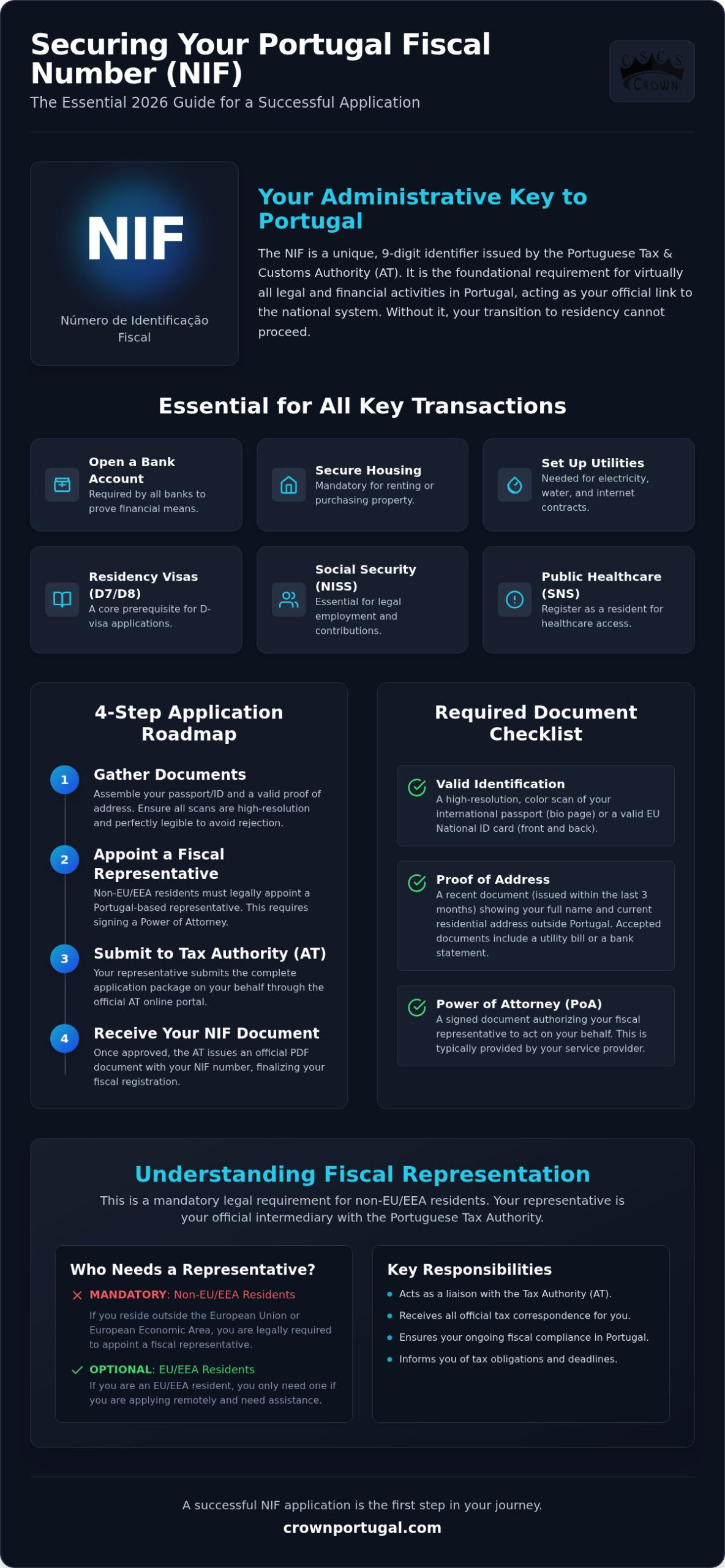
The NIF is a unique nine-digit identifier that the Tax and Customs Authority issues to track fiscal obligations and rights. It’s the fundamental prerequisite for all economic activity in Portugal. When you first apply as a non-resident, your NIF is typically associated with a temporary fiscal address, which is your current residence outside of Portugal. Once you establish a local home and obtain residency, you’ll update this to a permanent Portuguese address. This transition is a key milestone in your integration into the local system.
Essential Transactions Requiring a NIF
The NIF is required for almost every contract you’ll encounter. You can’t rent an apartment or purchase property without it; landlords and notaries won’t proceed without a valid fiscal number. It’s also mandatory for setting up essential utilities like water, electricity, and high-speed internet. Beyond housing, the NIF is necessary for:
- Opening a Portuguese bank account to prove financial means for visa applications.
- Enrolling in the Portuguese Social Security system (NISS) for legal employment.
- Accessing the public healthcare system (SNS) as a resident.
- Purchasing or registering a vehicle within national borders.
Step-by-Step Portugal Fiscal Number Application Process
Executing a Portugal fiscal number application requires a methodical approach to satisfy the strict verification standards of the Autoridade Tributária e Aduaneira (AT). While the process is standardized, the Tax Authority’s scrutiny of documentation remains high. Each submission must be technically perfect to avoid administrative delays. Professional guidance ensures that your file moves through the verification queue without friction. This process is not just about filling out a form; it’s about establishing a verified legal identity within the Portuguese state.
Phase 1: Documentation and Preparation
Before initiating the request, you must assemble a compliant document package. Your international passport or EU national ID card must be valid and scanned in high resolution to ensure all text is legible. A frequent point of failure is the proof of address; the AT requires a utility bill or bank statement issued within the last three months. This document must clearly display your full name and current residential address outside Portugal. If your original documents aren’t in Portuguese or English, they require a certified translation to be legally recognized by the tax office.
Phase 2: The Submission and Verification
For those applying remotely, a Power of Attorney (PoA) is the legal instrument that allows your representative to act on your behalf. This document authorizes a Portuguese resident to submit your data through the Finanças portal. The representative’s role is not merely clerical; they serve as your official liaison with the tax office. They’re responsible for receiving your initial passwords and official communications until you update your fiscal address to a Portuguese one. This relationship is built on legal compliance and ensures that the AT has a reliable point of contact within the country.
Once the submission is live, the AT performs an internal verification of your identity. If the application meets all criteria, they issue a Documento Provisório de Identificação Fiscal. This document serves as the official record of your permanent nine-digit NIF. In 2026, processing times for remote applications generally fluctuate based on the specific tax office’s workload. Ensuring your documentation is flawless from the start prevents common pitfalls that lead to rejection. If you’re seeking a streamlined Portugal fiscal number application, engaging an expert can provide the stability needed for a successful outcome. This meticulous preparation is the first step toward a seamless integration into the Portuguese system.
Fiscal Representation: Requirements for Non-EU Residents
Fiscal representation is a legal mandate designed to ensure the Portuguese Tax Authority (AT) has a reliable point of contact for individuals residing outside the European Union. While a Portugal fiscal number application can be initiated by anyone, the ongoing maintenance of that number often requires a local intermediary. This representative acts as your formal liaison, receiving official correspondence and ensuring you remain in good standing with national tax laws. In 2026, the necessity for a representative depends heavily on your residency status and whether you hold financial interests, such as property or local income, within the country.
Recent shifts in administrative policy have introduced the option for electronic notifications through the Finanças portal. Under a ruling from July 2022, some non-residents without tax obligations may waive the requirement for a physical representative by enabling these digital alerts. However, adoption of this waiver is inconsistent across different tax offices. For most third-country nationals, maintaining a professional representative remains the most secure method to avoid missed deadlines or administrative penalties. It’s a layer of security that protects your residency path from avoidable legal friction.
EU vs. Non-EU Application Nuances
Residents of the EU or the EEA generally benefit from an exemption regarding fiscal representation due to reciprocal agreements within the single market. In contrast, third-country nationals face mandatory requirements if they possess tax obligations in Portugal. This category now includes citizens of the United Kingdom following the post-Brexit transition. If you’re a UK resident, you’re treated as a non-EU applicant, meaning a representative is typically required to finalize your registration. This distinction is vital for those planning a move, as it changes the documentation and the legal structure of your initial filing. Non-EU nationals bringing family members to Portugal should also review the portugal residence permit for non eu family members requirements, as the NIF is a foundational prerequisite for the entire family reunification process.
The Duties of a Professional Fiscal Representative
A professional representative carries significant responsibilities that go beyond the initial application. They are legally tasked with acting as the intermediary for all official tax correspondence, including notices regarding income tax (IRS) or municipal property taxes (IMI). They ensure that you’re informed of payment deadlines and regulatory changes that could affect your fiscal status. You can secure your tax ID remotely with our NIF registration service to ensure these administrative duties are handled with meticulous precision. This professional oversight is particularly beneficial for those who don’t yet speak Portuguese or understand the complexities of the local tax calendar. Your representative provides the stability needed to manage your international interests without the anxiety of non-compliance.
Documentation Checklist for a Successful Application
A successful Portugal fiscal number application hinges on the technical precision of your documentation. The Tax and Customs Authority (AT) frequently rejects files for minor discrepancies that many applicants overlook. Meticulous organization at this stage prevents administrative delays that could stall your entire relocation timeline. You should treat the assembly of these documents as a formal compliance exercise where legibility and validity are the primary benchmarks. Each document serves as a verified data point in your emerging Portuguese administrative profile.
Your identification scan must be a high-resolution copy of a valid international passport or EU ID card. It’s essential that all four corners of the document are visible and that no glare obscures the biometric data or the machine-readable zone at the bottom. For applications involving minor children, the requirements expand to include a birth certificate. This document must be accompanied by a certified translation if it’s not originally in Portuguese or English. Both parents must provide their identification to authorize the minor’s registration, ensuring full legal transparency within the AT system.
Address Verification Standards in 2026
The AT maintains strict criteria for residency proof to prevent fiscal fraud and ensure accurate tax categorization. Your proof of address must be dated within the last three months to be considered valid by the tax office. Acceptable documents include bank statements, utility bills for fixed services like water or electricity, or a government-issued tax residency certificate. You should avoid submitting mobile phone bills or delivery invoices, as these are commonly rejected address documents. The address on your NIF must match your primary residence until relocation is complete. This consistency is vital for maintaining a clear fiscal trail during your transition.
Digital Compliance: Activating Electronic Notifications
In 2026, the shift toward a digital-first administration means that physical mail is no longer the primary communication method for the state. Once your NIF is issued, you must access the Portal das Finanças to activate electronic notifications immediately. This process involves linking your fiscal profile to the ‘ViaCTT’ digital mailbox, a secure platform for official correspondence. This system ensures that you receive official tax summonses, payment notices, and legislative updates in real-time without relying on international postal services. Failing to monitor this digital channel can lead to missed deadlines and subsequent penalties. Complete your setup by applying for a NISS to ensure your social security registration is as compliant as your fiscal profile. If you’re ready to delegate this administrative burden, our team offers a professional NIF registration service that manages every detail of the documentation process on your behalf.
Integrating Your NIF with Residency Visa Applications
The success of your residency strategy depends on the seamless integration of your fiscal registration with your visa submission. While many view the Portugal fiscal number application as an isolated administrative task, it’s actually the anchor for your entire legal file. Consular officials and AIMA (Agência para a Integração, Migrações e Asilo) officers require proof of a NIF to verify that you’ve established the necessary financial infrastructure to support your life in Portugal. This nine-digit number allows you to move from the status of a visitor to that of a potential resident with verified economic ties to the country.
One of the most critical functions of the NIF is facilitating the opening of a Portuguese bank account. For most residency pathways, you must demonstrate the availability of funds within a local financial institution. Without a NIF, banks cannot perform the required KYC (Know Your Customer) protocols, effectively halting your ability to prove financial self-sufficiency. This step is non-negotiable for both digital nomads and retirees who must show consistent income or significant savings to satisfy the national immigration criteria. Families navigating the Portugal residence permit for non-EU family members process will find that each dependent’s NIF registration must be completed before the family reunification application can be submitted to AIMA.
NIF Requirements for the D8 and D7 Pathways
The NIF is the first step in the Digital Nomad Visa Portugal requirements because it’s required to finalize the remote work contracts and local housing agreements needed for the D8 application. In 2026, D8 applicants must demonstrate a minimum monthly income of €3,680, which is four times the national minimum wage. This income must be clearly documented and, in many cases, supported by a local bank statement that identifies you via your fiscal number.
Similarly, when you’re coordinating your fiscal setup with the Portugal D7 Visa passive income roadmap, the NIF allows you to secure a long-term lease. For the D7 visa, a single applicant must show a passive income of at least €920 per month. Landlords will not sign a legally binding 12-month lease without a valid NIF, and the visa application will be rejected if the lease agreement isn’t registered with the Tax Authority. This interconnectedness ensures that your residency application is built on a foundation of documented legal and fiscal compliance.
Professional Consultancy for a Seamless Transition
Expertise in the administrative landscape is essential to manage the transition from non-resident to resident fiscal status once your visa is approved. Crown Portugal provides the meticulous organization required to review every document, ensuring that your proof of address and identification meet the AT’s evolving standards. This professional oversight prevents administrative delays that often occur when applicants attempt to navigate the portal without local guidance. You can explore our expert guidance on the Crown Portugal YouTube channel to see how we manage these complex transitions for our clients. Once your residency permit is issued, your next step is to update your fiscal address to your new Portuguese home, a process that officially marks your arrival as a full tax resident in the national system.
Finalizing Your Administrative Foundation in Portugal
Securing your NIF is the most critical step toward establishing a compliant life in Portugal. It’s the bridge between your current residency and your future home. A successful Portugal fiscal number application ensures you can open bank accounts and sign long-term leases without administrative friction. This guide has detailed how fiscal representation remains a vital safeguard for third-country nationals; it provides a stable link to the Tax Authority while you manage your transition. Since 2018, Crown Portugal has provided expert-led relocation support, combining national expertise with specialized D8 and D7 visa consultancy to ensure every detail is accounted for.
Our team manages the meticulous organization required for remote NIF acquisition and end-to-end administrative compliance. We’re ready to facilitate your move with the precision and reliability your relocation deserves. Secure your Portugal NIF and start your residency journey with Crown Portugal. With the right professional partner by your side, your move to Portugal becomes a series of well-defined, manageable steps that lead to long-term stability.
Frequently Asked Questions
Can I apply for a Portugal fiscal number (NIF) remotely in 2026?
Yes, you can complete a Portugal fiscal number application remotely by appointing a fiscal representative through a Power of Attorney. This legal instrument allows a resident of Portugal to submit your documentation to the Tax Authority on your behalf. This method is the standard procedure for non-residents who require a NIF before their arrival in the country. It ensures your administrative setup is finalized without the need for international travel.
How long does the Portugal fiscal number application typically take?
Processing times for a Portugal fiscal number application typically range from a few business days to two weeks, depending on the specific tax office’s current workload. While some applications are processed almost immediately when submitted in person, remote applications through the e-balcão portal may take longer during peak periods in 2026. Meticulous document preparation is essential to avoid delays caused by administrative requests for additional information or clarification.
Is a fiscal representative mandatory for all foreign NIF applicants?
Fiscal representation is legally mandatory for non-EU/EEA residents who have tax obligations in Portugal, such as owning property or earning local income. While a 2022 ruling allows some non-residents to opt for electronic notifications instead of a representative, this exemption is not universally applied across all tax offices. Most third-country nationals find that maintaining a representative provides the necessary security and compliance required for successful residency visa applications.
What documents are accepted as proof of address for the NIF?
The Tax Authority accepts bank statements, government-issued tax residency certificates, or utility bills for fixed services like water and electricity as valid proof of address. These documents must be issued within the last three months and clearly display your full name and residential address outside of Portugal. Mobile phone bills and delivery invoices are frequently rejected; therefore, you should ensure your selected document meets the AT’s specific verification standards.
Can a child or minor have a Portuguese NIF?
Yes, minors can obtain a Portuguese NIF, and it is often required for family reunification visas or school enrollments. The application must be submitted by both parents or legal guardians, providing high-resolution copies of their identification alongside the child’s birth certificate. If these documents are not in English or Portuguese, a certified translation is mandatory to satisfy the Tax Authority’s administrative requirements for registering a minor in the system.
Does getting a NIF automatically make me a tax resident in Portugal?
Obtaining a NIF does not automatically grant you tax residency status in Portugal. A NIF is simply a fiscal identification number used for administrative and economic activities. Tax residency is determined by other factors, such as spending more than 183 days in the country during a calendar year or having a permanent home that serves as your habitual residence. You remain a non-resident for tax purposes until you formally update your fiscal address.
What is the difference between a NIF and a NISS?
The NIF is your personal tax identification number issued by the Autoridade Tributária e Aduaneira for fiscal and financial matters. In contrast, the NISS is your Social Security Identification Number, which is required for legal employment, social security contributions, and accessing certain public services. While both are essential for living and working in the country, they are managed by different government departments and serve distinct administrative functions.
How much does it cost to apply for a NIF through the Tax Authority?
Applying for a NIF directly through the Portuguese Tax and Customs Authority is free of charge for the applicant. However, most non-residents incur costs related to professional facilitation services or the appointment of a mandatory fiscal representative. These fees cover the legal responsibility the representative assumes and the administrative management of your application. Professional assistance ensures that your documentation is compliant and that your registration is handled with expert precision.