

Portugal Startup Visa Requirements in 2026: Eligibility, Documents and Application Steps
Company registration alone won’t qualify a founder for Portugal’s Startup Visa. The Portugal startup visa requirements focus on an innovative, scalable venture, endorsement from a certified Portuguese incubator, and the founder’s own eligibility and supporting evidence. A strong business idea may fit this route, or it may be better suited to the broader D2 pathway.
It can be difficult to tell what counts as an eligible startup, what an incubator must assess, and which documents belong at each stage. The process involves more than submitting a visa application. Choosing the route and preparing evidence in sequence can help you identify gaps before you file.
This guide explains the core eligibility criteria for 2026, the roles of IAPMEI and certified incubators, and the documents founders should prepare. It outlines the main steps, from developing the business plan and seeking incubator endorsement to applying for the visa and residence permit. You’ll also see how the incubator-backed Startup Visa differs from the D2 visa, so you can compare the pathways against your venture before proceeding.
Key Takeaways
- Use the Portugal startup visa requirements to assess both your venture’s fit and your own eligibility before preparing an application.
- Gather evidence that explains your startup’s innovation, scalability and business potential.
- Compare the Startup Visa and D2 pathways by looking at your venture model, incubator involvement and application evidence.
- Keep programme documents separate from the evidence required for the consular visa application.
- Once you’ve chosen a route, document review and application preparation can help organise the next steps.
What Is Portugal’s Startup Visa, and Who Is It Designed For?
Portugal’s Startup Visa is a route for eligible non-EU founders to establish or develop an innovative, scalable business in Portugal with the backing of a certified incubator. It links assessment of the proposed startup with a separate immigration application. Meeting the programme criteria and qualifying for a visa are related, but distinct, decisions.
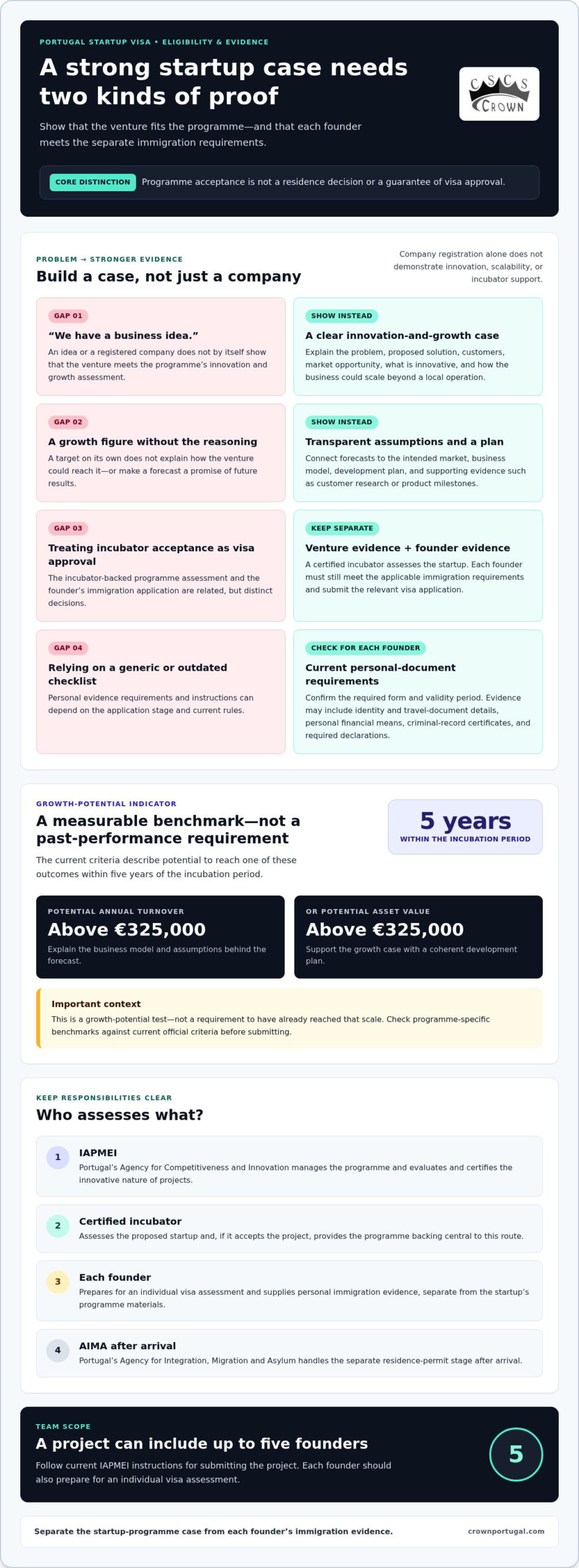
The programme is managed by IAPMEI, Portugal’s Agency for Competitiveness and Innovation, which evaluates and certifies the innovative nature of projects. When assessing the Portugal startup visa requirements, start with the venture itself. Company registration does not demonstrate innovation, scalability or incubator support. A registered company may be part of your plans, but it does not replace the programme assessment or the founder’s immigration evidence.
What kind of founder and business may fit?
The route is intended for entrepreneurs developing a business with a credible basis for innovation and growth, rather than anyone starting a business or working independently in Portugal. Explain what the venture offers, who its customers are and how it could grow beyond a local operation. The programme assessment considers whether the idea has potential to serve international markets and develop into a sustainable business.
One measurable indicator in the current criteria is the startup’s potential, within five years of the incubation period, to reach annual turnover above €325,000 or assets valued above €325,000. This is a growth-potential test, not a requirement to have already reached that scale. Explain the assumptions behind your forecasts, including the intended market, business model and development plan. The figures should support a coherent case, not stand alone as a promise of future results.
A conventional shop, freelance activity or small local service may be a viable business, but that alone doesn’t make it suitable for this programme. The key question is whether the proposal meets the innovation and growth assessment, not simply whether you plan to operate a company in Portugal.
What does the incubator contribute?
A certified incubator assesses the proposed startup and, if it accepts the project, provides the programme backing central to this route. Its involvement shows that the venture has been evaluated within the Startup Visa framework. Be ready to explain the project clearly and show how its development and growth plans are credible.
Incubator acceptance is not a residence decision or a guarantee of visa approval. It addresses the startup-programme stage. Each founder must still meet the applicable immigration requirements and submit the relevant visa application. After arrival, the residence-permit stage is handled separately by AIMA, Portugal’s Agency for Integration, Migration and Asylum.
Think of eligibility as two connected checks: whether the business qualifies for the programme, and whether each founder qualifies for the immigration route. Preparing for both from the outset helps you distinguish evidence for the venture assessment from documents supporting an individual visa application.
Portugal Startup Visa Requirements: Business, Founder and Evidence
Prepare three connected sets of evidence: documents about the venture, documents about each founder, and materials required for the relevant programme and immigration stages. The Portugal startup visa requirements cover both business assessment and personal eligibility. Keep those checks distinct. A persuasive business plan cannot replace an individual visa application, and personal documents alone cannot establish that a venture fits the programme.
Business-plan evidence and growth potential
The business plan should make the proposal easy to assess, not simply describe an idea. Set out the problem the business addresses, its proposed solution, intended customers, market opportunity and route to growth. Explain what is innovative about the product or service, how the company could scale, and what supports its potential to reach international markets. Connect claims to evidence, such as customer research, product-development milestones, relevant expertise or a reasoned commercial forecast.
Make projections transparent about assumptions and timeframes. A forecast records the founders’ plan; it does not guarantee revenue or asset growth. Planned recruitment can help explain how the business may develop, but don’t present qualified-employment potential as an independent pass-or-fail rule unless current IAPMEI guidance expressly sets it out that way. Check any programme-specific turnover, asset or employment benchmark against the current official criteria before submitting.
Founder eligibility and personal documents
Programme participation doesn’t remove the need to establish each founder’s immigration eligibility. The programme can accommodate a project with up to five founders, but the team should follow current IAPMEI instructions on how to submit the project. Each founder also needs to prepare for an individual visa assessment.
Use the current application checklist to confirm the required form and validity period for personal evidence. Depending on the stage, this may include:
- Identity and valid travel-document details for each founder.
- Evidence of personal financial means, with the applicable threshold and acceptable proof checked against current rules.
- Criminal-record certificates and any required declarations, prepared according to the instructions for the relevant application.
Don’t rely on an old checklist for age conditions, criminal-record requirements, declarations or financial thresholds. Confirm the precise rules and document formats in the 2026 official programme and consular guidance. Requirements can differ by stage, and documents requested for programme assessment don’t automatically replace those required with a visa application.
Keep programme and visa evidence separate
Organise materials in two folders. The programme file should support the project’s eligibility and incubator assessment, including its plan, market rationale and growth evidence. The visa file should address each founder’s personal requirements and follow the relevant consular checklist. This makes gaps easier to spot before submission and helps prevent one approval from being mistaken for a substitute for another.
For a structured review of business and personal documents, Startup Visa application preparation can help you organise evidence for the relevant stages.
Startup Visa vs D2 Visa: Which Founder Route Fits Your Business?
Choose between Portugal’s Startup Visa and D2 route by looking first at the venture, not the visa label. The Startup Visa is linked to an innovation-focused programme and certified-incubator involvement. The D2 is a separate entrepreneur pathway, generally considered by founders establishing a business or pursuing self-employment in Portugal. Neither route automatically suits everyone who wants to start a company. Fit depends on the founder’s circumstances, business model and current requirements.
| Comparison point | Startup Visa | D2 Visa |
|---|---|---|
| Intended venture | Innovative business with credible scalability and international-growth potential. | Broader entrepreneur route for establishing or operating a business, including ventures that may not meet the Startup Visa’s innovation focus. |
| Incubator involvement | Certified-incubator participation and programme assessment are central features. | Does not follow the Startup Visa’s incubator-backed programme route. |
| Evidence focus | Project innovation, business model, growth potential and programme-related assessment. | The founder’s business or self-employment plan and supporting evidence under the applicable D2 requirements. |
| Process | Programme assessment and incubator steps precede the relevant visa application. | A separate entrepreneur visa application process, based on current consular requirements. |
When an incubator-backed route may be relevant
Consider the Startup Visa if you can explain what is innovative about the business and make a credible case for growth beyond a local market. The Portugal startup visa requirements include programme-specific assessment, so founders need to present the venture to a certified incubator and explain how it could develop. This assessment is part of the route, not a step that company registration can replace.
An incubator’s interest or acceptance is not a visa decision. It doesn’t remove the separate immigration requirements or guarantee an outcome. The route is most relevant when the venture aligns with the programme’s innovation and growth focus, not simply because the founder prefers a startup-oriented title.
When founders should examine the D2 pathway
The D2 may warrant closer review if the planned business is a conventional commercial activity, a professional service or another entrepreneur project that doesn’t depend on Startup Visa programme endorsement. Its evidence emphasis differs: the founder presents a coherent business or self-employment case under the current D2 rules rather than seeking Startup Visa incubator backing. Check the exact supporting evidence against the applicable requirements.
Compare the routes against the actual business plan, the founder’s eligibility and the documents each pathway requires. For more detail on the separate route, see the Portugal D2 entrepreneur visa guide. A comparison based on documented fit is more useful than assuming every founder belongs in one category.
How to Prepare a Portugal Startup Visa Application Step by Step
The process has separate programme and immigration stages. Keep their documents distinct and review current instructions before filing. Forms, application channels, appointment arrangements and sequencing can depend on your circumstances and the rules in force. Use this sequence as a preparation framework, alongside the official checklist.
- Review the venture and founder fit. Compare the business with the current Portugal startup visa requirements, then assess each founder’s eligibility separately. Note gaps in the innovation case, growth plan, personal evidence or financial documents before beginning formal submissions.
- Build a coherent startup dossier. Prepare a business plan that explains the problem, proposed solution, target market and growth strategy. Organise founder profiles, financial projections and relevant supporting materials with it. Check that figures and claims are consistent across the plan and attachments.
- Approach the programme and incubator stage. IAPMEI manages the Startup Visa programme and assesses project eligibility and innovation. The process includes seeking acceptance from a certified incubator and submitting through the IAPMEI platform. Follow the current platform instructions for the required information and documents. Programme assessment is separate from a visa decision.
- Prepare each founder’s visa application. After programme approval, prepare each visa file according to the applicable Portuguese consular instructions. Identity, travel-document, financial-support and criminal-record evidence may be relevant, but the current checklist determines the exact documents, formats and submission channel. Documents prepared for IAPMEI don’t automatically replace consular evidence.
- Complete the residence-permit stage. After arrival in Portugal, the process continues with a residence-permit application through AIMA, the Agency for Integration, Migration and Asylum. Follow the current procedure for this stage. Programme and visa decisions do not themselves issue a residence permit.
Prepare and check the dossier
Keep a separate index for programme materials and each founder’s immigration documents. Before submission, confirm that names match across passports, forms and certificates, dates are consistent, and supporting evidence clearly relates to the claims in the business plan. Verify current rules for translations, certification, document validity and declarations. Requirements can change, so use the official instructions for the stage you’re completing rather than relying on an older checklist.
Track the decision points
IAPMEI’s programme assessment, the consular visa process and AIMA’s residence-permit stage are separate administrative steps, each with its own purpose and documentation. Record which authority handles each submission, the specified channel and any appointment instructions that apply to your case. Don’t plan around an assumed processing time or outcome. Follow the latest official updates as your application progresses.
For help organising documents and preparing the relevant application stages, get support with your Startup Visa application.
Get Expert Support for Your Portugal Startup Visa Next Steps
A considered application follows a clear sequence: assess whether the venture and founder fit the route, review the current requirements, organise the evidence, then proceed through the relevant programme and immigration stages. If the business doesn’t align with the Startup Visa’s incubator-backed model, compare the D2 pathway before committing to an application. This keeps the route decision grounded in the venture’s structure and documented eligibility.
The Portugal startup visa requirements involve evidence about both the project and the individual founder. Organising these materials can be demanding, especially when business-plan claims, personal documents and programme materials need to support a consistent account. Crown Portugal supports Startup Visa and D2 applications with document review and application preparation, helping founders structure materials for the relevant steps.
What application-preparation support can cover
A structured review can flag inconsistencies before submission, such as different figures in a business plan and financial projections, mismatched personal details, or claims without supporting evidence. Application preparation can also help organise documents for the distinct programme and visa stages, while appointment scheduling supports the administrative process. These services help with preparation; the competent authorities assess eligibility and make programme, visa and residence decisions.
Professional support can improve organisation and help founders address documentary gaps, but it cannot guarantee a visa decision. The relevant authorities decide the outcome, and current official instructions govern the documents and procedures for each stage.
Choose a practical next step
Before discussing an application, prepare a concise overview of the venture and the founder’s position. Keep it factual and include:
- The problem the business addresses, its proposed solution and intended customers.
- The innovation and growth rationale, including the markets the venture aims to reach.
- The founders’ roles, relevant experience and current development plans.
- An initial evidence list covering business materials and each founder’s personal documents.
Then compare the routes against those facts. A venture built around an innovation-led, scalable product, with plans to seek incubator assessment, may point toward the Startup Visa. A different business model may make the D2 route worth examining. In either case, review the current criteria and application instructions before filing, since forms, channels and document rules can change.
If you’re ready to review your route and organise the next steps, Discuss your Portugal Startup Visa application with Crown Portugal. A clear summary of your venture and initial evidence will help keep the discussion practical and focused.
Make Your Next Step a Prepared One
Your next decision is not simply whether to apply, but which route best reflects your business and founder profile. Use the Portugal startup visa requirements as a practical framework: clarify the venture’s case, identify what still needs evidence, and compare the Startup Visa with the D2 pathway before committing to a process.
When you’re ready to move from assessment to preparation, Crown Portugal supports Startup Visa and D2 applications with document review, application preparation and appointment scheduling. This support helps organise the file, while the competent authorities remain responsible for eligibility assessments and final decisions.
To turn your venture summary and initial document list into a clear set of next steps, Discuss your Portugal Startup Visa application with Crown Portugal.
Frequently Asked Questions
Can I apply for Portugal’s Startup Visa without an incubator?
The Startup Visa route generally involves an incubator, so don’t assume you can bypass that step. Review current official guidance for the required relationship with a certified incubator, the project materials it expects and when its assessment must take place. A company registration certificate or standalone business plan may support your case, but neither should be treated as a substitute for programme assessment.
Is Portugal’s Startup Visa available to non-EU founders?
The route is generally aimed at entrepreneurs from outside the European Union, but whether it fits your case depends on current programme rules and your circumstances. Nationality, existing residence status and the country from which you apply may affect the route or procedure. Review these points before making travel or business plans, and remember that meeting programme criteria doesn’t settle the separate immigration decision.
How much money do I need for a Portugal Startup Visa?
There may be a personal financial-support requirement for the immigration stage, while the programme may assess the startup’s financial plan and growth potential separately. These are different types of evidence: personal funds show how a founder can support themselves, while business projections explain the venture’s expected development. Check the Portugal startup visa requirements against current 2026 official guidance for your circumstances, rather than relying on an old figure or general online estimate.
Can my family join me in Portugal on a Startup Visa?
Family members may have a separate residence route, but their eligibility and application process depend on the relationship, the founder’s status and the rules in force when applying. They aren’t automatically covered by the startup’s programme assessment. If you plan to relocate with a spouse or children, identify the relevant family documentation and timing separately, then coordinate those applications with the founder’s immigration process.
How long does the Portugal Startup Visa application take?
There isn’t one dependable timeframe for every application. The overall process can involve document preparation, programme assessment, appointment availability and a separate immigration decision, and each stage may follow different procedures. A missing certificate or a request for further information can also affect an individual file. Review current updates from the responsible authorities before booking travel or setting business launch commitments, and treat informal estimates as guidance rather than deadlines.
Does a Portugal Startup Visa lead to permanent residence?
No. The Startup Visa isn’t itself permanent residence or citizenship. It is an entry route connected to establishing a qualifying venture, while any later residence status requires a separate assessment under the laws and requirements in force at that time. Keep records of your residence history and assess long-term eligibility independently. Programme acceptance alone doesn’t establish a future right to permanent residence.