

What to Carry When Moving to Portugal: Checklist

A moving checklist should distinguish what travels with you from what goes with the shipment. For a move to Portugal, carry the essentials you may need during the journey and on arrival instead of packing every important item out of reach.
The word has a broader meaning than simply transporting belongings. It can also describe having something with you as you go from place to place, which is the sense most useful when preparing for a move. The verb has been in use since the 14th century.
This guide explains what “carry” means in this context, how it differs from shipping household goods, and how to make a practical moving checklist. It also covers the word’s history and related meanings, helping you understand both the language and the everyday decision: what to keep close and what can travel separately.
Key Takeaways
- Separate belongings for the household shipment from the essentials you want with you during travel and arrival.
- In this moving context, the verb describes keeping an item with you as you go from place to place.
- Portuguese translations vary by meaning: the right word depends on whether you mean transporting, taking something along, or bearing an item.
- Recognize that the verb has other meanings in English, including supporting something or helping an effort succeed.
- If your move involves a visa pathway or tax registration, Crown Portugal offers visa support and NIF Registration for people moving to Portugal.
Having something with you
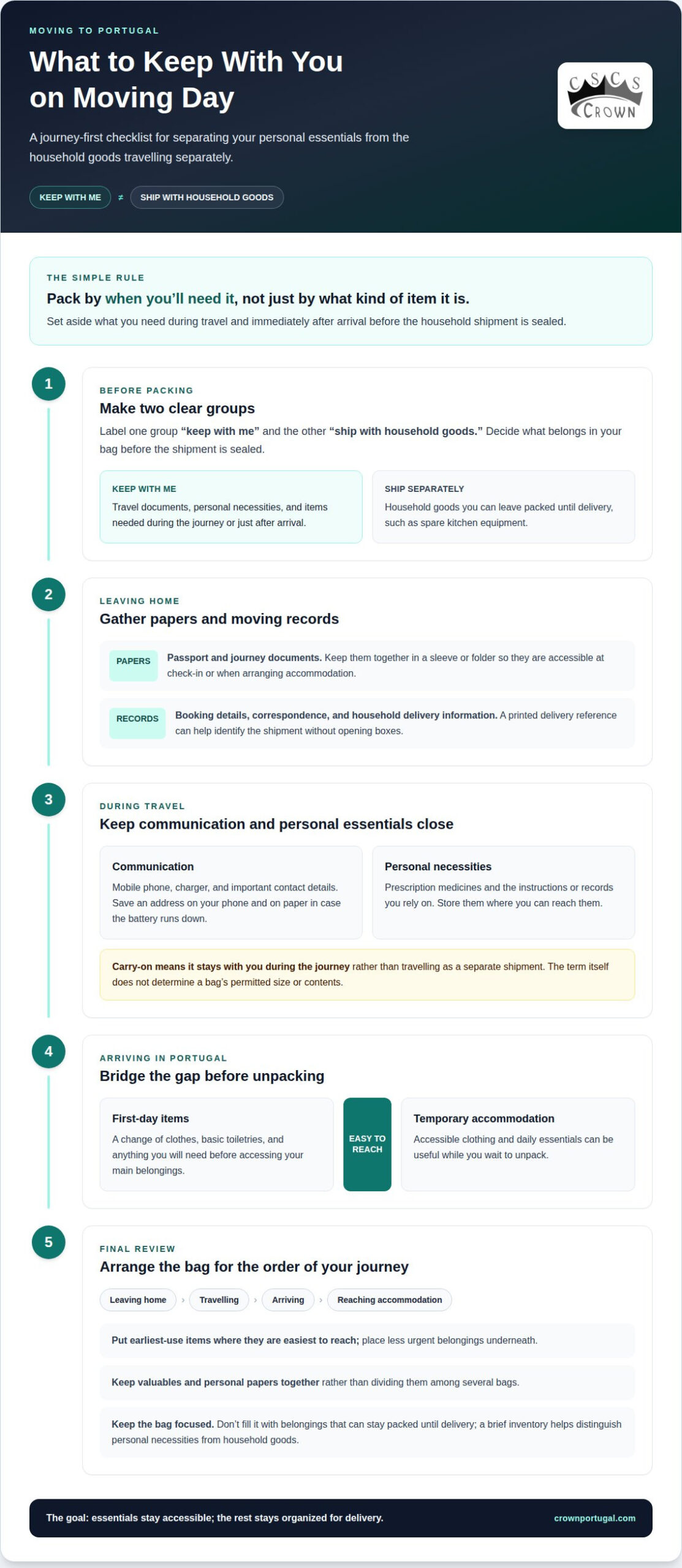
For a move to Portugal, separate the items you need during travel from household goods packed for delivery. A small day bag can hold documents, communication essentials, and immediate personal necessities. This makes it easier to find each item and helps prevent important papers from getting buried in a box. Decide what belongs in the bag before the shipment is sealed.
A carry-on bag is luggage that stays with you during a journey instead of travelling as a separate shipment. Its practical purpose is to keep the contents accessible during the trip and after arrival. For a flight to Portugal, put documents and daily necessities in the bag you keep close. The term itself doesn’t determine the bag’s permitted size or contents.
Build your checklist around when you will need each item, not just its category. List items needed before departure first, followed by those useful during travel and on arrival. A separate pouch or document sleeve can keep small essentials together. This makes it easier to find a specific item without emptying the whole bag.
- Travel papers: Keep your passport and documents relevant to your journey together. A sleeve or folder helps keep papers organized and accessible at check-in or when arranging accommodation.
- Moving records: Place booking details, correspondence, and household delivery information in one folder. A printed delivery reference can help you identify a shipment without opening packed boxes.
- Communication essentials: Keep your mobile phone, charger, and important contact details accessible. Save an address on your phone and on paper, so you can still find it if the battery runs down.
- First-day items: Set aside a change of clothes, basic toiletries, and anything you will need before unpacking. These can bridge the gap between arriving in Portugal and accessing your main belongings.
- Personal necessities: Keep prescription medicines and the instructions or records you rely on together. Store them where you can reach them rather than among household items packed for delivery.
Prepare the bag before the shipment is sealed. Gather what you expect to use during travel or immediately after arrival, then set the bag apart from boxes intended for delivery. If your accommodation in Portugal is temporary, accessible clothing and daily essentials can be useful before you unpack. A brief inventory also helps distinguish personal necessities from household goods.
Use a simple label or written list to keep your packing plan clear. Mark one group “keep with me” and another “ship with household goods.” Put a document folder in the first group if you need it during travel; spare kitchen equipment can go with the household shipment. This avoids relying on memory when you are preparing several bags and boxes at once.
Before departure, review the bag in the order of your journey: leaving home, travelling, arriving, and reaching your accommodation. Put the items you need earliest where they are easiest to reach, with less urgent belongings underneath. Keep valuables and personal papers together rather than dividing them among several bags. This makes it easier to find a booking record or phone without unpacking other belongings.
Choose a bag that is comfortable to manage alongside your other travel items. Don’t fill it with belongings that can stay packed until delivery; too much makes essentials harder to find. A focused list helps you carry what is useful at each stage while keeping the rest organized for arrival. Review the contents before leaving, and return each essential to its designated place.
In American English, “carry” can mean having something with you from one place to another. The verb “carry” can mean transporting someone or something from one place to another. In Portuguese, the English verb “carry” can be translated as “carregar” when referring to carrying something or someone, and as “levar” when referring to taking something or someone along. In Portuguese, “carry” can be translated as “portar” when referring to carrying or bearing an item such as a gun.
For this bag, the everyday sense is the relevant one: having something with you from one place to another. The authors find that equilibrium exchange-rate predictability may boost carry-trade performance, according to the European Union. This financial use of “carry” is distinct from taking personal belongings along on a journey.
Definition carry
The English verb “carry” changes meaning according to its object and context. In “She carried a folder across Lisbon,” it describes moving an item from place to place. In “He carries a notebook,” it means having that notebook with him. The verb is first known to have been used in the 14th century; the noun is first known from 1844.
As an action, “carry” can mean transporting a person or object, or taking someone or something along. “They carried the table into the room” emphasizes moving an object, while “She carried her notes to class” can emphasize bringing them with her. In a sentence about moving furniture between homes, the focus is on the journey. A sentence about taking a folder to an appointment focuses on bringing it along.
When it describes possession, “carry” means keeping an item with you as you go. “She carries her notebook to class” means the notebook accompanies her, not necessarily that she is lifting it at that moment. When relocating to Portugal, someone might carry a folder of household records during the journey. The context shows whether the focus is possession or physical movement.
Another meaning is to support weight without moving or breaking. In “The shelf carries a row of books,” the shelf supports their weight. The verb can also describe conveying information: “Please carry this message to Ana” means taking it from one person to another. The object clarifies the action: a shelf supports books, while a person conveys a message.
The verb can also mean having a quality, component, or result. “The application carries an additional document” indicates that the document is included; “the decision carries consequences” points to an outcome. These examples show why the surrounding words matter. A document included in an application is not being moved in the same sense as a folder taken to an appointment.
“Carry” can also mean supporting an activity or helping it succeed. In “Their planning carried the project,” the planning helped the project continue or succeed. The verb may also describe winning support or approval. A motion that receives enough votes can be said to have carried. Here, the subject is a proposal or effort, not a physical object moving across a room.
Some meanings belong to specific fields. In arithmetic, carrying means moving a number into another column during addition. In cricket, a ball carries if it reaches the catcher without first hitting the ground. In basketball, a carry is an illegal action involving a player’s hand beneath the ball while dribbling or starting to move. These specialized meanings don’t describe packing or relocation.
Phrasal verbs change the meaning of “carry” by adding a short word. “Carry out” means to perform or complete something, as in carrying out a test. “Carry over” can mean extending into another period or passing into a new situation. “Carry away” can mean losing control, while “carry on” can mean continuing or persevering. The added word helps identify the intended meaning.
Related expressions also have distinct meanings. “Carry weight” means lifting or bearing a load. A “carry-on bag” is luggage kept with you during travel; a “carry case” is a protective or portable container. A “carry strap” is used to hold or transport an item. These phrases describe particular objects or actions, not one definition that fits every sentence.
For English speakers preparing paperwork for Portugal, first identify the action, then select wording that expresses it. Taking a document to an appointment, moving furniture between homes, and performing a test require different phrases. Portuguese immigration guidance can help connect relocation questions with relevant administrative steps.
Beyond field-specific senses, “carry” can describe conveying something from one person or thing to another, rather than merely keeping it nearby. It can also mean supporting an activity, keeping it in operation, or helping it succeed. In another use, a person or proposal may carry a group’s support, agreement, or sympathy, meaning others are behind it.
“Carry” can also mean approving something, especially by voting. The verb can describe reaching or travelling a particular distance. It may also describe holding or moving the body in a particular way. In these uses, the subject and context distinguish approval, reach, and physical bearing from the more familiar meanings of transporting or supporting an object.
Crown Portugal
Crown Portugal helps people prepare for the administrative side of moving to Portugal, alongside practical decisions about what to keep accessible during the journey. If your move also involves choosing a visa pathway or arranging tax registration, its support includes the Portugal Digital Nomad D-8 Visa, Portugal Passive Income D-7 visa, Portugal Golden Visa D-9, and NIF Registration (Personal Tax Number).
The right next step depends on your circumstances, including your planned move and the administrative tasks you need to address. Keeping relevant paperwork accessible can make it easier to manage those tasks after arrival, while the rest of your belongings travel separately. Contact Crown Portugal to discuss support with your move to Portugal.
Prepare for the First Steps in Portugal
Planning a move is also an opportunity to organize the decisions that begin after arrival. Keep travel essentials accessible and give administrative paperwork a clear place in your plan. That way, you can focus less on locating belongings and more on the practical next steps of settling in.
Crown Portugal supports people with Portugal Digital Nomad D-8 Visa and Portugal Golden Visa D-9 applications, as well as NIF Registration (Personal Tax Number). The relevant support depends on the administrative task connected to your move. A well-prepared plan can bring your travel arrangements and paperwork into one clear sequence, without treating every document as something you need to carry throughout the journey.
As you prepare, focus on what needs to happen first and what can wait until your belongings are accessible. Clear priorities make the transition easier to organize. Contact Crown Portugal about your move, and take your next step with a more considered plan.
Plan Accordingly: Moving to Portugal Checklist – Crown Portugal at 10:48 am, November 18, 2026 -
[…] What to Carry When Moving to Portugal: Checklist […]