

Portugal Citizenship: Article 41 Requirements

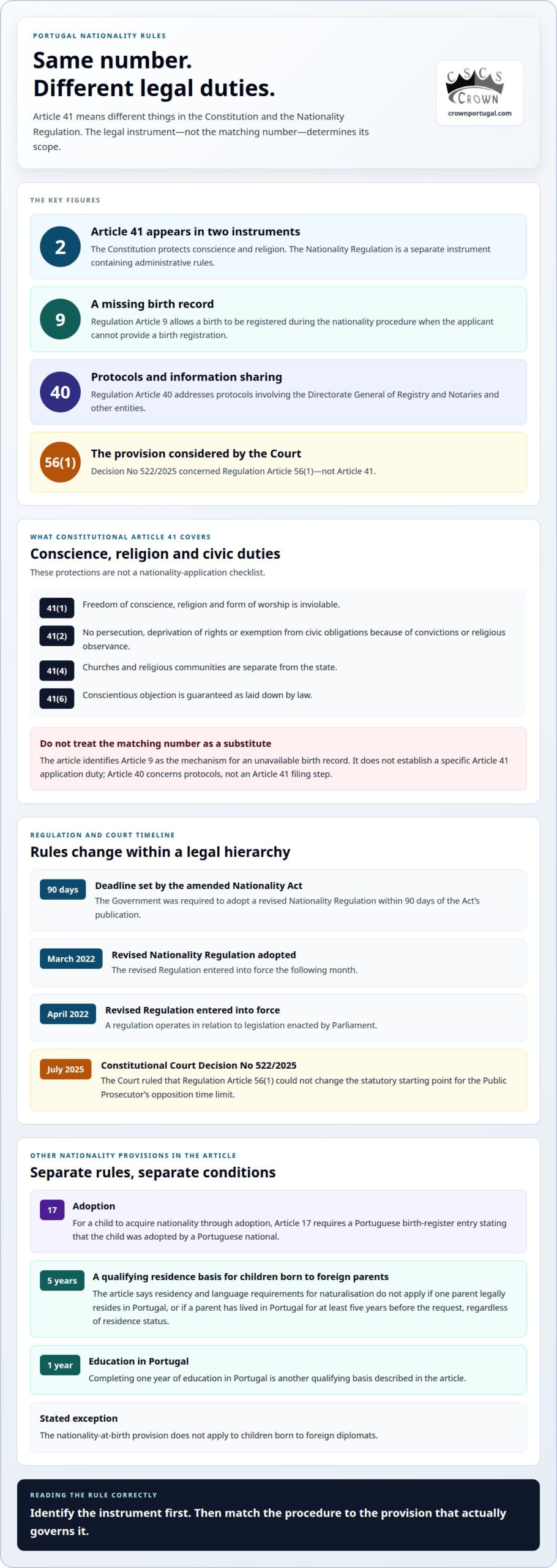
The matching article number can obscure an important legal distinction. Article 41 of Portugal’s Constitution protects freedom of conscience and religion; that constitutional protection is not a substitute for the procedural duties laid down in Article 41 of the Nationality Regulation. The two provisions belong to different legal instruments, so their scope and place in the legal hierarchy matter.
It is understandable to expect a nationality procedure to follow one clear rule, particularly when legislation and its implementing regulation address related matters. This article explains how to distinguish a constitutional provision from the Nationality Regulation, how procedural rules relate to legislation, and what the revised Regulation means for interpreting nationality requirements.
This focused guide covers the relevant duties, supporting documents and information, and the limits of treating one provision as a substitute for another. Understanding this distinction can help clarify which rule applies to a nationality procedure and why the wording and legal status of each provision matter.
Key Takeaways
- Distinguish the Constitution’s Article 41 protections from procedural provisions in the Nationality Regulation; the matching article number does not make them interchangeable.
- Understand how legislative hierarchy affects the interpretation of a regulation when it relates to requirements set by law.
- Learn when Portuguese public authorities can access civil-registry, criminal-record, or legal-stay information directly instead of requiring applicants to present certificates.
- See how court decisions on other nationality procedures illustrate the limits of regulatory rules when they conflict with legislation.
- Identify when a residence permit for an EU national and their non-EU family members is a separate matter from acquiring Portuguese nationality.
What does Article 41 of the Portuguese Nationality Regulation require?
Article 41 is a numbered provision whose meaning depends on the legal instrument it belongs to. In Portugal, Article 41 of the Constitution protects freedom of conscience and religion. It is not the same provision as Article 41 of the Nationality Regulation. The distinction matters because constitutional protections and nationality-procedure rules address different legal questions.
Freedom of conscience and religion means the Constitution protects a person’s convictions and religious observance. Under Article 41(1), freedom of conscience, religion and form of worship is inviolable. Article 41(2) prohibits persecution, deprivation of rights, or exemption from civic obligations because of convictions or religious observance. Article 41(4) separates churches and religious communities from the state. Article 41(6) guarantees conscientious objection as laid down by law.
Those protections do not, by themselves, set out the documents or steps required for a nationality application. A constitutional provision on religious freedom cannot substitute for procedural duties under a nationality regulation. For example, a person’s religious observance and the registration of a birth are separate matters: the first concerns constitutional protection, while the second concerns civil-registration procedure.
The Nationality Regulation is the instrument containing administrative rules for nationality procedures. The available rule relevant to an unavailable birth record is Article 9: it allows a birth to be registered during the nationality procedure when an applicant cannot provide a birth registration. That is a specific procedural mechanism. It should not be described as an Article 41 requirement without a reliable basis for that reference.
Legislative hierarchy describes how a regulation operates in relation to legislation enacted by Parliament. Portugal adopted a revised Nationality Regulation in March 2022, which entered into force in April 2022. The distinction became visible in Constitutional Court Decision No 522/2025, which addressed Article 56(1) of the Regulation. In July 2025, the Court ruled that the regulation could not change the statutory starting point for the Public Prosecutor’s opposition time limit.
That decision concerned Article 56(1), not Article 41. It illustrates why readers should identify the correct instrument and provision before relying on a proposed substitute. For a nationality file involving a missing birth record, the relevant question is whether Article 9’s registration mechanism applies. Article 41 of the Constitution remains relevant where conscience, religion, or civic duties are at issue.
- Identify whether a reference to Article 41 means the Constitution or the Nationality Regulation.
- For a missing birth registration, distinguish the procedural mechanism in Article 9 from constitutional protections.
For adoption, art. 17 requires a Portuguese birth-register entry stating that a child was adopted by a Portuguese national for the child to acquire nationality through adoption. Children born to foreign parents are exempt from residency and language requirements for naturalisation if one parent legally resides in Portugal, or if a parent has resided in the country for at least five years before the request, regardless of residence status. Completing one year of education in Portugal is another qualifying basis. The nationality-at-birth provision does not apply to children born to foreign diplomats. The amended Nationality Act required the Government to adopt a revised Nationality Regulation within 90 days of the Act’s publication.
What procedural duties are laid down in Article 41 of the Portuguese Nationality Regulation?
A procedural duty is a step or obligation governing how an authority handles an application. For this question, the first step is identifying the legal instrument: Article 41 of the Portuguese Constitution is distinct from Article 41 of the Nationality Regulation. The Constitution’s Article 41(2) protects people from persecution, loss of rights, or exemption from civic duties because of their convictions or religious observance. That protection concerns conscience and religion, not a nationality application’s filing checklist.
A regulation provision is a rule within the instrument setting administrative procedures for nationality matters. The legal facts relevant here identify Article 9 as allowing birth registration during a nationality procedure when an applicant cannot provide a birth registration. They identify Article 40 as addressing protocols, not an Article 41 application step. Those references should not be reassigned to Article 41 merely because the same number appears in another legal instrument.
A protocol is an arrangement between public bodies or other entities for handling information and related statements. Under Article 40, protocols may be negotiated between the Directorate General of Registry and Notaries and other entities. Their stated purpose is to provide information on nationality applications and transmit related statements to the Central Registry Office. Article 40 also provides for extensions of that Office’s reception centres with other public authorities. These arrangements concern administrative cooperation; they do not establish a substitute for an applicant’s specific procedural obligation.
Before relying on a proposed alternative, distinguish three questions:
- Which instrument? Determine whether the reference concerns the Constitution or the Nationality Regulation.
- Which provision? Keep Article 9’s missing-birth-registration mechanism separate from Article 40’s cooperation arrangements.
- Which action? Identify whether the matter concerns an applicant’s step, a public authority’s information exchange, or a constitutional protection.
Legislative hierarchy describes the relationship between legislation and rules made to implement it. The Constitutional Court’s Decision No 522/2025 addressed Article 56(1) of the Nationality Regulation, not Article 41. In July 2025, the Court ruled that the Regulation could not shift the statutory starting point for the Public Prosecutor’s opposition time limit. That example shows why a procedural shortcut cannot be treated as equivalent without examining the governing provision and its legal basis.
Accordingly, the references described here do not establish a procedural duty under Article 41 of the Nationality Regulation. They identify constitutional protections under Article 41 and distinct procedural mechanisms under Articles 9 and 40. A claimed substitute must be assessed against the specific step and provision involved, rather than inferred from a matching article number.
What documents and information are required under Article 41?
A document requirement is a rule specifying records an applicant must submit. The relevant Nationality Regulation facts identify Article 37, not Article 41, for certain certificate exemptions. They also identify Article 26 as allowing the Ministry of Justice to waive required documents in particular situations. Keep those provisions distinct when assessing a nationality file.
Article 37 concerns three categories: Portuguese civil-registry certificates, Portuguese criminal-record certificates, and documents proving legal stay. Naturalisation applicants are exempt from presenting these documents when the Public Administration can access the information directly. The condition concerns access by the administration. It does not establish that every applicant may omit every record.
Direct access means the Public Administration can obtain the relevant information itself. For example, if the administration can access a Portuguese civil-registry record, Article 37 removes the requirement for the applicant to present that certificate. The same stated exemption applies to Portuguese criminal-record certificates and proof of legal stay. The rule links the exemption to the authority’s access, rather than simply to the applicant’s preference.
A document waiver is permission not to submit a required document in a particular situation. Under Article 26, the Ministry of Justice may grant an exemption when there is no doubt about the relevant facts. The wording makes the waiver discretionary and conditional. It is not a general replacement for supporting evidence in every naturalisation application.
These provisions create two different routes:
- Article 37: the Public Administration can directly access specified Portuguese records or legal-stay information.
- Article 26: the Ministry of Justice may exempt an applicant from required documents in a particular situation, if the facts are not in doubt.
For an example, consider a naturalisation file involving a Portuguese criminal-record certificate. Article 37 is relevant if the Public Administration can access that information directly. If access is not the basis, Article 26 describes a separate possibility: the Ministry may waive documents where the relevant facts are clear. Neither provision says that an applicant can independently replace a document with an informal explanation.
The distinction also prevents a mistaken Article 41 reference from changing the document analysis. The relevant available rules place these exemptions under Articles 37 and 26. They do not identify Article 41 as the provision setting these document requirements or authorising these specific exceptions. When reviewing a proposed substitute, identify the exact record, the applicable provision, and whether direct access or a Ministry waiver is the stated basis. This keeps the application’s evidence question separate from a provision number that may refer to another subject.
Have courts or government guidance addressed substitutes for Article 41 duties
A judicial decision is a court’s ruling on a legal issue before it. Portugal’s Constitutional Court addressed the relationship between the Nationality Regulation and the Nationality Law in Decision No 522/2025. The decision concerned Article 56(1) of the Regulation, approved by Decree-Law 237-A/2006. It did not decide a dispute about Article 41 duties or approve a substitute for them.
The statutory opposition period is the period in which the Public Prosecutor may oppose nationality acquisition. Portuguese Nationality Law sets that period at one year, running from the underlying fact leading to acquisition. Article 56(1) of the Regulation instead made the period run from the date of registration. The Constitutional Court ruled that the Regulation could not replace the starting point set by the law.
The Court declared the Article 56(1) rule unconstitutional in July 2025. Its reasoning reaffirmed a hierarchy principle: an executive decree cannot change statutory deadlines or substantive conditions enacted by Parliament. The ruling also limited authorities’ ability to challenge nationality acquisitions after the statutory period. Those conclusions concern the opposition time limit, not an applicant’s evidence or filing duties.
Government guidance is an official explanation of how an authority applies a procedure. The facts relevant here identify no guidance approving an alternative to Article 41 duties. The court decision likewise provides no general permission to replace a required step with another document, declaration, or process. Its scope remains tied to the conflict between Article 56(1) and the Nationality Law’s one-year period.
For a proposed substitute, consider these questions separately:
- What is being replaced? Identify the exact document, declaration, or procedural step at issue.
- Which provision governs it? Check that the cited article addresses that specific requirement, rather than a different subject.
- Is there a decision on that issue? Decision No 522/2025 concerned the Public Prosecutor’s opposition period, not Article 41.
A precedent’s scope is the legal issue that a court actually resolved. For example, Decision No 522/2025 supports the principle that a regulation cannot reset a statutory deadline. It does not establish that Article 41 requirements may be waived or replaced. Applying the decision beyond its subject would confuse a hierarchy ruling with a ruling on a different procedure.
Accordingly, the court record described here offers a useful comparison, not a substitute rule for Article 41. The practical lesson is to match each proposed alternative to the specific statutory or regulatory duty involved. A ruling about Article 56(1) cannot, by itself, answer whether another Article 41 procedure permits an alternative.
How does the proposed substitute compare with the Article 41 procedure in practice
A proposed substitute is an alternative document or step offered in place of a required procedure. In Portugal, assess it by identifying the exact Article 41 reference first. Article 41 of the Constitution concerns conscience and religion, while the Nationality Regulation contains separate administrative provisions. A matching article number does not establish that an alternative is legally equivalent.
Procedural equivalence means an alternative serves the same legal function as the required step. Compare what the rule requires with what the proposed substitute proves or accomplishes. A document offered as a substitute for the procedural duties laid down in Article 41 of the Nationality Regulation must be assessed against the specific requirement it would replace. For example, a statement about a missing record and formal birth registration are not automatically interchangeable. Article 9 addresses birth registration when an applicant cannot provide a birth registration.
Legal authority is the provision or decision supporting a proposed alternative. Identify whether it comes from a specific regulation, an authorised administrative exception, or a court ruling. Article 26 permits the Ministry of Justice to exempt required documents in particular situations when the relevant facts are not in doubt. That waiver is distinct from an applicant independently choosing a replacement.
Use these practical checks to assess a proposed replacement:
- Match the function: determine whether the alternative establishes the same fact or completes the same administrative step.
- Locate the authority: identify the provision that permits the alternative, rather than relying on a similar article number.
- Separate the actors: distinguish an applicant’s submission from information accessed by the Public Administration or an authority’s discretionary waiver.
Administrative access means the Public Administration can obtain certain information directly. Article 37 covers Portuguese civil-registry certificates, Portuguese criminal-record certificates, and documents proving legal stay when the administration can access that information. This differs from a substitute supplied by an applicant. The practical distinction is who obtains the information and which provision permits the arrangement.
A court precedent is a ruling that resolves a particular legal issue. Constitutional Court Decision No 522/2025 concerned Article 56(1) and the start of the Public Prosecutor’s opposition period. It illustrates the need to compare a regulation with the governing law, but does not determine substitutes for Article 41 procedures. Its subject must remain separate from a document or registration issue.
If someone proposes a declaration as a substitute for the procedural duties laid down in Article 41 of the Nationality Regulation, identify the declaration’s legal basis and function before treating it as equivalent. For a nationality file, record the required step, the proposed alternative, and the authority supporting it. This keeps a ruling about Article 56(1) separate from another procedure. For practical context on Portuguese immigration matters, follow Portugal immigration updates.
Crown Portugal: Portugal Residence permit For EU national and their non-Eu families
Crown Portugal assists with residence permits for EU nationals and their non-EU family members. This is separate from Portuguese nationality procedures, but may be relevant if your immediate task concerns family residence rather than citizenship or a nationality application.
Keep the distinction clear: support with a residence permit does not replace the procedural duties in a nationality case. If you are weighing which immigration process fits your circumstances, Crown Portugal’s daily immigration news and articles can help you follow relevant developments.
For guidance on a residence permit for an EU national and their non-EU family members, contact Crown Portugal.
Choose the Right Next Step for Your Portugal Plans
Before acting on a proposed alternative, identify the precise requirement it would replace and the legal basis for that alternative. It should not be treated as a substitute for the procedural duties laid down in Article 41 of the Nationality Regulation unless its authority applies to that specific duty. This distinction can help keep a nationality matter separate from other immigration or administrative needs.
If your next step involves a different Portugal process, Crown Portugal offers support with the Digital Nomad D-8 Visa, Golden Visa D-9, and NIF registration. These services address separate needs; they do not replace nationality procedures. Choose the route that matches the matter you need to progress, and keep the relevant documents and process clearly identified.
Discuss your Portugal plans with Crown Portugal to explore the relevant next step. A clear understanding of your objective gives you a sound starting point.
Frequently Asked Questions
Which law or procedure is being proposed as a substitute for Article 41 duties?
No specific law or procedure is identified as a substitute for duties under Article 41 of the Nationality Regulation. The reference may confuse that provision with Article 41 of Portugal’s Constitution, which concerns freedom of conscience and religion. The Nationality Regulation’s relevant mechanisms include birth registration under Article 9 and document provisions under Articles 26 and 37. Identify the exact requirement before assessing any proposed alternative.
Does Portuguese nationality law allow alternatives to the Article 41 procedure?
Portuguese nationality rules provide specific mechanisms for certain circumstances, not a general alternative to an Article 41 procedure. For example, Article 9 addresses birth registration when an applicant cannot provide a birth registration. Articles 26 and 37 concern particular document exemptions. Each mechanism has its own scope and conditions, so it applies to the relevant issue rather than replacing unrelated procedural requirements.
Portugal Nationality: The 29-Month Rule Explained – Crown Portugal at 10:53 am, November 15, 2026 -
[…] Portugal Citizenship: Article 41 Requirements […]