

CRUE certificate registration in Portugal: application and timing

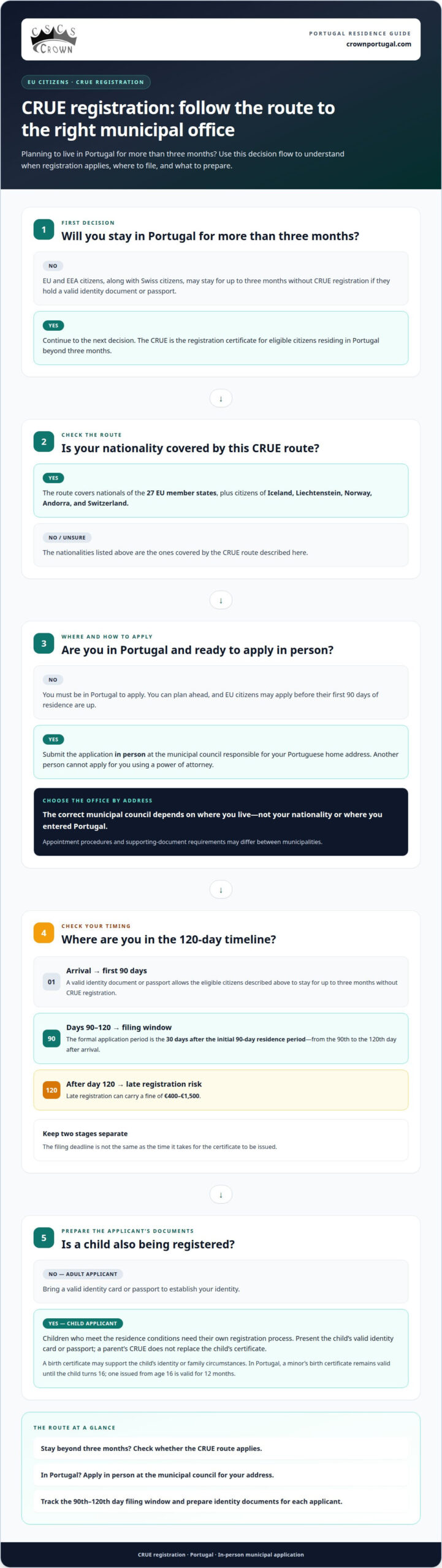
Yes, you must be in Portugal to apply for CRUE certificate registration as an EU citizen, and you must submit the application in person at the municipal council for the area where you live. The application period runs from the 90th to the 120th day after arrival: the filing deadline is 30 days after the first three months of residence.
It’s understandable to want to arrange this early, especially when you’re coordinating a move and other paperwork. EU citizens can apply before their first 90 days in Portugal are up, but the certificate itself can’t be obtained through a power of attorney.
This guide explains where to apply for CRUE certificate registration for EU citizens in Portugal, what to prepare, and how the application deadline differs from the time it takes to issue the certificate. You’ll also learn how long the CRUE remains valid and when to plan for renewal.
Key Takeaways
- Apply at the municipal council for the area where you live, and prepare to submit the application in person.
- Plan for the CRUE’s five-year validity and learn when to begin the renewal process.
- Understand how the CRUE differs from a residence card and a NIF, so you can identify which document fits your situation.
- Late registration can carry a fine of €400-€1,500, making the filing deadline important.
- Municipalities may differ in appointment procedures and supporting-document requirements, so prepare for local variations.
Where EU citizens apply for CRUE
EU citizens planning to live in Portugal for more than three months apply for a Certificate of Registration, commonly called the CRUE. You must apply in person at the municipal council responsible for your area of residence.
Application submission locations
Submit your application to the municipal council responsible for your Portuguese address. The correct office depends on where you live, not your nationality or where you entered Portugal. You must be in Portugal to apply; another person cannot submit the application on your behalf using a power of attorney.
The CRUE route covers nationals of the 27 EU member states, as well as citizens of Iceland, Liechtenstein, Norway, Andorra and Switzerland. This includes a Swiss citizen intending to reside in Portugal for more than three months. A valid identity card or passport is required, so bring the document you will use to establish your identity.
Before attending, identify the municipal office linked to your address and prepare the relevant application materials. Portugal’s CRUE registration is governed by Law No. 37/2006. The certificate records an EU citizen’s registration for residence; it is distinct from simply exercising the right of movement during a short stay.
Children who meet the residence conditions also need their own registration process. Present the child’s valid identity card or passport, rather than relying only on a parent’s identification. A birth certificate may support the child’s identity or family circumstances; in Portugal, a minor’s birth certificate remains valid until the child turns 16, while one issued from age 16 is valid for 12 months.
Application timing
EU and EEA citizens, along with Swiss citizens, may stay in Portugal for up to three months without CRUE registration if they hold a valid identity document or passport. If the stay will continue, the application period is the 30 days after the initial 90-day residence period, meaning the filing window runs from the 90th to the 120th day after arrival.
Early planning is useful: EU citizens can apply before completing their first 90 days of residence. That option can help people coordinate the application with a move, while the formal filing deadline remains tied to the first three months after entry. Do not confuse the registration deadline with the time taken to issue the certificate; these are separate stages.
First, establish your Portuguese address and identify the corresponding municipal council. Prepare a valid identity document for each applicant, then arrange to submit the application in person within the applicable period. If registering a child, plan for the child’s own application: a parent’s CRUE does not replace the child’s certificate.
Certificate validity and renewal
A CRUE is valid for five years. Note its expiry date as soon as you receive it. This validity period applies to the registration certificate, not automatically to every residence document held by family members. Keep the certificate details with your important Portugal records, such as rental documents, so you can find them when planning your next step.
Plan ahead for renewal before your CRUE expires. AIMA manages renewal, and starting within that period gives you time to organise the application before the printed validity ends. For example, if your certificate expires in October, use the 60-90-day window before that expiry to plan the renewal process.
Keep the original certificate and its expiry date accessible as you prepare. Before arranging an appointment, identify the renewal process and documents relevant to your circumstances. You may need information about your current residence in Portugal and your identity. Bring a current passport or identity card, as well as the existing CRUE you intend to renew.
Renewal and permanent residence are different routes. After five continuous years of legal residence in Portugal, an EU citizen may apply for a separate permanent residence certificate. That document is valid for 10 years and costs €15. The five-year period concerns continuous legal residence, rather than simply the date printed on the original CRUE.
Distinguish between the CRUE’s five-year expiry date and the date you complete five years of continuous legal residence. The first helps you plan for renewal; the second may allow you to apply for a permanent certificate. If you are a Swiss citizen, keep your residence record and identity document together when considering your next administrative step.
Use this sequence to organise your records:
- Record the CRUE expiry date when you obtain the certificate.
- Plan renewal within the 60-90 days before expiry, with AIMA handling the process.
- Track your continuous legal residence separately if you intend to apply for permanent residence after five years.
Check each family member’s document and expiry date separately. Do not assume a family member’s residence document shares the EU citizen’s CRUE validity period. Separate records help prevent confusion between an individual renewal, a permanent residence application, and another family member’s document.
How does CRUE registration differ from getting a Portuguese residence card or NIF?
The CRUE, a Portuguese residence card, and a NIF serve different administrative purposes. The correct document depends on the applicant’s nationality, family relationship, and reason for handling paperwork in Portugal. Understanding the differences helps you choose the right process instead of treating every document as proof of residence.
CRUE: The Certificate of Registration is for eligible EU citizens residing in Portugal for more than three months. CRUE certificate registration for EU citizens in Portugal records their registration under the applicable residence route. The right to reside beyond three months depends on conditions such as employment, self-employment, sufficient resources, or study. The CRUE is neither a tax number nor the residence card issued to a non-EU family member.
Portuguese residence card: This section refers to a residence document for a non-EU family member accompanying or joining an EU citizen. Portuguese law provides a card commonly called the “Article 15” card for dependent relatives of an EU citizen resident in Portugal. A family member must provide evidence of the relationship or partner status, along with the EU citizen’s registration certificate. For example, an EU citizen and a non-EU spouse follow separate document routes, even when applying as one household.
NIF: The Portuguese tax identification number, or NIF, is used for tax-related administration. It does not register an EU citizen’s residence or replace a family member’s residence document. You may need a NIF alongside your residence paperwork, but obtaining one does not complete CRUE registration.
Identify the applicant’s status before choosing a process:
- An EU citizen planning a stay beyond three months should consider CRUE registration.
- A non-EU family member joining an EU citizen should use the family-member residence-card route and provide relationship evidence.
- A person needing a Portuguese tax identifier should apply for a NIF separately.
These documents are not interchangeable, even if your household needs more than one. A non-EU spouse may need a residence card based on the EU citizen’s status, while the EU citizen holds a CRUE. Either person may also need a NIF for tax administration. Completing one step does not automatically complete the others.
Start by identifying whether the applicant is an EU citizen, a non-EU family member, or someone seeking only a tax identification number. Then prepare documents for the relevant process. This helps prevent a NIF application from being mistaken for residence registration, or an EU citizen’s CRUE from being treated as a family member’s residence card. CRUE certificate registration for EU citizens in Portugal covers the citizen’s registration, not every separate administrative need in a household.
What are the penalties for late CRUE registration?
Missing the CRUE registration deadline in Portugal can expose an EU citizen to a fine of €400-€1,500. The deadline is separate from the time needed to review an application or issue a certificate. A late filing and a longer processing period are therefore different situations: one concerns when registration is submitted, while the other concerns what happens after submission.
The timing of the late application matters. After 12 months of residence in Portugal, an EU citizen applying for the CRUE must pay the fine directly to AIMA before the certificate can be processed. This means the application cannot move into processing until the required fine has been paid. Someone who has passed the deadline but has not yet reached 12 months should still act promptly, rather than treating the later AIMA payment rule as extra time to wait.
For example, an EU citizen who has lived in Portugal for more than 12 months and has not registered should prepare to address the fine before expecting the certificate process to proceed. An applicant who is already late but below that 12-month point should submit their application without further delay. The amount and the payment step are not the same: the stated fine range is €400-€1,500, while the direct-payment-before-processing condition applies after 12 months of residence.
Use this practical sequence if your registration is overdue:
- Establish how long you have lived in Portugal, using your entry and residence timeline.
- Identify whether you have passed the first 90 days and whether residence has exceeded 12 months.
- Apply through the CRUE route for the municipality where you live.
- If residence has exceeded 12 months, pay the fine directly to AIMA before certificate processing.
Keep the application deadline distinct from the certificate’s eventual issue date. Filing late is the issue that may trigger the fine; waiting for a decision after filing does not change the original submission date. Likewise, the 12-month point affects the payment step described for late applicants, not the standard processing period.
Late registration does not change the need to use the correct route. The CRUE applies to eligible EU citizens intending to reside in Portugal beyond the short-stay period. A non-EU family member has a separate residence-document route, and a NIF does not substitute for CRUE registration. If your residence has already exceeded 12 months, organise the application and the AIMA payment step together so the file can proceed once the fine is paid.
Do CRUE procedures vary by municipality in Portugal?
Yes. Apply for a CRUE at the Câmara Municipal responsible for your Portuguese residence. Appointment arrangements and supporting-document requirements can vary between town halls. Applicants follow the same general registration route, but may need different evidence or submission arrangements depending on their municipality.
Some municipal offices require an appointment in advance; others may handle submissions differently. Treat the appointment as a separate planning step, not as proof that your documents are complete. For example, a resident in Lisbon should follow the process of the council responsible for their address, while someone living elsewhere should use their own municipality’s procedure. Applications are not submitted to a council chosen for convenience.
Document requests may depend on the basis of your residence. An employed applicant may need to declare their work status, while a self-employed applicant applies under that work category. Applicants relying on sufficient resources or studying at an officially recognised educational establishment have different circumstances to document. Some Portuguese town halls may request at least three months of bank statements to assess financial support. This is not a universal requirement across every municipality.
Use a practical preparation sequence:
- Identify the Câmara Municipal responsible for your Portuguese address.
- Establish whether that office requires an appointment before submission.
- Organise your evidence around your circumstances, such as employment, self-employment, study, or sufficient resources.
- Allow for additional financial evidence, including three or more months of bank statements where the municipality requests it.
Local variation matters particularly when your application is based on financial resources or study. If you rely on your resources, be ready to explain how you support yourself; if you are a student, your case centres on recognised enrolment and financial means. The municipality may request supporting evidence in a particular form, so documents accepted by one town hall may not meet another’s requirements.
The registration route is national, but practical submission details can vary locally. Your municipality is determined by your residence, while its appointment system and document requests shape how you prepare. Allow time to arrange an appointment and gather any local evidence, especially bank statements if your application is based on sufficient resources.
If you need help organising your Portugal residence paperwork, get support with your CRUE application before submitting it to your municipal office.
Crown Portugal: Portugal Digital Nomad D-8 Visa
Crown Portugal offers the Portugal Digital Nomad D-8 Visa for readers considering that visa pathway. It is separate from CRUE registration, which is the municipal registration route discussed above for eligible EU citizens. If your next step concerns CRUE, focus on the municipality responsible for your residence and its application process. If you’re exploring a visa route instead, Crown Portugal also offers the Portugal Passive Income D-7 visa, Portugal Golden Visa D-9, and NIF Registration (Personal Tax Number). These options address different administrative needs, so the relevant next step depends on your circumstances and the route you’re pursuing. For assistance with an applicable service, contact Crown Portugal or visit crownportugal.com.
Plan your next Portugal residence step
Align your CRUE application with your broader plans in Portugal. If your circumstances change or you’re preparing documents for family members, keep each person’s residence route and administrative needs distinct. CRUE certificate registration for EU citizens in Portugal is one part of establishing residence; other immigration or tax matters may involve separate processes.
Crown Portugal assists with Portuguese residence matters, including processes for EU nationals and their non-EU family members. Its other services address separate needs, including visa applications and NIF registration. To take the next step, tell Crown Portugal which document or process you’re managing and what support you need.
For guidance with your Portugal residence paperwork, contact Crown Portugal about CRUE. A clear plan can help you move forward with confidence.
Frequently Asked Questions
Do I have to be in Portugal to get the CRUE?
Yes. You must be physically present in Portugal to apply for the CRUE, and you cannot submit the application through a power of attorney. Plan to attend the municipal process in person rather than arranging submission from abroad. If you’re moving with family, prepare each applicant’s documents and attendance arrangements separately, even if you plan to attend together.
Who is obliged to obtain a CRUE?
Nationals of EU member states, Iceland, Liechtenstein, Norway, Andorra, and Switzerland need to register if they intend to live in Portugal for more than three months. The right to stay beyond that period is linked to conditions such as work, sufficient resources, or study. An employed applicant, for example, has different circumstances from a student or someone relying on personal resources.
How to apply for CRUE?
Apply in person to the Câmara Municipal responsible for your Portuguese residence. Prepare a valid passport or identity card, then assemble supporting documents relevant to your circumstances, such as employment, study, or financial means. Submit within the applicable filing period; applying before the first 90 days have ended is also possible. Keep the application date and any receipt or submission record with your residence documents.
What is the CRUE certificate in Portugal and who needs it?
The CRUE is Portugal’s Certificate of Registration for eligible EU citizens residing in the country beyond a short stay. It records the citizen’s registration and is distinct from a NIF or a residence card for a non-EU family member. An EU citizen and a non-EU spouse may need separate documents under different procedures, even if they share a Portuguese address.
How long can EU citizens stay in Portugal before registering for a CRUE?
EU citizens may stay in Portugal for up to three months without CRUE registration if they hold a valid identity card or passport. If you plan to stay longer, you can apply early; there’s no need to wait until the initial period ends. If you’re moving for work or study, prepare the relevant evidence before your intended application date.
Where do EU citizens apply for a CRUE in Portugal?
Apply at the Câmara Municipal responsible for the area where you live in Portugal. The council responsible for your residence determines the correct submission location, so a nearby municipality may not be the right office. Use the municipality associated with your home address, not simply the one closest to your workplace or arrival point.
What documents are required to apply for a CRUE in Portugal?
You need a valid passport or identity card. Depending on your circumstances and local requirements, supporting documents may include a Portuguese tax identification number, proof of address, and evidence of income. Workers, students, and applicants relying on sufficient resources may need different supporting evidence. Family-member applications also require proof of the relationship or partner status and the EU citizen’s registration certificate.
How do EU citizens book a CRUE appointment with their local Câmara Municipal?
Appointment arrangements depend on the municipality, and some town halls require advance booking. Identify the Câmara Municipal responsible for your address, then follow its published appointment process or contact its public office for submission instructions. Have your identity document and residence details ready when arranging attendance. If applying as a family, ask whether each applicant needs an individual appointment or can attend together.