

Portugal higher education visa consultant for student costs and support
A Portuguese student visa isn’t simply “easy” or “difficult”: the outcome depends on presenting a clear, complete application. For a stay longer than 90 days, students must apply for a higher-education residence permit. Financial means may include a grant, scholarship, work contract or promise, or a responsibility undertaking, according to Imprensa Nacional-Casa da Moeda, S. A.; a Portugal higher education visa consultant can help organize the application around these requirements.
It’s understandable to want clarity before committing to a course, especially when admission documents, immigration steps, and budgets all need attention. This guide explains the student residence permit process, the documents commonly needed for admission and a visa application, and how tuition and living expenses shape your study budget.
You’ll also learn what to prepare, how residence requirements differ for EU and non-EU students, and where professional visa support fits into the process. The aim is to make each decision easier to assess as you plan your studies in Portugal.
Key Takeaways
- Identify the residence route that matches your nationality, course length, and current status before planning your move.
- Treat university admission and immigration paperwork as connected steps, and keep your supporting documents consistent across both applications.
- Build a study budget that separates tuition from everyday expenses, since fees vary by institution and programme.
- Use a clear application sequence to prepare evidence, submit the visa application, and plan the transition to residence in Portugal.
- Consider specialist visa support when you need help organizing the process and understanding which documents apply to your circumstances.
Residence permits for higher education students
For studies lasting more than 90 days, the required route depends on nationality, current residence status, and course duration. Distinguish the entry visa from the residence registration or permit required for a longer stay.
Student Visa Application Steps
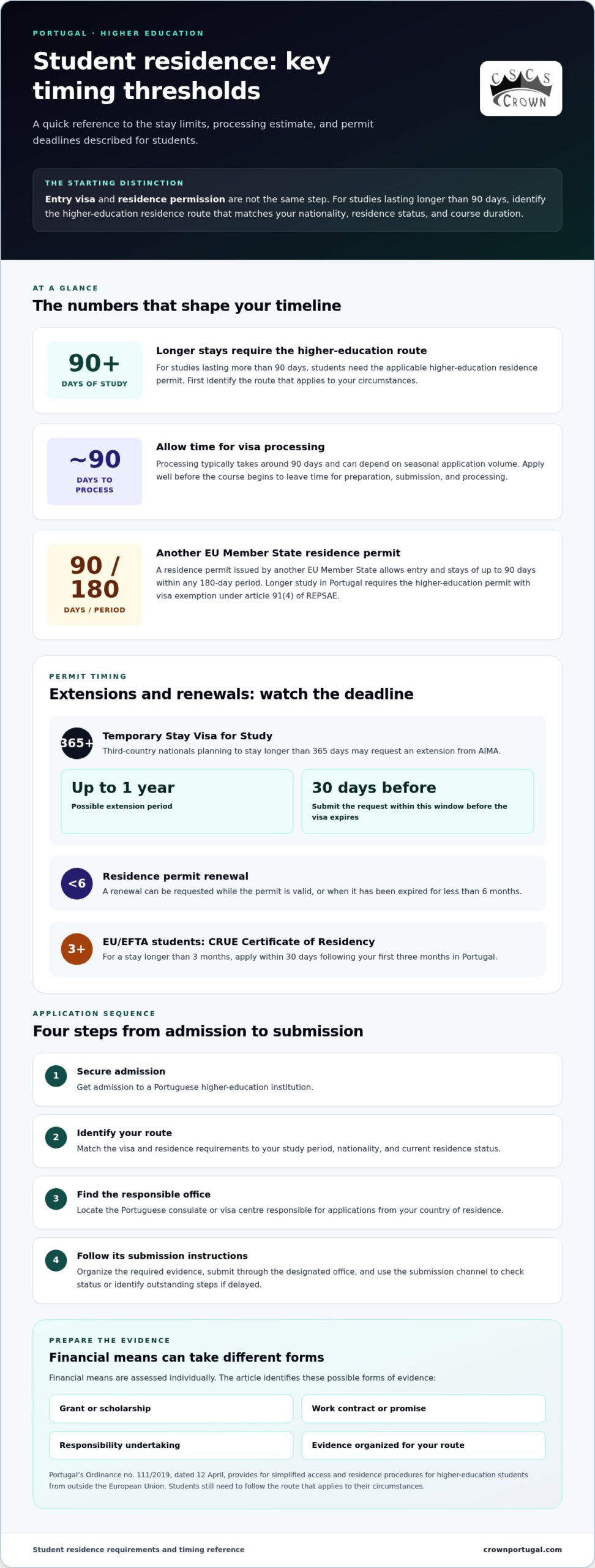
First, secure admission to a Portuguese higher-education institution and identify the visa route matching your study period. Then locate the Portuguese consulate or visa centre responsible for applications from your country of residence. Follow that office’s submission instructions and organize the required evidence. A residence permit issued by another EU Member State allows entry and stays of up to 90 days within any 180-day period; longer study requires the higher-education permit with visa exemption under article 91(4) of REPSAE.
Portugal’s Ordinance no. 111/2019, dated 12 April, provides for simplified access and residence procedures for higher-education students from outside the European Union. Students still need to follow the application route that applies to their circumstances.
Application Timing and Delays
Portugal student visa processing typically takes around 90 days, depending on seasonal application volume. Apply well before your course begins, allowing time to prepare documents, arrange submission, and account for processing. If an application is delayed, use the submission channel to review its status and identify any outstanding step. If refused, read the reasons, address the specific gaps, and prepare a complete application before taking further action.
Third-country nationals holding a Temporary Stay Visa for Study who plan to stay longer than 365 days may request an extension from AIMA for up to 1 year. Submit the request within 30 days before the visa expires. A residence permit renewal can be requested while valid or when it has been expired for less than 6 months.
Financial Evidence and Permit Costs
Financial means may include a grant, scholarship, work contract or promise, or a responsibility undertaking, assessed individually, according to Imprensa Nacional-Casa da Moeda, S. A. Scholarships and grants are available to EU and non-EU students enrolled at universities recognized by Portugal’s Ministry of Education.
Visa and residence-permit charges depend on the applicable application and permit procedure. EU/EFTA students staying in Portugal longer than 3 months must apply for a CRUE Certificate of Residency within 30 days following their first three months in the country. Non-EU students should check the applicable requirements before working while studying in Portugal.
Education and visa support services
Choosing a Portuguese degree involves more than comparing tuition fees. Assess the program language, admission requirements, application deadlines, and immigration steps that follow acceptance. Portugal offers university and non-university higher education, with programs taught in Portuguese, English, German, and French. Match your academic background and language ability to each program’s published criteria.
Course selection can shape both the learning experience and future career options. Compare the curriculum, teaching language, qualification level, and whether the program supports your academic or professional plans. Portugal has more than 150 courses available in English and more than 125 public and private universities. These figures provide a starting point for research, not a substitute for comparing each institution’s admissions requirements.
What education and visa support can cover
Portugal has three application sessions for international students. The listed August-September period is one application window; universities commonly schedule fall intake in September or October, with a limited spring intake in February. Build a calendar around the program’s deadline, allowing time to gather academic records and immigration documents. Missing a university deadline can affect your study plan even if your visa paperwork is ready.
Checking a consultant’s legitimacy
To reduce the risk of a visa scam, verify the business identity, get a written description of the work and charges, and keep copies of every document submitted. Treat guaranteed visa approval as a warning sign: a consultant can help organize an application but cannot decide its outcome. Never share account passwords or sign forms you haven’t read.
Ask for a clear explanation of which tasks concern university admission and which involve immigration preparation. For example, a consultant may help organize a document checklist, while the university assesses academic eligibility and the relevant authorities decide immigration applications. Written responsibilities clarify who handles each step and what remains your responsibility.
Before selecting a program, make a comparison table with the institution, course language, qualification, application session, and required documents. Add a separate column for questions requiring a direct answer from the university, such as whether prior study meets its entry criteria. For visa guidance alongside this planning, explore Portugal visa guidance.
Tuition and living costs
Plan your study budget in Portugal in two parts: university tuition and everyday living expenses. Use these figures as a planning range, then compare them with your chosen institution and accommodation.
Tuition depends on the institution, degree level, program, and student category. Public and private universities set their own fees, and specialist subjects may have different costs. Compare the fee schedule for your chosen program rather than assuming similar degrees cost the same. Higher education is paid, except for PhD students and researchers. Review the institution’s published tuition information and note which course expenses are included.
Living costs depend on where you study and your housing arrangement in Portugal. Assess accommodation, food, local transport, and study expenses around your institution. Housing choices can substantially change your budget, so list recurring expenses separately from one-off purchases.
Before accepting an offer, make a written budget with four headings: tuition, accommodation, daily expenses, and study-related costs. Record the institution’s actual tuition under the first heading. Add estimated monthly living expenses under accommodation and daily expenses, then list course materials or equipment under study-related costs. This makes it easier to see which costs drive your total and where personal choices can affect it.
For example, compare two offers by annual tuition, course language, location, and expected housing arrangement. A science program may require different materials from a program in another field, so review course details alongside the fee schedule. If you’re considering universities in different countries, compare the full study budgets, not tuition alone. Keep the application calendar in view, since an offer’s start date affects when funds need to be available.
Financial planning also supports the visa process: your application needs evidence of means, and a grant or scholarship may form part of that evidence. Keep award letters and university fee information with your budget. Revisit your figures if your institution, program, or accommodation changes, so your plan reflects your actual study arrangements.
For EU students studying in another European country, tuition fees are charged at local rates. Check whether this applies when comparing your study options.
How do you apply for a Portugal higher education student visa step by step?
Follow a sequence that connects university admission, visa preparation, and the residence procedure. For a course requiring a stay longer than 90 days, the student visa and higher-education residence permit are separate parts of the process. Keep the institution’s admission instructions beside your immigration checklist so each stage supports the same study plan.
- Choose a course and apply for admission. Compare the program’s qualification, language of instruction, entry criteria, and application session. Portuguese universities commonly offer fall intake in September or October, while some have a limited February intake. Apply directly according to the institution’s timetable and retain its admission correspondence.
- Obtain confirmation of enrollment. A student visa applicant must confirm enrollment at a Portuguese institution and demonstrate an intention to study in Portugal. Keep the admission or enrollment evidence with your course details. Check that names, dates, and program information match across the university documents and visa application.
- Identify the correct application channel. Find the Portuguese consulate or visa centre that handles applications from your country of residence. Its location determines where you submit the application and how you arrange submission. Use that channel’s instructions to organize the required forms and supporting evidence for your study purpose.
- Prepare the application file. Include evidence of enrollment and financial stability, along with the required identity documents. A Portuguese student visa application generally requires two recent passport-type photographs in good condition. The passport or other travel document must remain valid for three months after the estimated return date.
- Submit and follow the residence process. Submit through the responsible channel, then retain copies of the application and any submission records. After arrival, follow the applicable higher-education residence-permit procedure if your stay exceeds 90 days. EU/EFTA students follow a different registration route, including the CRUE Certificate of Residency for qualifying longer stays.
Financial evidence can take different forms. A grant, scholarship, work contract or promise, or responsibility undertaking may support the application, according to Imprensa Nacional-Casa da Moeda, S. A. Organize the evidence to show how it relates to your study period and available resources. Keep award letters, relevant contracts, and institutional documents together rather than submitting disconnected records.
Before submission, compare the completed form against your enrollment evidence, passport details, photographs, and financial documents. Correct inconsistencies before presenting the file. Processing times vary; Portugal student visa processing typically takes around 90 days, depending on seasonal application volume. Planning the university application and visa submission as linked steps helps you account for both admission deadlines and immigration processing.
What documents are required for a Portugal student visa, including proof of admission and finances?
Prepare documents that show who you are, where you will study, and how you will support your stay. Portuguese student visa applicants must confirm enrollment at a Portuguese institute and demonstrate financial stability and an intention to study in Portugal. Arrange the file by purpose so admission evidence, identity documents, and financial records are easy to review together.
- Proof of admission: Include evidence confirming enrollment at the Portuguese institution. Keep the course and institution details consistent with the information in your visa application. This connects your stated study purpose with the program you plan to attend.
- Passport or travel document: The document must be valid for 3 months after the estimated date of return. Compare its personal details with the admission evidence and application before submission.
- Photographs: A Portuguese student visa application generally requires 2 recent passport-type photographs in good condition that identify the applicant. Prepare photographs that meet these stated requirements.
- Financial evidence: Organize documents showing the resources supporting your study and stay. Financial means may include a grant, scholarship, work contract or promise, or a responsibility undertaking, assessed individually, according to Imprensa Nacional-Casa da Moeda, S. A.
A scholarship award letter can link financial support to your education plan. If a work contract or promise supports your means, keep it with your other financial evidence. A responsibility undertaking is another possible form of evidence. Present the document that reflects your actual arrangement rather than relying on a generic statement about available funds.
Use a simple review sequence before submission. First, compare the applicant’s name and identifying details across the passport, photographs, and application. Next, confirm that the admission evidence identifies the Portuguese institution and study program. Then group the financial evidence, placing any grant or scholarship documents beside related records. This sequence can reveal mismatched details before you submit the file.
Keep a copy of the assembled file and a record of what you submit. The Portuguese consulate or visa centre responsible for applications from your country provides the submission channel and instructions. Follow its directions on document format, and keep any submission confirmation with your copies. If the institution updates your enrollment information, add the new record to your application materials.
Visa documentation supports your study plan; it does not replace the university’s admission decision. For example, you may have evidence of financial support but still need enrollment confirmation from a Portuguese institute. Treat admission and financial records as separate parts of one application file. Review each document against its purpose: proving enrollment, identifying the applicant, or demonstrating financial means for study in Portugal.
Crown Portugal: Portugal Digital Nomad D-8 Visa
Crown Portugal provides the Portugal Digital Nomad D-8 Visa for people considering a move to Portugal through a digital nomad route. This is distinct from the higher-education student visa and does not replace the student residence process described above. It may be relevant if your plans also include relocating as a digital nomad rather than solely for university study.
If your immediate purpose is studying, keep your application focused on university admission and the applicable student visa route. If your circumstances involve a separate digital nomad plan, Crown Portugal can help you understand the D-8 application pathway. Contact Crown Portugal to discuss which immigration route aligns with your plans.
Make your Portugal study plan actionable
Your next step is to turn your intended course and relocation timeline into one organized plan. List the decisions still open, such as the program, admission schedule, financial evidence, and immigration route that fits your purpose. This gives a Portugal higher education visa consultant a clear basis for discussing the support you need and the documents to prepare.
Crown Portugal also offers the Portugal Digital Nomad D-8 Visa, Portugal Golden Visa D-9, and NIF Registration (Personal Tax Number). These address different circumstances from a student residence route, so keep your study purpose central when discussing your plans.
Contact Crown Portugal for student visa support to discuss your next steps. A clear plan can help you approach your studies in Portugal with greater focus and confidence.
Frequently Asked Questions
Is a Portugal student visa easy?
Preparing admission, finances, and immigration paperwork in a consistent order makes the process more manageable. The main challenge is showing that the course is genuine, enrollment is confirmed, and financial evidence supports the study plan. For example, if you rely on a scholarship, keep its award information aligned with the institution and course named in your application. Missing or conflicting details can complicate assessment.
What are Portugal’s student visa requirements for higher education students?
Applicants need confirmed enrollment at a Portuguese institution, evidence of financial means, and documents identifying the applicant and supporting the study purpose. Admission eligibility is separate from immigration eligibility: Portuguese university applicants must have completed 12 years of schooling, while each institution assesses its own entry criteria. Before applying, align your course information, identity details, and financial evidence, then follow the submission instructions for the consulate or visa centre handling your application.
What do Portugal education visa consultants do, and what services are included?
A Portugal higher education visa consultant can provide immigration guidance, review documents, help prepare an application, and assist with appointment scheduling. The practical value is procedural organization, such as checking that the study purpose and supporting records are presented consistently. The university decides academic admission, while immigration authorities assess the visa application. Crown Portugal offers immigration consultancy and application preparation for Portuguese visa routes. Its support can help you organize your documents and appointment preparation; the university and immigration authorities retain responsibility for their respective decisions.
What are the differences between applying independently and using a visa consultant for Portugal?
Applying independently means organizing the process yourself, interpreting the relevant instructions, and preparing your own application file. A consultant can add guidance through document review and application preparation, helping you spot inconsistencies before submission. Neither approach changes the university’s admission decision or immigration authorities’ assessment. Self-management may suit you if your case is straightforward and you’re comfortable with administrative details; additional guidance can help when the route or documents are harder to coordinate.