

How to Apply for a Portugal D4 Visa, Step by Step

The D4 visa’s initial validity is limited: it lasts four months and allows two entries, according to Portugal’s Ministry of Foreign Affairs. This gives you a defined period to enter Portugal and attend your AIMA appointment. A clear Portugal D4 visa step by step process helps you plan around that window, rather than treating the visa and your residence permit as the same stage.
It’s understandable to focus first on how long the visa lasts, but a successful application also depends on meeting the study-route requirements and presenting complete supporting documents. Financial evidence, insurance, family arrangements, appointment timing and fees all need attention before you submit.
This guide explains how to assess your eligibility, prepare your application and demonstrate your means of support, including when applying with family. It also covers what to expect at the appointment and during processing, so you can plan each step around your course start date and arrival in Portugal.
Key Takeaways
- Confirm that your course or other eligible activity fits the D4 route, and secure an acceptance letter from a Portuguese institution before preparing your application.
- Organise your passport, criminal record certificate, photographs, insurance and proof of paid application fees as a complete document set.
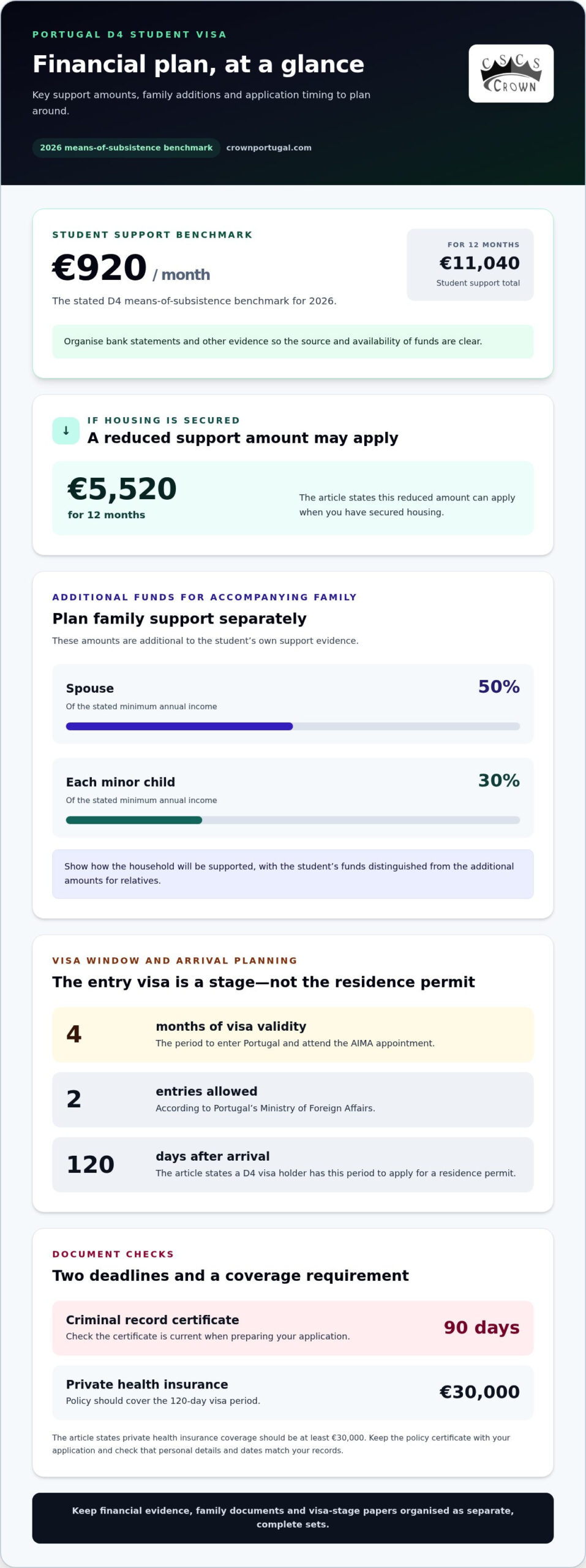
- For 2026, the means-of-subsistence benchmark is €920 per month; accommodation and accompanying family members can affect the financial evidence required.
- Plan around the visa’s four-month validity: according to Portugal’s Ministry of Foreign Affairs, it allows two entries and time to attend your AIMA appointment.
- Schedule the consular appointment with your course start date in mind, allowing time to assemble documents and for the application to be processed.
Application requirements and supporting documents
Prepare a complete application: study acceptance, identity records, financial evidence, relevant family documents and insurance. Keep the entry visa documents separate from those needed for the residence permit stage, so each set is ready when required.
-
Gather Required Visa Application Documents
Start with your Portuguese institution’s acceptance letter and a valid passport, then assemble the remaining application documents. Include two recent passport photographs measuring 3.5 × 4.5 cm, proof of paid visa application fees, and bank statements that support your financial evidence. Applicants over 16 must provide criminal record certificates from their citizenship country and countries where they lived for more than a year after turning 16.
Check that each record is current: a criminal record certificate for a Portuguese D4 application is valid for 90 days. Use consistent names and personal details across the passport, acceptance letter, forms, and certificates.
-
Prepare Family Documents and Funds
If your spouse or minor children are applying with you, prepare a separate document set for each family member. Include each person’s passport and identity records, along with documents proving your relationship, such as a marriage or birth certificate. Make sure names and dates are consistent across records, and arrange translations where the application process requires them.
Include additional financial evidence for accompanying relatives. A spouse requires funds equal to 50% of the stated minimum annual income, while each minor child requires 30%. These amounts are additional to the student’s own support evidence, so organise the documents to show how the household will be supported.
-
Compile Visa and Residence Permit Documents
Keep the visa application papers together, but prepare to use some documents again for your residence permit appointment. The Portuguese D4 residence visa is valid for 4 months, during which the holder can enter Portugal and attend the AIMA appointment, according to the Ministry of Foreign Affairs of Portugal. Its validity is an entry period, not the residence permit itself.
The D5 route is different: it concerns a student holding a residence permit in another EU country who joins a mobility programme in Portugal for up to 360 days by notifying AIMA. A D4 application is not a substitute for that mobility procedure.
-
Include Required Insurance
Add private travel insurance to the D4 application and check that the policy covers the 120-day visa period. The stated private health insurance coverage should be at least €30,000. Keep the policy certificate with your application documents, and make sure its dates and insured person’s details match the passport and planned visa period.
Missing documents, unclear financial evidence or inconsistencies between your stated study purpose and supporting records can weaken an application. If your application is refused, read the decision notice, identify the stated grounds and follow its appeal instructions and deadline. Address each issue with relevant evidence.
Family applications and financial requirements
Plan the student application, household finances and each family member’s immigration steps together. Where you apply and how relatives can join you depend on your country of residence and each person’s circumstances.
- Calculate the student’s means of support first. In 2026, the D4 benchmark is €920 per month, or €11,040 for 12 months. If you have secured housing, the means-of-subsistence amount can be reduced to €5,520 for 12 months. Organise bank statements and other financial evidence so the source and availability of funds are clear.
Then account for accompanying relatives separately. A spouse requires additional funds equal to 50% of the stated minimum annual income, and each minor child requires an additional 30%. Present a household budget that distinguishes the student’s support from the additional amounts for family members.
- Decide how each family member will apply before booking appointments. Since October 2025, family reunification in Portugal generally requires two years of residence first, with an exception for minor children. This can affect whether relatives apply alongside the student or use a later reunification process.
Gather identity and relationship records for each relative, such as passports, marriage certificates and birth certificates. Check that names and dates match across documents, and show how each person’s financial evidence fits into the household plan.
- Apply through the Portuguese consular channel responsible for your country. Once you receive the school’s acceptance letter, book an appointment with the Portuguese Embassy or consulate handling applications from your country. If applications are submitted through a designated visa centre, follow its intake process and document instructions.
Consular procedures vary by country, including appointment booking, document submission and local intake arrangements. Confirm you are using the correct office for your country of residence, and keep the appointment confirmation with your application records.
- Keep the visa and residence permit stages distinct. After arriving in Portugal, a D4 visa holder has 120 days to apply for a residence permit. Track the arrival date and appointment arrangements, and retain copies of the submitted visa documents for the residence permit stage.
A D4 visa itself is not a work permit. Students may be able to work alongside their studies, but should check the conditions that apply to their residence status. Separate the student’s work conditions from any family member’s immigration status.
What are the eligibility requirements for the D4 Visa?
Assess your reason for staying, your acceptance by a Portuguese institution and your ability to support yourself. Your evidence should match the study activity and period described in the application.
- Identify the activity that supports your application. Portugal’s D4 route covers study, research, high-school student exchange, internships, and volunteer work. Applicants must be non-EU/EEA citizens planning the relevant activity in Portugal; the documents should show a clear connection between that purpose and the Portuguese institution or organisation involved.
Applications for higher education, vocational study and exchange programmes must establish an eligible study purpose and acceptance by the relevant Portuguese institution. The route depends on the activity and supporting acceptance, not simply on whether you describe the programme as university or vocational education.
- Obtain written acceptance before starting your visa application. The letter should identify the school or institution, the programme or activity, and you as the applicant. Compare these details with your application forms to keep the stated purpose consistent throughout your file.
For an exchange, internship, or volunteer placement, use documents that explain the activity and identify the host organisation. For a course, use the institution’s admission or acceptance record. A vague invitation that doesn’t establish the applicant’s role can weaken the link between the intended stay and the D4 purpose.
- Prepare financial evidence that reflects the planned period in Portugal. In 2026, the means-of-subsistence benchmark is €920 per month, or €11,040 for 12 months. Arrange evidence so the available funds, account holder, and period covered are easy to understand.
Include the family’s additional financial needs where a spouse or minor child is applying with the student. A spouse requires additional funds equal to 50% of the stated minimum annual income; each minor child requires 30%. The financial plan should account for the applicant and accompanying relatives, not only tuition.
- Include private travel insurance with the application. The policy should cover the 120-day visa period, and private health insurance should provide at least €30,000 in coverage. Match the insured person’s name and policy dates to the passport and planned travel period.
Before submitting, compare the acceptance letter, financial records and insurance certificate against the same applicant details. This final check helps align the study purpose, evidence of support and insurance coverage across the application.
Financial means and proof of accommodation
Prepare financial records and housing evidence as one consistent account of your planned studies in Portugal. For 2026, the applicable benchmark and secured-housing adjustment provide the starting point for organising your application.
- Calculate the amount for the period you intend to support. In 2026, the benchmark is €920 per month, or €11,040 for 12 months. If you have secured housing, the means-of-subsistence amount can be reduced to €5,520 for 12 months. Use the figure that matches your accommodation situation, and make the calculation period clear in your application.
Do not treat tuition payments as a substitute for evidence of living costs. Show course fees, funds for daily expenses and housing costs as distinct parts of your financial plan.
- Collect bank statements covering three to six months. Put them in date order and check that the account holder’s name matches the passport and application form. Make deposits, balances and access to funds clear, rather than relying on an unexplained closing balance.
If someone else is supporting your studies, include evidence explaining your relationship and the support arrangement. Link that person’s financial records to your plan and show how the funds will be available during your stay.
- Document accommodation in Portugal before relying on the reduced €5,520 amount. Use records that identify the housing arrangement and show it is secured for your stay, such as a rental agreement or accommodation confirmation. Keep the address and dates consistent with the application form and planned study period.
If your housing evidence covers only part of your stay, document the remaining arrangements separately. A short booking for your arrival does not establish accommodation for the full period, so match your supporting evidence to the duration stated in your application.
- Reconcile the student’s funds with any accompanying family members. A spouse requires additional funds equal to 50% of the stated minimum annual income; each minor child requires 30%. List the student and each relative separately, then show the total household amount and the records supporting it.
For example, an application for a student, spouse and minor child should identify the requirements for each person rather than relying on a single combined balance. This helps connect the financial evidence to every family member named in the application.
- Review every financial and housing document before submitting. Check that account names, passport details, accommodation addresses and study dates agree across the records. If the application form lists a different address from the housing agreement, explain the difference with supporting documents.
Keep copies of your submitted bank statements and accommodation evidence. These records can also help explain your arrangements later, including during the residence permit process after you arrive in Portugal.
Visa processing time, fees, and appointments
Schedule your consular appointment with your course start date in mind, leaving time for document review and the later residence permit stage. Processing estimates, fees and appointment arrangements vary depending on the consulate handling your application.
- Book the visa appointment after receiving your Portuguese institution’s acceptance letter. Apply at least 3 months before your programme starts, allowing time to gather records and respond to document requests. The appointment location depends on your country of residence; follow the application channel used by the Portuguese consulate responsible for your case.
In some countries, a visa application centre receives documents and biometrics on behalf of the consulate. Check your appointment confirmation for submission instructions, required original documents and whether each family member must attend. Keep the confirmation with your application records.
- Budget for the consular fee and retain proof of payment. The D4 visa application fee is €110, and holders of a Portuguese State scholarship can apply without a visa fee. The payment receipt should match the applicant named on the form. Ask the appointment centre to record the receipt with the submitted documents.
Keep the visa fee separate from any charges for the later AIMA residence permit appointment in your budget. This is especially important when relatives are applying with the student.
- Allow for processing time before booking non-refundable travel. D4 visa processing is estimated at 30-90 days, while the Portuguese consulate has 60 days to decide an application. Treat the decision period and broader processing estimate as planning guides, not as identical milestones. The consulate may need to assess the acceptance letter, financial record, insurance, and criminal record certificate.
Check your passport validity and course dates against the expected timeline. If a decision arrives close to the programme start, contact your school about enrolment arrangements and keep the consulate’s application reference available for status enquiries.
- Prepare for the AIMA stage before travelling to Portugal. The first student residence permit decision is due within 90 days, or 60 days if the university is approved. Most D4 visas include a pre-scheduled AIMA appointment within 120 days of arrival, and the residence permit card is received about 2-12 weeks after the appointment.
Keep your appointment notice, passport, acceptance records, and copies of your visa application together. For structured help coordinating the D4 application stages, use D4 visa application support.
Crown Portugal: Portugal Digital Nomad D-8 Visa
Crown Portugal supports applicants considering Portugal’s Digital Nomad D-8 Visa when remote work, rather than study, is the basis for moving. The appropriate route depends on your purpose for residence and the evidence your application must provide. If your plans involve passive income, the Portugal Passive Income D-7 visa may be relevant; Crown Portugal also offers NIF Registration (Personal Tax Number) for tax identification needs in Portugal.
Use the D4 steps above to organise your study application, and consider another route only when its purpose fits your circumstances. For guidance on the next immigration step, contact Crown Portugal.
Choose your next step with confidence
Your next move is to align your immigration route with your actual plans in Portugal. The Portugal D4 visa step by step process is useful for preparing a study application, while a different purpose may call for another route. Crown Portugal offers the Portugal Digital Nomad D-8 Visa and Portugal Golden Visa D-9, as well as NIF Registration (Personal Tax Number). These options address distinct immigration and administrative needs, so consider which one matches your circumstances before proceeding.
If you’re ready to discuss your application or identify a suitable next step, contact Crown Portugal about your Portugal plans. A clear plan can help you move forward with greater confidence and focus on preparing for your next chapter.
Frequently Asked Questions
How long is the D4 Visa valid for?
The Portuguese D4 residence visa is valid for 4 months and allows two entries, according to the Ministry of Foreign Affairs of Portugal. This is the visa’s validity period, not the duration of the residence permit issued after arrival. Keep the visa dates in mind when planning entry and your AIMA appointment, since the permit application is a separate stage of the process.
What is the application process for the D4 Visa?
Secure acceptance from a Portuguese institution, prepare the required application records, and submit them through the Portuguese consular channel responsible for your country. Attend the appointment and pay the applicable visa fee, unless you hold a Portuguese State scholarship. The Portugal D4 visa step by step process also includes planning for the residence permit stage after arrival. Keep copies of your submitted documents and appointment records.
What documents are required for a Portugal D4 visa?
Prepare a valid passport, the Portuguese institution’s acceptance letter, completed application materials, proof of funds, private travel insurance, photographs, and proof of visa-fee payment. Include a criminal record certificate from your home country. Applicants over 16 also need certificates from countries where they lived for more than a year after turning 16. Check that names and personal details match across every document.
How do you apply for a Portugal D4 visa step by step?
To follow the Portugal D4 visa step by step process, first obtain acceptance for your eligible study or other qualifying activity. Assemble identity, criminal record, insurance, and financial documents, then book an appointment through the relevant Portuguese consular channel. Submit the application and payment evidence, and wait for the decision before arranging travel. After entering Portugal, follow the instructions for your residence permit appointment.
Where do you submit a Portugal D4 visa application in your country?
Apply through the Portuguese Embassy or consulate responsible for your country of residence. In some countries, a designated visa application centre receives applications on the consulate’s behalf. Local procedures determine where you book, how you submit documents and whether you need to attend in person. Use the consular jurisdiction covering your residence, rather than choosing an office solely for convenience or based on your nationality.
How much does the Portugal D4 visa application cost, including fees and insurance?
The consular application fee is €110, and holders of a Portuguese State scholarship can apply without a visa fee. Private travel insurance is required, with health coverage of at least €30,000 for the visa application. Insurance premiums depend on the policy and coverage period. Budget separately for any later residence permit appointment charges, since those are distinct from the visa application fee.
What are Portugal’s D4 visa income, accommodation, and financial requirements?
In 2026, the means-of-subsistence benchmark is €920 per month, or €11,040 for 12 months. Applicants with secured housing may qualify for a reduced amount of €5,520 for 12 months. Provide financial records that make the funds and account holder clear, and include accommodation evidence that matches the planned stay. Family members add separate financial requirements to the student’s own support.
What should you do after arriving in Portugal on a D4 visa to obtain a residence permit?
Arrange the residence permit application and AIMA appointment after arriving in Portugal. A D4 visa holder has 120 days after arrival to apply for a residence permit. Bring the appointment notice and keep your passport and application records accessible. Retain copies of the acceptance and supporting documents submitted for the visa, as they help keep your residence application details consistent.