

Portugal Specialized Worker Visa Consultancy Fees and Costs

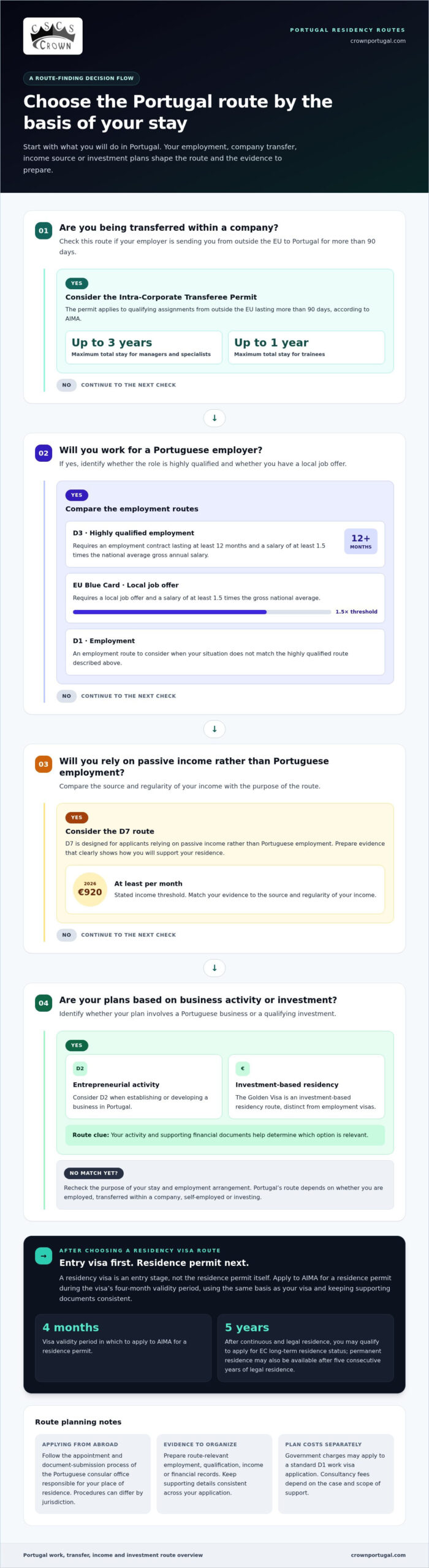
A transfer assignment and a local job offer follow different Portuguese residency procedures. For qualifying assignments from outside the EU lasting more than 90 days, Portugal’s Intra-Corporate Transferee Permit applies, according to Agência para a Integração, Migrações e Asilo (AIMA). The maximum total stay is three years for managers and specialists, and one year for trainees. Government charges may apply to a standard D1 work visa application, so include them in your cost planning. A Portugal specialized worker visa consultancy can help applicants understand which route fits their employment or investment plans and prepare the supporting documents.
It’s reasonable to want a clear picture of the process before committing time and money: visa category, income or investment evidence, timing, government charges and professional support all affect planning. This guide explains how worker and investor residency routes work, what the application steps involve, and which factors shape the overall costs. Consultancy fees depend on the case and are provided after a quote request; the route, document requirements and level of assistance all influence the scope of support. You’ll also see how employment arrangements, financial evidence and accommodation documents can affect an application, so you can assess the next steps with a more complete understanding of the process.
Key Takeaways
- Match your residence route to the purpose of your stay, such as employment, an internal company transfer, or investment.
- Understand how visa consultancy can help organize your application, and how its role differs from legal representation.
- Assess income requirements and processing expectations against your employment arrangement and supporting evidence.
- Plan for government charges separately from consultancy fees, which depend on the case and scope of support.
- Prepare clear evidence of financial means, insurance and accommodation to support your application.
What are the main residency options for work and business in Portugal?
Portugal’s visa route depends on whether you are employed, transferred within a company, self-employed, or investing. Your category determines the evidence to prepare and the steps toward residence.
Temporary and Residency Visa Categories
Temporary-stay visas cover limited periods, while residency visas allow applicants to enter Portugal and pursue a residence permit. For example, the D1 route concerns employment, while D2 supports entrepreneurial activity. Portugal’s Intra-Corporate Transferee Permit applies to qualifying assignees sent from outside the EU for more than 90 days, according to Agência para a Integração, Migrações e Asilo (AIMA).
How D3, the EU Blue Card, and Other Work Routes Differ
The D3 route serves highly qualified employment and requires an employment contract lasting at least 12 months. Highly qualified applicants need a salary of at least 1.5 times the national average gross annual salary. The EU Blue Card also requires a local job offer and a salary at least 1.5 times the gross national average. D1 is another employment route, while intra-company transfer applies to eligible company assignees.
D7 Income and Residence Requirements
The D7 route is designed for applicants relying on passive income rather than Portuguese employment. In 2026, the stated income threshold is at least €920 per month. Compare the source and regularity of your income with the route’s purpose, then prepare evidence that clearly shows how you will support your residence in Portugal.
Business and Investor Routes
Entrepreneurs can consider the D2 route when establishing or developing a business in Portugal. The Golden Visa is an investment-based residency route, distinct from employment visas. Applicants should identify whether their plans involve a Portuguese business, qualifying investment, or a local employment contract before assembling evidence. The activity and supporting financial documents help determine which route is relevant.
Consulate Appointments for Applicants Abroad
If you are applying from abroad, follow the appointment and document-submission process of the Portuguese consular office responsible for your place of residence. Procedures can differ by jurisdiction. Identify the responsible office, then prepare the required documents in the stated format before your appointment.
Residence Permits After a Residency Visa
A residency visa is an entry stage, not the residence permit itself. You must apply to AIMA for a residence permit during the visa’s four-month validity period. Prepare the application on the same basis as the visa, such as employment or highly qualified work, and keep supporting documents consistent. The length and renewal terms of a temporary residence permit for a highly qualified worker can depend on the applicable permit conditions.
Permanent and EU Long-Term Residence
After five years of continuous and legal residence, you may qualify to apply for EC long-term residence status in Portugal. Permanent residence may also be available after five consecutive years of legal residence. These are later-stage options, not substitutes for maintaining valid residence during the initial period. Keep records of your permits and residence history to support a future application.
Immigration lawyer and visa consultancy services
A visa consultancy can help organize an application, while a lawyer can advise on legal issues and appeals. Common weaknesses include missing documents, inconsistent information, and evidence that does not support the chosen route. If your application is refused, address the reasons stated in the refusal notice.
Immigration Consultations
An immigration consultation can help clarify which Portuguese route matches your work arrangement, intended length of stay, and residence plans. Bring your employment offer or transfer details, qualifications, and available supporting records. An adviser can compare your information with the route’s criteria and identify documents that need clarification.
Use a consultation to map the application stages, responsibilities, and outstanding evidence. For example, an employee applying through a highly qualified work route should organize employment terms and qualification records together. A clear checklist helps distinguish essential evidence from supplementary records and spot gaps before submission.
Immigration Legal Assistance
Legal assistance is most relevant when an application raises questions about eligibility, interpretation, prior immigration history, or refusal. A lawyer can assess the legal issues and explain procedural options. A visa consultancy can focus on practical preparation, such as organizing forms, checking document consistency, and clarifying the submission sequence.
These roles are not interchangeable. Before engaging support, clarify whether it covers document preparation, legal advice, communication with authorities, or representation in proceedings. Keep signed employment documents, identity records, and correspondence together. A well-organized file gives an adviser a consistent record to review and helps prevent conflicting details in the application.
Refusal Reasons and Appeals
Common weaknesses include incomplete evidence, contradictions between the application and employment records, and documents that do not demonstrate the chosen route’s requirements. After a refusal, read the decision notice carefully, identify each reason, and organize evidence that addresses those points. Follow the review or appeal instructions in the notice, including the applicable procedure and deadline.
A response should address the decision, not simply repeat the original application. If the notice questions the job description, for example, focus on the relevant employment evidence and explain any discrepancy. If a document was missing, determine whether the procedure allows it to be supplied at that stage. Keep the refusal notice, application, and supporting records together for review.
Visa income thresholds and processing times
Income evidence and processing timelines depend on the visa category and work arrangement. When planning, distinguish the salary test, government charges, and document preparation.
Visa Income Thresholds
For Portugal’s highly qualified work routes, the stated salary threshold is 1.5 times the national average gross annual salary. The relevant evidence should connect the employment offer, salary terms, and professional qualifications. Check that the contract and supporting documents describe the same role and remuneration, since inconsistencies can complicate assessment.
Other routes use different income tests because they support different activities. In 2026, the D8 route requires at least €3,680 per month in remote income, while the D7 route requires at least €920 per month in passive income. These are distinct from a Portuguese employer’s salary offer. Identify the income source first, then assemble records that clearly show its amount and regularity.
Work Visa Processing Time
The approximate timeframe stated for obtaining a Portuguese work visa is 60 days. Treat that as a planning estimate, not a guaranteed appointment or decision date. Completeness matters: missing documents, unclear employment terms, or records requiring further review can affect the practical schedule.
For a highly qualified worker application, organize the file in a logical sequence: employment contract, role description, qualifications, identity documents, and supporting income evidence. Check names, dates, and job details across every record before submission. If documents need translation or certification, plan that work alongside the visa application.
Applicants asking about fees and timing should distinguish the highly qualified route from other work categories. The listed government application fee for a D1 work visa is €159, while the approximate work visa timeframe is 60 days; the D1 fee should not be treated as a D3 fee. Application charges and residence-permit costs relate to separate stages, so budget by route and procedure.
Consultancy support can help structure the file and track practical steps, but it does not replace your evidence. Start by matching your work arrangement to the visa category, then check the contract and income records against that route. If you work independently, account for social security registration, which is mandatory when registering as a freelancer or sole trader.
Before submission, make a document list and mark each item as ready, awaiting translation, or needing an update. This helps identify gaps without confusing visa evidence with later residence formalities. Keep copies of submitted forms and correspondence together in case the application requires clarification or additional documents.
Consultancy and government fees
Separate the consultancy charge from government fees, document costs, and later residence administration. For Portugal, the listed government fee for a D1 work visa application is €159. That figure applies to the D1 application, not automatically to other visa categories or every stage of residence.
When assessing a Portugal visa consultancy, review its stated qualifications, written service scope, and available client feedback. Compare the written quote with the specific tasks covered, such as route assessment, document organization, and application preparation, rather than relying on a headline price alone.
Consultancy pricing depends on the case and is provided after a quote request; the visa category, application complexity, document preparation, and level of assistance affect the scope. A D3 application with detailed professional qualifications may require different preparation from an application based on a straightforward employment offer. The quote should make clear which tasks it covers and which government charges remain separate.
Build a cost plan by separating expenses into practical groups:
- Government charges: visa application and residence-related fees, identified by route and stage.
- Consultancy work: assessment, document review, form preparation, and procedural guidance included in the agreed scope.
- Supporting documents: translation, certification, or replacement records required for the applicant’s file.
- Relocation administration: items such as tax registration or social security registration, where relevant to the applicant’s circumstances.
This distinction matters because a consultancy’s professional fee is not a government charge. For example, an applicant planning employment in Portugal should budget separately for the D1 government application fee and any agreed consultancy support. A Golden Visa applicant follows a different route, so the relevant government charges and evidence requirements must be assessed for that category rather than copied from a work-visa estimate.
Review a written quote in stages. First, confirm the visa category and named applicant. Then check which services are included, which documents you must provide, and whether any work is charged separately. Finally, distinguish government fees from consultancy charges. This makes the expected costs clearer before application work begins.
Education, employment history, and immigration records can affect how much document preparation is needed. For example, qualifications or employment records that need translation may bring additional document-related expenses. Applications involving dependants or complex prior residence history may also require more coordination. These factors affect the scope of support, not the government fee for a particular application category.
Keep the quote, payment record, application copy, and government receipts together. Good recordkeeping helps distinguish consultancy work from official payments throughout the visa and residence process.
The listed €159 government fee applies to a D1 application and does not automatically apply to the D3 highly qualified-worker route. Consultancy pricing is provided after a quote request and depends on the case and services included.
Proof of subsistence, insurance and accommodation
Financial and housing records should present a consistent picture of your planned residence in Portugal. Organize documents by purpose: showing available support, explaining income, and establishing where you intend to live. A foreign worker with a signed employment contract will have a different financial profile from an applicant relying on passive income.
For the D7 route, the stated 2026 passive-income threshold is at least €920 per month. Evidence should make the income source and regularity understandable, such as matching statements with records identifying the payments. For an employment-based application, keep the contract and related income documents together. The job title, employer, and remuneration should be consistent across the file.
Accommodation evidence should connect you to a real address or housing arrangement in Portugal. Treat the stated figure as an example of a possible rental cost, not a universal price: costs vary by location and city. Keep tenancy or booking records consistent with your intended stay.
- Subsistence: arrange income statements and supporting records by source, including employment income or passive income.
- Employment: keep the signed contract, employer details, and related financial records together.
- Insurance: if insurance documents form part of the application file, include the policy certificate and ensure the named insured matches the applicant’s identity records.
- Accommodation: organize housing records by address, applicant name, and intended period of residence.
Consistency is the practical test. If a contract names one role but the supporting explanation describes another, the file may be difficult to assess. A bank record is also easier to interpret when you can identify the source of funds. Use a document index to show what each record supports, then compare names, dates, addresses, and employment details before submission.
A qualified professional can review how financial, insurance, and housing evidence fits your selected route. A lawyer can also help explain legal questions about a document or the application requirements. For example, group foreign income statements with clear descriptions of their source, and keep accommodation evidence in a separate section.
Prepare the file in a practical order: identify your income basis, collect the relevant records, arrange accommodation evidence, and add insurance documents where applicable. Then check the complete set for consistency before submission. Crown Portugal offers Accommodation in Portugal for applicants arranging a place to live as part of their relocation planning.
Crown Portugal: Portugal Digital Nomad D-8 Visa
Crown Portugal supports applicants pursuing its Portugal Digital Nomad D-8 Visa, a relevant option for professionals whose work is remote. If your income comes from employment or work outside Portugal, organize the documents that show your work arrangement and financial evidence before beginning the application. Applicants with investment or passive-income circumstances may wish to explore whether a suitable residency route is available. NIF Registration (Personal Tax Number) may also be relevant to settling administrative matters in Portugal. The appropriate route depends on the purpose of your stay and the evidence available, so compare those details before deciding on your next application step. To discuss your Portugal residency plans, contact Crown Portugal or visit crownportugal.com.
Move Forward With a Clear Application Plan
Your next step is to build an application file that reflects your actual work, income, and intended residence in Portugal. A Portugal specialized worker visa consultancy can help you identify the relevant route and organize supporting documents. Contact Crown Portugal to discuss your Portugal visa application and relocation needs.
Crown Portugal offers the Portugal Digital Nomad D-8 Visa and Portugal Golden Visa D-9, as well as NIF Registration (Personal Tax Number). These options address different residency and administrative needs, so consider which best matches your purpose in Portugal before proceeding. A focused discussion can help clarify the relevant service and the next practical steps for your application.
Contact Crown Portugal about your visa to discuss your plans and take the next step toward preparing your Portugal application.
Frequently Asked Questions
How does the residency procedure work for transferred workers and investors?
Transferred employees and investors use different Portuguese residence routes: eligible assignees apply through an intra-corporate transfer route, while investors pursue an investment-based option. Portugal’s Intra-Corporate Transferee Permit applies to qualifying assignees sent from outside the EU for more than 90 days, according to Agência para a Integração, Migrações e Asilo (AIMA). For a temporary-stay transfer visa, the applicant must have worked in a senior or specialised role for the sending entity for at least one year. Begin by documenting the employer relationship and assignment.
How long does the process take?
The approximate timeframe stated for obtaining a Portuguese work visa is 60 days. This is useful for initial planning, but it isn’t a complete relocation schedule: document preparation, appointment arrangements, and the later residence-permit stage also take planning. Build a personal timeline by listing each task, such as obtaining employer records, preparing translations, and arranging submission. Keep the visa application and residence-permit steps distinct in your schedule.
How much income do I need for a Portugal visa in 2026?
Income requirements depend on the visa category and source of funds. In 2026, the stated D8 threshold is at least €3,680 per month in remote income, while the D7 threshold is at least €920 per month in passive income. Highly qualified work routes use a salary threshold of 1.5 times the national average gross annual salary. Identify whether your evidence is employment, remote, or passive income before comparing it with a route’s requirement.
What services can expatriates in Portugal benefit from?
Relocation can involve both immigration procedures and practical settlement needs. Crown Portugal offers NIF Registration (Personal Tax Number), Social Security Number (NISS), accommodation in Portugal, and airport pick-up. For example, a new resident may need a NIF for administrative tasks and accommodation support while arranging a move. Choose services based on your immediate needs, such as registration, housing, or arrival logistics.
Which documents are required for obtaining a residence permit in Portugal?
Prepare a document file that establishes your identity, visa basis, and living arrangements. Depending on the route, useful records include your passport, residence visa, employment contract, qualification evidence, income documents, and accommodation records. Keep names and key details consistent. For example, check that the employer and role in your contract match the application. Organize the file by purpose so each record supports a clear part of your case.
What is Portugal’s specialized worker visa, and which visa or residence permit applies to highly qualified professionals?
Portugal does not use one single visa for every specialised worker; the applicable route depends on the role and employment arrangement. Highly qualified professionals may use the D3 visa or the EU Blue Card route. The D3 requires an employment contract lasting at least 12 months, and its salary threshold is 1.5 times the national average gross annual salary. Compare your contract, qualifications, and salary evidence with the route before preparing the application.
How do you apply for a Portugal specialized worker visa, and what documents are required?
Start by identifying the work route that matches your contract, then assemble documents supporting it. A practical file may include a valid passport, employment contract, role description, qualification records, and income evidence. Check that names, job details, and salary terms align across documents. If applying from abroad, follow the appointment and submission procedures of the Portuguese consular office responsible for your place of residence. Keep copies of submitted forms and supporting records.
Which Portugal visa consultancies specialize in highly qualified worker and work visa applications?
Crown Portugal is an immigration consultancy supporting Portuguese visa applications for professionals, among other applicants. People looking for a Portugal specialized worker visa consultancy can review its Portugal Visa for workers and Portugal D3 Visa step by step process offerings. Its professional immigration consultancy services include document review and application preparation. For a useful initial discussion, organize your employment details, qualifications, and intended route so the application’s practical requirements can be considered clearly.