

Portugal Digital Nomad Visa Spouse Sponsorship: Routes, Documents and Steps for 2026
What if the best route for your spouse depends on whether you apply together or wait until you’re resident in Portugal? That timing is central to Portugal digital nomad visa spouse sponsorship. A spouse may be able to apply for a residence visa alongside the main D8 applicant, while family reunification is a separate route for joining someone who already holds residence in Portugal.
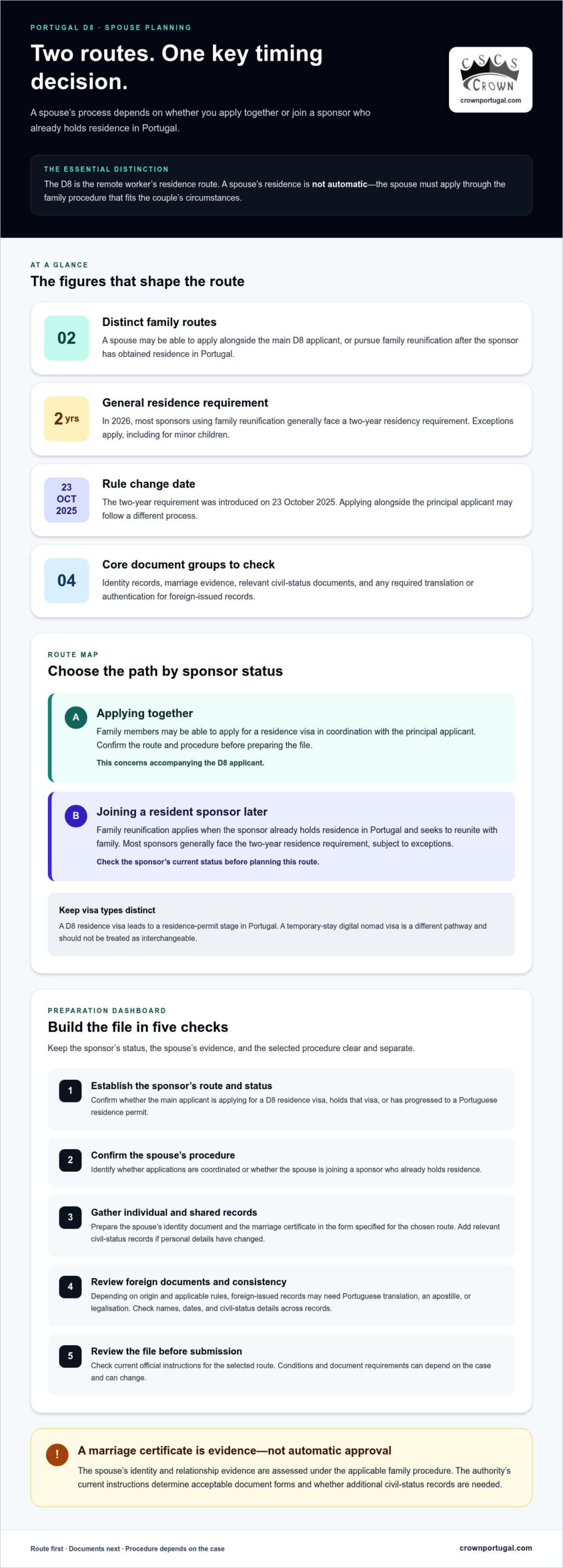
It’s understandable to be unsure which process applies. The D8 visa type and the main applicant’s stage of relocation can affect the next steps. In 2026, most sponsors using family reunification generally face a two-year residency requirement, introduced on 23 October 2025, subject to exceptions. Applying together may follow a different process.
This guide explains how to identify the likely route, prepare relationship and supporting records, and plan the application sequence. It also covers why marriage certificates and other foreign documents may need authentication and Portuguese translation, and how the visa application stage differs from the residence-permit process. Organising the route and documents early can help you plan your household’s move with greater clarity.
Key Takeaways
- “Spouse sponsorship” is a common search phrase, not necessarily the formal name of a separate visa. The D8 route concerns residence in Portugal for qualifying remote professional activity.
- Portugal digital nomad visa spouse sponsorship depends on the D8 holder’s application route and timing. Identify the applicable procedure before assembling the file.
- A D8 holder’s approval doesn’t automatically grant a spouse residence. The spouse must follow the relevant application process and provide evidence of the relationship.
- Organise the application in sequence: establish the sponsor’s route, confirm the spouse’s procedure, gather individual and shared records, review the file, then submit.
- Structured document review and application preparation can help couples coordinate the immigration process and plan related relocation administration.
Portugal Digital Nomad Visa spouse sponsorship: what the term means
“Spouse sponsorship” is a useful search phrase, but it isn’t necessarily the official name of a standalone Portuguese visa. The D8 is the main applicant’s residence route for carrying out qualifying remote professional activity in Portugal. A spouse applies through the relevant family procedure, with the route depending in part on when the couple applies and the principal applicant’s immigration status.
In short: D8 eligibility belongs to the remote worker. A spouse’s right to join them must be assessed and applied for through the applicable family route.
Is there a separate Portugal D8 spouse visa?
There isn’t a separate visa category that should automatically be assumed from the phrase “D8 spouse visa.” The principal applicant applies based on their remote work and other D8 requirements. Their spouse applies on a family basis, providing evidence of the relationship and meeting the procedure’s requirements. For the main applicant’s eligibility and documents, see the complete 2026 D8 guide.
This distinction matters because approval of the worker’s application doesn’t, by itself, grant the spouse residence. The spouse needs a separate application and decision under the applicable family-related process. Portugal digital nomad visa spouse sponsorship is therefore best understood as a way to describe planning for that process, not as the name of a guaranteed or automatic visa benefit.
Accompanying family or later family reunification?
Depending on the circumstances, family members may be able to apply for a residence visa in coordination with the principal applicant, or pursue family reunification after the D8 holder has obtained residence in Portugal. These are distinct procedural routes. The first concerns accompanying the applicant; the second applies when the sponsor is already resident and seeks to reunite with family.
Timing can change the route. A D8 residence visa leads to a residence-permit stage in Portugal, while a temporary-stay digital nomad visa is a different pathway and shouldn’t be treated as interchangeable. Under family reunification rules effective from 23 October 2025, most sponsors generally face a two-year residence requirement, with exceptions including for minor children. Establish the sponsor’s status before planning a later application.
Before preparing forms or formalising documents, identify whether the principal applicant is applying for a residence or temporary-stay visa, whether the spouse will apply alongside them, and whether the sponsor already holds a residence permit. Check individual eligibility, terminology and procedure against current Portuguese official guidance, since requirements depend on the case and can change.
Who can join a Portugal D8 visa holder as a spouse?
A spouse’s application is assessed on a different basis from the remote worker’s D8 application. The principal applicant must qualify for the D8 route, while the spouse must qualify under the family procedure that applies to the couple’s circumstances. Marriage is central to documenting the relationship, but it shouldn’t be treated as automatic approval or proof that every procedural condition has been met.
For Portugal digital nomad visa spouse sponsorship, start by establishing two separate sets of facts: the sponsor’s immigration status, and the spouse’s relationship and identity evidence. The correct route and supporting file depend on whether applications are coordinated or the sponsor already holds residence in Portugal.
How the D8 holder’s status affects a spouse’s application
Before selecting a spouse route, establish whether the remote worker is applying for a D8 residence visa, holds that visa, or has progressed to a Portuguese residence permit. A spouse applying alongside the principal applicant may follow different steps from a spouse joining someone who is already resident. This distinction can affect where and how the application is made, and which sponsor documents belong in the file.
Don’t assume that income, accommodation or residence-duration conditions are identical across procedures. Verify the current requirements for the selected route against official guidance before relying on a threshold or preparing the final application.
What relationship evidence may need preparation?
Prepare the spouse’s identity records and evidence of the marriage as separate document groups. A marriage certificate is a key starting point, but the authority’s current instructions determine the acceptable form and whether additional civil-status records are required. Documents issued outside Portugal may need translation, an apostille or legalisation, depending on their origin and the applicable rules.
Check the file for consistency before submission. Differences in name spelling, dates or recorded civil status across passports and certificates can prompt questions or require clarification. A preliminary checklist may include:
- The spouse’s valid identity document and any requested identity records.
- The marriage certificate in the form specified for the application route.
- Relevant civil-status documents if names or personal details have changed.
- Required translations or authentication for foreign-issued records, based on current rules.
Keep a copy of each document and note which version is intended for submission. If a certificate uses a former name, for example, include the records needed to explain the change when the official checklist requires them. Crown Portugal provides document review and application preparation to help couples organise these details before filing. The applicable rules and final decision remain with the competent authorities.
Does a D8 visa automatically let a spouse move to Portugal?
No. Approval of the principal applicant’s D8 visa doesn’t automatically give their spouse permission to reside in Portugal. The spouse needs to qualify under the applicable family procedure and complete the required application. Portugal digital nomad visa spouse sponsorship is not a shortcut around that separate assessment.
The route often turns on timing: will the spouse apply in coordination with the D8 holder, or join after the sponsor has moved and established residence? These routes have different procedural contexts. The visa stage is also distinct from the later residence-permit process. After a residence visa is issued, the holder still proceeds through the relevant residence-permit stage in Portugal.
| Point to compare | Applying in coordination | Applying later through family reunification |
|---|---|---|
| When it may arise | The spouse’s application is prepared alongside the principal applicant’s D8 process. | The D8 holder has moved to Portugal and seeks to bring their spouse through a later family procedure. |
| Status to establish | The principal applicant’s visa category and the spouse’s eligibility under the relevant accompanying-family procedure. | The sponsor’s current residence status and whether the applicable family-reunification conditions are met. |
| Details to verify | Whether and how the responsible consular process accepts coordinated applications, and which documents each applicant must submit. | Current sponsor-residence conditions, application steps, and the evidence required for the spouse’s file. |
Applying alongside the principal D8 applicant
Before submitting, establish whether the spouse can apply through the accompanying-family procedure for the principal applicant’s specific visa type. Consular procedures and document instructions matter. Plan the intended travel sequence, prepare both applicants’ records, and make sure names, dates, addresses and details about the planned move are consistent across both files. A coordinated plan helps avoid treating the spouse’s application as an automatic extension of the D8 application.
Applying after the D8 holder has moved
Family reunification may be a later route, but the sponsor’s actual status matters. A visa, an application in progress and an issued residence permit are not interchangeable. The spouse’s file may need updated sponsor evidence, including proof of residence and accommodation, in the form specified by current instructions.
Portugal’s family-reunification rules introduced a two-year residence requirement for most sponsors from 23 October 2025, with exceptions, including for minor children. Confirm whether the rule applies to the particular case and check current official guidance before choosing the later route. Neither route guarantees a particular decision or timetable, so coordinate document preparation and travel plans around the applicable procedure rather than assuming both applications will be decided together.
How to prepare a Portugal D8 spouse sponsorship application
Prepare the application in a defined order. First establish the principal applicant’s visa route and current status. Next identify the spouse’s procedure, collect individual and shared records, review the complete file, and submit it through the correct channel. For Portugal digital nomad visa spouse sponsorship, this sequence helps keep the applicants’ evidence coordinated without treating their applications as one.
Keep the visa and residence-permit stages distinct. A residence visa is not itself a residence permit, and the next steps depend on the visa route and current procedure. The Portugal residence permit types guide explains this distinction. Once the immigration route is clear, the Portugal relocation checklist can help with wider household planning.
Build a spouse-focused document file
Use separate sections for the spouse’s personal records and for shared or sponsor evidence. This makes it easier to see what belongs to each applicant and spot missing items before submission.
- Spouse’s records: passport and other identity documents, relationship or civil-status evidence, and the forms and photographs required by the applicable procedure.
- Sponsor and shared evidence: proof of the D8 holder’s visa or residence status, relevant accommodation records, and any supporting information requested for the chosen family route.
- Document formalities: translations, certification, apostille or legalisation, where required for the document and its country of origin.
Use the current official checklist for the applicants’ circumstances to confirm document validity, photo specifications, translations, authentication and form versions. Don’t assume that one set of formalities applies to every document or application channel.
Review the file for consistency before submission. Check that names, dates of birth, marriage details and addresses match across passports, certificates and application forms. If a name has changed, include the supporting record required to explain the difference. A clear document index and labelled copies can also make it easier to respond if additional evidence is requested.
Coordinate submission and post-arrival steps
Confirm the competent application channel and appointment procedure for both applicants’ circumstances. Track each application separately, including submission references, appointment details, official messages and requests for further evidence. Keep copies of submitted forms and records so both applicants can refer to the same information.
After arrival, any registration or residence-permit steps depend on the visa route and current instructions. Crown Portugal provides document review and application preparation for Portuguese visa and family processes. Arrange structured support for your D8 and spouse application to organise the file and coordinate the next steps.
Plan your spouse’s Portugal D8 route with structured application support
A clear decision path makes the next steps easier to manage: identify whether the principal applicant is pursuing a D8 residence or temporary-stay route, establish the spouse’s applicable procedure, verify current official requirements, then prepare and review the evidence. For Portugal digital nomad visa spouse sponsorship, confirming the route first helps couples avoid assembling a file around the wrong process.
When application-preparation support can help
A structured document review can help identify missing records, inconsistent personal details or evidence that has been filed in a confusing order. Reviewing the principal applicant’s and spouse’s documents together can also clarify which information is shared, which belongs to each applicant, and what needs to be ready before submission.
Crown Portugal assists with Portuguese visa application preparation, document review and appointment scheduling. This administrative support helps couples organise their files and submission steps. It doesn’t determine the outcome: decisions remain with the relevant authorities, and no application-preparation process can guarantee approval or a fixed processing time.
Plan beyond the visa application
Once the spouse’s route and application sequence are clear, plan household administration as a separate relocation phase. Depending on your needs, this may include NIF registration, NISS acquisition, address registration or accommodation. Keeping these tasks distinct from the visa file helps maintain focus while preparing for the wider move.
Before proceeding, use this short checklist:
- Identify the principal applicant’s D8 visa type and current stage.
- Establish the spouse’s corresponding application route.
- Review current forms, document formalities, application channels and appointment instructions.
- Organise each applicant’s records, check for inconsistencies, and keep copies of submissions and official communications.
- Plan relocation administration separately, in line with your household’s needs.
For help organising visa preparation, document review, appointment scheduling and related relocation administration, explore Portugal immigration support.
Set a clear route for your move to Portugal
The key to Portugal digital nomad visa spouse sponsorship is identifying the spouse’s route before preparing the application. A D8 holder’s approval doesn’t automatically grant their spouse residence, and applying alongside the main applicant differs from seeking family reunification later. Confirm the current procedure, then organise relationship, identity and sponsor records against its requirements.
A coordinated file review can help uncover missing documents or inconsistencies before submission. Crown Portugal, an immigration consultancy founded in 2018, supports visa application preparation, document review and appointment scheduling. Couples can also plan related relocation administration, including NIF and NISS assistance, as a separate step in preparing their household move.
For structured support with your application and relocation planning, explore Portugal immigration support with Crown Portugal. With the route and next steps clearly mapped, you can move forward with greater confidence and prepare for your plans together.
Frequently Asked Questions
Can my spouse apply for a Portugal Digital Nomad Visa with me?
Yes, your spouse may be able to apply for a residence visa alongside your D8 application through an applicable family procedure. The spouse doesn’t apply as a second digital nomad unless they independently meet the D8 requirements. Confirm the route, application channel and consular instructions for your circumstances before submitting, and prepare separate applicant files with consistent shared information. Applying together doesn’t guarantee that both applications will receive the same decision or processing time.
Does Portugal’s D8 visa automatically include a spouse?
No. A D8 visa decision for the remote worker doesn’t automatically grant their spouse permission to live in Portugal. The spouse must make a separate application under the relevant family route and provide the required evidence. Portugal digital nomad visa spouse sponsorship describes this planning process, rather than a standalone visa or automatic entitlement. Identify whether the spouse will apply alongside the D8 applicant or through a later family procedure.
Can my spouse join me in Portugal after I receive my D8 residence permit?
Potentially. A spouse may be able to apply later through family reunification, subject to the sponsor’s status and the rules that apply to the case. Since 23 October 2025, most sponsors generally face a two-year residence requirement before applying, with exceptions, including for minor children. Check current official guidance to establish whether the requirement applies and what sponsor, accommodation and relationship evidence the spouse must provide.
What documents does a spouse need for Portugal D8 sponsorship?
Common preparation categories include the spouse’s passport and identity records, marriage certificate, application forms, and evidence relating to the D8 holder, such as visa or residence status. Supporting records may also include proof of remote work and income, accommodation, health insurance and a criminal-record certificate. The required file varies by route. Check current official instructions for document validity, translations, apostille or legalisation, photographs and any additional evidence.
Does a spouse need to meet the D8 income requirement separately?
The spouse doesn’t usually apply as a second D8 remote worker if joining through a family route, but the household may need to demonstrate additional means. The stated 2026 figures indicate a main-applicant threshold of €3,680 monthly, plus €460 for a spouse, making €4,140 for a couple. Confirm how income must be evidenced and which rules apply to your specific application before relying on these figures.
How long does Portugal D8 spouse sponsorship take?
There’s no single confirmed processing time for every spouse route. The typical D8 visa processing estimate is 30 to 90 days, but this shouldn’t be treated as a timeline for the spouse’s application or the full family process. Timing can depend on the application route, appointment availability, document completeness and requests for further evidence. Track each applicant’s case separately and avoid making fixed travel plans based on an estimate alone.
Can an unmarried partner join a Portugal D8 visa holder?
Possibly, if the relationship qualifies under the applicable family procedure and the couple can provide the required evidence. An unmarried partner shouldn’t assume that the process is identical to a spouse’s application: the authority may require evidence establishing a recognised durable partnership, alongside identity and sponsor records. Check current Portuguese official guidance for the applicable definition, proof requirements, document formalities and route before preparing or submitting an application.