

D7 Visa Rental Income Proof Requirements in Portugal: 2026 Guide

What if a signed lease still doesn’t show that your rental income is reliable? To meet the D7 visa rental income proof requirements Portugal applicants must address, connect the evidence: show your entitlement to income from the property, the rental arrangement, and the payments received.
A lease or a series of bank deposits may not be enough on its own. A lease doesn’t necessarily show that rent was paid, while a deposit may not identify its source or explain who is entitled to the money. A clear evidence package ties these records together, including when property or tax documents come from another country or are in a foreign language.
This 2026 guide explains which records can support each part of the evidence trail, how to organise them, and how to address gaps or inconsistencies before applying. It also covers the financial benchmark mentioned in current guidance and why you should check the instructions for your application route. Crown Portugal provides D7 document review and application preparation to help applicants organise their evidence before submission.
Key Takeaways
- The D7 visa rental income proof requirements Portugal applicants need to meet depend on current official guidance and the application route.
- Build a document trail connecting your entitlement to the income, the rental agreement, payments received, and your share of the proceeds.
- Consider how stable long-term rent, variable short-term receipts, or jointly owned property affect the evidence you need to explain.
- Reconcile figures across records, arrange translations if required, and use an index to guide the reviewer through your documents.
- A document review can help identify inconsistencies and gaps to address before you submit a D7 application.
What counts as rental income proof for a Portugal D7 visa?
Rental income proof is a set of records showing that you own a property or are entitled to its rental income, that a rental arrangement exists, that payments have been received, and that you can access or use the funds. A lease or bank statement can support part of that picture, but may not establish every link.
The D7 visa rental income proof requirements Portugal applicants must meet depend on current official guidance and the application route, including instructions from the Portuguese consulate or visa centre handling the application. Use general document lists as a starting point, then follow the applicable instructions before filing. The broader Visa policy of Portugal provides general context, but it doesn’t replace current, application-specific requirements.
How rental income fits the D7 passive-income application
Rental income is one possible passive-income source, subject to the rules that apply to your circumstances. Distinguish it from savings, which show funds held, and employment earnings, which come from work. Pensions and investment income have their own sources and supporting records. Evidence for one category doesn’t automatically prove another.
Consider both where the money comes from and whether it is available to you. A rental agreement and payment records can help establish the source. Ownership records, co-owner arrangements, or other relevant documents can clarify who is entitled to the proceeds. Bank deposits may show that money was received, but the account holder and access to the funds should also make sense in the context of the application. No single income figure or document guarantees that an application qualifies.
The four links in a persuasive proof trail
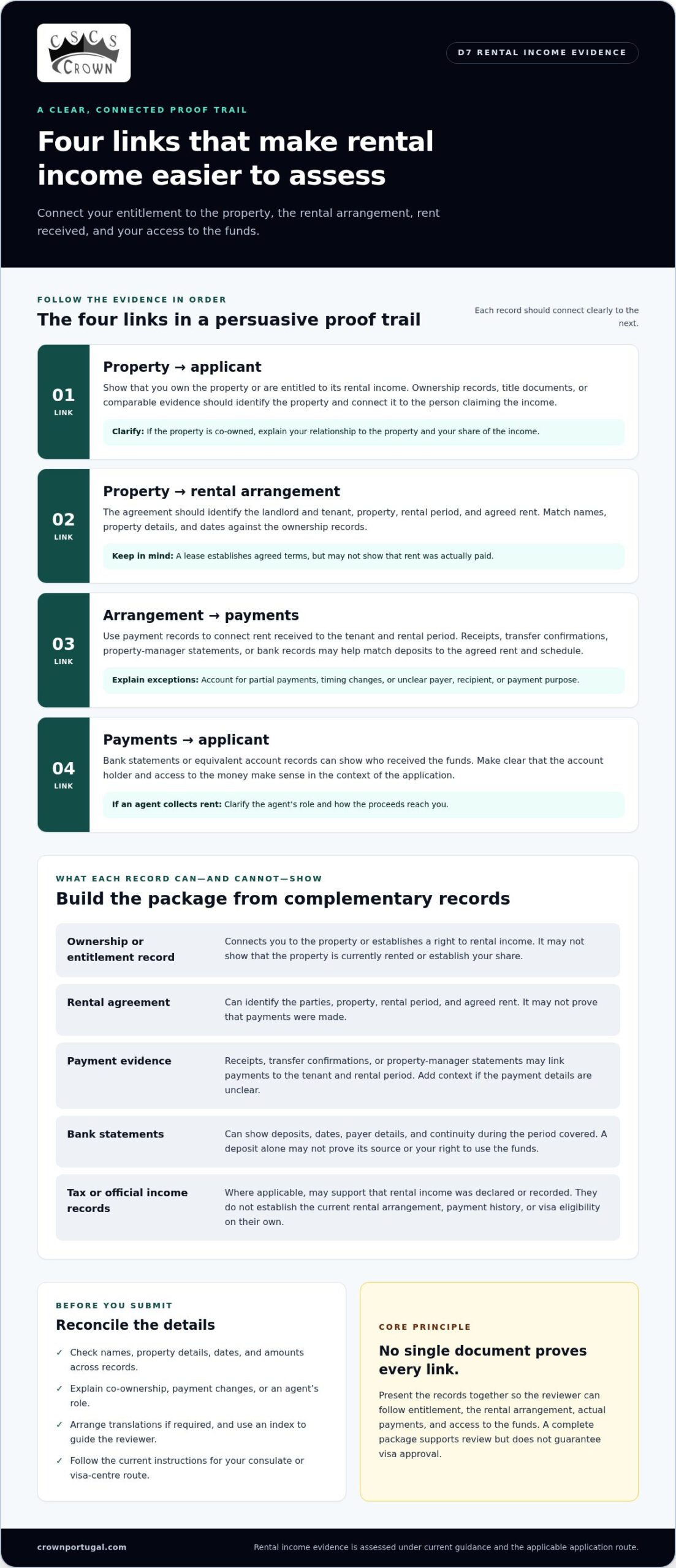
Arrange your evidence so a reviewer can follow these four links without having to infer missing details:
- Property to applicant: Ownership records, title documents, or other evidence of entitlement should identify the property and connect it to the person claiming the income. If the property is co-owned, clarify your relationship to the property and the income.
- Property to rental arrangement: The agreement should identify the property, tenant, and rental period. Check that names, property details, and dates match the ownership records.
- Arrangement to payments: Payment records should show that rent was received and help match deposits to the agreed rent and schedule. Explain partial payments or changes in timing instead of leaving them unexplained.
- Payments to applicant: Bank statements or equivalent account records can show who received the funds and whether you can access them.
No single document proves every link: persuasive rental-income evidence connects entitlement, the rental arrangement, actual payments, and the applicant. A lease can establish agreed terms, for example, but not necessarily prove that rent was paid. A deposit shows that money arrived, but may not identify its source. Present the records together, with consistent names, dates, and amounts, so the claim is easier to assess. A complete documentary package supports review, but it doesn’t guarantee visa approval.
Which documents can prove Portugal D7 rental income?
A useful document set shows what each record establishes, where another record fills a gap, and whether names, property details, dates, and amounts are consistent. The D7 visa rental income proof requirements Portugal applicants face can vary with current official guidance and the filing route. Treat the records below as potential supporting evidence, not a universal mandatory checklist. Check the relevant consular instructions and the Portuguese Ministry of Foreign Affairs Visa Information before submitting.
Use this guide to assess what your documents demonstrate and where additional context may help:
Ownership or entitlement record: Connects you to the property or establishes a right to receive its rental income. It may not show that the property is currently rented or establish your share of the income.
Rental agreement: Can identify the landlord and tenant, property, rental period, and agreed rent. It sets out the terms but may not prove that payments were made.
Payment evidence: Receipts, transfer confirmations, or statements from a property manager may link rent payments to the tenant and rental period. If the payer, recipient, or payment purpose isn’t clear, add an explanation.
Bank statements: Can show deposits, dates, payer details, and continuity during the period covered. A deposit alone may not prove that the funds are rent or that you’re entitled to use them.
Tax declarations or official income records: Where applicable, these may support a claim that rental income was declared or recorded. They don’t establish the current rental arrangement, payment history, or visa eligibility on their own.
Ownership records and rental agreements
Start with a property-title document, deed, registry extract, or comparable record from the property’s country. Match the property details and owner names to the rental agreement. Check that the agreement identifies the parties, property, rental period, and agreed rent. If there are co-owners, explain how the income is divided. If an agent collects the rent, clarify the agent’s role and how the proceeds reach you.
Payment records, bank statements, and tax documents
Use statements or payment records to trace deposits over the period covered. Note the dates, payer references, and currency. Compare each amount with the rental agreement. If fees, deductions, partial payments, or currency conversion account for differences, explain them rather than leaving mismatched figures without context. Tax records can support the income history, but declared amounts or reporting periods may differ from the cash received. Check whether your application route requires translations, particular document formats, or additional records.
Call a document “mandatory” only when the relevant official instructions say it is. Otherwise, explain what it supports and note any limitations. Crown Portugal reviews D7 documents to help organise records and identify inconsistencies to address before submission. Explore D7 application support to prepare a coherent evidence package.
Will rental income alone qualify, and what if the evidence is complicated?
Rental income may support a Portugal D7 application, but whether it is sufficient depends on current rules, your circumstances, and the evidence submitted. A strong record of rent doesn’t establish by itself that an application meets every applicable requirement. Check the current instructions for your filing route, especially if your income is irregular, shared, or difficult to trace.
The D7 visa rental income proof requirements Portugal applicants need to address can be more complex when receipts don’t follow the pattern in the agreement or when your personal share isn’t clear. Use the comparison below to identify what needs explaining and what records may provide useful context.
Stable long-term rent: Regular deposits may make the payment pattern easier to follow. Support the agreed amount and rental period with the agreement and account records.
Short-term or seasonal lets: Receipts can vary by month, and vacant periods can interrupt deposits. Match available payments to booking, rental, or management records, and explain periods without income.
Co-owned property: The total rent may be more than your personal income. Show the ownership arrangement and explain how the proceeds are divided or transferred to you.
Cash payments or amount differences: Cash may be harder to trace, while deductions, currency conversion, or partial payments can create mismatches. Provide available receipts or records and explain how the figures relate.
Variable rent, short-term lets, and payment gaps
Irregular receipts need context. For example, a property rented during selected periods may generate deposits in some months and none in others. Where records are available, connect each receipt to a booking, rental period, or payment statement. Identify vacant periods and distinguish them from late or missing payments. Short-term income isn’t automatically accepted or excluded; its relevance depends on current official requirements and the facts of the application.
Joint ownership, overseas records, and foreign documents
If a property has multiple owners, make your personal share clear rather than relying on the total rent. Explain how payments from the tenant or agent reach you, using relevant ownership and payment records. For documents issued overseas, check the filing authority’s current requirements for translation, certification, or legalisation. These requirements may depend on the document and application route. Keep names, dates, and amounts consistent across the original and translated records.
Proof that you own a property is not the same as proof that rental income belongs to you personally. A gap or discrepancy can make your evidence harder to understand, but it doesn’t mean automatic refusal. Address each issue directly, connect it to supporting records where possible, and verify document-format requirements before submission.
How to organise rental-income evidence before submitting a D7 application
A well-organised application lets a reviewer trace the income claim from its source to the records supporting it. Use this workflow to spot gaps and prepare a package that follows the current instructions for your filing route. For broader eligibility context, see the Portugal D7 passive-income guide.
- Define the claim. State which property generates the rent, who is entitled to the income, the period covered, and whether receipts are regular or variable. Keep this description consistent with your application forms and current official guidance.
- Collect the supporting records. Gather relevant ownership or entitlement records, rental agreements, payment evidence, bank statements, and applicable tax documents. Use the filing authority’s checklist to identify the documents required for your application.
- Reconcile the figures. Compare the rent in the agreement with deposits and other payment records. Identify differences caused by fees, partial payments, currency conversion, or vacant periods. Where supporting evidence is available, record the reason for each difference.
- Check names and details. Compare applicant and owner names, property descriptions, dates, currencies, amounts, and ownership shares across the records. Resolve spelling variations or unclear references with supporting documents, not by editing original records.
- Prepare translations and review the package. Check whether the relevant authority requires translations, certified copies, or legalisation. Review the complete set against the current application instructions, then arrange originals and copies in the requested format.
Build a clear document index and income summary
Create a short index that gives each document’s date, issuing party, relevant period, and purpose, such as proving ownership or recording a rent deposit. A separate income summary can show gross receipts and documented deductions, as long as each figure can be traced to the underlying records. Label items consistently and organise originals and copies as the application instructions require.
The index guides the reviewer; it doesn’t replace evidence. Don’t present estimates as confirmed income or combine currencies without showing how you calculated the figures. If a record covers only part of the period claimed, say so rather than implying that it proves a longer history.
Resolve inconsistencies before the application is filed
Address discrepancies with a concise explanation and relevant supporting records. Don’t alter, obscure, or selectively omit documents to make amounts appear consistent. Check current route-specific rules for translation, certification, and legalisation, as requirements may vary by document and authority. In your final review, confirm that every figure in your summary can be traced to a source record.
Professional document review can help identify inconsistencies and organise your evidence before submission. Arrange a review of your D7 rental-income documents as part of preparing your application package.
How Crown Portugal can help review D7 rental-income evidence
Rental-income records may come from different countries, institutions, and time periods. The challenge is making them work together to explain the property, rental arrangement, payments, and your entitlement to the income. Crown Portugal advises on the D7 passive-income visa, reviews documents, and prepares applications. This support helps applicants organise evidence and identify inconsistencies to address before submission.
What a focused document review can address
A focused review considers whether the records tell a consistent story. For example, it can compare ownership or entitlement documents with the landlord named in the agreement, then assess whether payment records and bank statements support the rental income described. If an agent collects rent or the property is jointly owned, the review can flag where your relationship to the funds needs a clearer explanation.
A review can also help surface practical issues that are easy to miss during self-review, including:
- Different spellings or versions of names across property, banking, and rental records.
- Rental periods that don’t align with payment dates, or statements covering only part of the period claimed.
- Differences between the agreed rent and deposits that need context, such as deductions, currency conversion, or shared ownership.
- Unexplained gaps, missing supporting records, or foreign-language documents that may need further preparation.
The purpose is to make issues visible so you can clarify them with relevant records or explanations. A review supports document preparation but doesn’t determine the outcome of an application. Eligibility and document requirements remain subject to current instructions and assessment by the relevant Portuguese authorities.
Plan the next step for a Portugal D7 application
Before a review, gather the property or entitlement records, rental agreements, payment evidence, bank statements, and relevant tax documents you have. Include any records that explain co-ownership, an agent’s role, interruptions in rent, or differences between amounts. A simple index showing each document’s date, source, and purpose can help organise the package. Keep the underlying records so each point can be checked.
For broader questions about the D7 route and passive-income eligibility, consult the complete Portugal D7 residency guide. Crown Portugal can also assist with application preparation and appointment scheduling, while keeping the evidence review focused on clarity, consistency, and the requirements for your filing route.
If you’re preparing a D7 application and want a structured review of your rental-income evidence, discuss your documents and D7 application with Crown Portugal. Start by outlining the property, the income claimed, and any records or inconsistencies you’re unsure how to present.
Make your next step a clear one
Before submitting, review your evidence from the perspective of someone unfamiliar with your rental history. Can they see how the property relates to you, how it generates income, and what each record establishes? If an explanation depends on details that aren’t immediately apparent, prepare it before filing and check the latest instructions for your application route.
Crown Portugal provides D7 document review and application-preparation support. A structured review can help identify inconsistencies and organise your materials, while the final decision rests with the relevant authorities. The D7 visa rental income proof requirements Portugal applicants face call for careful preparation, not assumptions about what any one document proves.
For support with your documents and next steps, discuss your Portugal D7 rental-income evidence with Crown Portugal.
Frequently Asked Questions
What documents prove rental income for a Portugal D7 visa?
Applicants commonly use property ownership or entitlement records, rental agreements, payment records, bank statements, and relevant tax documents. The D7 visa rental income proof requirements Portugal applicants must follow depend on current official instructions and the filing route, so treat these as possible supporting records rather than a universal checklist. For overseas property, use documents that identify the owner and property clearly, and make sure account records can be understood alongside them.
Can rental income qualify for a Portugal D7 visa?
Rental income may qualify as a passive-income source, subject to the rules and assessment that apply to your application. The authority considers your circumstances and the wider application, not just the existence of a rental property. Keep rental income distinct from savings and salary: savings show funds held, while salary is earned through work and may fall under a different visa route. Check current official requirements before relying on rent as your principal income source.
Is a rental agreement enough to prove D7 visa income?
No. A signed agreement can establish the rental terms, but it doesn’t show that payments were made or that you received or can use the funds. For example, if the agreement names one owner but deposits go to another person’s account, explain the relationship and provide supporting records. Check that the agreement dates cover the period you describe. A current lease doesn’t automatically prove an established payment history.
How many months of rental income proof do I need for a Portugal D7 visa?
There isn’t one universal number of months for every filing route. Current guidance advises applicants to prepare six to twelve months of financial documentation to demonstrate consistency, but the relevant consular instructions determine what is requested for your application. Don’t confuse this income-evidence period with the separate savings guidance, which generally refers to funds equivalent to twelve months of minimum income and may vary by consulate.
What if my rental property is jointly owned?
Show how your personal entitlement relates to the total rent. If you and another owner split the proceeds, the full property income may not represent the amount available to you. Supporting material could include ownership records, an agreement describing the allocation, or account transfers tracing your share. If rent goes into a joint account, explain who can access the funds and how your portion is calculated.
Do foreign rental-income documents need translation or legalisation?
That depends on the document and the authority handling your application. Check the current instructions for your consular route to see whether translation, certification, or legalisation is required. Don’t assume an English-language document will automatically be accepted. Keep the original available and organise any translation alongside it so names, dates, property details, and amounts can be compared. Requirements may differ between document types and application routes.
Can short-term rental income support a Portugal D7 application?
It may support an application, but don’t assume short-term receipts are automatically accepted or excluded. Income can vary with bookings, cancellations, seasonality, and vacant periods, so records from a rental platform or property manager may help explain the receipts. Compare those records with bank deposits and tax declarations where applicable, and check current official guidance to understand how this income is assessed for your application.