

Portugal Immigration Rules 2024: What Still Applies in 2026?

What if the Portugal immigration rules 2024 you relied on no longer determine your options today? Outdated information can blur the difference between rules that changed, provisions that may still affect earlier cases, and requirements introduced since then.
The question “Do the Portugal immigration rules 2024 still apply to me?” has no single answer. Portugal ended the expression of interest route in June 2024, while later changes to nationality rules altered the residency period and how it is counted. The relevant rule may depend on your application route, key dates and whether transitional provisions cover your circumstances.
This guide explains the major 2024 changes, who may be affected by transitional provisions, and which details to verify against current official guidance in 2026. It separates visa, entry, residence and nationality requirements, so you can identify which rules apply to your situation and which records may help clarify your route. When the rules or your documents are complex, case-specific document review and immigration guidance can help you assess next steps.
Key Takeaways
- Read “2024 rules” as a historical snapshot, not a complete guide to the requirements for every immigration route today.
- The Portugal immigration rules 2024 may affect applicants differently depending on the route, application timing, and any transitional provisions.
- Separate entry and short-stay requirements from national visa, residence, and nationality rules before assessing your next step.
- Check legislation in the Diário da República and compare it with current instructions from the responsible Portuguese authorities.
- Organise your application dates, status records, and supporting documents. A case-specific review can help clarify your route and prepare an application.
What did Portugal’s immigration rules cover in 2024?
“2024 rules” describes a historical snapshot, not a guarantee of what applies today. The phrase refers broadly to Portuguese and relevant European rules in force at a particular point in that year. Their scope could include entry, short stays, national visas, residence authorisations and procedures for particular statuses. The applicable provisions depended on a person’s purpose, nationality and stage in the process. A change to one route did not automatically affect every migrant or visa category.
For a wider historical and demographic overview, see Immigration to Portugal. That context can help frame the subject, but it doesn’t establish which legal requirement applies to an individual application.
The following video discusses concerns about immigration rules changing during a process:
Which immigration processes should readers distinguish?
Permission to enter, a visa and a residence authorisation are related, but they are not interchangeable. Entry rules govern whether a traveller may cross the border. A visa, where required, permits travel for a specified purpose and period, subject to applicable conditions; it doesn’t itself amount to a residence authorisation. Residence routes concern permission to live in Portugal under the relevant category and procedure.
Short-stay Schengen rules address temporary visits, while Portuguese national visa and residence routes address different purposes, such as work, study or joining family. Nationality and citizenship applications are separate again: they follow nationality law, even when a person’s residence history is relevant to eligibility.
Why do the date and application stage matter?
A legal change’s effective date can matter, as can when an application was filed, the route involved and the applicant’s documented history. Some transitional provisions may address people already in a process or with particular records, including contribution history where relevant. Their scope must be established from the applicable legal text, not assumed from a general summary.
That distinction matters in practice. Someone planning a first application may need to follow current instructions, while a person with a pending application or existing status may need to assess the rules and transitional provisions relevant to their timeline. The Portugal immigration rules 2024 are best treated as a dated reference point. To understand their relevance to a case, identify the rule, its effective date, the applicant’s route and the records available.
What changed in Portugal’s immigration rules during 2024?
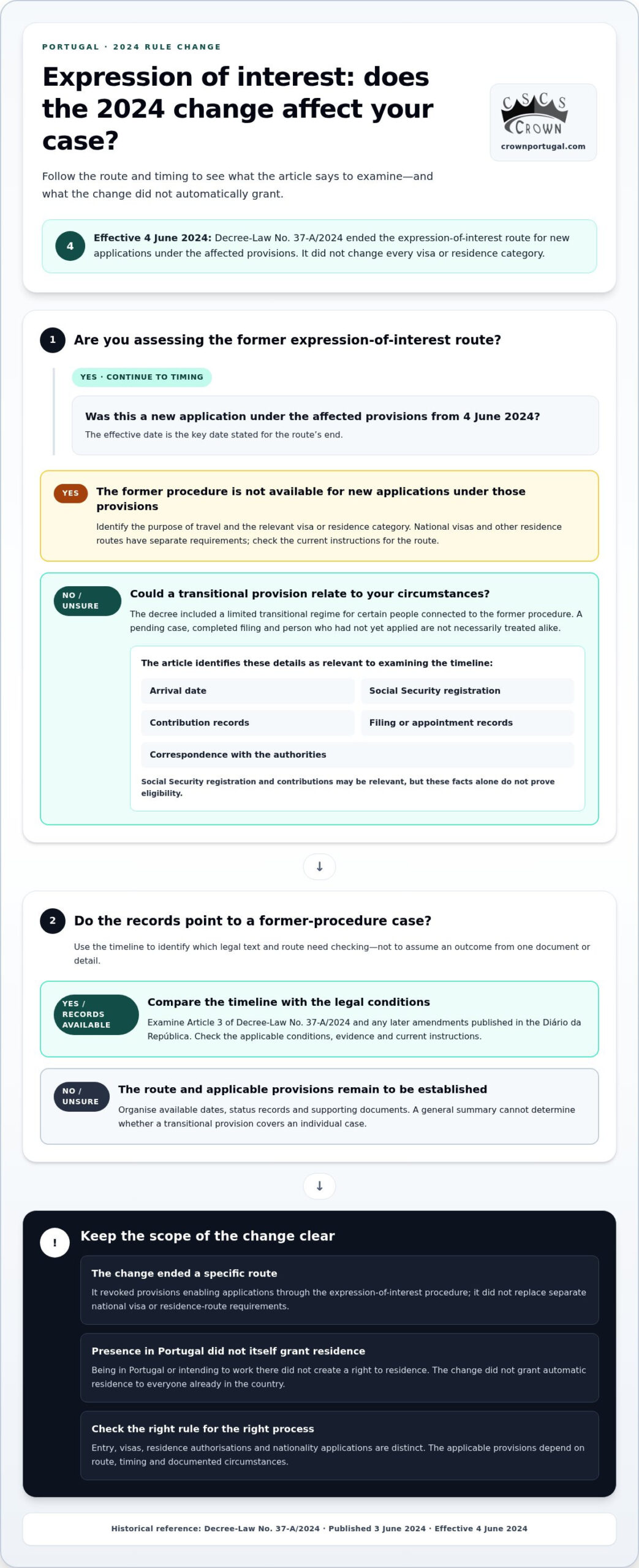
The change most directly associated with Portugal’s 2024 immigration rules was the end of the manifestação de interesse, or expression of interest, as a route for certain non-EU nationals to seek residence after arriving in Portugal. The legal basis was Decree-Law No. 37-A/2024, published on 3 June 2024 and effective from 4 June 2024. Its scope was specific: it revoked the provisions that enabled applications through this route, rather than changing every visa or residence category.
In short: from 4 June 2024, new applications could no longer use the expression-of-interest procedure under the revoked provisions, while a limited transitional regime may be relevant to some people already in the process. The change did not grant automatic residence to everyone already in Portugal, and it did not replace the separate requirements for national visas or other residence routes.
What happened to the manifestation of interest procedure?
Before the change, eligible applicants could use the procedure to seek residence on the basis of work after entering Portugal, rather than applying through the corresponding visa route before travel. Decree-Law No. 37-A/2024 ended that route for new cases under the affected provisions. Simply being in Portugal or intending to work there did not create a right to residence.
For a new application, identify the purpose of travel and the relevant visa or residence category. The Portuguese Ministry of Foreign Affairs sets out documentation for national visa categories in its official Portuguese visa requirements. Requirements depend on the route, so a summary of the 2024 change cannot replace current instructions.
Who may need to examine transitional provisions?
The decree included a transitional regime for certain people connected to the former procedure. The legal text makes Social Security registration and contributions relevant to assessing whether that regime may apply. These facts alone should not be treated as proof of eligibility. Check the applicable conditions, evidence and any subsequent legal changes against the official text and current instructions.
Build a record of your timeline before drawing a conclusion. Gather your arrival date, Social Security registration and contribution records, any expression-of-interest submission or appointment records, and correspondence with the authorities. Then compare those details with Article 3 of Decree-Law No. 37-A/2024 and any later amendments published in the Diário da República. A pending case, a completed filing and a person who had not yet applied are not necessarily treated alike.
For the Portugal immigration rules 2024, the practical distinction is between the end of a specific application route and the limited transition that may protect some existing circumstances. Case-specific document review and application preparation can help organise relevant records and clarify which route to assess, without assuming an outcome.
Which Portugal immigration rules apply to your situation in 2026?
To apply the Portugal immigration rules 2024 to your circumstances, start with your purpose for moving, then identify your nationality, where you’ll apply and whether you already hold Portuguese status. Those details can point to different procedures, even when two people have similar work or income plans. The 2024 rules provide historical context, but your route must be assessed against current requirements and your own application stage.
| Purpose | Broad route category | Facts to verify |
|---|---|---|
| Remote work | D8 digital nomad route | Where you work, the nature of your work, supporting evidence and current eligibility criteria. |
| Passive income | D7 residence route | Income sources, supporting records, intended residence and current requirements. |
| Employment | Relevant work visa or residence route | Job and employer details, qualifications where relevant, application location and current procedure. |
| Study | Student visa or residence route | Course and institution details, intended stay and required supporting documents. |
| Entrepreneurship | Entrepreneur or startup route | Business activity, project documentation and the route’s current criteria. |
| Family | Family reunification or another applicable family route | Relationship, sponsor’s status, application stage and current family rules. |
How do nationality and application status affect the route?
EU nationals generally follow a different residence process from non-EU nationals, who may need a national visa and subsequent residence authorisation depending on purpose and circumstances. The route can also differ for an applicant applying from abroad, someone who has recently arrived, and someone who already holds a Portuguese permit. Don’t assume that a job, income level or family relationship alone establishes eligibility.
For a category-by-category overview, see Portugal residence permit types. The Portuguese Ministry of Foreign Affairs also outlines official Portuguese visa information. Use current instructions for the relevant route and application location.
How do common visa purposes differ?
The D8 is a broad route to consider for eligible remote-work circumstances. Assess its requirements against the applicant’s actual work and supporting evidence. See the Portugal D8 visa requirements guide for route-specific information. The D7 is associated with passive-income circumstances, while employment and study routes address different purposes and document sets. The Portugal D7 visa guide covers that pathway in more detail.
Before choosing, list your purpose, nationality, current location, existing status and key application dates. A case-specific document review can help distinguish which route questions need answers and which records support your circumstances.
How can you verify Portugal immigration requirements and prepare?
Use a repeatable check rather than relying on a search result or an undated summary. A historical explanation of the Portugal immigration rules 2024 can identify a change, but your next step is to confirm the legal text, current procedure and facts specific to your case.
Which official sources help check current rules?
Begin with the legislation published in the Diário da República. Read the relevant provision, its commencement date and any amendments or transitional clauses. Then compare it with current instructions from the authority responsible for the procedure. As of October 2026, AIMA is responsible for migration and asylum services; the Ministry of Foreign Affairs provides national visa information and consular guidance. The right source depends on whether you’re checking a visa application or a migration procedure in Portugal.
Check the publication or update date on each legal instrument and official guidance page, and record it alongside your notes. Compare dated legislation in the Diário da República with the latest relevant AIMA guidance, Ministry of Foreign Affairs visa information and consular instructions. The legal text establishes the rule, while updated authority pages explain the current process. An online summary can provide context, but it may not reflect a later amendment or the instructions for your application location.
What information should you organise before acting?
Set out your circumstances before interpreting a rule. A clear timeline helps distinguish someone planning an application from someone with an existing status or pending process.
- Define your purpose: identify whether you’re seeking entry for a short stay, work, remote work, study, family reasons or another route.
- Record your status and nationality: note whether you’re an EU or non-EU national, where you currently live, and whether you already hold a Portuguese visa or residence authorisation.
- List key dates and location: include intended travel dates, application and appointment dates, and where you plan to submit the application.
- Collect relevant records: organise receipts, official correspondence and documents related to any transitional provision you believe may apply.
- Compare route-specific instructions: check the current official checklist for your category and application location. Don’t assume a generic list covers your case.
Keep copies securely and avoid sending sensitive identity or immigration documents through unsecured channels. If the route or transition is unclear, case-specific document review and application preparation can help organise the evidence and identify questions to resolve before filing.
Get help reviewing your immigration documents and application route.
How can Crown Portugal help with an immigration route?
Once you’ve identified your purpose, status and key dates, the next task is connecting those facts to a route and preparing the supporting record. Crown Portugal is an immigration and relocation consultancy that helps applicants organise route questions, review documents and prepare applications. This can be useful when a historical procedure, such as one associated with the Portugal immigration rules 2024, is being confused with a route available under current requirements.
What can tailored immigration support clarify?
Every case depends on its facts and the rules that apply to the relevant route. A case-specific review can help distinguish an earlier process from the options to assess now, organise relevant dates and identify documents that need attention. For example, someone with prior application records or correspondence may need to arrange that history alongside current identity and route documents, rather than rely on a generic checklist.
Crown Portugal provides document review and application preparation for Portuguese visa and residence matters. This support helps make the file and its chronology easier to assess, but it doesn’t guarantee an immigration outcome. Decisions remain subject to the applicable requirements and the relevant authorities’ assessment.
What should happen after the route is identified?
With a route in view, preparation can move through practical stages: assemble the documents relevant to the applicant’s circumstances, review the application materials, coordinate the filing process and schedule appointments as appropriate. Keeping records organised can also help applicants respond consistently to instructions and avoid mixing requirements from different visa or residence categories.
Planning may continue after the immigration application stage. Depending on the person’s needs, related relocation administration can include assistance with a Portuguese tax number (NIF) or Social Security number (NISS). These are practical administrative matters, not substitutes for meeting visa or residence requirements. For broader planning after a move, consult the Portugal relocation checklist.
If you’re unsure how your dates, existing status or documents relate to a possible route, Crown Portugal can help review your circumstances and prepare next steps. A clear review can help organise the questions and application preparation required.
Take the Next Step With a Clearer Immigration Plan
The Portugal immigration rules 2024 are a historical reference, not a complete answer to what applies in 2026. Match the relevant rule and any transitional provision to your purpose, nationality, application stage and supporting records. Check current official instructions before acting, especially when your circumstances involve an existing application or status.
Crown Portugal supports applicants with visa advice, document review and application preparation. Related assistance with NIF and NISS registration and relocation administration can help organise practical steps alongside your immigration planning. Each case depends on its facts and applicable requirements, and preparation cannot guarantee an outcome.
Discuss your circumstances, route questions and possible next steps with Crown Portugal. Discuss your Portugal immigration options with Crown Portugal, and move forward with a clearer understanding of the process.
Frequently Asked Questions
What changed in Portugal’s immigration rules in 2024?
A major change ended the manifestation of interest procedure for new applications under the affected provisions. Decree-Law No. 37-A/2024 was published on 3 June 2024 and took effect on 4 June 2024. This change concerned a specific route; it didn’t automatically rewrite every visa or residence category. To understand how the Portugal immigration rules 2024 affect a case, distinguish the rules in force at the relevant time from current instructions and any applicable transitional provisions.
Does Portugal still accept applications through the manifestation of interest route in 2026?
No, new applications can’t use the manifestation of interest procedure under the provisions revoked in June 2024. That doesn’t settle the position of every person who began a process earlier. Transitional provisions may be relevant in specific circumstances, so distinguish a new application from an existing or potentially transitional case. Check the current legislation and official instructions, then assess your dates, immigration status and supporting evidence before deciding what action to take.
Can a person already in Portugal benefit from transitional immigration rules?
Possibly, but being in Portugal by itself doesn’t establish eligibility. A transitional provision applies only if the person’s circumstances meet its legal conditions. Review the relevant provisions of Decree-Law No. 37-A/2024 and any applicable amendments, and gather records such as application receipts, official correspondence and evidence related to the circumstances relied upon. Check current official instructions or seek case-specific guidance before relying on a transitional route; eligibility or residence shouldn’t be assumed.
What is the difference between a Portuguese visa and a residence permit?
A visa generally relates to travel or entry for a stated purpose, while a residence permit concerns authorised residence under the applicable route. The steps and sequence depend on the visa category, nationality and rules in force. They’re related but not interchangeable. For an overview of residence categories, see Portugal residence permit types, then check the current official instructions relevant to your application.
Do Portugal immigration rules apply differently to EU and non-EU citizens?
Yes. EU citizens and non-EU nationals generally follow different residence frameworks, so one checklist shouldn’t be assumed to fit both. The applicable process may also depend on family circumstances and whether the person already has Portuguese status. Confirm the official guidance for your nationality and situation before preparing an application. This overview can help identify the questions to check, but it can’t determine individual eligibility without the relevant personal and procedural facts.
Where can I check current Portugal immigration rules?
Start with the relevant legal instrument in the Diário da República, then compare it with current guidance from the competent Portuguese authority and relevant consular services. Check the publication or update date and make sure the material applies to your visa or residence route and application location. If an older summary conflicts with current official information, don’t rely on the summary alone. Identify the specific uncertainty and seek qualified, case-specific guidance before proceeding.
Does a 2024 immigration rule automatically apply to an application made in 2026?
No. Whether a 2024 rule matters to a 2026 application depends on its effective date, later amendments, the application stage and any transitional provisions. Don’t carry an old checklist forward without checking the current legal text and official instructions for your route. Historical guidance can explain how a change began, but it isn’t an individual decision or proof that the same requirements still apply to your circumstances.