

Portugal Cultural Production Golden Visa Requirements: 2026 Guide

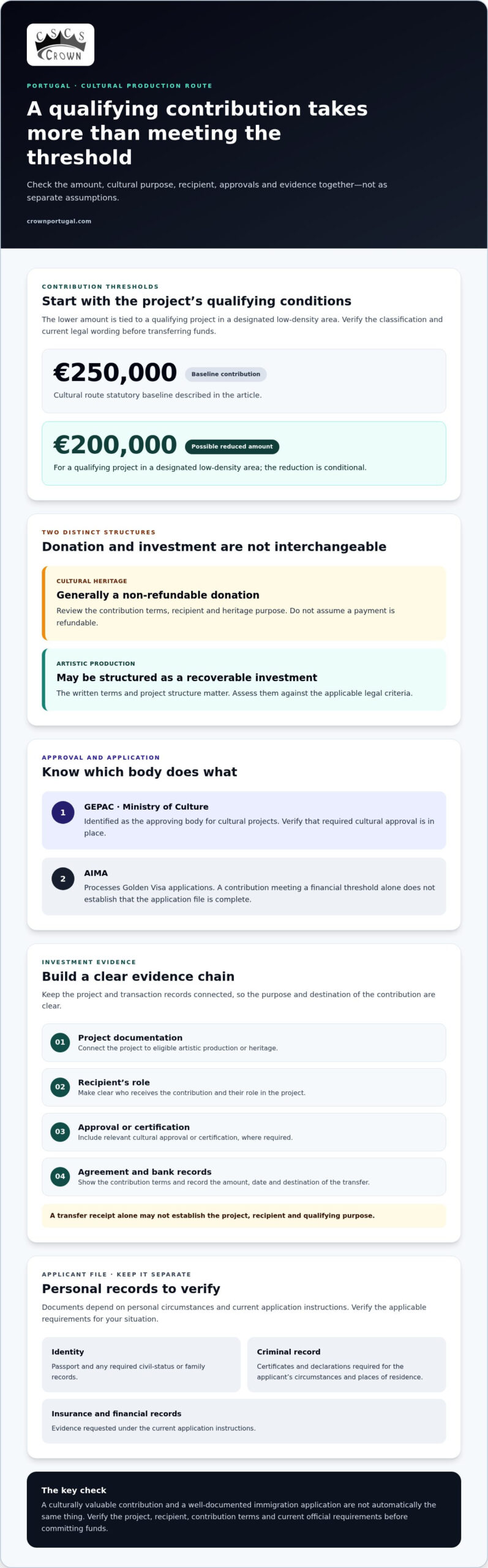
Could a cultural contribution meet Portugal’s investment threshold and still fall short as an immigration application? That distinction matters when assessing the Portugal cultural production Golden Visa requirements. Eligibility depends on the contribution’s structure and the evidence supporting it. The cultural heritage route involves a non-refundable donation, generally €250,000, reduced to €200,000 for qualifying projects in designated low-density areas. Artistic production may be structured as a recoverable investment, so the two options shouldn’t be treated as interchangeable.
It’s understandable to focus first on the contribution amount, but the project, recipient and supporting records also need to align with the applicable rules. Cultural projects require approval by GEPAC, under the Ministry of Culture, while Golden Visa applications are processed by AIMA. Meeting a financial threshold alone doesn’t establish that an application file is complete.
This 2026 guide explains the route’s structure, the evidence applicants may need, and what to verify before making a contribution. It also sets out a practical preparation path for organizing investment records and applicant documents, so you can assess the pathway against current requirements before proceeding.
Key Takeaways
- The Portugal cultural production Golden Visa requirements involve more than meeting a contribution threshold: the cultural purpose and supporting evidence must also align.
- Understand the difference between a non-refundable cultural heritage donation and an artistic production investment that may be recoverable before choosing a route.
- Review how project approval, the recipient’s status and transfer records can support evidence of a qualifying contribution.
- Compare cultural production with other eligible investment routes by looking at their purpose, asset structure and documentation needs.
- Prepare in stages by assessing the pathway and organizing investment and personal documents before submitting an application.
What Is Portugal’s Cultural Production Golden Visa Route?
Portugal’s cultural production route is an investment-residency pathway for eligible non-EU nationals whose contribution supports a qualifying cultural purpose. Paying an arts organization or funding a creative project isn’t enough on its own. The contribution must meet the immigration rules and applicable cultural-purpose criteria, with evidence connecting the investment to an eligible purpose and recipient.
This distinction separates the route from an ordinary donation. A payment may support culture in a general sense but still fail to qualify for residence if it doesn’t meet the scheme’s legal conditions. The route also differs from property investment, which was removed as a Golden Visa investment option in October 2023, and from pathways with different investment structures, such as qualifying investment funds. The Golden Visa program overview provides broader context, but applicants should use current Portuguese sources to confirm route-specific requirements.
How the cultural production option fits Portugal’s Golden Visa
The cultural route sits within Portugal’s residence permit for investment activity framework, commonly referred to as the ARI regime. Its statutory basis is Law No. 23/2007, as amended. Since legal wording and implementing rules can change, check the current consolidated law and official guidance before committing funds. The cultural project and its recipient must fit the applicable criteria. An arts-related payment alone doesn’t establish eligibility.
There are distinct cultural structures to assess. A cultural heritage contribution is generally a non-refundable donation, while artistic production may be structured as a recoverable investment. These arrangements are not interchangeable. The terms, project purpose, recipient and transfer records all affect how the contribution should be described and evidenced in an application.
Who should assess this route?
This pathway may be relevant to non-EU nationals comparing Portugal’s investment-residency options, particularly applicants whose investment objectives align with cultural production or heritage. A useful assessment considers three connected questions: Does the project serve a qualifying cultural purpose? Do the contribution and recipient meet the rules? Can the applicant document the transaction and satisfy the wider immigration requirements?
General guidance explains the route’s structure, but individual eligibility depends on the specific project, contribution terms and personal circumstances. Before making a commitment, verify the applicable 2026 threshold, any location-based reduction, qualifying recipient rules and application evidence against official sources. Reviewing these points helps distinguish a culturally valuable contribution from one that is also properly structured for an immigration application.
Portugal Cultural Production Golden Visa Requirements to Verify
The Portugal cultural production Golden Visa requirements involve two connected assessments: whether the contribution meets the investment rules and whether the project, recipient and purpose qualify under the cultural provisions. The statutory baseline is a contribution of €250,000, which may be reduced to €200,000 for a qualifying project in a designated low-density area. The reduction depends on the project meeting the applicable location criteria, so confirm the classification and current legal wording before transferring funds.
Portugal’s official government legislation sets out amendments to the investment-residence framework, including provisions relating to cultural heritage. For the cultural route, verify that the proposed recipient and purpose fit the rules and that any required cultural approval is in place. GEPAC, the cultural planning and evaluation office under the Ministry of Culture, is identified as the approving body for cultural projects. Look for evidence that clearly identifies the recipient, connects the project to eligible artistic production or heritage, and records the contribution’s amount, date and destination. A transfer receipt alone may not establish all of these details.
Contribution amount, recipient, and cultural purpose
Before committing funds, review the project and transaction records together as one evidence chain. This may include project documentation, confirmation of the recipient’s role, relevant approval or certification, the contribution agreement, and bank records showing the transfer. The records should make the purpose and destination clear, rather than relying on a broad description such as “arts donation.” Don’t assume a contribution is refundable or qualifies simply because it supports a cultural initiative. Assess the written terms against the route’s legal criteria.
Applicant eligibility and supporting records
Keep the applicant file separate from the investment file. The documents required, and how they’re assessed, can depend on personal circumstances and current application instructions. Items to verify include:
- Identity: passport and any required civil-status or family records.
- Criminal record: certificates and declarations required for the applicant’s circumstances and places of residence.
- Insurance and financial records: evidence requested under current AIMA instructions, including applicable insurance and proof related to the investment’s source or transfer.
- Document form: translation, legalization or authentication, validity period, and accepted format for each record.
Separate requirements set out in law from document requests that depend on the case or application channel. Check the current consolidated legislation, AIMA instructions and relevant government guidance before preparing the final file. A structured review of both the contribution evidence and applicant records can help identify gaps before submission. Portugal Golden Visa application preparation can provide a practical starting point for organizing that review.
Cultural Production vs Other Portugal Golden Visa Investment Routes
The cultural route is one of several investment pathways associated with Portugal’s residence permit for investment activity, but each has a distinct purpose and evidence profile. The routes below offer comparison points, not a guarantee that every category remains open or suits a particular applicant. Confirm current eligibility and conditions against official guidance before deciding.
| Route | Purpose and structure | Typical evidence focus | Key question to verify |
|---|---|---|---|
| Cultural production or heritage | Contribution connected to an eligible cultural purpose; the structure may differ between heritage support and artistic production. | Project purpose, recipient, required cultural approval, contribution terms and transfer trail. | Does the project and recipient meet the current criteria, and can the contribution be traced to the stated purpose? |
| Qualifying investment funds | Investment in a fund meeting the applicable Golden Visa rules. The article identifies a €500,000 threshold for this route. | Fund eligibility, subscription records, proof of transfer and evidence of the investment structure. | Does the fund meet the current statutory conditions, and what are its terms and risks? |
| Research activity | Investment linked to qualifying research activity. | Evidence of the research purpose, the receiving entity, approval or eligibility, and payment records. | Does the activity and receiving organization qualify under current rules? |
| Business or job-creation activity | Investment associated with a qualifying business structure or job creation. | Company records, investment documents, business activity and any required employment evidence. | Which current conditions apply to the company, investment and employment commitments? |
Property investment is not a current Golden Visa route: the real-estate option was terminated in October 2023. The table is not a complete legal checklist. For a wider overview, consult the Portugal Golden Visa investment guide alongside current official requirements.
What makes the cultural route different?
Cultural eligibility turns on the connection between the funds and a qualifying cultural purpose. Evidence may need to show who receives the contribution, what project or activity it supports, and how the transfer fulfils the stated arrangement. By contrast, fund evidence focuses on the fund’s qualifying structure, while research or business pathways require records related to their respective activities. The Portugal cultural production Golden Visa requirements therefore involve both immigration eligibility and purpose-specific proof.
Those requirements are separate from investment suitability. A route may appear compatible with an applicant’s immigration objectives yet involve financial terms, liquidity limits or project risks that don’t fit their circumstances.
How to compare routes against your priorities
Compare the evidence burden, investment structure and residency objectives before selecting a pathway. Consider your risk tolerance and whether preserving or potentially recovering capital is important. Don’t assume any route guarantees a return or that cultural support is refundable. A case-specific assessment can then focus on the route’s current legal status, documentation, investment terms and fit with your plans.
How to Prepare a Cultural Production Golden Visa Application
A clear preparation sequence helps connect the cultural contribution to the applicant’s file and reduces the risk of missing evidence. Check the Portugal cultural production Golden Visa requirements against current rules before committing funds, since project eligibility and application procedures may change.
- Assess the pathway. Compare the cultural route with other investment options. Consider whether its purpose, structure and documentation fit your immigration objectives.
- Review the project and recipient. Gather official information identifying the recipient, describing the project and explaining the intended cultural use. Verify the recipient’s eligibility and any required approval through current official guidance.
- Confirm the contribution terms. Review the agreement, amount, recipient details and transfer instructions. Establish how the contribution must be documented and whether the project meets any conditions for a location-based reduction before making a payment.
- Record the transaction. Keep the signed agreement, transfer confirmations, receipts and relevant correspondence together. The records should trace the funds from the applicant to the recipient and connect them to the stated project.
- Prepare the applicant file. Use a dated checklist for identity and civil-status records, criminal-record documents, insurance and financial evidence required for the case. Check document validity, translation and legalization requirements against current instructions.
- Verify submission and follow-up steps. Confirm the application channel, appointment process, fees and any stated processing timelines through current AIMA and government guidance. Keep copies of all submitted materials and track official requests for further information.
Organize investment evidence and personal records as separate sections of one application file. This makes it easier to spot gaps, such as an agreement that names the recipient but doesn’t clearly describe the cultural purpose, or a transfer record that can’t be linked to the documented contribution.
Applicants comparing residence pathways can review Portugal residence permit types as part of their planning. Application channels, appointment steps and fees may change, so confirm older checklists or timelines against current official instructions before relying on them.
Crown Portugal provides document review and application preparation for Portugal Golden Visa applicants. Get help preparing your Golden Visa application by reviewing both the cultural contribution evidence and the applicant documents.
Plan Your Portugal Cultural Production Golden Visa with Crown Portugal
A cultural contribution needs to be assessed alongside the applicant’s records and immigration objectives. Crown Portugal, an immigration consultancy established in 2018, helps applicants organize Portugal Golden Visa documents and prepare applications through a structured review process. For this route, that means reviewing whether the project and recipient evidence, contribution records and personal documents tell a consistent, well-supported story.
What structured application support can address
Document review can help identify missing, inconsistent or unclear information across the investment and applicant files. An adviser can map available records to relevant application requirements, organize evidence by category, and flag points that may need further documentation or clarification. For example, project details, recipient information and transfer records should fit together clearly rather than appear as unrelated papers. This preparation supports a more orderly application, but it can’t guarantee a particular outcome. The competent Portuguese authorities make the final decision.
The next step for prospective applicants
Before an assessment, prepare a brief outline of your immigration objectives, the proposed cultural contribution and the project or recipient you’re considering. Bring questions about cultural eligibility, contribution terms, evidence, personal records and current application procedures. This gives the review a practical focus: your goals, the proposed investment structure and the records available to support the case.
It’s also useful to compare the cultural pathway with other investment options and consider how each fits your capital objectives and residency plans. Crown Portugal’s Golden Visa investment guide offers broader route context. Use it alongside current official requirements when evaluating your options.
The Portugal cultural production Golden Visa requirements call for careful attention to cultural-purpose evidence and applicant documentation. A structured review can help you identify what is ready, what needs clarification and what to verify before committing funds or preparing a submission.
Discuss your Portugal Golden Visa application with Crown Portugal to review your objectives and organize the next steps.
Prepare Your Cultural Golden Visa Pathway with Confidence
The Portugal cultural production Golden Visa requirements involve more than a qualifying contribution. Applicants need to assess the cultural purpose and recipient alongside the immigration criteria, then organize evidence connecting the project, funds and personal records. Check current thresholds, approvals and application procedures against official guidance before making a commitment.
Comparing the route with other investment options can clarify whether its structure and documentation fit your financial and residency objectives. A careful review before submission helps identify gaps, but approval remains a decision for the Portuguese authorities.
Crown Portugal supports Golden Visa applications through document review and application preparation. Discuss your Portugal Golden Visa application to consider your objectives and organize the next steps. With a clear plan and well-prepared records, you can approach the process with greater confidence.
Frequently Asked Questions
Is cultural production still a qualifying route for Portugal’s Golden Visa in 2026?
Yes, Portugal’s cultural contribution route remains a qualifying investment-residency option in 2026, subject to the project and applicant meeting current requirements. Cultural projects require approval by GEPAC, under the Ministry of Culture, and Golden Visa applications are processed by AIMA. Check current legal provisions and official guidance before committing funds, since the project’s cultural purpose and supporting evidence matter as well as the contribution.
How much must I contribute to qualify through cultural production?
The standard minimum contribution is €250,000, reduced to €200,000 for a qualifying project in a designated low-density area. The reduced threshold depends on the project meeting applicable location conditions, so don’t assume a project qualifies based only on its address. Verify current legal criteria, project approval and recipient eligibility before transferring funds, and retain documents showing the contribution amount, recipient and payment.
What cultural projects qualify for the Portugal Golden Visa?
Eligible projects must meet the route’s cultural-purpose criteria and receive the required approval from GEPAC. The route covers qualifying cultural heritage and artistic production, but an arts-related payment or donation isn’t automatically eligible. Before contributing, review evidence describing the project’s purpose, the recipient’s role and how the funds will be used. The relevant cultural approval and supporting records should align with the immigration application requirements.
Can I recover my cultural production contribution later?
It depends on the contribution structure and its written terms. A cultural heritage contribution is a non-refundable donation. Artistic production may be structured as a recoverable investment, but recovery isn’t automatic or guaranteed by Golden Visa eligibility. Review the project and investment agreements carefully, including any repayment conditions and risks, and distinguish those financial terms from the separate question of whether the contribution qualifies for residence.
What documents are required for a cultural production Golden Visa application?
Applicants should prepare evidence for both the investment and their personal eligibility. This may include passport and identity records, criminal-record documents, applicable insurance and financial evidence, plus project and recipient details, required cultural approval, contribution agreements and transfer records. AIMA’s current instructions determine the applicable document list. Check translation, legalization, validity periods and accepted formats for each record before submission, as requirements may vary by case.
Do I need to visit Portugal to apply for the cultural production Golden Visa?
Don’t assume the process can be completed without visiting Portugal. Application and appointment steps, including any in-person requirements, depend on current AIMA procedures and should be checked before planning. The Golden Visa has a minimum-stay obligation of seven days in the first year and 14 days over each subsequent two-year period. Confirm how those residence obligations apply to your permit and circumstances using current official guidance.
Does a Portugal Golden Visa guarantee citizenship?
No. A Golden Visa grants a residence pathway, not automatic citizenship. Naturalization requires a separate application and meeting the nationality rules in force at that time. Under the 2026 Nationality Law described in this guide, most non-EU nationals face a 10-year legal-residence requirement, counted from the issue date of the first residence card. Portuguese authorities decide naturalization applications, and eligibility doesn’t guarantee approval.