

Portugal Residence Permit: Non-EU Family Guide 2026

Applying for a portugal residence permit for non eu family members in 2026 is no longer a matter of simple paperwork; it’s a high-stakes administrative synchronization where a single missing document can lead to months of additional delays. You’ve likely already felt the frustration of navigating the AIMA portal or trying to decipher the technical difference between Article 15 and standard family reunification pathways. It’s exhausting to manage these requirements while facing language barriers and a minimum income threshold that has now risen to €920 per month.
We understand that your primary goal is securing a stable future where your loved ones have the unrestricted right to work and study in Portugal. This guide provides a definitive 2026 procedural roadmap to help you bypass common bureaucratic pitfalls and secure a valid 5-year residence card. We’ll examine the specific financial criteria for sponsors, the mandatory Portuguese language integration rules, and the exact steps for transitioning from a D6 consular visa to a successful AIMA appointment.
Key Takeaways
- Distinguish between the specific legal frameworks of Article 15 for EU relatives and Article 98 for national reunification to ensure the correct application pathway is selected.
- Identify the updated 2026 eligibility requirements for spouses, de facto partners, and dependent descendants to confirm family qualification before starting the process.
- Navigate the multi-phase roadmap to secure a portugal residence permit for non eu family members, moving systematically from legal entry to the issuance of a 5-year residence card.
- Compile a precise documentation portfolio, including translated certificates and proof of financial means, to satisfy the rigorous administrative standards of the Portuguese authorities.
- Understand the strategic importance of expert assistance in managing AIMA appointment scheduling and overcoming the current procedural backlogs in the immigration system.
Understanding the Portugal Residence Permit for Non-EU Family Members
The portugal residence permit for non eu family members, formally known as the Cartão de Residência, is a specific document issued to family members of EU, EEA, or Swiss citizens who reside in Portugal. Unlike standard residence permits that often require pre-approval from a home country consulate, this card is valid for five years and recognizes a pre-existing right under European law. It grants the holder immediate access to the Portuguese labor market, educational institutions, and the national healthcare system (SNS) as soon as the application is submitted. The historical context of Immigration to Portugal demonstrates that the state prioritizes family integration to support the local economy and social stability. Non-EU family members who are already present in the Schengen area on a valid short-stay visa or visa-exempt entry don’t typically need to return home for a D-series visa; they can initiate the process directly within Portuguese territory.
The Legal Framework: Article 15 vs. Portuguese National Law
Determining the correct legal pathway is essential for a successful application. Article 15 (Directive 2004/38/EC) applies to family members of EU citizens who are exercising their right of free movement. If you’re a non-EU citizen married to a French or German national living in Portugal, you follow this streamlined path. Portugal also extends these favorable EU rules to the non-EU family members of Portuguese citizens to ensure equal treatment. In contrast, Article 98 governs national family reunification for those joining non-EU residents who hold a standard residency permit. Article 98 is generally a more restrictive process that often requires a D6 visa obtained abroad. For those exploring independent residency routes, comparing these rules with the Digital Nomad Visa Portugal Requirements: The Complete 2026 D8 Guide highlights how much simpler the family-based Article 15 pathway can be for eligible dependents.
Step 0: The Fiscal Prerequisite (NIF and NISS)
Before attending an AIMA appointment, every applicant must secure their fiscal identity. The NIF (Número de Identificação Fiscal) is the primary requirement for all legal acts in Portugal, including signing lease agreements or opening bank accounts. Simultaneously, the NISS (Número de Identificação de Segurança Social) allows for legal employment and social protection. You can find detailed instructions on this in our Social Security Number Portugal Foreigners: The Complete 2026 NISS Guide. For those who prefer visual walk-throughs of the documentation, we provide updated tutorials on the Crown Portugal YouTube channel. Crown Portugal facilitates these registrations remotely, ensuring that the portugal residence permit for non eu family members application isn’t stalled by administrative delays or missing fiscal data.
Eligibility Criteria: Who Qualifies as a Family Member in 2026?
The eligibility for a portugal residence permit for non eu family members is strictly defined by the relationship to the EU or Portuguese sponsor. In 2026, the primary categories include legal spouses and registered partners, direct descendants under 21 years of age, and dependent direct relatives in the ascending line, such as parents or parents-in-law. For children over 21, dependency must be clearly demonstrated through financial or health-related evidence. The “Extended Family” category also allows for the inclusion of siblings or other relatives if they’re financially dependent on the sponsor or have serious health grounds requiring personal care. For a broader perspective on the humanitarian aspects of these rules, you can consult the UNHCR guide to family reunification in Portugal.
Proving a De Facto Union (Unmarried Partners)
A common hurdle for many couples is the legal recognition of a de facto union. To qualify for a portugal residence permit for non eu family members as an unmarried partner, you must provide documentary evidence of cohabitation for a period exceeding two years. AIMA requires proof of a shared life, which is most effectively demonstrated through consistent fiscal addresses on official documents. If your NIF records or utility bills show different addresses during the two-year period, your application faces a high risk of rejection. We often see applicants struggle because they lack a joint bank account or a formal declaration from their local parish council (Junta de Freguesia). You can find specific tips on document preparation in our tutorials on the Crown Portugal YouTube channel.
Dependency Requirements for Adult Children and Parents
Proving dependency for adult children over 21 or for parents is a process-heavy task that requires meticulous record-keeping. Financial dependency is typically established by showing regular bank transfers from the sponsor that cover essential living costs, such as rent, food, and healthcare. These transfers should be consistent for at least six to twelve months prior to the application. In cases of health-related dependency, you must provide detailed medical certificates translated into Portuguese that justify the need for the family member to reside with the sponsor. Authorities look for a clear link of necessity rather than just a preference for family proximity. If you’re managing a complex union or dependency case, it’s beneficial to partner with an administrative expert who understands how to structure these arguments for AIMA.
The Application Roadmap: From Entry to the 5-Year Residence Card
Securing a portugal residence permit for non eu family members requires a sequential approach. It’s not a single application but a multi-stage integration into the Portuguese administrative system. The process begins with legal entry. If the non-EU family member enters Portugal through a border that isn’t controlled, such as flying from another Schengen country, they must submit an entry declaration to AIMA within three working days. Skipping this step often complicates the residency appointment later because it creates a gap in the proof of legal entry. Following entry, the roadmap shifts toward domestic registration and biometric data collection.
Registering the EU Citizen First (CRUE)
Before the non-EU family member can apply for their card, the EU sponsor must formalize their own residency. This is done at the local Town Hall (Câmara Municipal) to obtain the Certificado de Registo de Cidadão da União (CRUE). This document proves the sponsor is legally residing in Portugal and possesses sufficient financial means to support the household. A critical part of this step is ensuring the sponsor’s Portugal Fiscal Number Application is current and correctly reflects their Portuguese residential address. Without a valid CRUE, the non-EU applicant has no legal basis for their claim under Article 15 regulations.
The AIMA Appointment: Managing 2026 Backlogs
In 2026, scheduling an appointment remains the most challenging phase of the journey. Wait times for family reunification slots currently range from one to six months due to administrative backlogs. You must use the AIMA telephone lines or the digital portal to book a specific slot for biometric data collection. During this appointment, the applicant provides fingerprints, a digital signature, and a recent photograph. It’s a formal procedure where the original documentation is verified against the digital application submitted previously. For updated strategies on how to secure these elusive appointments, we provide regular updates on the Crown Portugal YouTube channel.
Upon successful submission at the appointment, AIMA issues a “Guia” or formal receipt. This document serves as legal proof of stay while the 5-year residence card is being manufactured and printed. It’s vital for proving the right to work and study while waiting for the physical card. The process concludes when the residence card is delivered via registered mail to your registered fiscal address. This card confirms the holder’s status and facilitates easier travel across the Schengen area.
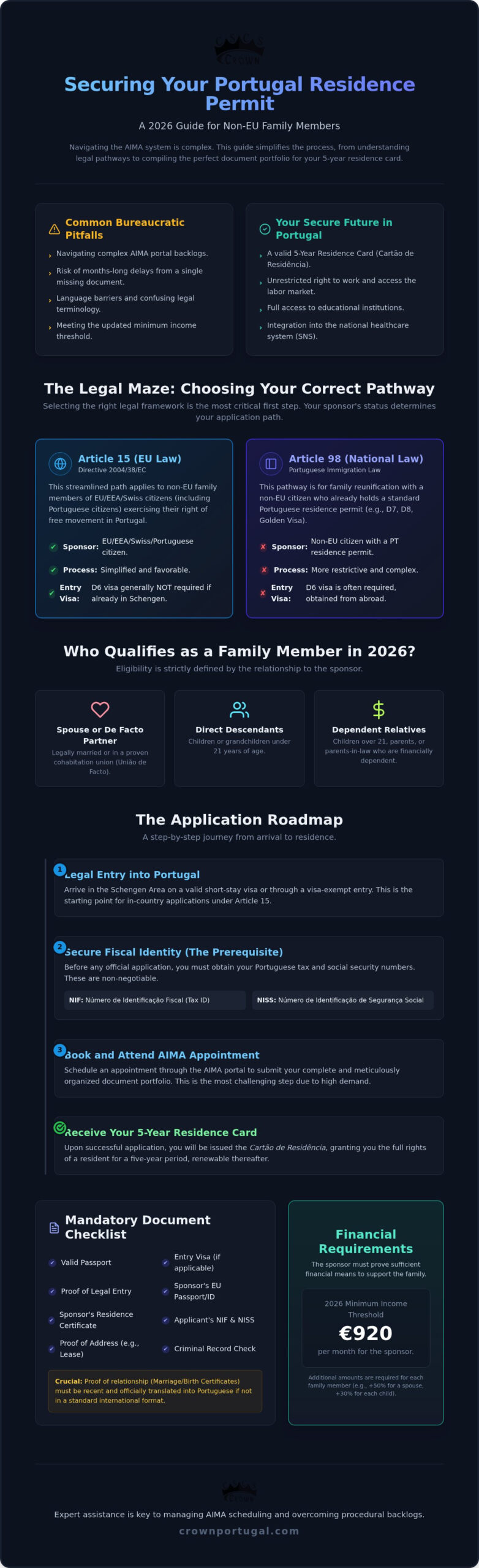
Mandatory Document Checklist for Non-EU Family Members
Achieving a successful outcome for a portugal residence permit for non eu family members depends heavily on the quality and legal standing of your dossier. AIMA officers operate with a zero-tolerance policy for incomplete or incorrectly formatted documents. Your primary identification must be a valid passport with at least six months of validity remaining from the date of your appointment. Additionally, you must provide full-narrative birth and marriage certificates. In 2026, authorities also require concrete proof of your fiscal address in Portugal, such as a registered rental agreement or a property deed. You must also demonstrate financial stability by showing the sponsor earns at least the national minimum wage of €920 per month. This requirement increases by €460 for a spouse and €276 for each dependent child, meaning a family of three must show a monthly income of approximately €1,656.
Legalization and Translation Standards
All official documents issued outside the European Union must carry the Hague Apostille to be recognized in Portugal. If your home country isn’t a signatory to the Hague Convention, you’ll need legalization from the nearest Portuguese consulate instead. Once legalized, documents in languages other than Portuguese require a certified translation. In Portugal, only specific professionals like lawyers, solicitors, or the chamber of commerce are authorized to certify these translations. When preparing for digital uploads to government portals, ensure every file is in PDF format and doesn’t exceed the 2MB size limit per document.
Proof of Relationship for Complex Cases
For de facto unions or extended family applications, standard certificates might not suffice. AIMA often requests secondary evidence to prove a genuine and stable relationship. This includes joint bank account statements, utility bills in both names, or tax returns from your country of origin that list the family members as dependents. These documents help bridge gaps in your narrative and lower the risk of administrative rejection. You can find detailed visual guides on document preparation on our YouTube channel to ensure your dossier meets every technical requirement.
If you find the documentation phase overwhelming, you can book a professional document audit with Crown Portugal to verify your dossier before your appointment.
Professional Assistance: Why Crown Portugal is Your Strategic Partner
Securing a portugal residence permit for non eu family members involves navigating an administrative system that often feels like a “black box,” particularly regarding AIMA appointment availability. Since our founding in 2018, Crown Portugal has specialized in demystifying these complex administrative hurdles. We provide end-to-end management that begins with your initial NIF registration and continues through to the delivery of the final residency card. This comprehensive oversight is vital for avoiding common rejection pitfalls, such as failing to meet the updated 2026 income requirements or submitting documents that lack the necessary Hague Apostille. Our role is to ensure that your family unit remains compliant with national regulations at every stage of the five-year permit period.
Our end-to-end management service includes:
- Remote NIF and NISS registration for all family members before they arrive.
- Meticulous document auditing to ensure 2026 compliance with AIMA standards.
- Strategic intermediary support for AIMA appointment scheduling.
- Long-term renewal tracking and guidance on the path to permanent residency.
Handling Administrative Friction
We manage all direct communication with the Portuguese immigration authorities, acting as your official representative to resolve procedural delays. By utilizing a professional Power of Attorney (Procuração), we can execute remote steps that would otherwise require your physical presence in Portugal. This is particularly beneficial for multi-generational families who need to synchronize multiple applications simultaneously. While some families may also require work-specific pathways, such as those detailed in our Portugal D1 Visa Step-by-Step Guide, our primary focus for family members is the seamless transition under Article 15 or Article 98 laws. We take the burden of bureaucracy off your shoulders, allowing you to focus on your family’s relocation.
Ensuring a Seamless Relocation
Successful relocation isn’t just about the permit; it’s about the integration of fiscal and social security identities into a cohesive strategy. We integrate NIF and NISS registration with your residency strategy to prevent the administrative gaps that often delay access to healthcare or employment. As of 2026, the path to Portuguese citizenship has been extended to ten years for most non-EU nationals, making the long-term management of your residency status more critical than ever. We provide the expert oversight needed to manage renewals and maintain legal standing throughout this decade-long journey. For detailed video walkthroughs on these processes, you can visit the Crown Portugal YouTube channel. Consult with Crown Portugal to secure your family’s future in Portugal and ensure every procedural detail is accounted for by a seasoned professional.
Securing Your Family’s Future in Portugal
Successfully obtaining a portugal residence permit for non eu family members requires a disciplined approach to documentation and an exhaustive understanding of AIMA’s 2026 administrative requirements. It’s essential to correctly identify your legal pathway, whether you’re navigating the streamlined Article 15 process for EU relatives or the national family reunification route. The precision of your fiscal registration and the meticulous legalization of your foreign documents are the primary factors that determine your success.
Since 2018, Crown Portugal has provided the deep local administrative expertise necessary to manage these complex transitions. We offer comprehensive packages that integrate NIF and NISS registration with specialized D8 and D7 family integration support. By partnering with a seasoned consultant, you can bypass the uncertainty of appointment backlogs and ensure every procedural detail is accounted for through a structured, professional roadmap.
Secure your family residence permit with Crown Portugal expert assistance and take the first step toward a stable life in Portugal. Your family’s relocation deserves the security and stability of professional oversight.
Frequently Asked Questions
Can my non-EU spouse work in Portugal while waiting for their residence card?
Your non-EU spouse has the legal right to work and study in Portugal immediately after submitting their residency application. Once the biometric appointment is completed, AIMA issues a formal receipt known as a Guia. This document serves as temporary proof of legal stay and work authorization while the physical card is being manufactured. It’s essential to present this receipt to employers to demonstrate compliance with national labor regulations during the processing period.
How long does the Article 15 residence permit process take in 2026?
The total timeline for obtaining a portugal residence permit for non eu family members under Article 15 currently ranges from four to ten months. This duration includes the initial entry, the registration of the EU sponsor, and the wait for an AIMA appointment. Scheduling the appointment itself can take between one and six months due to administrative backlogs. Once the biometric data is collected, the physical residence card is typically delivered within 60 to 90 days.
Do I need a NIF for my non-EU family member before we arrive in Portugal?
It’s highly recommended to secure a NIF for your non-EU family member before arriving in Portugal. This fiscal number is a prerequisite for almost every legal and administrative action, including signing rental contracts or opening bank accounts. Crown Portugal facilitates remote NIF acquisition, ensuring that your family is ready to proceed with residency steps immediately upon arrival. Having these numbers in advance prevents unnecessary delays in the 2026 application roadmap.
What is the difference between family reunification and the Article 15 permit?
The primary difference lies in the legal framework and the sponsor’s nationality. Article 15 applies to non-EU family members of EU, EEA, or Swiss citizens, granting them rights based on EU free movement directives. National family reunification, governed by Article 98, applies to the families of non-EU residents holding a standard Portuguese permit. Article 15 is generally more streamlined, often allowing for application within Portugal without requiring a prior D6 residency visa from a consulate.
Can I apply for a residence permit for my non-EU parents?
You can apply for a residence permit for your non-EU parents provided you can demonstrate they’re financially or physically dependent on you. In 2026, authorities require proof of regular financial support, such as bank transfers for essential living costs, or medical certificates justifying the need for care. The parents must be direct relatives in the ascending line. If they’re under 65, the burden of proof for dependency is significantly higher than for those over 65.
Is a marriage certificate from outside the EU valid for a Portuguese residence permit?
A marriage certificate issued outside the EU is valid for a portugal residence permit for non eu family members if it’s properly legalized. This typically requires the Hague Apostille from the issuing country or legalization by a Portuguese consulate. Additionally, you must provide a certified translation into Portuguese. Only authorized professionals in Portugal, such as lawyers or solicitors, can sign these certifications to ensure they meet the technical standards required by AIMA for residency dossiers.
What happens if my family member enters Portugal as a tourist and the 90 days expire?
If a family member’s 90-day tourist stay expires before their appointment, they’re generally protected if they’ve already initiated the residency process. Having a scheduled AIMA appointment or a formal entry declaration serves as proof of intent to regularize their status. However, it’s critical to avoid international travel outside of Portugal once the initial visa-free period ends. Staying within the country while waiting for the biometric appointment ensures they remain compliant with national immigration laws during the 2026 backlog.
Do we need to show a minimum bank balance for family residency?
You must demonstrate sufficient financial means to support the entire family unit. For 2026, the sponsor must show a monthly income at least equal to the national minimum wage of €920. This amount increases by 50% for a spouse and 30% for each dependent child. While there’s no fixed bank balance requirement, providing bank statements showing these funds are consistently available is essential. These funds must be accessible in a Portuguese or international account to satisfy AIMA’s criteria.